

 Posted By
By Hamilton ETFs
(Sponsor Blog)
If you want a diversified large-cap Canadian equity fund with the added benefit of earning passive income beyond dividends, our new ETF may just be the one-ticket solution for you.
Introducing CMAX
Launched in May 2026, the Hamilton Canadian Equity YIELD MAXIMIZER™ ETF (CMAX) provides broad exposure to the Canadian stock market, attractive tax-efficient monthly income, and modest growth potential.
CMAX invests in six of our established sector-focused YIELD MAXIMIZER™ ETFs and is designed to broadly resemble the S&P/TSX 60 index in terms of sector weightings. Each of the underlying funds is managed by our experienced options team, which actively writes at-the-money options on the underlying stock holdings to generate income in the form of premiums.
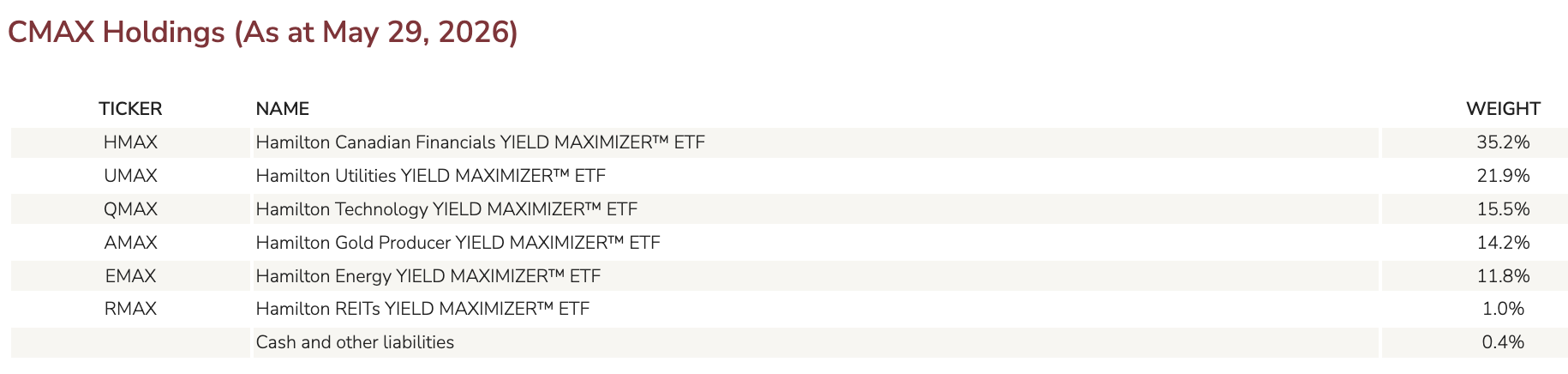
The result is a diversified Canadian equity portfolio with a heavy focus on Canadian bank and insurance stocks, which have long been core holdings for many Canadian investors. CMAX also has meaningful exposure to utilities, telecoms and gold producer stocks, often considered defensive during periods of market volatility.
While CMAX closely reflects the Canadian large-cap stock market, it also holds select U.S. stocks through its underlying ETFs. Investors may ask why a Canadian-focused ETF includes U.S. equities rather than sticking strictly to Canadian names.
The answer is diversification. While CMAX is designed to provide a sector mix broadly similar to the S&P/TSX 60, it also makes what we believe are some important improvements. The Canadian technology sector, for example, is heavily concentrated, with Constellation Software, Shopify and Celestica representing roughly 75% of the sector[1].
Rather than replicate that concentration, CMAX gets its technology exposure through the Hamilton Technology YIELD MAXIMIZER™ ETF (QMAX). This addition provides exposure to a broader group of technology heavyweights like chipmakers NVIDIA, Intel, AMD and Micron, and the FAANGs, which add some prudent diversification, strength and quality to the portfolio.
More choice for income-seeking investors
With covered call ETFs like CMAX, investors can maintain their equity exposure while earning a higher tax-efficient yield to supplement other sources of income. It depends on your own unique financial position and needs, but if you want a balance of capital growth and income and don’t just want to focus on one sector, CMAX may be the right choice to add to your portfolio.
CMAX is part of our broader equity YIELD MAXIMIZER™ lineup, which also includes SMAX for U.S. equity exposure and IMAX for international equity exposure. Each ETF gives investors a simple way to choose the market exposure they want while accessing our active covered call strategy for monthly income.
For investors who want to be more selective, our popular YIELD MAXIMIZER™ suite also offers sector-specific ETFs across areas such as Canadian financials, U.S. financials, technology, utilities, energy, REITs, gold producers, and fixed income. These funds can be used individually to customize exposure based on an investor’s income needs, market views or existing portfolio.
To learn more about our YIELD MAXIMIZER™ suite, including CMAX, visit hamiltonetfs.com/maximizer.
CMAX vs. HDIV: Partners for different investors
For investors familiar with our entire suites of ETFs, you might wonder why we’ve launched CMAX when the Hamilton Enhanced Canadian Covered Call ETF (HDIV) already exists. CMAX bears some resemblance to HDIV with one very big difference. Both provide broad sector exposure similar to the S&P/TSX 60, but HDIV has a modest cash leverage of 25% to enhance yield and growth potential.
Investors with a lower risk appetite may prefer to own CMAX. CMAX is also a suitable alternative for advisors navigating limits on allocating funds to alternative ETFs.
[1]S&P/TSX Capped Information Technology Index. As at May 29, 2026.
____
Commissions, management fees and expenses all may be associated with investments in exchange traded funds (ETFs) managed by Hamilton ETFs. Please read the prospectus before investing. ETFs are not guaranteed, their values change frequently, and past performance may not be repeated.
Certain statements contained in this website may constitute forward-looking information within the meaning of Canadian securities laws. Forward-looking information may relate to a future outlook and anticipated distributions, events or results and may include statements regarding future financial performance. In some cases, forward-looking information can be identified by terms such as “may”, “will”, “should”, “expect”, “anticipate”, “believe”, “intend” or other similar expressions concerning matters that are not historical facts. Actual results may vary from such forward-looking information. Hamilton ETFs undertakes no obligation to update publicly or otherwise revise any forward-looking statement whether as a result of new information, future events or other such factors which affect this information, except as required by law.
The index performance returns do not reflect any management fees, transaction costs or expenses. Investors cannot invest directly in an index.


The S&P 500 Index (“Index”) and associated data are a product of S&P Dow Jones Indices LLC, its affiliates and/or their licensors and has been licensed for use by Hamilton ETFs © 2025 S&P Dow Jones Indices LLC, its affiliates and/or their licensors. All rights reserved. Redistribution or reproduction in whole or in part are prohibited without written permission of S&P Dow Jones Indices LLC. For more information on any of S&P Dow Jones Indices LLC’s indices please visit www.spdji.com. S&P® is a registered trademark of Standard & Poor’s Financial Services LLC (“SPFS”) and Dow Jones® is a registered trademark of Dow Jones Trademark Holdings LLC (“Dow Jones”). Neither S&P Dow Jones Indices LLC, SPFS, Dow Jones, their affiliates nor their licensors (“S&P DJI”) make any representation or warranty, express or implied, as to the ability of any index to accurately represent the asset class or market sector that it purports to represent and S&P DJI shall have no liability for any errors, omissions, or interruptions of any index or the data included therein.
