

 Posted By
Second Quarter 2026 BMO Macro Regime Model – Strategy Report
By Bipan Rai, BMO ETF & Structured Solutions
(Sponsor Blog)
Upon reflecting on the current state of markets, we’re reminded of the lessons from Barbara Tuchman’s The Guns of August, which illustrates how hubris and rigid systems can override rational decision-making.
While we are not drawing direct parallels to the current situation in the Middle East, the book offers important lessons for investors as they navigate portfolio construction in the months ahead.
As an example, periods of higher inflation generally increase the co-movement between U.S. stocks and interest rates, requiring a more pragmatic approach to diversification. This often leads to greater interest in real assets like gold, as we’ve seen in recent years.
But what happens when even gold fails to provide adequate diversification during a geopolitical shock? Tuchman’s work reminds us of the importance of stress-testing assumptions before a crisis unfolds. When correlation structures break down and traditional hedges falter, investors who have considered tail risks in advance are better positioned.
With that in mind, let’s consider the present environment. Even if the Middle East conflict is resolved quickly, the economic and market consequences will likely persist. Inflation risks are no longer symmetrically distributed, and price pressures appear likely to rise. Damage to energy-related infrastructure points to a prolonged period of crude oil and LNG supply disruption, pushing prices higher for longer. This affects refined products (such as gasoline, jet fuel, and kerosene), fertilizer production, and the supply of helium: complicating central bank messaging. Markets have responded by pricing out expected Federal Reserve rate cuts and pricing in aggressive hikes for other developed-market central banks (Chart 1).
Chart 1 – Markets Have Priced in Tighter Central Bank Policy by End-2026
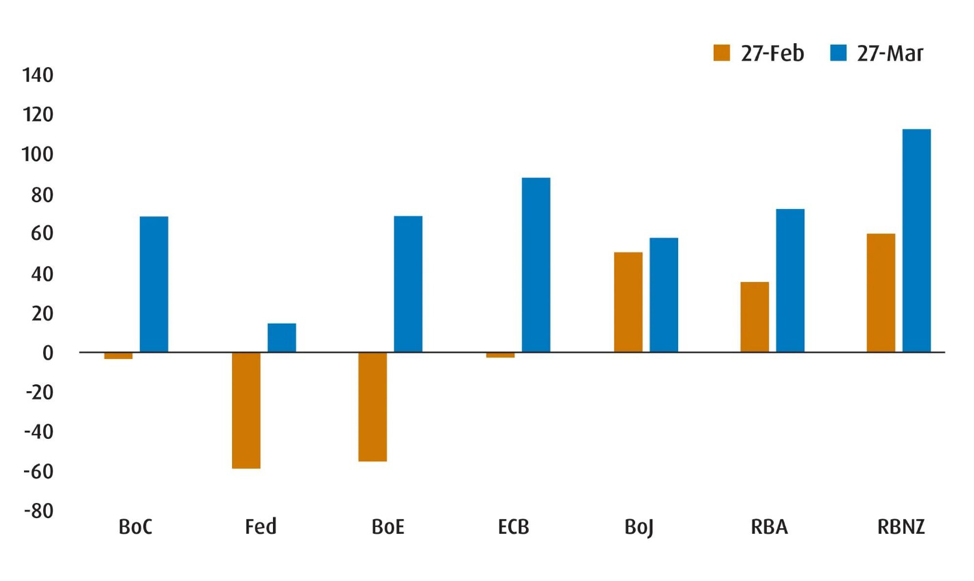
Source: BMO Global Asset Management, as of March 27, 2026.
At the same time, growth risks are shifting in the opposite direction. Higher input costs act as a tax on consumers and weigh on corporate margins. The speed at which rising energy prices feed into slower growth depends largely on a country’s economic slack, which explains why some central banks have recently acknowledged growth risks more explicitly than they did in early 2022.
Indeed, our own proprietary macro regime model is signaling that we are transitioning from a ‘reflation’ backdrop to a more stagflation-like regime (Chart 2).1 This emerging stagflation regime need not mirror the 1970s, but we are still positioning our portfolios to be more robust and resilient. We’re broadening our commodity exposure to provide a more direct hedge against supply shocks. In an environment where inflation surprises are more likely to be positive, this type of convexity is valuable.2
We are also allocating to front-end TIPS (Treasury Inflation-Protected Securities) as a hedge against inflation pressures. While breakevens3 have moderated with recent disinflation progress, they do not fully reflect a sustained energy shock. TIPS offer a cleaner way to express inflation risk without requiring a strong view on nominal growth.
Within equities, we are tilting toward quality and low volatility. If growth slows while cost pressures persist, companies with strong balance sheets, durable margins, and stable cash flows should outperform more cyclical or highly leveraged peers. Low-volatility exposures can also help reduce drawdowns during headline-driven market swings.
History teaches us that conflict does not guarantee crisis. But periods of stress often reveal underlying fragilities. Our role as stewards of capital is not to forecast every geopolitical development, but to recognize that the distribution of macro outcomes is tilting toward a stagflation-like environment: and to position portfolios accordingly.
Chart 2 – Broad Commodity Exposure is Now a Better Diversification Strategy than Just Relying on Metals
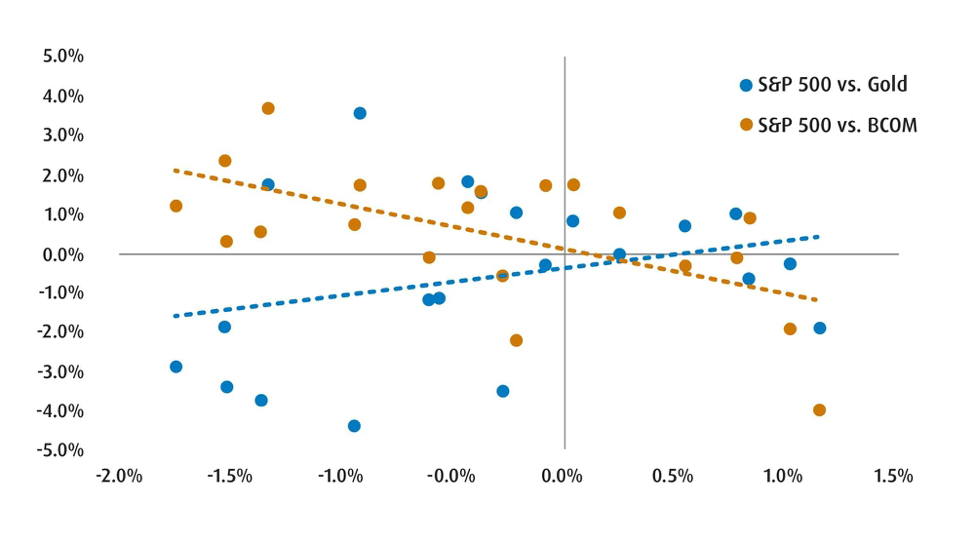
Source: BMO Global Asset Management, Bloomberg. Daily returns from February 27 to March 27.
Asset Allocation
- Relative to the Q1 edition, we’re making some modest changes to our asset allocation splits. The most notable shifts are that we are paring our positions in the equity and alternative sleeves and reallocating them towards fixed income. Of course, these aren’t big changes: as we still remain underweight fixed income and overweight both equities (slightly) and alts.
- Our macro regime model suggests that we are in the midst of a transition from reflation to stagflation: characterized by low growth and high inflation. This is still consistent with the late cycle feel of the macroeconomic backdrop.
- Despite the challenging backdrop, the underlying fundamentals remain sound enough to maintain a neutral/slightly overweight broad equity position for now. Ahead of the conflict, we did see earnings growth across several sectors in the U.S. and Canada. At the same time, the situation in the Middle East remains fluid, which requires us to be nimbler and more flexible.
- In the fixed-income sleeve, the increase in weight reflects our view that the Canadian yield curve4 provides better value and that we feel U.S. TIPS should outperform in the months ahead. For the alts sleeve, the reduction in weight reflects our shift away from gold and towards a broader set of diversifiers in the commodity and infrastructure spaces.
- Importantly, we are bullish on the U.S. dollar (USD) for the coming months. This means that our preference is to keep our U.S. exposure unhedged on a tactical basis. The main reasons for this view are the following:
- We expect the CAD swaps market to price out rate hikes for the Bank of Canada in 2026.
- We expect USD upside as net long positioning remains relatively light.
Equities
- We are increasing our allocation to ZCN (BMO S&P/TSX Capped Composite Index ETF) as Canada remains well positioned as a commodity and energy producer. With energy prices supported by ongoing geopolitical uncertainty, the Canadian equity market should continue to benefit, though outcomes will remain sensitive to the duration of the conflict in the Middle East.
- For our U.S. position, we are adding ZLU (BMO Low Volatility US Equity ETF) to complement our existing exposure through ZUQ (BMO MSCI USA High Quality Index ETF) . This combination reflects a preference for defensive characteristics and earnings resilience during a period whereby investors remain selective on valuation and fundamentals.
Fixed Income
- We’ve swapped out ZUAG.F (BMO US Aggregate Bond Index ETF – Hedged Units) and added ZUAG (BMO US Aggregate Bond Index ETF) to reintroduce U.S. dollar exposure in the FI sleeve. Our view on the USD is the main reason for this change.
- We’ve also added ZTIP (BMO Short‑Term US TIPS Index ETF) as a tactical position as we expect inflation risks to stay firm given energy and broader commodity pressures.
Alts/Hybrids
- The most notable change we’ve made in Alts/Hybrids is adding a tactical allocation to ZCOM (BMO Broad Commodity ETF) to broaden our inflation and geopolitical hedge. Energy has led performance on a year‑to‑date basis, but a persistent risk premium can support a wider set of commodities, which improves diversification if equity volatility picks up.
- We’ve also upgraded the weight for BGIF (BMO Global Infrastructure Fund ETF) as we continue to constructive on infrastructure, including electric grids, and engineering/construction projects.
Chart 3 – Q2 2026 Regional Exposure
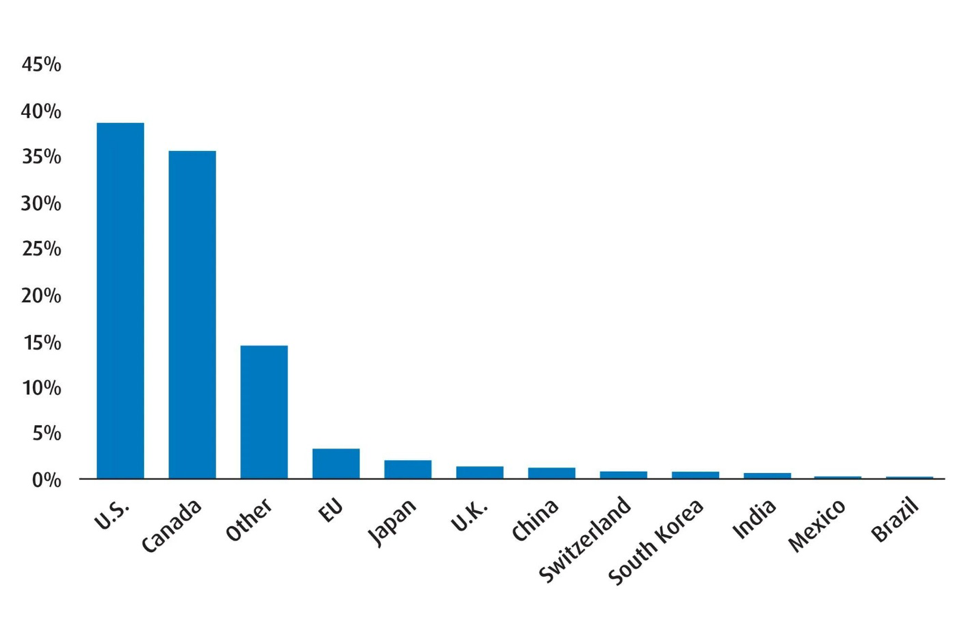
Source: BMO Global Asset Management, as of March 31, 2026.
Chart 4 – Global Equity Sector Breakdown
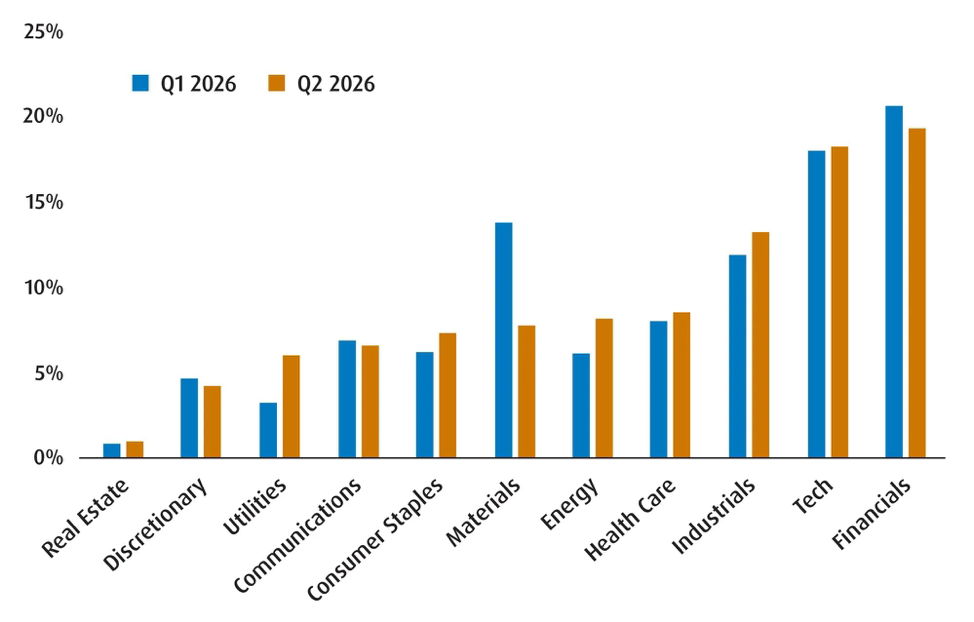
Source: BMO Global Asset Management, as of March 31, 2026.
Standard Performance Data
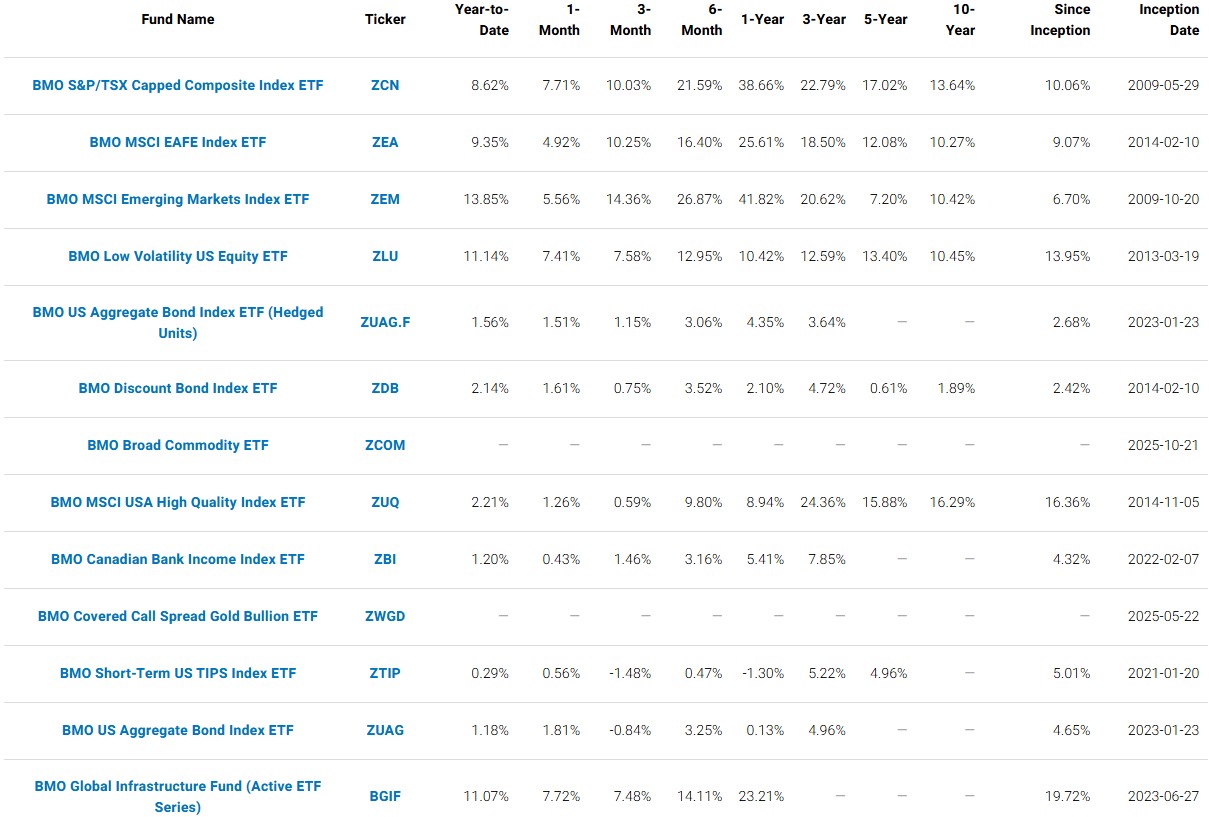
| Source: BMO Global Asset Management, as of March 31, 2026. The portfolio holdings are subject to change without notice and only represent a percentage of portfolio holdings. They are not recommendations to buy or sell any particular security. Past performance is not indicative of future results. | |||||||||||
| Fund Name | Ticker | Year-to-Date | 1-Month | 3-Month | 6-Month | 1-Year | 3-Year | 5-Year | 10-Year | Since Inception | Inception Date |
| BMO S&P/TSX Capped Composite Index ETF | ZCN | 8.62% | 7.71% | 10.03% | 21.59% | a38.66% | 22.79% | 17.02% | 13.64% | 10.06% | 2009-05-29 |
| BMO MSCI EAFE Index ETF | ZEA | 9.35% | 4.92% | 10.25% | 16.40% | 25.61% | 18.50% | 12.08% | 10.27% | 9.07% | 2014-02-10 |
| BMO MSCI Emerging Markets Index ETF | ZEM | 13.85% | 5.56% | 14.36% | 26.87% | 41.82% | 20.62% | 7.20% | 10.42% | 6.70% | 2009-10-20 |
| BMO Low Volatility US Equity ETF | ZLU | 11.14% | 7.41% | 7.58% | 12.95% | 10.42% | 12.59% | 13.40% | 10.45% | 13.95% | 2013-03-19 |
| BMO US Aggregate Bond Index ETF (Hedged Units) | ZUAG.F | 1.56% | 1.51% | 1.15% | 3.06% | 4.35% | 3.64% | — | — | 2.68% | 2023-01-23 |
| BMO Discount Bond Index ETF | ZDB | 2.14% | 1.61% | 0.75% | 3.52% | 2.10% | 4.72% | 0.61% | 1.89% | 2.42% | 2014-02-10 |
| BMO Broad Commodity ETF | ZCOM | — | — | — | — | — | — | — | — | — | 2025-10-21 |
| BMO MSCI USA High Quality Index ETF | ZUQ | 2.21% | 1.26% | 0.59% | 9.80% | 8.94% | 24.36% | 15.88% | 16.29% | 16.36% | 2014-11-05 |
| BMO Canadian Bank Income Index ETF | ZBI | 1.20% | 0.43% | 1.46% | 3.16% | 5.41% | 7.85% | — | — | 4.32% | 2022-02-07 |
| BMO Covered Call Spread Gold Bullion ETF | ZWGD | — | — | — | — | — | — | — | — | — | 2025-05-22 |
| BMO Short-Term US TIPS Index ETF | ZTIP | 0.29% | 0.56% | -1.48% | 0.47% | -1.30% | 5.22% | 4.96% | — | 5.01% | 2021-01-20 |
| BMO US Aggregate Bond Index ETF | ZUAG | 1.18% | 1.81% | -0.84% | 3.25% | 0.13% | 4.96% | — | — | 4.65% | 2023-01-23 |
| BMO Global Infrastructure Fund (Active ETF Series) | BGIF | 11.07% | 7.72% | 7.48% | 14.11% | 23.21% | — | — | — | 19.72% | 2023-06-27 |
Q2 Income Portfolio Strategy Report
Leaning Into the Canadian Curve
- The fixed-income backdrop remains uneven across North America as we see a more supportive setup for Canada as opposed to the U.S.: especially in the front end of the yield curve.
- In our view, the Bank of Canada (BoC) is likely to remain on pause for the next several meetings. That is largely because the impact of the energy price could exacerbate the degree of economic slack in the Canadian economy: offsetting any rise in incomes from the energy sector.
- And as the CAD swaps market has moved to price in rate hikes for the BoC this year, the front-end of the cash curve looks relatively cheap. This creates a tactical opportunity to add exposure in short‑and mid‑term Canadian duration.5 To capitalize on that view, we are initiating a long position in ZFS (BMO Short Federal Bond Index ETF) at 10%.
- Further out the curve, we remain mindful that term premium risk6 has not disappeared. Long‑end supply dynamics and global spillovers can still reprice duration quickly, which keeps us biased toward parts of the curve where carry is steadier and the policy signal is clearer.
- Another notable change is that we are exiting ZUAG.F (BMO US Aggregate Bond Index ETF – Hedged Units) . With our current view that the USD may hold up better in the months ahead, we prefer not to maintain a structure that would mute potential currency upside.
- We are also upgrading ZBI (BMO Canadian Bank Income Index ETF) to 25% to strengthen the income profile while staying in a familiar domestic credit complex.
Chart 1 – Credit Summary
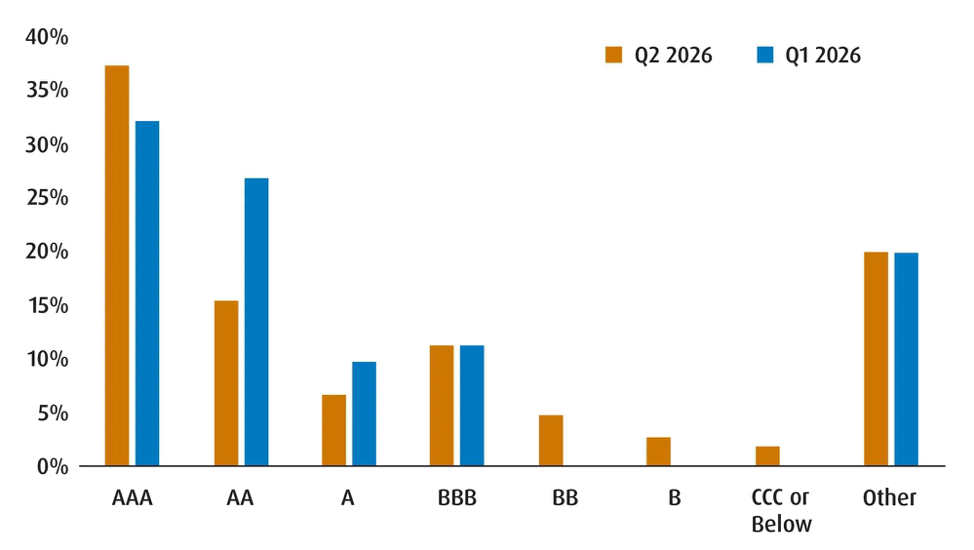
Source: BMO Global Asset Management, as of March 31, 2026.
Chart 2 – Term Summary
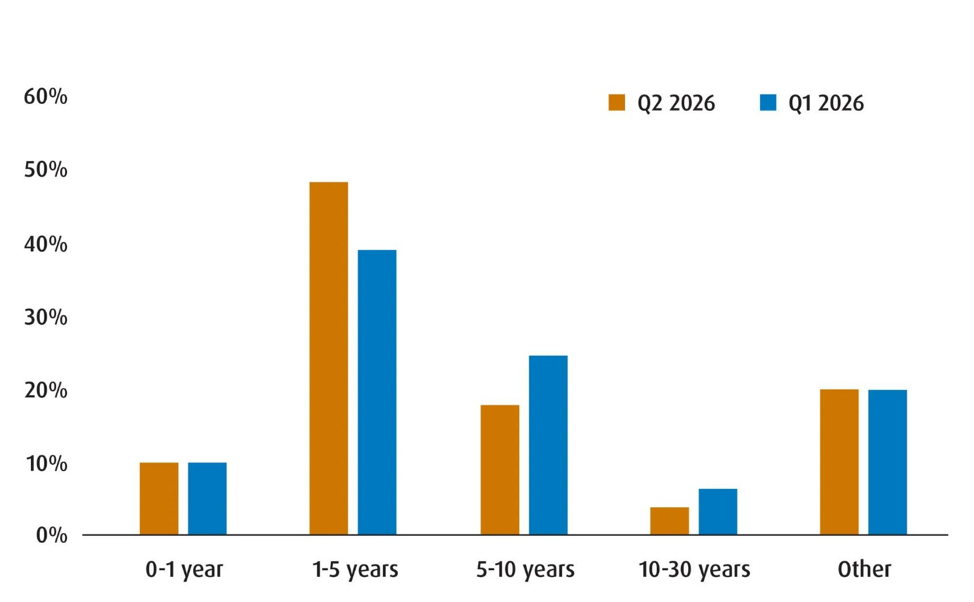
Source: BMO Global Asset Management, as of March 31, 2026.
Standard Performance Data
Source: BMO Global Asset Management, as of March 31, 2026. Past performance is not indicative of future results.
Sources
1Stagflation is a rare and difficult economic cycle defined by the combination of slow economic growth (stagnation), high unemployment, and high inflation.
2Convexity is a measure of the non-linear relationship between an asset’s price and its underlying risk factors, most commonly seen in bond markets regarding interest rates. While duration provides a linear estimate of how much a bond’s price will change for a small move in interest rates, convexity accounts for the “curvature” of this relationship.
3Breakevens in bonds, specifically breakeven inflation rates, represent the expected annual inflation rate over the life of a bond, calculated as the yield difference between nominal bonds (e.g., Treasuries) and inflation-indexed bonds (e.g., TIPS) of the same maturity. It is the inflation rate at which both bonds provide the same return.
4The curve on a graph in which the yield of fixed-interest securities is plotted against the length of time they have to run to maturity.
5Duration is defined as the average time it takes to receive all the cash flows of a bond, weighted by the present value of each of the cash flows.
6Term premium is the extra compensation investors demand for holding long-term bonds instead of rolling over short-term bonds, acting as a reward for taking on risks associated with time.
 Bipan Rai is Head of ETF and Structured Solutions Strategy, Exchange Traded Funds for BMO Global Asset Management. Bipan joined BMO Global Asset Management in 2024 and currently serves as Head of ETF Strategy, delivering strategic research for the ETF and Structured Solutions team. He is highly regarded for his macroeconomic insights as well as his knowledge of market structure for various asset classes. His focus is on fundamental macro research and the implications for the ETF market place, including economic, monetary and fiscal policy analysis alongside developments in funding and liquidity. Prior to joining BMO GAM, Bipan spent 13 years as a top-ranked strategist at a large Canadian dealer. He has won several awards for his research from various publications (Greenwich Survey, Bloomberg) and is a regular contributor to global business media outlets (BNN/Bloomberg, CNBC, WSJ). He holds an MBA from the Schulich School of Business at York University and a Bachelor of Engineering degree (Aerospace Engineering) from Toronto Metropolitan University.
Disclaimers

The portfolio holdings and asset allocations are subject to change without notice and individual holdings only represent a small percentage of portfolio holdings. They are not recommendations to buy or sell any particular security.

Any statement that necessarily depends on future events may be a forward-looking statement. Forward-looking statements are not guarantees of performance. They involve risks, uncertainties and assumptions. Although such statements are based on assumptions that are believed to be reasonable, there can be no assurance that actual results will not differ materially from expectations. Investors are cautioned not to rely unduly on any forward-looking statements. In connection with any forward-looking statements, investors should carefully consider the areas of risk described in the most recent prospectus.

The viewpoints expressed by the author represents their assessment of the markets at the time of publication. Those views are subject to change without notice at any time. The information provided herein does not constitute a solicitation of an offer to buy, or an offer to sell securities nor should the information be relied upon as investment advice. Past performance is no guarantee of future results.

This communication is for information purposes. The information contained herein is not, and should not be construed as, investment, tax or legal advice to any party. Particular investments and/or trading strategies should be evaluated relative to the individual’s investment objectives and professional advice should be obtained with respect to any circumstance.

Index returns do not reflect transactions costs or the deduction of other fees and expenses and it is not possible to invest directly in an Index. Past performance is not indicative of future results.

The ETFs referred to herein are not sponsored, endorsed, or promoted by MSCI and MSCI bear no liability with respect to an ETF or any index on which such ETF is based. The ETF’s prospectus contains a more detailed description of the limited relationship that MSCI has with the Manager and any related ETF.

The Index is a product of S&P Dow Jones Indices LLC or its affiliates (“SPDJI”), and has been licensed for use by the Manager. S&P®, S&P 500®, US 500, The 500, iBoxx®, iTraxx® and CDX® are trademarks of S&P Global, Inc. or its affiliates (“S&P”) and Dow Jones® is a registered trademark of Dow Jones Trademark Holdings LLC (“Dow Jones”), and these trademarks have been licensed for use by SPDJI and sublicensed for certain purposes by the Manager. The ETF is not sponsored, endorsed, sold or promoted by SPDJI, Dow Jones, S&P, their respective affiliates, and none of such parties make any representation regarding the advisability of investing in such product(s) nor do they have any liability for any errors, omissions, or interruptions of the Index.

You cannot invest directly in an index.

Commissions, management fees and expenses all may be associated with investments in exchange-traded funds. Please read the ETF Facts or prospectus of the BMO ETFs before investing. The indicated rates of return are the historical annual compounded total returns including changes in unit value and reinvestment of all dividends or distributions and do not take into account sales, redemption, distribution or optional charges or income taxes payable by any unitholder that would have reduced returns. Exchange-traded funds are not guaranteed, their values change frequently and past performance may not be repeated.

For a summary of the risks of an investment in the BMO ETFs, please see the specific risks set out in the BMO ETF’s prospectus. BMO ETFs trade like stocks, fluctuate in market value and may trade at a discount to their net asset value, which may increase the risk of loss. Distributions are not guaranteed and are subject to change and/or elimination.

Distribution yields are calculated by using the most recent regular distribution, or expected distribution, (which may be based on income, dividends, return of capital, and option premiums, as applicable) and excluding additional year end distributions, and special reinvested distributions annualized for frequency, divided by current net asset value (NAV). The yield calculation does not include reinvested distributions. Distributions are not guaranteed, may fluctuate and are subject to change and/or elimination. Distribution rates may change without notice (up or down) depending on market conditions and NAV fluctuations. The payment of distributions should not be confused with the BMO ETF’s performance, rate of return or yield. If distributions paid by a BMO ETF are greater than the performance of the investment fund, your original investment will shrink. Distributions paid as a result of capital gains realized by a BMO ETF, and income and dividends earned by a BMO ETF, are taxable in your hands in the year they are paid. Your adjusted cost base will be reduced by the amount of any returns of capital. If your adjusted cost base goes below zero, you will have to pay capital gains tax on the amount below zero.

Cash distributions, if any, on units of a BMO ETF (other than accumulating units or units subject to a distribution reinvestment plan) are expected to be paid primarily out of dividends or distributions, and other income or gains, received by the BMO ETF less the expenses of the BMO ETF, but may also consist of non-taxable amounts including returns of capital, which may be paid in the manager’s sole discretion. To the extent that the expenses of a BMO ETF exceed the income generated by such BMO ETF in any given month, quarter, or year, as the case may be, it is not expected that a monthly, quarterly, or annual distribution will be paid. Distributions, if any, in respect of the accumulating units of BMO Short Corporate Bond Index ETF, BMO Short Federal Bond Index ETF, BMO Short Provincial Bond Index ETF, BMO Ultra Short-Term Bond ETF and BMO Ultra Short-Term US Bond ETF will be automatically reinvested in additional accumulating units of the applicable BMO ETF. Following each distribution, the number of accumulating units of the applicable BMO ETF will be immediately consolidated so that the number of outstanding accumulating units of the applicable BMO ETF will be the same as the number of outstanding accumulating units before the distribution. Non-resident unitholders may have the number of securities reduced due to withholding tax. Certain BMO ETFs have adopted a distribution reinvestment plan, which provides that a unitholder may elect to automatically reinvest all cash distributions paid on units held by that unitholder in additional units of the applicable BMO ETF in accordance with the terms of the distribution reinvestment plan. For further information, see the distribution policy in the BMO ETFs’ prospectus.

BMO ETFs are managed by BMO Asset Management Inc., an investment fund manager, a portfolio manager, and a separate legal entity from Bank of Montreal.

BMO Global Asset Management is a brand name under which BMO Asset Management Inc. and BMO Investments Inc. operate.

“BMO (M-bar roundel symbol)” is a registered trademark of Bank of Montreal, used under licence.
