Tag Archives: bonds

Inflation is Kryptonite to anything but Short-term Bonds

By Dale Roberts, Retirement Club/Cutthecrapinvesting

Special to Financial Independence Hub

Bonds may be the adult in the room, but they are certainly afraid of inflation. Bonds usually do their thing: they go up when stock markets get hit hard. They provide ballast. During periods of expected high inflation, or during rising inflation bond prices go down. That can create and contribute negative returns. The bonds can contribute to a portfolio decline.

But not all bonds are the same. Ultra-short bonds carry no price risk, while long-term bonds can carry extreme price risk. It’s crucial that investors understand the ‘types of bonds.’ To intermediate- and long-term bonds, inflation is Kryptonite. How do we battle that force?

As always, the following is not advice.

As a refresher, be sure to have a read of:  Stocks are the unruly kids. Bonds are the adult in the room.

Too funny, a rare case when Cut The Crap Investing actually ranked high on search.

Inflation up. Bonds down.

Bond yields rise during inflation primarily because investors demand higher returns to compensate for the reduced purchasing power of future fixed interest payments. Furthermore, inflation often prompts central banks to raise interest rates, which directly drives up yields, while existing bond prices fall to align with new, higher-yielding securities.

As interest rates rise due to inflation, new bonds are issued with higher coupon rates to attract investors. Existing bonds, which pay lower interest rates, become less attractive and must drop in price to remain competitive, which simultaneously increases their yield.

Join us at Retirement Club

We’ve had some recent experience with the inflation scare of 2021 and into 2022. The bond market (XBB-T) experienced one of its worst performances in 2022, losing around 11% or more as inflation surged, reversing a four-decade bull market in fixed income.

In the above chart we see that bonds provided no ballast. Quite the opposite. That said, we have to keep in mind that bonds have done their thing in every major recession. They stink the joint out, one time, and investors turn on them.

Traditional global stock and bond portfolios have delivered wonderful returns …

Asset Allocation ETF Page – to the end of December 2025

Inflation fighters and the all-weather portfolio

In mid-March we had a refresher on what works during inflation with:  How do we defend against stagflation?

If you have dedicated inflation fighters in the portfolio you’re not too worried about bonds delivering negative returns. We know that stocks don’t always go up. It’s the same for bonds.

In the following chart, we’ll start in 2021. Markets think ahead, of course, and enough investors loaded up on inflation-fighting assets as inflation storms gathered in 2021. The Purpose Real Asset ETF (PRA-T) is a nice one-stop inflation-fighting shop.

PRA-T was up 23.5% in 2021 and 15.9% in 2022.

Add 20% PRA-T to 80% XBAL-T and we have annual returns over 10% with no negative years from 2021 through 2023.

Continue on into 2026 and it gets even better. PRA-T is up almost 16% in 2026.

Go short and clip the inflation price risk

Ultra-short-term government bonds (CBIL-T) do not carry price risk: they are cash-like. In fact, they will provide greater and greater income as inflation expectations and yields rise. Continue Reading…


Why your Grandparents’ Investment Strategy may no longer be enough

Image by Unsplash

By Devin Partida

Special to Financial Independence Hub

The investment playbook has changed. It may have performed well for the last several generations, but finding financial stability is a different game in the 2020s. The best practices established by your grandparents have become obsolete. Therefore, you should look to new financial horizons to establish financial freedom in a way that is more accommodating to modern dynamism and volatility.

How traditional Investment Strategies fail to adapt

The contemporary investing landscape is different from that of the last several decades. The techniques of previous generations are less viable. While you may ask your parents or grandparents for investing advice, their strategies could minimize your wealth generation and financial opportunities.

Most of your grandparents likely maintained a portfolio that followed a simple framework:  the 60/40 rule. Place 60% of your money in reliable stocks or index funds and the rest in high-interest-rate bonds. Today, this is far from the portfolio diversity modern experts want to see. These kinds of portfolios are only growing 2.2% a year now, so professionals are recommending even more varied investments, including precious metals, collectibles, venture capital and private equity, to name a few.

Past portfolios worked alongside robust pensions that were once common in the workforce. It is less common now for this type of security to supplement a 60/40 portfolio. These factors, combined with lengthening lifespans, mean nest eggs are ill-equipped to make it through potential market downturns and the entire length of your retirement. If you are living in retirement longer than previous generations, then the money has to work for you longer.

Why Economic Shifts demand a different Investment Approach

Interest rates have collapsed, and bond prices are mostly trending less than in previous decades, making them unsuitable for outpacing inflation. This reality is why people are seeking even more places to put their money.

The democratization of investments, such as the rise of cryptocurrencies, has also made market understanding more complex. Pair this with exchange-traded funds (ETFs), real estate investment trusts, non-fungible tokens and more, and you have the most enigmatic market history has ever seen: long gone are the days of just relying on blue-chip stocks.

Additionally, retirement savings have become more of a personal responsibility as the number of pension plans has decreased by millions since 1975. An IRA or a 401(k) is the more common route nowadays, as they are cheaper and less risky for employers. Now, many could view their investments as a replacement for what could have been a pension.

Ultimately, the set-it-and-forget-it model of your grandparents’ investment strategies is missing the wealth-generating opportunities you need to prepare for retirement in this climate. The rising cost of living, the financial influence of technological advancements and geopolitical tensions are only a few other factors that could shape how you divert your money.

Ways to Adapt to increase Risk Tolerance and Wealth

You can diversify while still embracing security. It will allow you to prepare for the unexpected. For example, your grandparents’ generation likely faced fewer natural disasters, as climate stressors have increased in recent years. In 2024, natural disasters caused at least $368 billion in economic damage worldwide, affecting people and their financial well-being.

These are the best ways to consider external factors outside of your control while taking advantage of how the investor market looks today.

Craft your Investment Goals

Many choose to work with a financial adviser, but you should start planning by identifying short-, medium- and long-term goals. These could involve buying a house, starting a business or building for retirement. Each goal has a time frame, allowing you to make informed decisions about your risk. At this stage, evaluating the stability of your job, debt and household expenses is critical. Continue Reading…

The Critical Element of Bonds  

Image from Shutterstock, courtesy Outcome

Pleased to meet you
Hope you guess my name
But what’s puzzlin’ you
Is the nature of my game

  • Sympathy for the Devil, by The Rolling Stones


By Noah Solomon

Special to Financial Independence Hub

Historically, bonds have offered investors two main benefits. Firstly, their yields provided a reasonable, if unspectacular return. Secondly, they offered diversification value, muting overall portfolio losses during bear markets.

In my view, it is the second attribute that is the most important. In relative terms, bonds are not particularly useful for providing investors with strong long-term returns (that’s equities’ job!). So, by process of elimination it follows that the primary function of bonds is their diversification value.

When comparing equity strategies, one should compare their relative returns, volatilities, Sharpe ratios, drawdown characteristics, etc. However, given bonds’ primary purpose of providing diversification, an extra layer of diligence is required when evaluating bond strategies. Specifically, you should analyze their differing correlations to equities, and by extension their varying abilities to offset stock price declines during challenging environments.

There is no Free Lunch Part I

Economist and Nobel Prize recipient Milton Friedman famously stated, “There is no such thing as a free lunch,” which means that every choice has a cost, even if it’s not immediately obvious.

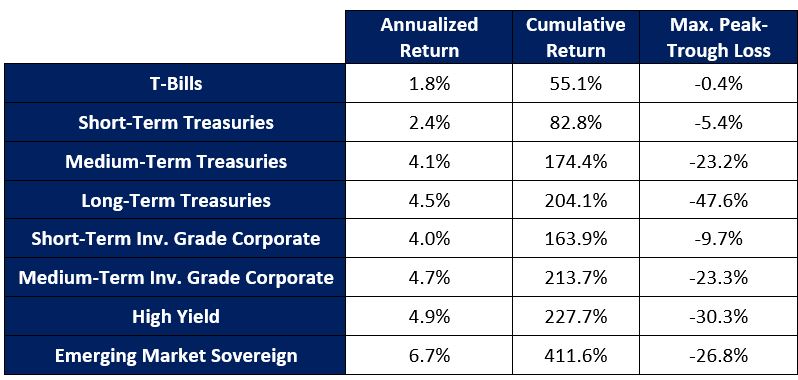
Traditional bond mandates each have their individual advantages and pitfalls with respect to returns, risks, and diversification properties. In terms of the tradeoff between risk and return, history strongly suggests that there is no clear free lunch to be had.

Risk vs. Return by Bond Type: 2000 – 2024


As the above table illustrates, there is a clear relationship between the returns of the various segments of the bond market and the maximum losses that they have sustained over the past 25 years. If you want extra return, you can reasonably expect to suffer larger losses in bad times. That being said, large losses in bond holdings are generally not what investors want or expect.

There is no Free Lunch Part II

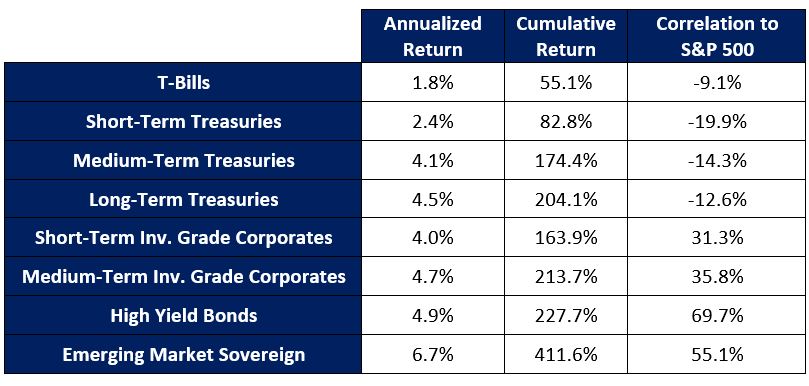
Not only is there no free lunch with respect to the tradeoff between risk and return, but there is also none when it comes to diversification value. Higher returns are not only associated with larger losses but are also associated with higher correlations to equities.

Return vs. Correlation to Stocks by Bond Type: 2000 – 2024

Bonds that offer higher returns have a greater tendency to move in tandem with stocks, thereby providing less ability to mitigate stock losses during bear markets. In contrast, lower-return bonds possess greater diversification properties and thus are better equipped to offset stock-price declines during times of equity market turmoil.

None of the above: Sometimes there’s Nowhere to Hide

Notwithstanding the fact that higher-return bonds have on average suffered more severe losses and offered less diversification value than their lower return counterparts, these relationships have exhibited significant variations across different bear markets. Continue Reading…

Bonds are Back

Image from Outcome/Shutterstock

Guess who just got back today

Them wild-eyed boys that had been away

Haven’t changed, had much to say

But man, I still think them cats are crazy

 The boys are back in town, the boys are back in town

  • The Boys Are Back in Town, by Thin Lizzy 

By Noah Solomon

Special to Financial Independence Hub

Government Bonds: The Gift That (Usually) Keeps on Giving

Historically, bonds have provided investors with two main benefits. Firstly, their yields have provided a reasonable, if unspectacular return. Secondly, they have offered diversification value, muting overall portfolio losses during bear markets. By owning high-quality bonds, you got paid for protecting your portfolio during times of market turmoil, which is akin to receiving (rather than paying) a premium for fire insurance: a remarkably sweet deal indeed!

However, these benefits have historically ranged from significant to nonexistent, depending on the investment environment. Given this fact, Investors should alter their bond exposure as conditions warrant, both in terms of their aggregate allocation to the asset class as well their bond portfolios’ exposures to changes in interest rates and credit conditions.

A Bear Market Sedative

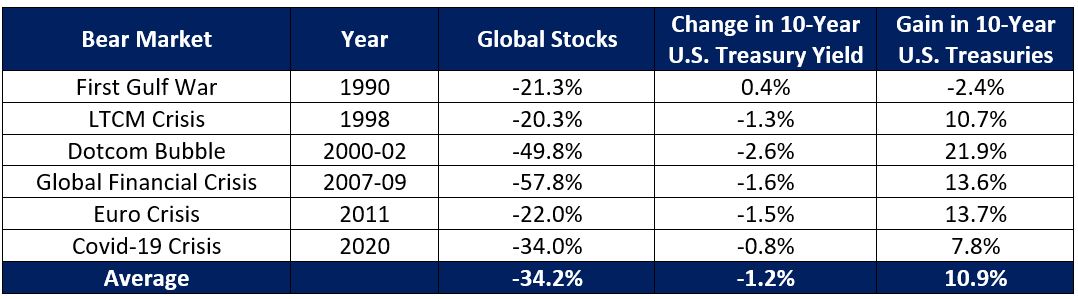
As the following table illustrates, in five of the six equity bear markets before that of 2022, bonds provided investors with much needed gains, thereby mitigating the overall damage to their portfolios.

During the tech wreck of the early 2000s, a balanced portfolio that was 60% weighted in the S&P 500 and 40% weighted in 7–10-year U.S. Treasuries declined 16.41%, as compared to a fall of 42.46% for the all-stock portfolio. In the global financial crisis (GFC) of 2007-2009, the balanced portfolio lost 23.92% vs. a loss of 45.76% in equities.

The ZIRP Era and the Erosion of Bond Powers

During the GFC, central banks entered hyper-stimulus mode to stave off a collapse of the global financial system and avoid a worldwide depression. ZIRP (zero interest rate policy) stances became the norm for monetary authorities around the world, with rates remaining at historically low levels for the next 14 years.

Bonds eventually became a victim of their own success. Although stimulative policies were successful in making the great recession less severe than would have otherwise been the case, they also robbed bonds of their two key attributes. Firstly, high-quality bonds ceased to offer reasonable yields. Secondly, ultra low rates also limited the ability of bonds to provide capital gains during times of equity market turmoil, thereby hindering their diversification value.

In 2016, PIMCO Co-Founder and “Bond King” Bill Gross commented that to repeat the bond market’s 7.5% annualized return over the past 40 years, yields would have to drop to negative 17%:  the math just didn’t work!

A Clear Warning Sign

As the saying goes, “Hindsight is 20/20.” It is easy to understand what should have been done after an event has already happened, even if it was not obvious at the time. However, market behaviour during the Covid crash offered a clear warning that all was not well in bond land.

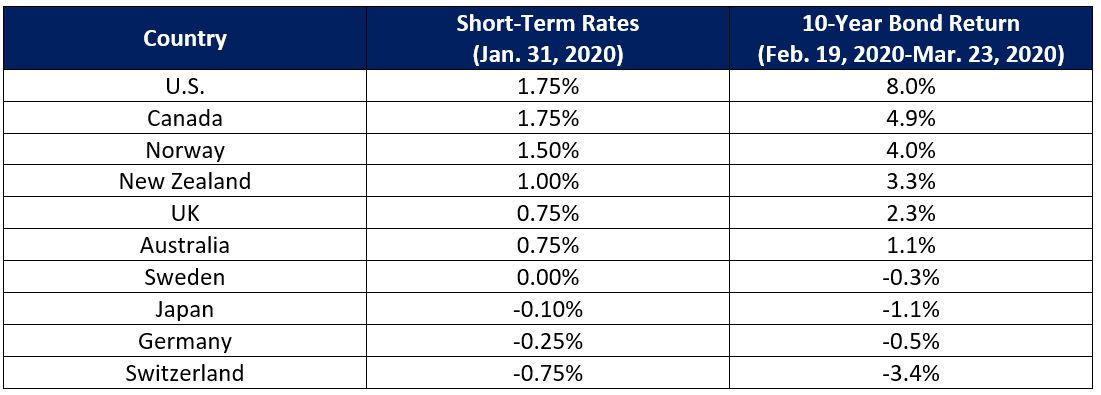
The following table compares countries by their pre-pandemic short-term rates and the returns of their 10-year government bonds during the subsequent bear market.

There is a near perfect relationship across countries in terms of where their short-term rates stood prior to the pandemic and the subsequent return of their 10-Year bonds.

  • In the countries that initially had relatively high short-term rates, such as the U.S. Canada, and Norway, 10-year bonds produced substantial gains and mitigated the damage caused by the vicious decline in stocks.
  • In countries that started with rates that were neither relatively high nor low, such as the UK and Australia, 10-year bonds provided some, albeit lower amounts of protection.
  • Lastly, in countries which started with the lowest rates, such as Sweden, Japan, Germany, and Switzerland, not only did government bonds fail to mitigate stock losses but actually declined.

Given the strong correlation between where pre-Covid rates stood in different countries and the subsequent ability of their bond markets to offset stock market losses, it was clear that there was little, if any, gas left in the tank in the post-Covid world of zero rates, leaving investors largely unprotected.

From Hedge to Texas Hedge

Post-Covid, not only did ultra-low rates obliterate the insurance value of bond holdings, but the unprecedented amounts of monetary and fiscal stimulus that had been injected into the global economy left bonds particularly vulnerable to capital losses. Against this backdrop, when the rubber of stimulus hit the road of inflation in early 2022, central banks were forced to raise rates at a clip not seen since the Volcker era of the 1980s, resulting in painful declines in bond prices. Continue Reading…

How often should you rebalance your portfolio?

By Dale Roberts, cutthecrapinvesting

Special to Financial Independence Hub

How often should you rebalance your portfolio? There’s good news on that front as less is more. We’ll take a look at a very telling chart from Frederick Vettese. And I take another look at the very telling perfomance table for the core Tangerine Portfolios. In this post I will also take you through my top observations of the week – by way of my Twitter / X Tweets. That includes – bonds vs GICs, big dividends under attack, my U.S stock portfolio returns, and what’s in store for the Canadian banks.

Courtesy of Fred Vettese in the Globe and Mail, a look at rebalancing a core ETF portfolio.

Here’s the link for those who have a Globe subscription.

On April 1, 2013, $1,000 was invested in each of four exchange-traded funds: a U.S. stock ETF, denominated in Canadian dollars (stock symbol XUS), a Canadian stock ETF (XIC), an international stock ETF (XEF) and a Canadian bond ETF (XBB). The initial asset mix is therefore 75-per-cent equities and 25-per-cent bonds.

Fred’s test showed almost identical results for rebalancing every quarter and once a year. That suggests that you can save yourself some time and effort (and perhaps trading costs) by rebalancing just once a year.

We can also see that when the unbalanced portfolio performed better during a period of robust stock returns. That said, the portfolio risk level has increased.

I have been evaluating portfolios for many years (decades) and more often find that rebalancing once a year often leads to greater returns. It allows a successful asset to go on a greater run before the money is moved to the under performing asset.

You might also consider rebalancing based on thresholds – perhaps when an asset is 5% or more about your target allocation.

The lessons of the Tangerine Portfolios

I had another look at the index-based Tangerine Portfolios. As you may know I was an advisor and trainer with Tangerine for several years. Those are a wonderful solution for those who want lower-fee managed portfolios and investment advice.

You can also have a look at the Tangerine Global ETF Portfolios.

There are many lessons that can be learned or observed from the returns of the portfolio models. I offered some ideas in this Twitter thread.

While you can check out that thread, and yes you should follow me on Twitter / X I will strip out the main lessons (shown below).

Lesson 1: Risk and returns

Investors were rewarded for taking on more risk. The risk/reward proposition.

An all-equity portfolio might earn in the area of 9% annual, while a balanced growth model is more 7%’ish and a balanced model more 6%’ish. Keep in mind that the start dates for the balanced portfolios was terrible – just before the financial crisis in 2008. Continue Reading…