Tag Archives: debt

Review: The Procrastinator’s Guide to Retirement

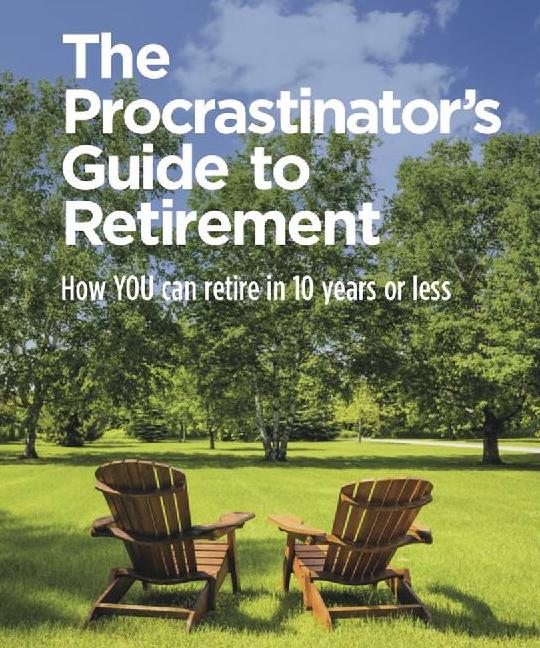
TPGTRI have to hand it to financial author David Trahair. He and his publishers have come up with a catchy title that’s bound to sell a few copies of his latest (sixth) book. It’s titled The Procrastinator’s Guide to Retirement and sports an equally alluring subtitle: How YOU can retire in 10 years or less.

You can find a Q&A I conducted with Trahair about the book here at MoneySense.ca.

When I perused the book initially, my first impression was that there seemed to be relatively little about procrastination and the critical last ten years of Retirement. The book doesn’t have an index but my initial perception was that the book is a standard-issue retirement guide covering all the good things you should do throughout your working career, not just the final ten years.

Which came first, the book or the title?

Continue Reading…

Debt is more than a four-letter word during your drawdown years

_MG_4309
Doug Dahmer

By Doug Dahmer, Emeritus Financial Strategies

Special to the Financial Independence Hub

 The month of April is always a particularly busy time for Retirement Income Specialists. One of our key roles is to provide each of our clients with a year-by-year draw-down recipe: outlining how much and where to source their annual cash flow needs.

The ultimate goal is not to minimize the amount of income tax they pay on any given year, but instead to minimize the amount of tax they pay over the balance of their lives. (Please note these two goals are frequently confused, and seldom accomplished simultaneously as often you will need to pay more tax sooner in order to pay significantly more later.)

One of our many sources of insight for the guidance we provide is found within our clients’ annual tax returns. At the same time our clients’ previous year’s tax returns act much like a report card, keeping them informed as to how well we performed our role over the previous year, as we endeavor to accomplish this important long term goal.

Debt can more than offset taxes

Continue Reading…

The Real Cost Of Personal Debt

MarieEngen
Marie Engen, Boomer & Echo

By Marie Engen, Boomer & Echo

Special to the Financial Independence Hub

We are constantly reminded about the rising level of outstanding personal debt carried by Canadians. Every few months we hear about the perils of rising interest rates that may leave many in financial difficulty.

The reality is – debt is not all bad. Most of us wouldn’t have been able to purchase our homes without a mortgage, or buy a car, or pursue secondary education. Even credit cards are not evil in and of themselves no matter how they are often portrayed.

To never (ever) borrow money is to live in the land of the already rich, or to always be a renter. At the other extreme, using other people’s money to fully finance your lifestyle is ridiculous and precarious.

Most of us don’t fall into these extreme circumstances. We hold a reasonable amount of debt, make our payments on time and have good, to very good, credit ratings. That being said, most people fail to optimize their overall debt management strategies to pay the least amount of interest.

Consolidating debts

We no longer hear about the “all-in-one” mortgages offered by financial institutions such as the Manulife ONE and National Bank All-in-One. These accounts combine chequing, savings, and borrowing into one account. If used properly, consumers could simplify their debt and lower their overall interest paid.

These won’t work for most people because they like to keep all their accounts separate. They have multiple liabilities at different interest rates:

  • Home mortgage
  • Car loan
  • Line of Credit
  • Student loan
  • Credit card to use for discounts at your favourite store
  • Credit card for other rewards.

When I worked in banking, I gave out many consolidation loans. I confiscated and cut up credit cards, cancelled overdraft protection, and closed out other loans and lines of credit. Invariably, within a couple of months, more than half of these clients would reapply for their credit cards, reinstate ODP, and sneak off to a different branch to get another line of credit.

More personal debt mismanagement

Here are some other ways people don’t think clearly about managing their personal debt.

  • Mike and Molly are determined to pay off their mortgage (2.7%) in less than 10 years. They put every available dollar towards the principal. They also have two car loans at 4.5% and 8% and purchased a “don’t-pay-for-six-months” entertainment system. It makes more sense to address these debts first.
  • When their mortgage came up for renewal, Fred and Ethel rolled the balance into a new Home Equity Line of Credit. However, they continue to finance their lavish life style with their credit cards. They pay off the cards each month from the HELOC on which they make the required minimum payment of accrued interest. After all, they have a huge balance still available to them. They think they are managing their debt well by paying off “bad” credit card debt and having “good” mortgage debt.
  • Jess went to her favourite home décor store to purchase some sheets. There was a store promotion that gave 20% off purchases when opening a new store credit card. Excited by the discount, Jess picked out a whole bedding set from duvet to accent cushions. The balance is too high to pay when the bill arrives so she makes minimum monthly payments while incurring interest charges of 29.9%. Meanwhile, she has enough money in her low-interest savings account to pay the entire bill, but chooses not to.
  • Leonard works on commission and his paycheque amounts vary. He makes up the difference in lean months with his overdraft protection at 24%. Until he learns how to budget for his irregular income, he should use his credit card for purchases, even if he carries a balance for a month or two.
  • Ross receives a credit card offer with a “teaser” 0% interest on balance transfers. He transfers the balance from his high interest rate card and cancels it. He uses his new card for future purchases, not realizing that the 0% only applies to the amount of the transfer. His payments go to the new purchases he made which carry a much higher rate. He would have been better off to continue using his old card for his occasional new purchases, pay the monthly balance in full, and avoid using the new card at all.
  • Barney and Betty have a systematic plan to pay off all their debt. They are using the “snowball” method popularized by author Dave Ramsey, which states that it is psychologically satisfying to first rid yourself of the smallest debts first, regardless of interest rates. The reasoning is they would be better prepared – and more enthusiastic – to stick with the strategy. But, once the small debts were done they took their foot off the gas and paid random amounts on the higher debts whenever the inclination hit them.  

Final thoughts

Instead of speculating about the direction of future interest rates, we should be examining our own habits.

Take a look at how you think about – and manage – your personal debt and see if you can minimize your borrowing costs.

Also read:

Marie Engen is the “Boomer” half of Boomer & Echo. In addition to being co-author of the website, Marie is a fee-only financial planner based in Kelowna, B.C. This article originally ran at the Boomer & Echo site on Feb. 9, 2016 and is republished here with permission.


It’s Blue Monday, and we’re ashamed of credit-card debt, study finds

Sponsored Blog

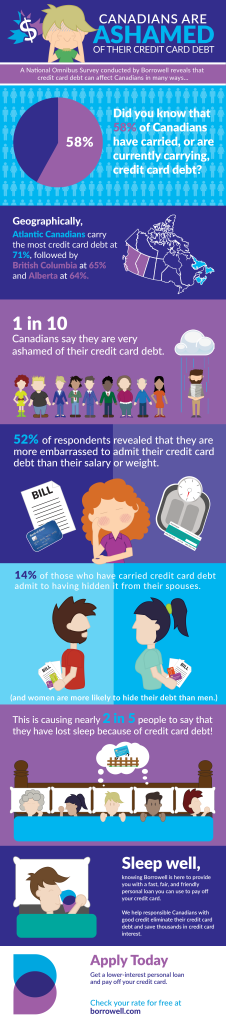
Borrowell Blue Monday InfographicThe holidays are over, the weather is cold and dreary and credit-card bills are rolling in—it’s no wonder the third Monday in January is considered the most depressing day of the year, known as Blue Monday.

We know that Canadians carry a lot of credit-card debt, but beyond the numbers we wanted to understand how Canadians feel about their debt. So the team at Borrowell commissioned a survey of 1,500 Canadians to understand our emotions around credit-card debt.

To see Borrowell’s Blue Monday video, click on the red/white button in the centre of the video image above.

Shame can affect our relationships

It turns out Canadians feel a lot of shame around carrying debt, and it’s not only affecting how we feel and what we can do, but our personal relationships as well, as the infographic to the left shows.

Like many issues, shame can prevent us from seeking solutions. Feeling shame may be a factor in explaining why so many Canadians carry expensive credit-card debt – even those who have good credit and could get a lower interest rate somewhere else!

Take control of your finances

Although Blue Monday is supposed to be depressing, let’s not just wallow in self-pity with a tub of ice cream. Take control of your finances, take a step in the right direction and if you’re carrying a balance on your credit card, look into a lower-interest loan to pay it off.

For more information on Blue Monday, including more on the survey, check out www.borrowell.com/bluemonday.


David Trahair’s contrarian stance: Be a loaner, not an owner

125_Enough_Bull_High_Res_Cover_FinalBy Jonathan Chevreau

Financial Independence Hub

In this summer’s series on the 7 eternal truths of personal finance, one of the articles was entitled Be an Owner, Not a Loaner, which reflects the usual financial industry advice that stocks are more likely to generate long-term investment returns than cash or bonds.

There is of course a contrary view to this eternal truth and it’s best contained in the new second edition of David Trahair’s book, Enough Bull, originally published early in 2009, right at the bottom of the financial crisis..

Trahair, a chartered accountant and author, could as easily have titled his book Be a Loaner, Not an Owner, because he’s adamant that stocks (i.e. equities), whether individual or pooled through mutual funds or ETFs, are just too risky for the average person.

The book cover includes a small image of a bull (as in a steer), so clearly the title Enough Bull is a double entendre: as in no more bullish prognostications on the stock market, as well as no more bovine excrement, whether dispensed by the animals or financial advisors.

Skeptical about the financial industry and its central belief in stocks Continue Reading…