Tag Archives: debt

11 ways Millennials can eliminate Credit-card debt

Many people find themselves struggling with credit card debt. If you happen to be one of them, replace your stress with an action plan. Becoming debt-free is a liberating experience, but it takes discipline to get there. 

Below, 11 business executives share their take on the best way to rid yourself of credit card debt. Plus, they reveal their own practices when it comes to credit cards.

Treat Credit Cards like Debit Cards

I have no credit card debt at 27! I haven’t used a debit card in over 8 years. I currently have 5 credit cards – Discover IT, Alaska, Delta, Costco, and Target. Each card provides a different benefit and allows me to maximize the rewards and discounts I receive. I have always treated credit cards like a debit account, ensuring I don’t spend more than I have. I don’t make large purchases on credit cards that cannot be paid off at each billing cycle. — Megan Chiamos, Cannabis ERP Software 

Pay off the smallest balance first

Intentionally paying it off with the smallest balance first.  Now with the current situation things are a little different as I need to be mindful to keep some of that money I would have used to double up payments. — Leeanne Gardner, Unbridle It

Understand where every Dollar is going

We have lines of credit that have credit cards attached to them. The balances vary depending on the situation. Cash flow is one of the most challenging aspects of being a small business and I believe it is wise to leverage good credit to cover those gaps. It is extremely important to be aggressive about paying down that debt and knowing where every dollar is going. — Lukas Ruebbelke, BrieBug

It doesn’t matter how broke you are

Before we were married, my wife worked for Sears credit central. Her job was to turn down people with bad credit. As a result of her experience, we have never carried credit card debt during our entire marriage, no matter how broke we were. Makes for both great finances and a happy marriage! — Rick DeBruhl, RickDeBruhl.com

Think of the benefits of being Debt-Free

I don’t have any credit card debt, and to the best of my ability I never will. The interest rates on credit cards are fairly high, so I do my best to pay down my balance every month. If you do this, you’ll rack up all kinds of free points and have a great credit score on top of it. Win-win. — Michael Norris, Youtech

Try Debt Consolidation products

debt consolidation products have been helpful to me in reducing that debt. You have to be very careful though & diligent. That is a solution that only works if you change your habits too. — Emily Beattie, Recruiting Manager Continue Reading…


How to manage your Finances in your 20s

Image by unsplash

By Cloe Matheson

Special to the Financial Independence Hub

Your twenties are often touted as the best years of your life. They’re full of fun, frivolity, and finding out who you are. But it’s easy, as a twenty-something, to surrender any thought of saving for your future.

Now, we aren’t saying that every millennial will squander their chance of buying a house because they spend too much money on smashed avocado toast. There are, however, a few key things that we could all do better in our twenties to manage our finances. Want to know how to save your pennies for the future? Here are some top tips.

1.) Don’t get into (more) debt

Most of us will already have large loans to pay back for college. Avoid saddling yourself with even more debt by buying things you can’t afford. This habit will only lead to a world of pain in the next decade of your life.

So how do you avoid getting yourself into financial trouble by spending carelessly? Firstly, evaluate and reflect whenever you look to purchase items over a hundred or so dollars. It’s not only big-ticket purchases you need to watch out for, either. All those discretionary purchases – a top here, a coffee there – really do add up. 

Unsplash

2.) Build your credit history

You also need to build up your credit history carefully and surely. For many banks and mortgage brokers, a total lack of debt signals financial immaturity. Start building a solid credit history by making a small purchase on credit (say, a washing machine), and promptly paying the moneylender back.

3.) Learn to live with less

It might take some philosophising, but it’s time to re-evaluate your attitude toward material things. Young people tend to compare their circumstances with their friends’ more than most. There’s also a tendency to covet the gadgets and homes that we see plastered on social media. But you don’t need to live this way to be happy. Continue Reading…

Financial tips and tricks for savvy Home Buyers

Image courtesy of Rawpixel

By Jim McKinley

Special to the Financial Independence Hub

Purchasing a house is a major investment, and finding one you can afford can feel like quite a puzzle. However, there are some smart, money-stretching strategies you might not know, but that can make all the difference in your financial situation. Read on for tips and tricks to help you land the home you’re dreaming about.

Dealing with Down Payments

One of the big hurdles for home buyers is gathering funds for a down payment. Lenders traditionally require 20 per cent down, which calculates to tens of thousands of dollars that many people don’t have sitting in their bank accounts. There are strategies for gathering those funds, like paying off credit cards and saving your cash, taking on a second job, or selling belongings.

Bear in mind that lenders will look at your bank statements to examine where your funds came from, and if anything looks fishy, such as a sudden large deposit, they might hold it against you. Mortgage lenders want to see financial stability, so big fluctuations, bounced checks, and irregular activity could damage your chances for a loan.

For home buyers struggling to come up with a down payment, there is good news. There are FHA loans available that permit as little as 3.5 per cent money down (in the United States). On top of that, you might be able to use gifted funds, which most lenders do not allow.

A couple other opportunities for special mortgages are available. Veterans can aim for a home loan through the VA, and for low-income applicants in rural areas, the USDA offers 100 per cent financing through Rural Housing loans.

Squeaky clean Credit

No matter where you apply for a loan, the lender will examine your credit history. Chances are you know if you’ve made some mistakes, but sometimes credit reports have clerical errors on them. Thankfully, there are ways you can clean up your credit score, but it can take a little time, so if you plan to apply for a loan, get started early.

Start by requesting a free credit report and give it a thorough once-over. If you find errors, you will need to dispute them with the reporting agency, explaining the problem and documenting the error. After that, there will be a time period in which the error can be substantiated by the appropriate credit institution, and if they fail to do so, it is then removed from your credit report.

It can also help to pay down your debts because lenders will examine your debt-to-income ratio. As InCharge points out, you will generally need a result no higher than 43 percent of your income. Keep in mind the lender will include your potential mortgage payment in that calculation.

Rethink your Search

House hunters often search traditional home listings in hopes of finding the home of their dreams. However, thinking outside the box can mean broadening your search. For example, foreclosures can be a bargain under the right circumstances, but you should weigh the pros and cons carefully. Continue Reading…

Don’t let Credit Card debt take over your life: 4 tips for paying it off quickly

By Shiv Nanda

Special to the Financial Independence Hub

Credit cards are great, aren’t they? We can use them to pay bills, buy stuff online or in stores, and travel, even if money’s tight right now. Of course, the ability to buy now and pay later also means it’s easy to get carried away and spend more than we can actually afford!

Many of us have racked up huge credit card bills, and paying them off seems impossible sometimes. If you’re in the same boat, don’t despair. We’ve put together some great tips to help you pay off credit card debt faster.

Here’s what you should do:

1.) Avoid the Minimum Payment Trap: It’s tempting to pay just the minimum due every month, especially when it means paying only a few extra dollars in interest charges.

But have you ever thought about how much this adds up to? Total up the interest you pay in one year, and you’ll know why everyone advises paying in full every month. If full payment isn’t possible, pay as much as you can. It’ll significantly reduce the interest you pay in the long term.

2.) Consolidate High-Interest Debt: Debt consolidation is a good way to reduce the cost of high-interest credit cards, loans and other debt. If you tend to lose track of due dates for multiple cards, it also helps you avoid late payment fees and penalties.

Use a debt consolidation loan or personal loan with affordable interest rates to pay off expensive credit cards and loans, and then make repayments in one place.

3.) Prioritize One Debt at a Time: Speed up debt repayment by focusing on clearing one credit card in full (with minimum payments on the rest). There are two ways to handle this: Continue Reading…

Borrower and lending practices deepening the burden of debt in Canada  

By Doug Conick, DUCA Credit Union and Chair of Duca Impact Lab

Special to the Financial Independence Hub

Financial institutions play an important role in Canada’s economic well-being. They support growth in personal wealth, job creation and impact the country’s prosperity overall. It is my firm belief that when it comes to the household debt burden of Canadians, there is an even greater role for financial service providers to play. We have a duty to act in the best interest of our clients and proactively contribute to the financial wellbeing of Canadians.

On Wednesday (Jan 15) DUCA Impact Lab released the results of a first-of-its-kind Canadian study to capture the perceptions of Canadian borrowers and lenders, ultimately shining a light on disparities between the two groups. The research uncovers interesting new details about how Canadian borrower and lenders interact with each other and explains how borrowers are impacted by debt. You can find the full report here.

The mounting stress of debt on Canadians

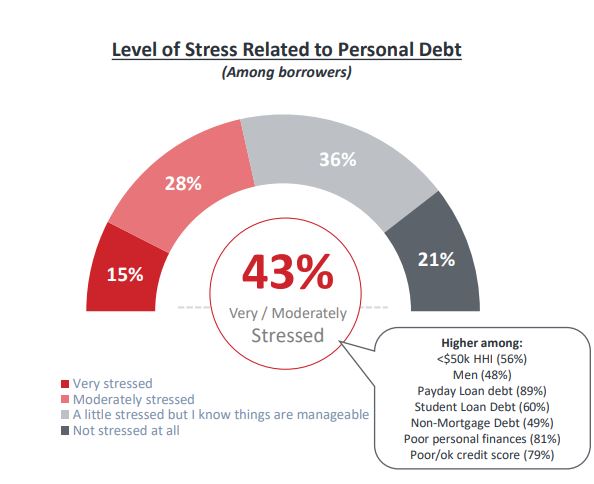
We talked to over 2,000 Canadian borrowers, nearly half of which reported that personal debt has impacted their ability to save and build wealth. It’s concerning that over one-third of borrowers surveyed report avoiding interactions with their financial advisor, despite recent Statistics Canada research which shows Canadians are spending more money than ever on debt payments.

The household debt-service ratio, which represents the percentage of after-tax income used for debt payments, rose to a record 14.96 per cent in the second quarter of 2019. This underscores the increasing need for better understanding among Canadians on how to manage existing debt. Canadians need help but they simply aren’t asking for it.

Our survey also shows debt affects access to healthcare and quality of life. Those surveyed report anxiety, trouble sleeping and poor lifestyle choices like skipping meals, eating unhealthy foods and spending more time alone.

The gap in perception

A quarter of borrowers surveyed say they don’t trust their financial institution to guide them through their debt issues and 37 per cent report avoiding their financial services representatives due to perceived pressures to manage their finances in a way they do not feel comfortable with or because they are recommended products they do not understand. At the same time, 42 per cent of lenders surveyed report they don’t believe their clients fully understand the products they are purchasing.

This demonstrated lack of trust in financial services professionals and gaps in understanding of financial products can lead to a cycle of debt and a missed opportunity to set or prioritize financial goals. Continue Reading…