Tag Archives: debt

7 things you can do now to have a Debt-free Life

By Emily Roberts

For the Financial Independence Hub

Living debt-free might seem like a distant pipe dream to many, and that’s unfortunate. Being crippled with debt is difficult, and even more so when you feel like the situation is hopeless. The reality is that most people who have large amounts of debt could be making simple steps every day to turn their situation around. The issue for many is knowing where to start. Let’s take a look at what you can do today to get on the road to a debt-free life.

Take a long hard look at your Financial Situation

The first thing you have to do is know exactly how much debt you have. This will allow you to get a clear assessment of your finances and start working on repaying them. Not only that, but there could be cases where your situation might not be as bad as you thought. For instance, did you know that entries on your credit report have to be removed after a certain period? This means that some of the debt that you thought you had may have been expunged from your report a long time ago. This is why you need to keep a close eye on your credit report and get your annual statutory copy from the one of the three major credit reporting agencies. Once you know exactly what you owe, you can build a plan.

Call your Creditors

The next thing you have to do is get in touch with your creditors and work on a plan. There are some cases where you can work with a professional who will help consolidate all of your debt and have you pay a fixed sum per month. This can be a good option in some cases, but you don’t necessarily have to hire someone. Calling your creditors and speaking with them directly could help you shave off a few dollars of your debt. Also note that the more you can pay upfront, the more they will be willing to lower the amount of money you owe. Try to get them to report the payment to the credit reporting agencies in writing as well so it can be reflected on your credit score.

Use your Credit Cards wisely

If you have multiple credit cards, we would suggest that you start paying them off one by one. Tuck away the one with the highest balance and commit to paying it in full. Set up automatic payments if you have to. This will allow you to both reduce your overall debt and significantly improve your credit score by lowering your credit utilization ratio.

You then have to use your other cards wisely. A lot of people believe the myth that paying the minimum is something credit card companies will reward, but that’s complete hearsay. In reality, companies love people who use credit responsibly, and one of the best ways to do that is to use as little of your credit as possible. So, if you want to be viewed favorably by creditors, aim to keep your total utilization ratio under 30%.

If you want help with credit card debt and feel like you don’t have the discipline to pay them off on your own, we suggest you check out Tally. Their app will allow you to manage your credit cards all in one place and could even help you save on interest if you qualify for their low-interest line of credit. They will help you pay your cards automatically through an easy-to-understand interface, ensuring you don’t have to deal with a late fee ever again.

Know what you’re signing up for

Very few people take the time to read the fine print when they get a credit card and more people should. One piece of research reviewed credit card agreements for clarity and found that the majority of people surveyed could not understand them. That’s a big problem when considering that credit card agreements can include provisions that will allow them to change the interest rate at will. Continue Reading…
Debt lifts Gold

By Nick Barisheff

Special to the Financial Independence Hub

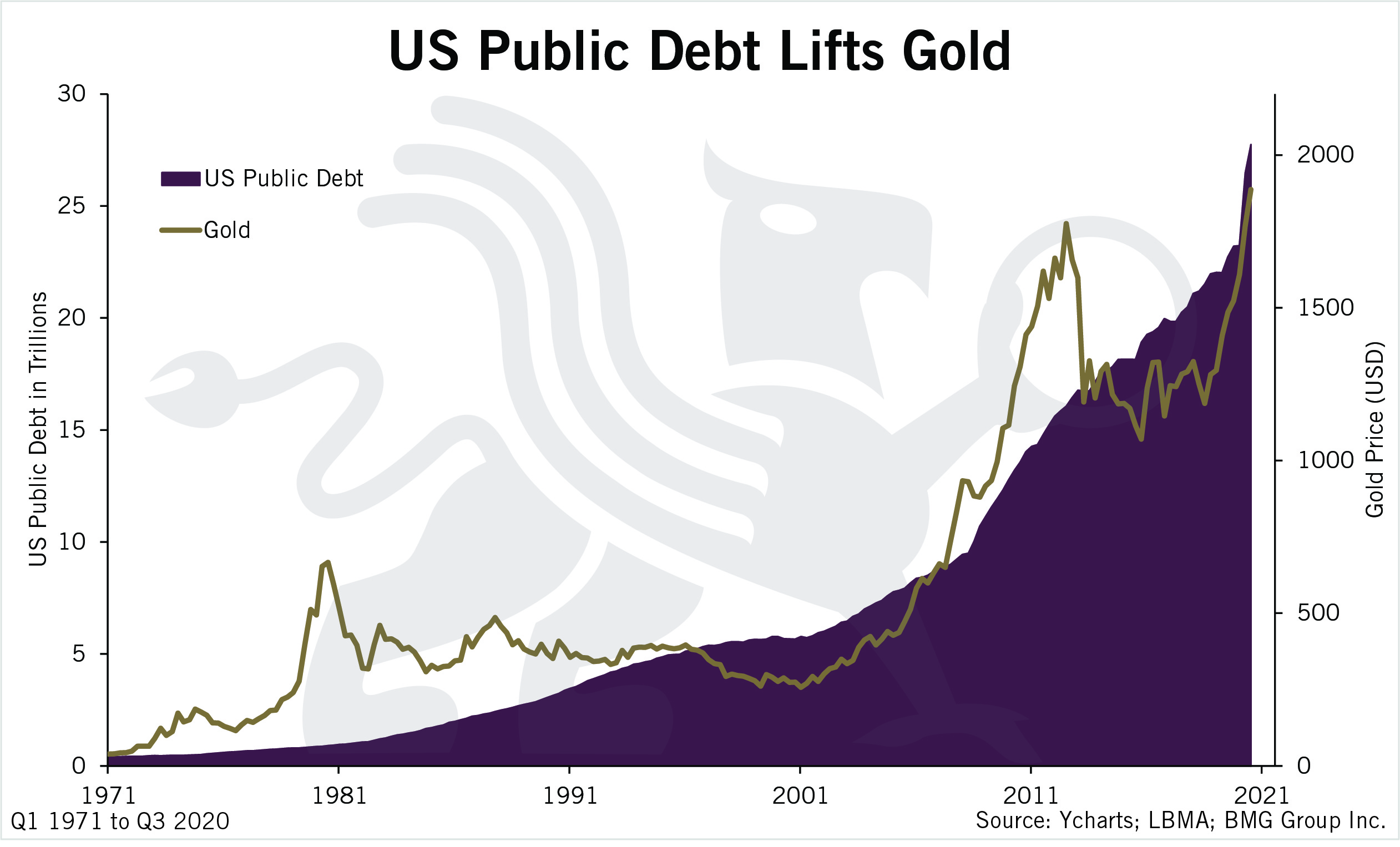
The world is awash in debt, an immense, unfathomable ocean of financial obligations. The stack of IOUs is so enormous, the balances so large, they will never be fully settled without dreadful consequences to the global economy. This tsunami of debt was unleashed in 1971, when Nixon ended the backing of the US dollar with gold.

Since 1971, US debt and gold prices have increased greatly. Traditionally, rampant increases in US debt occur when trying to pull the economy out of an economic downturn as displayed in the spikes that occurred in 2008 and 2020.

Considering the amount of debt that has already been taken on to combat the pandemic — combined with the rising uncertainty involving vaccinations and new strain variants — it can be anticipated that the worst is yet to come. As Democrats push towards passing an additional US$1.9 trillion stimulus package, governments are willing to take on previously unforeseen levels of debt to prop up the economy during the pandemic. This could lead to a promising future for the price of gold.

Manipulation of Precious Metals markets

This divergence has been caused by manipulation of precious metals. A great deal has been written about this and one of the best books on the subject is Rigged – Exposing the Largest Financial Fraud in History, by Stuart Englert.

Price manipulation never lasts, and when it ends there always tends to be a reset to inflation-adjusted levels. The biggest questions are: when and how high will gold and silver prices rise?

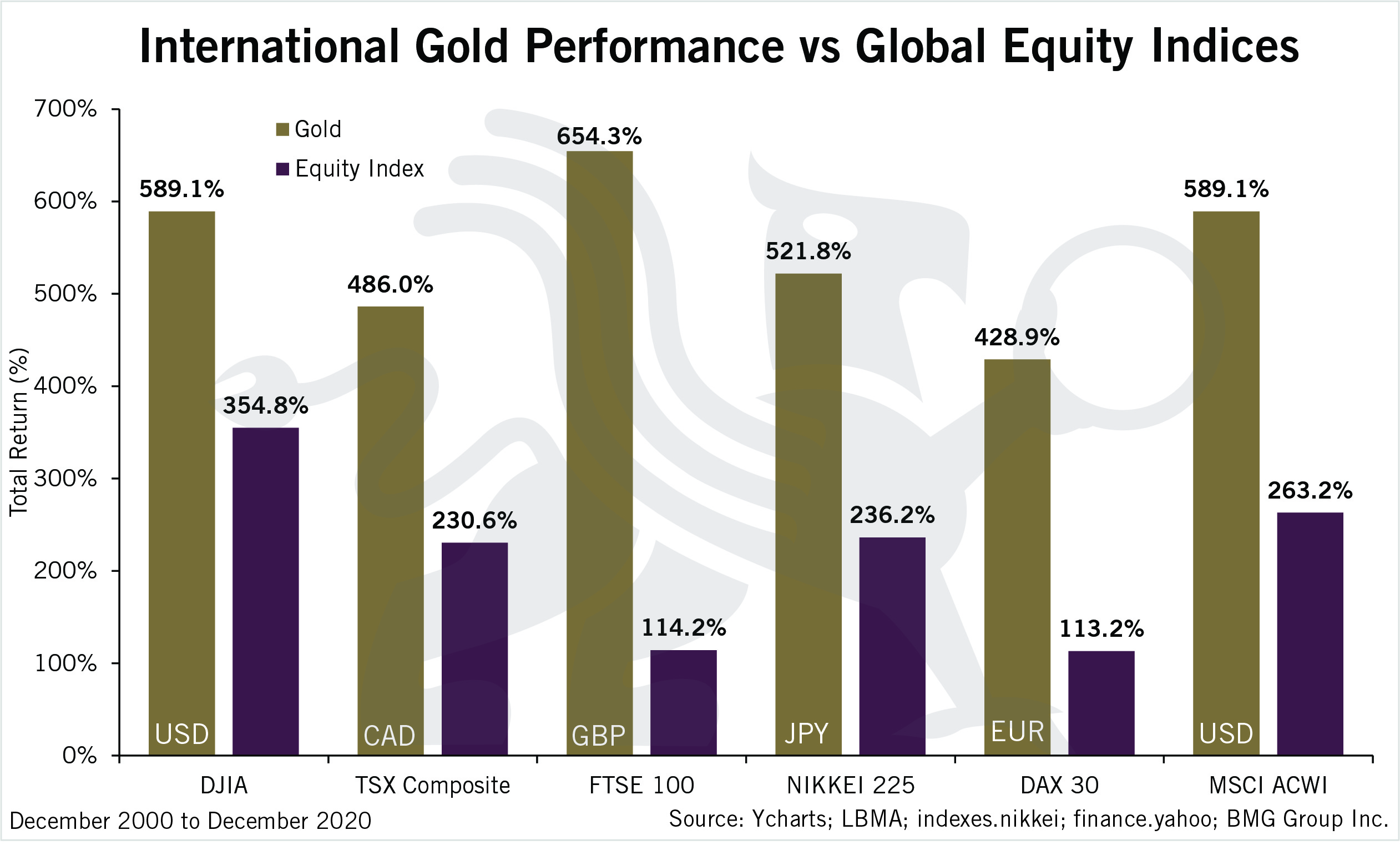
However, even with manipulated markets precious metals have outperformed traditional financial markets and have generated over 10% returns in all currencies over the last 20 years.

How soon precious metals rise to normalized levels depends on how rapidly governments and central banks inundate the world with debased dollars and other fiat currencies, and how quickly individuals and institutions lose faith in those increasingly worthless debt-based currencies.

The US national debt alone is nearly US$28 trillion. This doesn’t include the $159 trillion of unfunded liabilities, which brings the total to US$187 trillion or about US$480,000 per American citizen. This number also doesn’t include the $21 trillion in unaccounted federal expenditures discovered by Prof. Mark Skidmore and his economic students at Michigan State University.

Global debt hits 365% of World GDP

Global debt hit $277 trillion last year, or 365% of world gross domestic product (GDP). Public debt as a percentage of GDP has soared to unsustainable and perilous levels. The US debt-to-GDP ratio hit 136% last year. Canada’s debt-to-GDP ratio increased by nearly 80% through the third quarter of 2020, the highest rate among developed nations.

When you translate these incomprehensible and burgeoning debt totals into per capita obligations, it is obvious that they will never be repaid. They can only be inflated away.

Combined with hundreds of trillions in unfunded government liabilities, swelling debt and unregulated financial derivatives form a bottomless abyss that eventually will engulf nations and swamp the entire financial system. Little wonder that in 2002, billionaire investor Warren Buffett dubbed derivatives — which essentially are debt instruments used as collateral to take on more debt — “financial weapons of mass destruction.” At that time derivatives totaled $100 trillion, whereas today they are in excess of $1 quadrillion.

Socialists maintain public debt is acceptable when borrowing is for the common good, and Modern Monetary Theory (MMT) advocates claim unlimited government spending is not a problem. They believe governments can create an infinite amount of currency to fund social services and public works projects. They fail to recognize that debt is not wealth and increasing the currency supply decreases its value and produces price inflation.

Continue Reading…

6 things you can do to stay out of Debt

By Sia Hasan

Special to the Financial Independence Hub

No one wants to be in debt, but the good news is that you don’t have to be if you make smart financial decisions. Here are six ways you can change your habits and stay out of debt.

Create a monthly budget

Creating a monthly budget can help you visualize how much money you have coming in and how much typically goes toward expenses such as electricity, Internet and maintenance. There are plenty of apps that can help you get started, or you can go the old-fashioned route and use a pencil and paper. After about a month, you’ll be able to see how you can cut down on your expenses, such as canceling subscriptions that you don’t need or use.

Go Green

Not only can you go green on a budget, but it can actually save you money in the process. The next time you’re low on food, try going to the local farmers market instead of the grocery store. Contrary to popular belief, one study found that farmers markets are 10 to 20% less expensive than grocery stores. While you’re at it, bring your own reusable bag with you when shopping. Some stores will give you a refund, which can add up to $10 of savings a week. If you’re looking for another way to go green, installing solar panels in your home can be a great way to help the environment and save money at the same time. Although the initial investment may be large, you’ll actually end up cutting electrical costs in the long run. One study found that you can save up to $30,000 in the first 20 years after installing solar panels. If you’re interested in going solar, Loanpal can provide you with financing options.

Leave your credit cards at home

Unlike a credit card, you can’t overspend cash once it’s gone. Before you go on your next trip to the grocery store, bring only the amount of money that you think you’ll need. This way, you can stick to your list and you won’t be tempted to buy any extra treats or unnecessary items. Credit cards can make it difficult to know how much you’re actually spending, which can lead to costs rapidly accumulating. Continue Reading…

Study: Coronavirus Pandemic creating Tax Problems that could get worse in 2021

By Mike Brown, LendEDU

Special to the Financial Independence Hub

Americans struggling to repay their 2019 taxes in the midst of a recession has been just another issue to deal with during the coronavirus pandemic.

Recognizing this, the Internal Revenue Service (IRS) actually extended the filing and payment deadline for 2019 tax obligations from April 15, 2020, to July 15, 2020.

The extension may have temporarily stopped the bleeding, yet there’s a looming tax debt crisis that has the potential to boil over in 2021 when 2020 taxes are due.

That’s because millions of Americans took to relying on unemployment benefits, retirement funds, or stock sales to stay afloat amidst the pandemic recession.

All of those things could lead to a heavier tax obligation in 2021, and with many people still out of work and struggling to get by, the country could be looking at staggering tax debt numbers next year.

The U.S. tax gap (total outstanding tax debt) currently hovers around $400 billion, but that figure could approach crisis levels after next year’s tax season.

To capture the struggles from the 2020 tax season and also the fears regarding the 2021 tax season, LendEDU surveyed 1,000 adult Americans to better understand what the average taxpayer has been dealing with during these unprecedented times.

Observations & Analysis

All data is based on an online survey of 1,000 adult Americans commissioned by LendEDU and conducted by research firm Pollfish. The survey was conducted on December 1, 2020. For some questions, the answer percentages may not add up to 100% exactly due to rounding.

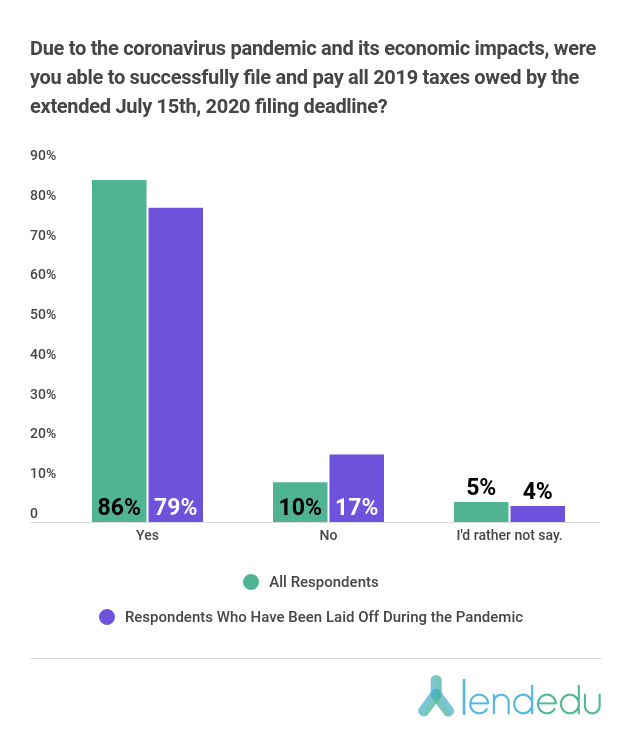
17% of Americans laid off because of Pandemic unable to pay all 2019 Taxes

As mentioned above, the IRS extended the deadline to pay 2019 taxes by three months given the financial hardships experienced by many as a result of the coronavirus pandemic and recession.

However, paying all taxes owed by the July 15th deadline was still impossible for many Americans, especially those who have lost jobs due to the pandemic.


Amongst respondents who have lost their jobs during the coronavirus pandemic, 17% were not able to pay their 2019 taxes on time and in full.

Many still haven’t filed Tax Returns

Even if you are unable to fully pay all tax obligations by the filing deadline during any given year, you should always file your tax returns on time.

When dealing with the IRS, a failure-to-file penalty is much worse (5% of unpaid taxes for each month your tax return is late, up to 25%) then a failure-to-pay penalty (.5% of unpaid taxes for each month you don’t pay, up to 25%).

Yet still, data from our survey found many Americans that couldn’t pay all their taxes on time also didn’t file on time.


32% of taxpayers who couldn’t pay all 2019 taxes on time didn’t file their taxes by July 15th either. Even worse, 72% of these taxpayers who missed the July 15th filing deadline still have yet to file their tax returns for 2019, which could lead to serious financial and legal troubles.

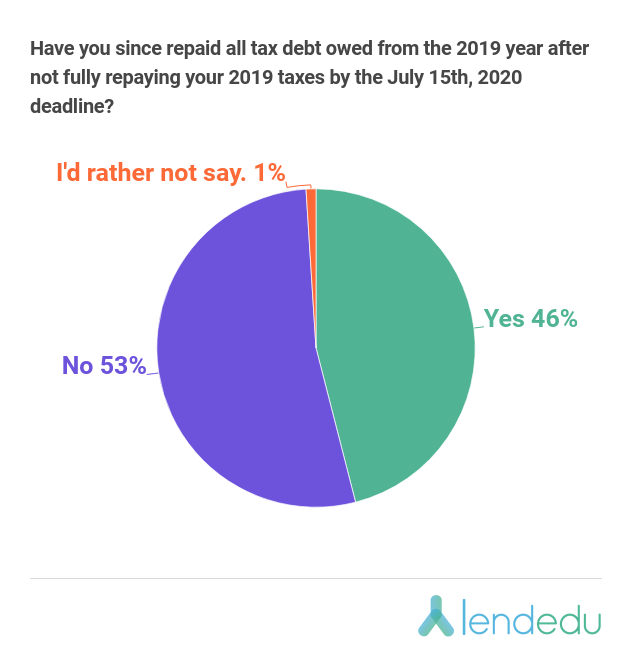
Amongst respondents who at least have filed their 2019 tax returns despite not being able to fully pay all taxes by July 15th, here’s how many have been able to finally repay all 2019 taxes owed…


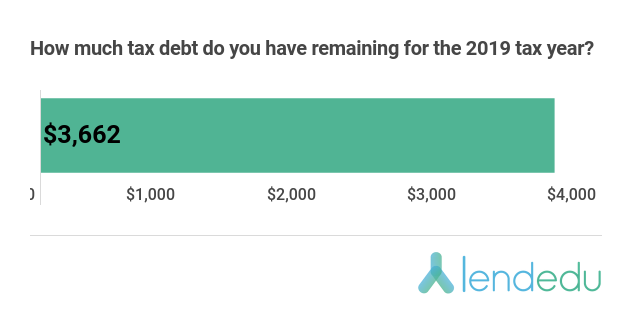
With 53% of applicable taxpayers still having tax debt from 2019, we wanted to see how much they have left…


For American taxpayers that still have some amount of tax debt from the 2019 tax year, the average amount remaining is $3,662.

If you are someone that is currently repaying tax debt, you may want to learn more about tax relief as a possible way to settle or reduce your tax bill.

The data from our survey makes it clear that repaying 2019 taxes has been unusually tough, and mass unemployment brought on by the coronavirus pandemic has been a big reason for the struggles.

But the coronavirus pandemic’s impact on the tax system won’t end in 2020 and likely will be more damaging in 2021 as taxes from this unprecedented year will be owed.

Over half worried about next year’s Tax Debt

The 2021 tax season is shaping up to be a brutal one as the full financial ramifications of the coronavirus pandemic and recession develop. Continue Reading…

Covid pandemic impacting Canadians’ mental health with worries about rising Debt and Housing


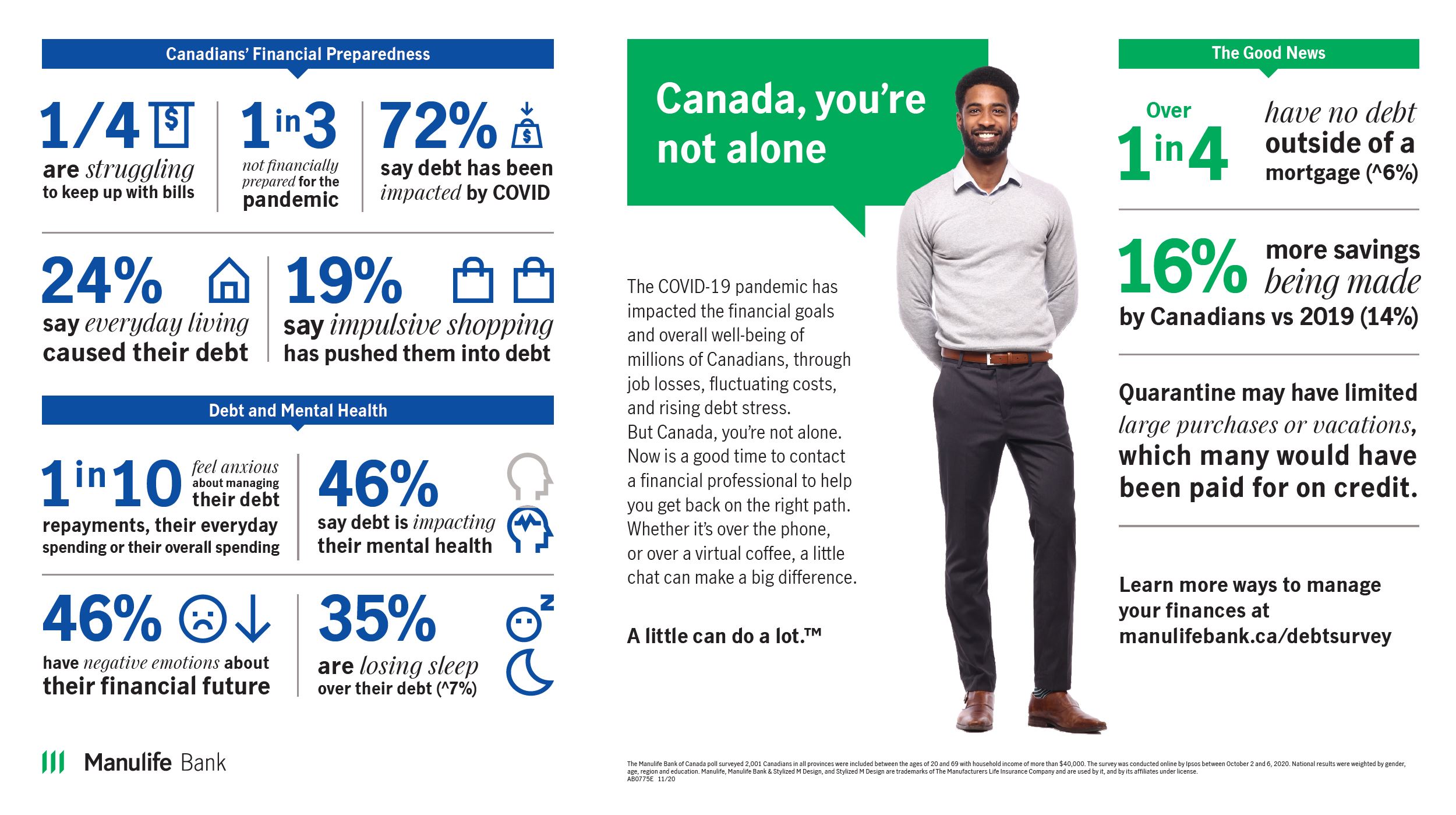
A third of Canadians were financially unprepared for the pandemic, and more than 75% think Covid-19 has impacted their mental health, according to a Manulife Debt Survey released late Tuesday. Young people are particularly concerned that their hopes for home ownership are slipping out of reach: two thirds of Canadians served who do not own a home worry about saving for one. 

A whopping 36% said they worry significantly about saving for a home, while 28% are concerned about supporting their children through post-secondary education (28%) and 28% about saving for retirement.

On average, Canadians have been allocating nearly half their income to essentials like food and housing since COVID-19 began, with 58% of homeowners and 54% of renters worry about making payments.

Manulife Bank CEO Rick Lunny

“Debt can negatively impact mental health and leave Canadians feeling like their financial goals are unachievable. The pandemic has made that even more pronounced,” said Rick Lunny, President and CEO, Manulife Bank. “It’s so important to have financial flexibility, especially when one looks at purchasing a home – it’s easy to feel stressed. Financial conversations are essential to identify opportunities, what matters most and help you stay on track, no matter the financial environment.”

A financially unprepared population

The survey found 35% admit they were financially unprepared for the pandemic. 74% believe their financial situation has been impacted as a result of the pandemic and 69% of them  say the impact has been overall negative: 42% worry that it may take them over a year to recover to pre-COVID-19 levels.

One in four are struggling to keep up with their bills, with one in six laid off due to COVID-19: an equal number say they would have been laid off had it not been for the wage subsidy provided by Ottawa.

Some have flourished

The survey reveals a sharp disparity in how the pandemic has impacted us, with some flourishing as others have been devastated. Manulife views this as evidence of  a K-shaped recovery narrative. On the one hand, while Canadian on average, appear to be saving more compared to a year ago (16%  of after-tax income, on avg. vs. 14%  in Fall 2019), 24% have been saving absolutely no after-tax income compared to the same period last year. Within the indebted population there has been a significant increase in the proportion of those who say everyday living is the cause of their debt: 24%. This suggests more Canadians who are in debt are struggling to make ends meet, even if fewer Canadians (27% debt-free vs. 21% on Fall 2019) are now in debt overall compared to a year ago.

Continue Reading…