Tag Archives: investing

Strategies for Self-Managed Portfolios

By Del Chatterson

Special to the Financial Independence Hub

First the disclaimer: I am not an expert. Certainly not a certified financial planner or financial advisor. But I have managed my own portfolio for more than thirty years and I’m willing to share the strategies that worked for me and might work for you.

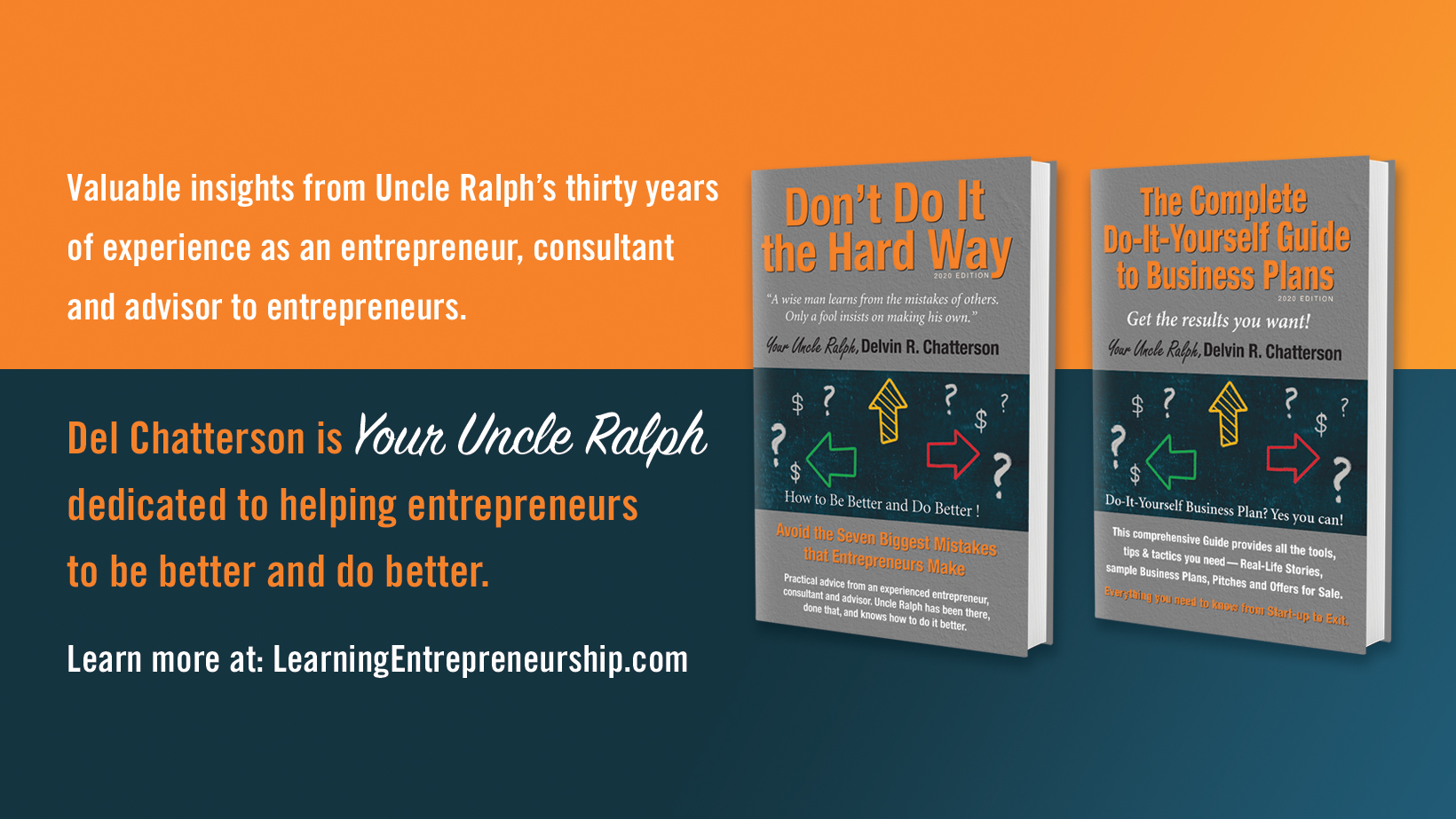
Like the Random Ramblings of Uncle Ralph in my book of advice for entrepreneurs, Don’t Do It the Hard Way [shown on the left], I strongly believe in the value of learning by sharing stories and ideas with my fellow adventurers in life, business and investing. Based on my experience in successfully growing an investment portfolio over several decades, these are my suggestions for your consideration.

Start with educating yourself. Learn from the experts. Read Warren Buffett’s bible, the Intelligent Investor by Benjamin Graham, to understand the basic principles of investment analysis and value investing. (The technical details may be beyond your understanding and are probably more than you need or want to know.) Look at current recommendations and valuation assessments of competent financial analysts to understand their processes and the factors that most affect future prospects for any business. You’ll discover that while there may be consensus, there is never unanimity. Learn to evaluate businesses against the criteria used to identify the top performers in Built to Last and Good to Great by James Collins and Jerry Porras. You will gain confidence and learn to trust your own analysis and instincts to select investments in businesses that you also understand, like and respect. Would you buy from this company? Would you like to work for this company?

Start to build your self-managed portfolio with an online direct-investing resource. You may choose to gradually transition from your current advisor or financial planner as you gain confidence, before deciding whether or not the results justify their fees for portfolio management services. You may decide not to interfere with their good management and avoid taking on the responsibility of managing your own portfolio.

Although I’ve been satisfied with my own portfolio management, I’ve still left some of the family portfolio with an investment advisor. I don’t want all the financial responsibility and it continues to give me a convenient comparative benchmark and resource for evaluating my own portfolio management. But if you’re confident in your knowledge and analysis and in your ability to remain calm, cautious and patient through the inevitable crises and extended downturns, then you’re ready to take charge and do it yourself for some of your investment portfolio.

At this point, the decision depends on your confidence, interest and ability to achieve better performance at lower cost. Although, the rationale for assuming management of a self-directed portfolio can range from loving the challenge and the learning experience to the thrill of taking risks and enjoying the entertainment spectacle of volatile and irrational markets.

If you do decide to start building and managing your own portfolio, it is essential to give yourself some key ground rules related to risk and return, just as you would give your risk tolerance profile and return expectations to your financial planner. Control your impulses with restraining limits on the amount of individual investments and the criteria for risk-reducing diversification. My two overriding guidelines: never more than ten percent of the portfolio in any one investment and never less than fifteen distinctly different investments. Continue Reading…

3 ways to build your Finances with minimal sacrifice

Image by Pixabay

Gary Bordeaux

Special to the Financial Independence Hub

Money is an ever important facet of living in human society. As they say, “money makes the world go ‘round,” but it often seems like your bank account is never full enough to meet all your needs, let alone desires. However, there are methods available to help the average person get ahead of the curve to improve their finances and otherwise build their dream lives. Here’s what you need to know.

Financing Luxuries

When thinking of financing, one tends to think of a house or a car. This service has been integral in providing the working class with things that are necessary but prohibitively expensive for quite some time. However, there are other scenarios in which financing expensive products can be the best way to balance smart financial decision making with living your best life. For example, you can finance swimming pools to get the summertime recreation and relief you desire without spending a fortune on it in the moment. By spreading that cost out over time, you can bring your vacation to you without breaking the bank. This principle can also apply to many high end electronics, such as iPads, and it can also apply selectively with general retail products via layaway programs. Using these methods, you can gain the advantages of living beyond your means without actually taking the risk of doing so.

Reducing Costs

One of the most important methods of saving money is by spending less. Some might argue that refusing to spend money on creature comforts and luxuries is the right choice, that is only partially true. While some luxuries can be eliminated, those that enrich your life are important to maintaining mental health. Instead of making meaningful sacrifices, costs can be cut by simply buying less expensive alternatives to costly staples. Name brand products often fill that role, but you can often get the same value at a lower price by choosing off brand products instead. Continue Reading…

Three things you and I don’t know about Investing

By Steve Lowrie, CFA

Special to the Financial Independence Hub

There’s never a lack of commentary on what we know about investing: or at least what we think we know. Experts and amateurs alike love to opine on the subject.

For a change, let’s cover three things we don’t know about investing, and how to use our “ignorance” to become better investors.

1.) We don’t know what tomorrow will bring

What’s money for? It’s for funding everything you would like to consume in your lifetime (and bequest to your heirs). The catch is, none of us knows exactly how our lives and financial positions are going to unfold. In How To Think About Investment Risk,” Professor Ken French describes this risk as “uncertainty about lifetime consumption.”

Because we don’t know what lifetime risks we’ll be facing, or when we’ll be facing them, it’s best to build them into your investment strategy from the beginning. That way, you’re already as ready as possible when they do occur. It’s why we suggest maintaining liquid lifestyle reserves, balancing your portfolio between stocks and bonds, diversifying across broad market risks, and buying insurance to safeguard your most valuable consumables.

2.) We don’t know ourselves 

Another common blind spot is how often our subconscious thinking tends to drive our supposedly deliberate decisions. In his book of the same title, Nobel laureate Daniel Kahneman calls this Thinking, Fast and Slow.” Fast thinking keeps us alive in an emergency. Slow thinking helps us solve complex equations. By realizing you’re usually thinking on two levels, you can build this into your planning, particularly when balancing risks and expected rewards.

For example, Kahneman describes how people are inherently loss averse: We usually hate losing money about twice as strongly as we enjoy making money. You can leverage this hidden bias (along with basic math) to create an appropriate investment balance between the risks and expected rewards you choose to invest in. For example, would you bet your entire life savings on a 70% chance of doubling your money, but a 30% chance of losing everything? Most people wouldn’t take that bet, as the downside would seem too severe.

By acknowledging our hidden “fast thinking” tendencies, we stand a much better chance of sensibly building its influence into the financial choices we face.

3.) We don’t know what we don’t know

Ever heard of “the Dunning-Kruger Effect”? It’s a fancy term for describing how people who are less familiar with a subject tend to be more confident about their understanding of it than someone who is an expert in the same.

This MindfulThinks video describes how the effect works by comparing a college basketball fan to an actual player. An ardent fan may believe they know almost everything about the game, while the player may feel they’ve only mastered half of its intricacies. Why the disconnect? The player’s deep, hands-on experience leads to a more realistic assessment of everything there is to know about the sport. In contrast, the fan is blissfully unaware of huge gaps in their second-hand understanding. Continue Reading…

Investing ― not Speculating ― in Growth

Image courtesy Franklin Templeton; iStock

By John P. Remmert, Franklin Global Growth Fund

(Sponsor Content)


Growth stocks attract a lot of attention, especially when momentum markets take share prices to heartpounding new heights. But as growth investors ourselves, we think many investors may be missing the point.

A single-minded focus on momentum is little more than speculation. If you want to invest in growth, rather than simply speculate, sustainable earnings are the key to unlocking value.

Stocks are the longest-duration assets in the capital markets. It may be several years until a stock’s value is fully realized, and as the COVID-19 pandemic has starkly reminded us, a lot can change in the meantime. We think it’s important to develop a mindset with a long time horizon and we seek to own the stocks of attractive companies that will benefit from the secular shifts that we think will shape the fortunes of businesses for many years to come.

Technology crosses all sectors

Technology is increasingly at the core of every business, not just those in the technology sector. If anything, the COVID-19 pandemic has simply sped up adoption of existing trends like ecommerce, machine learning and big data analytics. Health care, especially drug discovery, has surged forward with the rise of machine learning, like the biotech company we’ve owned for years that is now at the cutting edge of COVID-19 drug treatments with an antibody therapy that could help reduce symptoms in severely ill patients.

Within the information technology sector itself, we have invested in many US companies, as they tend to be global leaders with good corporate governance. But when we look at the pervasiveness of technology in other sectors, we find great opportunities in other countries and regions, like the South American stock we bought 10 years ago when ecommerce was non-existent; today the company is a market leader in ecommerce and has developed its own payment and shipping services to facilitate transactions.  Or the education company in China that was able to quickly move their business online when the pandemic hit, because they had been methodically investing in their online offering for years.

Supply chain links surprisingly strong

Although the pandemic and global trade tensions have put supply chains in the spotlight, in the long run, globalization still produces the best products at the cheapest price for the consumer. Continue Reading…

Should investors “go defensive” in uncertain times?

Lowrie Financial: Richard Clark, Unsplash

By Steve Lowrie, CFA

Special to the Financial Independence Hub

Lately, the wisdom of having adequate cash reserves has been painfully hitting home for many investors. Sometimes, it has spurred attempts to fix the issue as soon as possible by “going defensive.” During this year’s booms and busts, investors have been asking me:

“With all the bad news, stock markets seem overpriced.
Should I sell some of my stocks and use the proceeds to become more defensive?”

Market-timing by any other name

You probably don’t remember, but back in 2018, we used a modest market downturn to remind everyone how important it is to have enough liquid cash to ride out market storms.  Today, let’s tackle how to create those comforting reserves to begin with.

There’s never a bad time to build more cash reserves or similar safe harbour holdings if your investment plan calls for it.  However, I would not advise reducing your position in stocks and going to cash simply because markets seem too hot to handle.  This is just another form of market-timing

Whether the strategy is successful depends more on random luck than evidence-based reason.

Here’s a powerful new video from Dartmouth Professor Ken French (the “French” in the Fama/French 5-Factor Model) with several reasons why this sort of market-timing is so difficult.  He concludes, “Most investors shouldn’t try to time the market.  When they do, they’re simply spending resources to move away from a better portfolio.”


Deliberately defensive investing

So, how can you shore up your cash reserves?  If you happen to receive a windfall of cash next week, congratulations!  Problem solved.  More realistically, you’ll need to extract the reserves out of your carefully structured portfolio, while keeping its overall asset allocation intact. Continue Reading…

Powered by the Financial Independence Hub.
© 2013-2026 All Rights Reserved.
Financial Independence Hub Logo

Sign up for our Daily Digest E-Mail!

Get daily updates from the FindependenceHub.com straight to your inbox.