

 Posted By
My latest MoneySense Retired Money column has just been published and is available via this hyperlinked headline: AI for Conservative Investors.
The subject was how conservative investors and retirees can participate at least partly in the AI investing boom, allaying some of their FOMO (Fear of Missing Out) while also remaining sufficiently diversified that any popping of the alleged AI Bubble would not severely damage their long-term Retirement prospects.
Readers of Findependence Hub had the chance to view the webinar because we three times provided advance notice that this site was conducting the webinar in association with The Successful Investor/TSI Network. TSI founder and CIO Patrick McKeough contributes guest blogs to this site roughly twice a month.
The MoneySense column constitutes my initial reporting on the webinar. As I note there. from where I sit — well into RRIF age — AI is a theme young investors have little choice but to embrace, at least in part. Growth is the preferred strategy for those just starting their investing careers, particularly for TFSAs. And if any transformative innovation seems poised for major growth in the long term, it seems to be A.I.
But for those in the Retirement Risk Zone, there is potential danger in jumping whole hog onto the AI bandwagon, even if it should not be ignored as a key growth play for the “satellite” portion of a portfolio, as opposed to the “core” of a well-diversified global portfolio.
A more cautious approach to investing in AI
The Successful Investor’s approach to investors partaking in the AI revolution is suitably cautious. Enthusiastic investors may see new ideas sparking market excitement and huge growth potential, the webinar warned, but they may also overlook the risks of unexpectedly longer-than-expected profitability or the fact that new innovations may disrupt existing businesses. As for the pure AI stocks and start-ups, some certainly promise major upsides and some will succeed but history shows that “most will struggle or fail … as they always have in venture capital and junior stocks.”
Fortunately for conservative investors, there may be no need to experience FOMO about missing out on the IPOs of SpaceX or (soon), AI start-ups like OpenAI or Anthropic: “The biggest gains from AI will come from investing in established businesses that are already profitable and growing,” said TSI account executive Bob Wiseman, “They will profit by developing AI and its applications to their customers; that’s on top of applying AI to streamline their operations.”
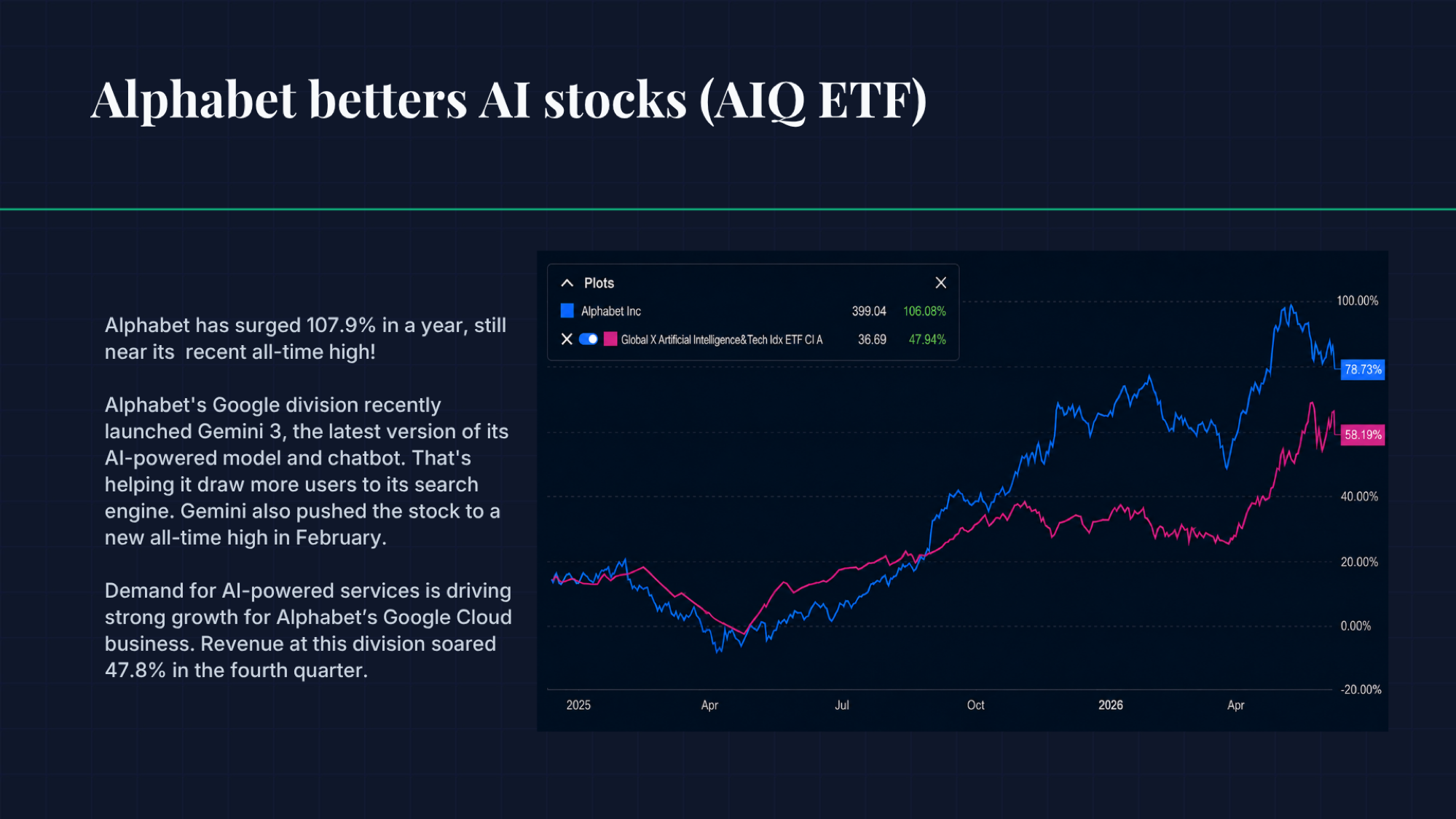
Indeed I was struck by one slide (shown immediately below), which showed conservative investors may be better off sticking with the big names that leverage AI, including the so-called “hyperscalers”, rather than the lesser known pure-play AI start-ups. It showed that the one-year performance of one AI ETF (AIQ/Nasdaq) was relatively flat, while household names like Intel were up more than 500%. Similarly, AIQ was trounced by such long-established companies as Alphabet and Cisco Systems. During the period, Alphabet was up more than 100%, versus 47% for AIQ, and Cisco was up almost 83%.
All this serves as a textbook example of why seasoned investors may want to adhere to the three three main principles long espoused by TSI founder and chief investment officer Patrick McKeough: invest primarily in established, dividend-paying companies; diversify across the five main economic sectors (manufacturing and industry, resources and commodities;, Consumer; Finance and Utilities); and Avoid stocks in the Broker/Media limelight. The last goes double for “AI start-ups without a history of solid revenue, earnings and preferably dividends.”
Wiseman says this approach has stood the test of time: “It has weathered and continues to weather AI Volatility. “While many of our AI stocks fell with the broader markets, they were in many cases the quickest to recover, with some moving up even as other ‘AI stocks’ fell on AI Bubble fears.”
