

 Posted By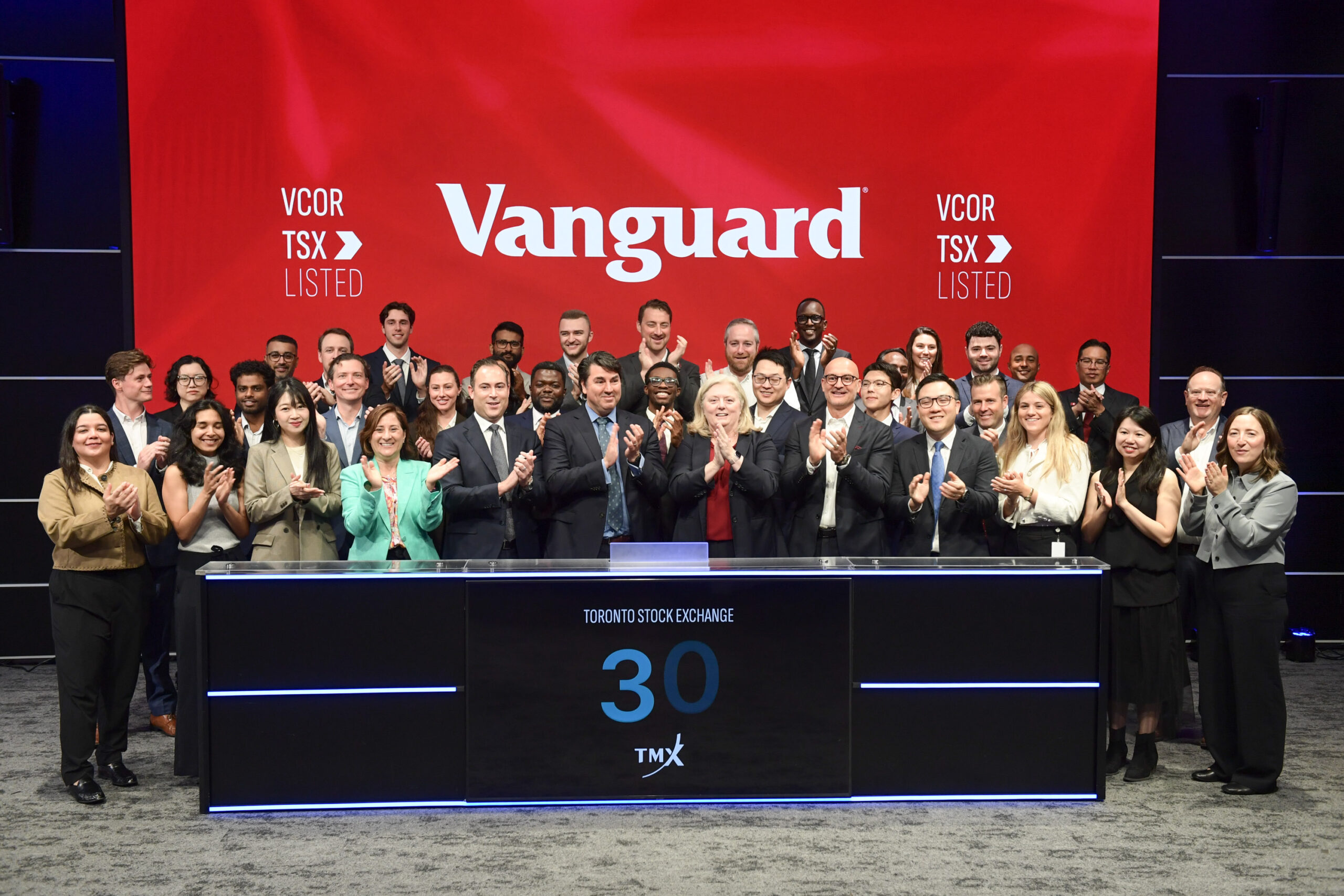
Yesterday, Vanguard Investments Canada Inc. announced the launch of what it says is its first actively managed fixed-income ETF: the Vanguard Global Core-Plus Bond ETF (TSX: VCOR). VCOR began trading on the Toronto Stock Exchange on Wednesday (Sept.9, 2026), where Vanguard opened trading for the day (as shown on left.)
The new ETF was a major focus of one of two major presentations at Vanguard Canada’s annual Global Insights Forum, held in Toronto at the Royal York Hotel. The other was billed as Megatrends, AI and Market Implications.
In a press release, Vanguard Capital Management CIO and Global Head of Vanguard Fixed Income Group Sara Devereux described VCOR as being part of the firm’s push to make Vanguard’s specialized fixed-income capabilities accessible to more investors. She said it “combines the resources of our global investment platform, a disciplined active process, and broad diversification across fixed-income markets in a single ETF.”
It aims to provide investors and their financial advisors with an “actively managed, single-ticket fixed-income solution at a low management fee of 0.25%.” While the “core” allocation is to investment-grade bonds, it also invests in global rates, credit, and securitized markets, along with a “plus” component that allocates to higher-yielding bonds. Depending on markets, investors can expect allocations of between 20% and 50% for investment-grade credit; 0 to 20% U.S. treasuries/agency; 10 to 35% mortgages; 5 to 20% Emerging Markets debt and 0 to 20% high-yield corporates. The fund seeks to hedge its U.S.-dollar currency exposure back to the Canadian dollar and plans to pay monthly distributions.
Sal D’Angelo, Head of Vanguard Canada, said active ETFs have experienced significant growth in Canada and now account for roughly a third of Canadian ETF assets: “We continue to see strong advisor and investor demand for active global fixed-income solutions that offer broader diversification and access to a wider opportunity set.”
Bonds becoming more important for financial advisors as well as their clients

At the Forum on Wednesday, the new ETF was the focus of a presentation by Vanguard principal and senior portfolio manager Dan Shaykevich (pictured on right). Fixed income is once again playing a central role in investor portfolios, he said. As Canadian financial advisors prepare for CRM3 (Client Relationship Model Phase 3), it will also play a more important role for advisors too. The fund taps one of the world’s largest Fixed-Income money managers: Vanguard’s global fixed income team manages US4.2 trillion in assets under management, including C$30 billion in Canadian Bonds. It’s supported by more than 20 portfolio managers, 35 traders, 50 credit researchers and at least eight quantitative analysts.
Generally speaking, financial advisors tend to spend more time with clients on equities than on Fixed Income, Shaykevich said, “even though Fixed Income may be 20 to 40%” of advisors’ money under management.
Marketing materials distributed at the event included an insert on Fixed Income Investing reminding investors that bonds can complement the growth potential of equities by providing stability, generating income and supporing diversification.
The insert lists several already existing Canadian Index-based Fixed Income ETFs. They include:
VAB: Vanguard Canadian Aggregate Bond Index ETF.
VGV: Vanguard Canadian Government Bond Index ETF.
VSB: Vanguard Canadian Short-Term Bond Index ETF.
VCB: Vanguard Canadian Corporate Bond Index ETF
VSC: Vanguard Canadian Short-Term Corporate Bond Index ETF
VVSG: Vanguard Canadian Ultra-Short Government Bond Index ETF
In addition to the above Canadian Bond index ETFs, Vanguard Canada also provides three global bond index ETFs:
VBG: Vanguard Global ex-US Aggregate Bond Index ETF (CAD-hedged)
VBU: Vanguard U.S. Aggregate Bond Index ETF (CAD-hedged)
VGAB: Vanguard Global Aggregate Bond Index ETF (CAD-hedged).
The above list of fixed-income ETFs does not include Vanguard’s Asset Allocation products, which combine equities, fixed income and occasionally other asset classes. I’m thinking of balanced ETFs I own personally, including VBAL (60/40 stocks/bonds) or the newer VRIF, which has been as much as 70% in fixed income and is aimed at generating income for retirees. Presumably those products too will benefit at least indirectly from the active management expertise generated by the VCOR team.
