All posts by Financial Independence Hub

Millennials and Gen Z struggling with debt but open to finding solutions

BDO Affordability Index Spring 2023 (CNW Group/BDO Canada LLC)

By Jennifer McCracken, BDO

Special to Financial Independence Hub

The cost of living has spiked significantly in the past year and Canadians across the country are feeling the pinch. Younger Canadians between the ages of 18 and 34 are particularly affected, having not had the chance to build up as much savings as older generations.

BDO’s newest Affordability Index shows that 45% of young Canadians say their debt load is overwhelming and they’re unsure how to tackle the problem. That’s higher than those between the ages of 35 to 54, where 39% say they’re in that situation and significantly larger than the 13% of Canadians between the ages of 55+ who feel the same.

Credit-card debt appears to be the main reason younger Millennials and Gen Z are falling behind, with 37% of 18-34 year olds saying this form of debt causes them the most stress. Mortgage debt and student debt were the next closest reasons, with 22% for the former and 21% the latter.

What are Canadians doing to cope with inflation and rising debt?

It’s not surprising then that 49% of younger Canadians say they’re reducing their living expenses to cope with inflation and the high cost of living, while 32% say they’re lowering how much they contribute to savings as well.

While younger Canadians may be struggling more than their older counterparts, they’re also more open minded when it comes to finding solutions.

The Affordability Index indicates that younger generations are much more willing to look for new streams of revenue compared to older ones. Some 24% say they are adding part-time work to keep up with inflation, compared to just 13% of 35-54-year-olds and only 5% of those 55 or older.

Young Millennials and Gen Z would also find side hustles and gig work to increase their income. Of those doing this, 35% said it was to help them pay for essentials and 27% say it’s to help them pay down debt.

It’s not just part-time and gig work that younger Canadians are using to fight inflation, they’re also looking for higher paying jobs. A total of 13% say they’ve recently found a new full-time job in response to the affordability crisis. That’s compared to just 7% of those aged between 35-54 and only 1% of those 55 and older.

However, while younger generations are keen to seek out new ways to increase their income, they’re very unfamiliar with many of the most common debt relief options available.

A lot of people just don’t know what their debt relief options are  …

Only 19% of them said they were familiar with the idea of bankruptcy, 11% said they know what a debt management plan is and 9% with a debt consolidation loan. Continue Reading…

The Value of Advice


John DeGoey, CIM, CFP

Special to the Financial Independence Hub

Since I’m an advisor myself, it should be obvious that I am a strong proponent of quality financial advice.  The concern that I have is that within my own industry, the financial media has taken that perspective a step further and is moving toward boosterism that is almost jingoistic.  There are two things that the ‘for advisors only’ media seems to gloss over.  In both instances, the short shrift is because a more fulsome discussion might be awkward for certain elements of the industry.

The two things “Advisors Only” media gloss over

The two issues are:

1.) The distinction between good advice and bad advice. This is admittedly subjective, but the media doesn’t ever seem to venture into making a distinction because it seems unwilling to alienate a segment of the advisor population.  Surely to goodness, not all advice is good advice and not all advisors are good advisors.

2.) The ongoing focus on the cost and value of advice while simultaneously and conspicuously remaining silent on the cost and value of investment products. Clients pay for both advice and products, so why explore one aspect ad nauseum while saying almost nothing about the other?

Let’s begin by looking at the touchy subject of what constitutes good advice in the first place.  Obviously, there is no single best set of answers to this matter.  Continue Reading…

Less than Half of Canadians have a Will and many don’t even know where to start: NIA

By Mark Venning, ChangeRangers.com

Special to Financial Independence Hub

Following Canada’s National Institute on Ageing (NIA) since their beginning in 2016, it’s been a year since I last commented on the value of the NIA as a knowledge resource for Canadians on topics related to ageing and longevity.

And I would say, their regular reports, generated often in collaboration with other groups, are also a resource for anyone engaged in comparative research outside this country.

Now here’s today’s feature on one report from the NIA files from 2023 so far

Where There’s a Will, There’s a Way: Exploring Canadian Perspectives on Estate Planning.

When I first received my NIA email notification of this report on May 17th, I was not surprised in the least by the lead headline: “Less than Half of Canadians Have a Will – and Many Don’t Even Know Where To Start.” For over twenty plus years, back when I was working in partnership with financial planners to deliver seminars on later life transitions, this was always a commonly known fact, and most people who didn’t have a Will knew that they should have had one.

The April 2022 Ipsos survey for this NIA report was conducted in collaboration with RBC Royal Trust. As the report details, it all starts with overall Estate Planning, and this includes setting up a Will, Powers of Attorney (POA) for care and property and, what was less discussed twenty years ago, Advanced Care Planning. As it happens my Will and POAs are ready for some small updating, but this time advanced care will also be on the agenda.

So if, as the report suggests, people know the value of planning and the subsequent sad consequences from not doing so – what’s the reason for inaction? I recall facilitating group conversations where literally some have said things like “if I do a Will, I know fate will bring me an early death” or, “I don’t have enough of an estate to worry about.” Of course the other concern I heard was about the perceived high cost of legal fees which halted the move to getting to the matter.

How fortunate for me, straightforward household budgeting and for that matter, estate planning Wills and POAs were things I learned early on at home from my parents, not from the education system. Today, learning from professionals in these topic areas should not be that intimidating or made difficult to access. Regardless of your age, picking up this report would be a great start. Continue Reading…

A Self-Checkup on your Financial Health to help your Mental Wellbeing

Image courtesy FPCanada


By Sahar Abdul Zahir, BlueShore Financial

Special to Financial Independence Hub

Many people view money as simply numbers that get you from point A to point B, and may not make a connection between how finances can also impact mental and physical health. However, FP Canada’s 2022 Financial Stress Index survey found that 38% of Canadians believe finances are their biggest source of stress, ahead of both health and relationship issues. More alarmingly, FP Canada’s study also found that 43% of respondents had lost sleep over financial anxiety.

There are a variety of reasons why many of us do not seek professional advice for our financial problems, ranging from not thinking we need the help, to being embarrassed, or not knowing where to go. Regardless of the reason, there is a clear link between finances, anxiety, stress, and mental health, and avoidance of the problem is not the answer. The good news is, there are many steps you can take today to help get yourself back on track.

Understand your relationship with money

Many people still believe that talking about money is taboo, or feel embarrassed to discuss financial troubles, even with a professional. Financial literacy should begin at an early age and continue as a lifelong learning process. Having an open dialogue around finances and money management as a family can be a good thing as your experience with money, or lack thereof, in your childhood can impact your attitude and emotions towards money later in life. Make note of impulse buying behaviour and what may trigger it: perhaps a hard day at work, or an argument with your partner. Understanding these spending patterns will allow you to find better ways to manage these stresses and adjust accordingly.

Financial health checkups

Just like doing a regular physical health checkup, having periodic financial wellness checkups is important for detecting any areas that you should focus on. This can be done by completing a thorough audit of finances, budgets, and plans with an advisor. An annual checkup can help you better prepare for the future and minimize the impact of any surprise events. Also utilizing online advice tools such as BlueShore’s Financial Wellness Checkup tool can help get you started, by providing an assessment of how you are doing, and advice on where you need to improve along your path to financial wellness.

Small cuts for long-term impact

We have all heard the latte-a-day and avocado toast analogy. While these items can seem like small expenses that are not likely to make a big impact on our overall financial health, they are really representative of our spending habits. Cutting out your morning coffee is not going to make you wealthy, but you may have some ongoing small expenditures that quickly add up and could affect your long-term financial goals. Continue Reading…

The superiority of Canadian “Robo Advisors” over mutual funds

By Dale Roberts, cutthecrapinvesting

Special to Financial Independence Hub

This is a battle between lower-fee Canadian Robo Advisor portfolios vs high-fee Canadian mutual funds. As you are likely aware, Canadians pay some of the highest investment fees in the world. Larry Bates, the author of Beat The Bank, calls those fees wealth destroyers. Lowering fees is one of the most predictable ways to increase your investment returns. More money stays in the right pocket; your pocket. By way of the Questwealth Portfolios (from Questrade) let’s have a look at the superiority of Robo Advisors over Canadian mutual funds.

Here’s the review of Larry’s Beat The Bank. That is a must read. On Larry’s site you will also find a tool that will calculate the cost of high investment fees.

The Questwealth Portfolios

There are three simple ways that Canadians can leave behind their advisor and high fee mutual funds. If you want investment advice and managed global ETF portfolios, you can look to one of the Canadian Robo Advisors.

Here is a post on what is a Robo Advisor? As you’re about to discover, this is a far superior approach to a typical high-fee mutual fund. Also consider that most high-fee mutual funds in Canada are offered by salespersons and not ‘real’ advisors.

Questwealth is one of the Canadian Robo Advisors. And don’t be fooled by that Robo word. While you can choose to do everything online from start to finish, real humans are available for investment advice and guidance. And at a shop such as Justwealth you’ll have a dedicated advisor, with financial planning available.

You can have it all in a low-fee environment.

Not investing with Mom and Dad’s guy

Questwealth offers the Questwealth Portfolios. They are the lowest fee Robo offering in Canada. And they are famous for their advertising. Many younger Canadians are not following their Mom and Dad, running into the bank, Investor’s Group or AGF (or other mutual fund sales shop) to fill the pockets of advisors and mutual fund creators. Nope, they are learning how to self-direct and how to take control of their own wealth building destiny.

In one commercial the younger brother turns to his embarrassed older bro and offers …

You’re not still investing with Mom and Dad’s guy, are you?

It’s nice to see many Canadians become their own advisor. Keep that 2% or more in your own pocket. You’ll need bigger pockets, by the way.

Questwealth Portfolios vs Canadian mutual funds

Questrade suggests (based on the simple fee math) that over time Canadians could retire 30% wealthier. That said, it’s a much greater benefit than that 30% suggestion. Based on the return differential to date, you’d be looking at returns that are 50% better (or more) over a 30-year period. Retiring with 50% more is obviously life changing.

And of course, a 5-year performance is a shorter period, but it aligns with the known underperformance of high-fee actively-managed Canadian mutual funds.

Also, past performance does not guarantee future returns.

You’ll find a calculator on their site.

Here’s the Questwealth Portfolios vs typical or average mutual funds in Canada, to the end of February 2023. The mutual fund returns are based on Questrade calculations, looking at the available data for the mutual fund space. That list and returns for the individual mutual funds was also provided to me.

And here’s Questwealth vs the RBC Select balanced mutual funds.

And here is a post that looks at Justwealth vs Canadian bank mutual funds.

The outperformance is outrageous.

Ditch your high-fee mutual funds

It appears to be a no-brainer: ditch your high-fee Canadian mutual funds. If you decide that a Robo option such as the Questwealth Portfolios is right for you, you’ll find it is an easy process to make the move. They can help you with the transfer process.

Here’s the link to Questrade.

But please pay attention to any tax consequences should you have any taxable accounts. You might consider Justwealth if you need to transfer considerable taxable amounts. They can accept your taxable account mutual funds and will drawdown the assets over time in a tax-efficient manner.

Create your own ETF Portfolio

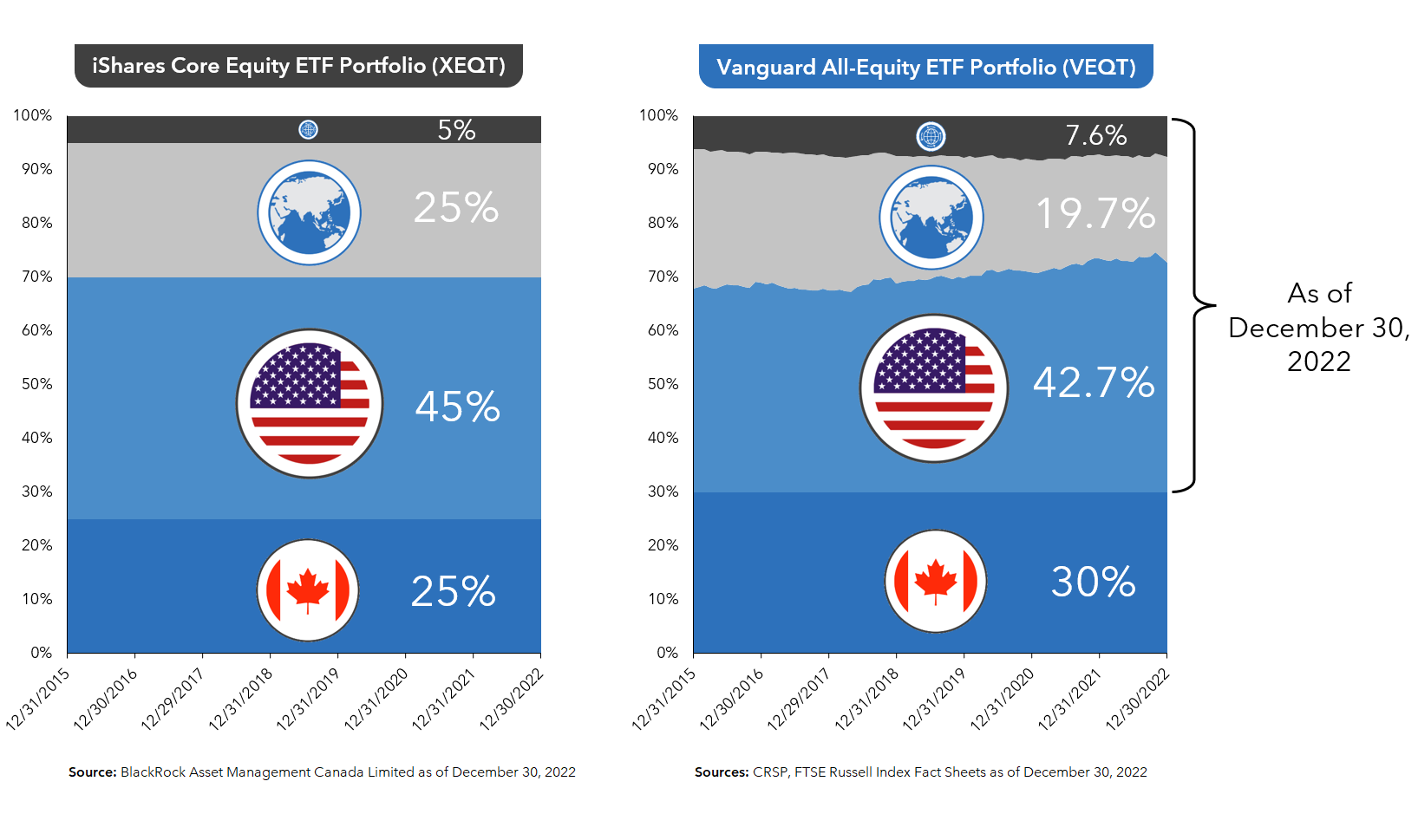
If you want to leave your mutual funds behind, you can also create your own ETF portfolio. Here’s the performance of the core ETF portfolios.

Continue Reading…