

 Posted By
 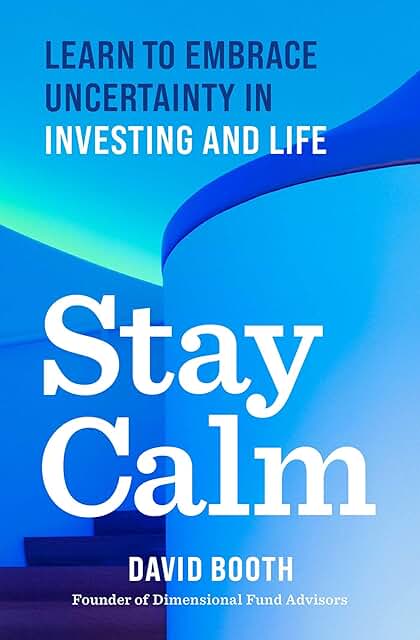 As we telegraphed in the September installment of my MoneySense Retired Money column, this month’s column is a book review of David Booth’s Stay Calm, published early in September. For the full review in the October column, click on the highlighted headline: The calming genius of passive investing.
David Booth is founder of Dimensional Fund Advisors (DFA), maker of DFA Index Funds and DFA ETFs. I have long invested some of our family’s money in DFA funds, along with many of the other usual indexing suspects.
They are famously champions of taking a passive set-it-and-forget it approach to investing while minimizing the noise of what they have dubbed “financial pornography” propagated by traditional and social media, and the self-appointed experts who claim they can pick individual stocks or consistently time the markets.
As someone who takes a decidedly hybrid approach to investing in ETFs in various asset classes, — and occasionally indulging in a bit of high-conviction “index skimming” — I found Booth’s Stay Calm to be a refreshing reminder of the sound principles that underlie DFA.
Those who need a refresher on the virtues of passive investing will not be disappointed but as the book’s subhead implies, there are also quite a few lessons about embracing uncertainties in life in general, as well as investing in particular.
Stay Calm was published early in September by Authors Equity and is aptly subtitled “Learn to Embrace Uncertainty in Investing and Life.” The book is divided into three main parts. Part 1 is on the science of investing and covers the Gift of being an Outsider, how Markets work and how to harness public markets. Part 2 is titled “The Mindset to Stay Calm” and the four chapter titles all make for excellent bullet points; Flexibility is the key to navigating Life’s Uncertainties; Don’t Predict, Plan; Control what you can control and manage what you can’t; and Tune out the Noise.
The meat of the book is part 2, which starts with a reminder that the whole DFA indexing concept began with the idea that public markets, when left to do their work, usually reward long-term investors. The pioneering research by financial academics like Gene Fama and Ken French proved that “a broadly diversified, low-cost investment approach makes sense.” Gene Fama coined the term “efficient market” in 1965 in a University of Chicago paper titled Random Walks in Stock-Market prices.” Booth explains that the Efficient Market Hypothesis means investors can accept prices in public markets (notably U.S. stock and bond markets) as being correct. And as Fama explained at the time, “prices change as new information comes into the market.” (Fama and French and many others have all worked for or with DFA at some point in their careers.)
Chapter 2, How markets work, describes how research built around Chicago’s Center for Research in Security Prices (CRSP) showed just how high market returns actually were. U.S. stocks earned an annualized compound return of 9% per year from 1926 to 1960, before taxes. Booth says that was “a lot higher than most people expected.” More to the point, it was also “greater than what had been achieved by most Wall Street money managers who were charging high fees.” Even as the actively managed priesthood tried to downplay these findings, the data got even better for the indexing crowd: From 1961 to 2025, the return has been 10.7%! And it’s 10.2% for the hundred years between 1926 and 2025.
Over time, the market as a whole goes up. Booth estimates the reward for sticking it out over the long term is hugely rewarding: “$100 invested in the stock market in 1960 would be worth $75,800 today … Markets do the work so you don’t have to.”
Tune out the Noise
As we noted a month ago in this space, the main principles of the DFA approach to investing is to keep costs low by minimizing trading and using passive investing vehicles like ETFs, and above all trust the markets over the long term while avoiding picking individual stocks and attempting to time financial markets.
 For the most part this means tuning out the noise from stock-picking and market-timing pundits disseminating their views 24/7 on mass media and social media. You should definitely check out a full-length documentary film which is all about DFA investing principles, with interviews from most of the founders and inner circle, including Ken French, Eugene Fama, Booth himself, Rex Sinquefield and many more. Produced by Errol Morris, it’s titled Tune out the Noise, and is available free on YouTube here.
