By Steve Lowrie, CFA
Special to Financial Independence Hub
Short answer: stock prices reflect what investors expect to happen in the future, not what the headlines are reporting today. Markets rise when outcomes turn out better than investors feared, even if conditions still look bad.
By the time a story feels alarming enough to act on, the market has usually already priced it in. That’s why reacting to headlines rarely works, and why discipline tends to beat prediction.
Every market cycle seems to produce the same question. The headlines are negative. Investors are worried. Economists are warning about risks. Yet the stock market keeps climbing a wall of worry. How can both things be true?
It’s one of the most common investing questions I hear, and it usually sounds something like this:
“I don’t understand it. There’s a war in the Middle East. Governments are running massive deficits and have accumulated huge amounts of debt. Economists keep warning about recessions. Every day the news seems filled with uncertainty and risk. So why is the stock market near record highs?”
It’s a fair question, and if you’re asking it, you’re not alone. The answer comes down to one of the most important concepts in investing:
Markets Live in the Future
That may sound like a strange statement at first. After all, investors own businesses that operate in the real world today. Shouldn’t stock prices reflect what’s happening right now?
To a degree, they do. But the value of any business depends far more on the profits it’s expected to earn in the future than on the profits it earned last quarter. Every day, investors around the world are trying to answer the same question: what are those future profits worth today?
To answer it, they evaluate interest rates, inflation, economic growth, corporate earnings, government policy, geopolitical risks, and thousands of other pieces of information. As those expectations change, stock prices change. That’s why stock prices often seem disconnected from the headlines, and it’s where many investors get tripped up.
We naturally assume stock prices should move in response to what’s happening in the economy today. If growth slows, unemployment rises, or geopolitical tensions increase, it seems reasonable to expect stock prices to fall. But there’s an important distinction.
Most financial news and economic data tell us what has already happened. In many cases, that information is weeks or even months old by the time it’s reported. The stock market, on the other hand, is constantly trying to estimate what happens next.
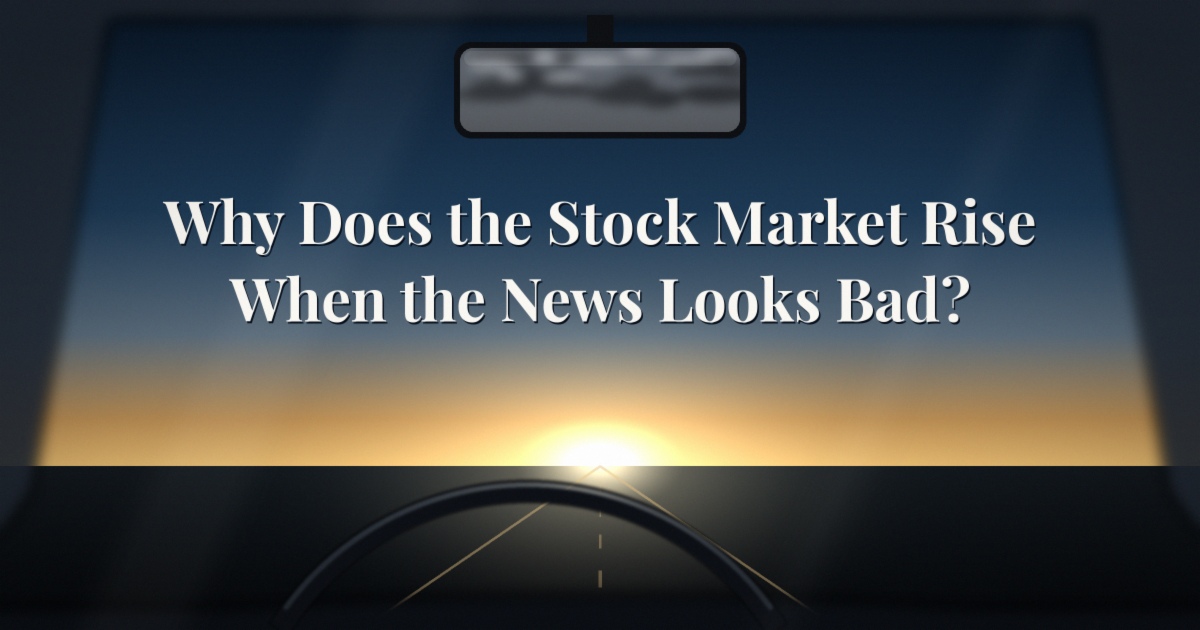
I often think of financial news and economic data as a rearview mirror. They help us understand where we’ve been.
The stock market is the windshield. Investors are looking ahead, trying to estimate what businesses, profits, interest rates, and economic conditions might look like in the future.
Once you understand that difference, it becomes much easier to see why headlines and market performance so often seem disconnected.
Why does the Stock Market Rise when the News Looks Bad?
One of the biggest misconceptions in investing is that markets move based on whether news is good or bad. In reality, markets tend to move based on whether outcomes are better or worse than expected. That may sound like a subtle distinction, but it’s an important one.
Imagine investors become convinced a severe recession is coming. Businesses prepare for it. Economists forecast it. Investors position their portfolios for it. If the economy ultimately experiences only a mild slowdown, stock prices may rise even though conditions look bad. The outcome wasn’t necessarily good; it was simply better than investors feared.
The opposite happens all the time too. A company can report record profits and still see its stock price fall, because investors expected even better results. Markets are constantly comparing reality against expectations.
That may sound abstract, but history gives us a powerful example. During the global financial crisis, stock markets reached their lowest point in March 2009. At the time, the news was still overwhelmingly negative. Unemployment continued rising. The economy remained weak. Many investors were convinced conditions would deteriorate further, yet the market began recovering.
Investors who waited for reassuring headlines missed a significant portion of that recovery, because the market wasn’t waiting for conditions to improve. It was already looking ahead to a future in which they eventually would.
Investors who wait for good news often discover that the stock market has moved higher long before the headlines improved.
That’s what I mean when I say markets live in the future.
What does “It’s Already Priced In” mean in Investing?
This idea also explains one of the most misunderstood phrases in investing. You’ll often hear investors say something is “already priced in.” What they mean is that the market has already incorporated known information into stock prices.
By the time most of us hear a major news story and start wondering what it means for our investments, millions of investors around the world have already evaluated that information and built their views into prices.
That doesn’t mean markets are always right. Far from it. Markets can be overly optimistic. They can be overly pessimistic. Prices can move too far in either direction. But current prices generally reflect the collective expectations of investors based on everything they know today. Put another way, they give the best available estimate of what a company is worth right now.
For prices to move significantly, something usually has to happen that differs from those expectations. That’s why major headlines often have less impact on markets than people expect. Investors aren’t reacting to the news itself. They’re reacting to whether the news is better or worse than anticipated.
Why is Market Timing so Difficult?
Once you understand how markets work, it becomes easier to see why market timing is so challenging. To successfully move in and out of the market, you have to do more than predict what will happen next. You also have to predict what millions of other investors expect to happen and then determine whether reality will turn out better or worse than those expectations. That’s an extraordinarily difficult task.
It’s one of the reasons decades of academic research have found that consistently outperforming the broad stock market is so difficult. Whenever someone tells me they believe the market has it completely wrong, I think it’s worth asking a simple question: who exactly are they betting against?
At any given moment, stock prices reflect the collective judgment of massive pension funds, sovereign wealth funds, hedge funds, insurance companies, analysts, economists, business leaders, professional investors, and millions of individual investors around the world. Could the market be wrong? Of course. But consistently identifying mispricing and systematically profiting from it before everyone else is remarkably difficult. Decades of evidence suggest very few investors do it successfully over long periods.
What is the Practical Lesson for Investors?
The practical lesson isn’t that markets are perfect. It’s that reacting to headlines is usually not a successful investment strategy. By the time a story feels important enough to make you want to change your portfolio, the market has often already processed that information and adjusted accordingly.
This is worth saying clearly, because it’s easy to take the idea too far. “It’s already priced in” is a reason to ignore the daily news cycle. It is not a reason to ignore your own plan. Rebalancing back to your target mix, adjusting your portfolio as your goals and time horizon change, and managing risk, taxes, and costs are all decisions driven by your circumstances, not by the headlines. Discipline doesn’t mean doing nothing. It means acting on your plan rather than on the news.
So this doesn’t mean investors should ignore the news. It means they should be careful about making investment decisions based on it. Successful investing is rarely about predicting the next headline. It’s about building a sensible portfolio, staying disciplined during periods of uncertainty, and focusing on your long-term plan rather than the daily news cycle.
The next time you find yourself wondering why the stock market is rising despite negative headlines, remember that investors aren’t just evaluating what’s happening today. They’re trying to estimate what happens next, and more often than not, the market begins looking ahead long before the rest of us do.
That’s why markets can reach new highs during periods that feel uncertain, uncomfortable, or even frightening. And it’s why some of the best investment decisions are often the ones that feel hardest in the moment: staying disciplined, ignoring the noise, and sticking to a well-thought-out plan when the future feels least certain.


 Posted By
 Dan Coconate is a local Chicagoland freelance writer who has been in the industry since graduating from college in 2019. He currently lives in the Chicagoland area where he is pursuing his multiple interests in journalism.