 Posted By
Happy New Year!


 By Mark Venning, ChangeRangers.com
Special to the Financial Independence Hub
Unless you have been hiding in a cave for the last couple of decades, you have likely heard more than enough versions of the dialogue and plays with words around the changing attitudes and approaches to the long-standing social construct “Retirement.”
Not to mention the numerous metaphors we have applied to interpret this later life transition from a full time working life to…whatever we think we should call it…whatever works for you. In this case, it’s a Victory Lap.
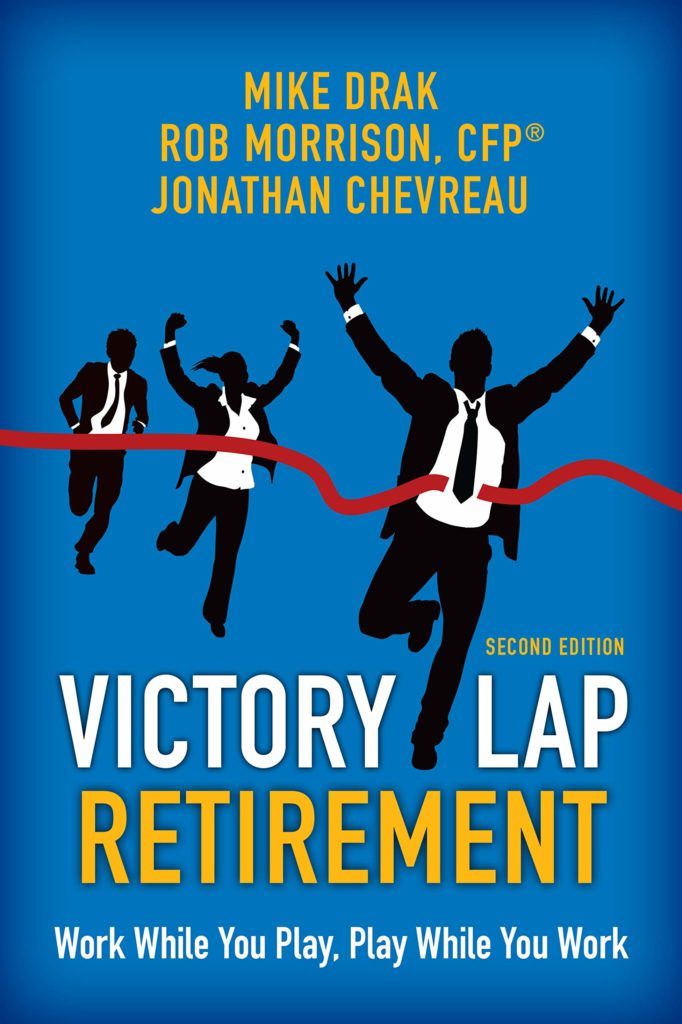
Exactly three years ago in a two-part blog post, I interviewed the then co-authors of the book Victory Lap Retirement: Mike Drak and Jonathan Chevreau, published October 2016. Now in May 2019, the second edition arrived. Based on the success of book sales for version one and some strong endorsements from a number of respected specialists and writers in the financial services field, this no doubt is good cause for this second round.
Beyond those reasons, I asked Mike Drak recently, “What prompted you to arrive at the 2nd edition and add a third contributor, Rob Morrison?”
Mike: “Our intention is to keep revising Victory Lap Retirement as we learn more from ongoing research and also from our own experiences. We added Rob Morrison CFP® as we wanted to release the book in the US and he could bring US expertise to the table as President of financial services firm Huber Financial Advisors, LLC, in Lincolnshire, Illinois. He is well versed with respect to Retirement.”
Smart decision, given the size of the US market and that fact that perspectives are not that much different between the US and Canada when it comes to older adults rethinking pathways in a later life journey. And in this manner, when it comes to co-authors working together as Mike Drak says, “We speak the same language and share the same beliefs that traditional full stop Retirement is a thing of the past and that we need to develop a better concept, one that will work today.”
As I mentioned in my 2016 post on the first review of Victory Lap Retirement, over my twenty years in the career services world, where I worked directly with business executives in their later life transitions – leaving the corporate crow’s nest, as I called it, since 2001 I produced three Retirement programs, delivered countless seminars and engaged many coaching conversations. Continue Reading…

By Barry Choi
Special to the Financial Independence Hub
Even as another holiday season has arrived and nearly gone, retailers are trying their best to get us to spend money at their stores. One way they hope to achieve this is by offering enticing rewards and promotions when you sign up for their store credit card. This is a great strategy for retailers, but it’s also potentially a good deal for you since store credit cards can help you pocket additional savings.
Since many people already have a credit card, does it make sense to sign up for a new store credit card? Like any other credit card, it really comes down to the pros and cons of the card and how it fits into your spending.
Instant welcome offers
Although the welcome offers that come with store credit cards aren’t as generous as some other cards out there, sometimes they’re worth paying attention to. For example, the Hudson’s Bay credit card gives you 10% off your first purchase. If you’re buying a big-ticket item, then it might be worth your while to sign up: especially if you shop from Hudson’s Bay on the regular card.
Unlike most credit cards, the savings offered by store credit-card promotions are also instant. You won’t have to wait several statement periods or spend a certain amount (i.e. $3,000 within three months) to access the offer.
What’s really attractive about store credit cards is their enhanced in-store rewards. This, of course, is only relevant if you happen to shop at the retailer on a regular basis.
For example, with the Triangle Mastercard, you’ll earn 4% in Canadian Tire Money per dollar spent at Canadian Tire stores. There’s no other credit card out there that can beat that return at Canadian Tire, so if the iconic retailer is a regular part of your shopping routine, you could stand to save big with this store credit card.
PC Optimum is another popular retail loyalty program in Canada. If you were to apply for a PC Financial Mastercard, you could earn up to 30 PC Optimum points per dollar spent at Loblaws-owned grocery stores and up to 45 points per dollar at Shoppers Drug Mart: a 3% and 4.5% return respectively. Those earn rates add up to considerable savings on your grocery and pharmacy bills, even compared to what non-retail credit cards offer.
What’s also appealing about store credit cards is that they often have low income requirements and there’s usually no annual fee: so they’re easy to get and free to carry. The reason retailers do this is so you’ll be more inclined to apply. For example, the Costco credit card from Capital One has no annual fee and the application doesn’t list a minimum income requirement.
Sometimes store credit cards offer special in-store benefits that can’t be ignored, such as Canadian Tire’s credit cards, which offer no interest financing up to 24 months that applies to qualifying purchases of $200 or more at participating stores.
Let’s say an emergency has come up and you’ve had to spend $600 at Canadian Tire. By taking advantage of the no-fee, no-interest financing, you’d only have to pay $25 a month for 24 months with no additional interest or fees. This is handy if you don’t have the funds available to pay off the purchase right away. Continue Reading…
 By Billy and Akaisha Kaderli, RetireEarlyLifestyle.com
Special to the Financial Independence Hub
Why do women lag in retirement savings as compared to men?
Are women at a disadvantage for reasons too numerous to list? Is it sexism? Are females not good savers? Big spenders? Is it really true that women get paid less for the same work performed? Is the world financially stacked up against women?
I read lots of articles noting all the reasons that “women have it harder” than men when it comes to saving for retirement. Regularly listed are the following:
Think outside the box
I don’t enjoy reading articles that tell me “statistically,” I’ll be settling for less and that I don’t have options. Or that “according to the numbers” – somehow – I am doomed to a mediocre savings rate and career path. Or because I am a woman, I’m going to have it tougher in life: all across the board.
So, let’s think outside the box for a moment.
First things first: education and career choice
It’s called OPEH.
OPEH is an anacronym for Occupation, Position, Education and How many hours worked a week. These four things affect a person’s income far more than one’s gender.
And we, as women, have choices in all of these categories.
Occupation
Georgetown University composed a list of the best paying college majors and the percent of men and women majoring in those fields.
The highest paying majors were Engineering, Math and Science. Men dominated these job choices, so their career path was set to earn a good, solid wage with upward mobility.
The lowest paying majors were those in Psychology, education, and social services. Women dominated these fields, so their career path was set to earn less than the above-mentioned choices that males made. These different career choices limited their upward mobility within their jobs.
We women have a choice as to what field we want to excel in, and we need to choose wisely.
Position
Teaching young girls the value of STEM courses (Science, Technology, Engineering and Math) will place them in careers where they will earn more. Upward mobility in STEM careers is greater and this will translate to better earnings on their future bottom line.
Education
Within those STEM fields, males tended to gravitate towards a specialty or training that paid better. In other words, males once again made different choices for their focus. Nothing is stopping us from making these same choices. Our brains are every bit as good, wouldn’t you agree?
Hours worked per week
Even within the same job categories – and this is important here – one of the things that differentiated male workers from female workers was the willingness of male workers to put in more hours per week on the job. Males were more inclined to be on call or be at the office any time the firm might call them. Continue Reading…

Special to the Financial Independence Hub
In between meetings with your financial planning advisor, where do you go for ongoing news and commentary on personal financial matters? If you live in North America there is a wealth, so to speak, of media options, books and seminars to pick from, but one reliable source for news and views that has served up some of the best, curated content over the last five years is the website Findependence Hub, produced by Jonathan Chevreau.
Author of the book Findependence Day, Chevreau got the idea for this title around 2008, just before the financial crisis. As Jonathan tells me, “It just came to me one day, when I was playing around with the idea of Financial Independence and the American Independence Day … Financial Independence was a bit of a mouthful, so shortened it to Findependence.”
Isn’t that the way most of today’s catchy brand names or tag lines come to life?
Uniquely, the Findependence Day book has a Canadian and US version. Jonathan describes it as, “a Wealthy Barber-ish financial fiction format,” based on a story of a couple undergoing their financial life cycle as they experience the usual modern churn in a narrative of job loss, buying a home, raising children, investing and pensions, starting a business all the while navigating stock market volatility and other life dilemmas.
True, Jonathan says, “David Chilton’s classic bestseller Wealthy Barber spawned many imitators but I tried to be a bit different with my book … it makes an attempt to incorporate real elements of traditional fiction: plot, characterization, setting, including frequent “setbacks” or conflicts between the characters that keep people reading. It turns out that the ‘setback’ or conflict structure of fiction is well suited to portraying financial planning.” Continue Reading…
