The Hub’s Millennial blogger teaching ESL in Hong Kong
By Helen Chevreau
Hub Staff
As a millennial living abroad, I am constantly discovering new challenges that I’m supposed to overcome with a smile and a positive attitude. Creating and keeping to a budget while I’m on the other side of the world, it turns out, is one of those challenges.
I suppose this is really a challenge that every recent graduate is facing — whether at home or away. When the learning curve is so steep in every other aspect of life, though, it can often be a bit more difficult to feel financially stable while abroad.
How to budget in expensive Hong Kong
After teaching english at a learning centre for a year, I’ve now begun volunteering for a grade 2 class at an international school here in Hong Kong, where the kids are learning about how to use similes in poetry. As I was sitting in class listening to the children share their similes, I found myself envisioning a poetic simile of my own.
There are many pitfalls that can trip up Canadian investors as they try to save and invest sensibly for the long run. High and/or hidden fees, poor diversification, inappropriate investments for a given risk tolerance, under-utilization of tax efficient accounts are a few we see regular, but the one that might just have the largest negative impact is behavioural.
You see, when it comes to investing unfortunately people are psychologically hardwired to do the opposite of what’s good for them. In an October 2008 op-ed piece in the New York Times Warren Buffett advised investors to:
“be fearful when others are greedy, and be greedy when others are fearful.”
Words of wisdom but easier said than done, especially in the grips of the financial crisis.
Investors hurt by emotions
But it doesn’t take a financial crisis to spur fits of fear and greed — in fact, investors are prone to these emotions a lot of the time and it hurts them. The data shows that individual investors who often use mutual funds as their investment vehicle of choice, perform much worse than the funds in which they invest.
This is because they invest more of their money during times of euphoria when markets are at their peak or when certain funds are performing well and they sell more of their investments during market bottoms at times of panic or when certain funds are performing poorly. (You’re supposed to buy low and sell high, not the opposite). Investors get caught in a performance chasing struggle driven by fear of either missing out or losing their shirt.
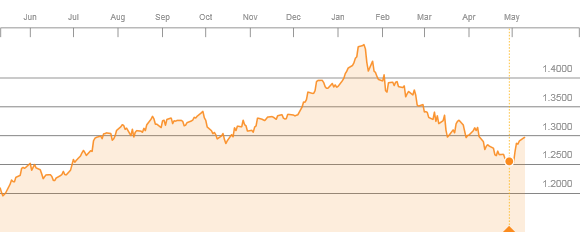
One of the biggest drivers of this psychological roller coaster for Canadians in the last couple of years has been the Canadian dollar. The following chart from Bloomberg Markets shows the USD/CAD over the last year:
The loonie hits its weakest point in mid-January which was actually the end of a long decline from the last point where the CAD was at par with the USD back in January of 2013. Canadian investors tend to be too overweight Canadian stocks and bonds and this hurt through mid-January. Having exposure to investments denominated in currencies other than Canadian dollars provided a return booster during that period. Unfortunately this is where the poor behaviour kicks into high gear. In December of 2015 investors piled out of Canadian equity and bond funds an into US and global funds. According the Financial Post in January at the very trough of the loonie:
“of the five best selling fund types in December, four were global or US focused. Of the five worst, four were Canadian, reflecting the continued flight from our slumping equity markets and devaluing loonie.”
Timing couldn’t be worse
The timing couldn’t have been worse! The turnaround since then has been steep, at least until the beginning of May this year when the trend seemed to reverse again. You can understand how investors and their advisors can become really frustrated. Performance chasing can be a killer in these circumstances. Rob Carrick chronicled this really well in his Sunday Globe & Mail article “How the rising loonie is costing Canadian investors” capturing the sentiment as follows:
“They made a lot of money when the dollar was falling, but this year’s reversal has cost them. They’re annoyed about this turn of events and wondering who to blame. God help us when the housing market falls. People are going to self-combust.”
The reality unfortunately for many investors is that they didn’t make a lot of money when the dollar was falling because they waited to invest in foreign markets when the dollar had already fallen and are now being punished for chasing performance.
The evidence shows clearly that trying to time the market is extremely difficult and that is especially true of currency markets. Carrick suggests some investors may want to hedge foreign currency exposure to mute this type of volatility. Whether you hedge or keep currency as a source of risk and return in your portfolio, the most important thing is to just set a target allocation to domestic and foreign stocks and bonds that suits your risk profile and trade only when things drift out of balance. That will force you to buy low and sell high and that is good investing behaviour.
Graham Bodel is the founder and director of a new fee-only financial planning and portfolio management firm based in Vancouver, BC., Chalten Fee-Only Advisors Ltd. This blog is republished with permission: the original can be found on Bodel’s blog here.
You’ve been saving all your working life and now that you have entered your retirement phase, it’s time to start drawing from your savings. In some circumstances there will be people who will be able to live off their dividends and interest alone. Most retirees, however, will have to start spending the money they have saved.
Once you have decided on the amount of income you need annually for your retirement lifestyle and determined how much of it will come from your guaranteed pensions, the remainder must be withdrawn from your nest egg.
You may have multiple accounts and both registered and unregistered savings. Your investments could be stocks and bonds, ETFs and/or mutual funds. You might be in a position where you must withdraw a minimum amount from your RRIFs.
This example will show you how you can manage your retirement withdrawals, taking the total of all your accounts as a whole. It assumes dividends and interest will be reinvested, but you can use them as part of your yearly cash allotment if you so choose. You just have to adjust as necessary.
A model for retirement withdrawals
Meet newly retired Rodney and Pamela O’Brien. They have a retirement nest egg totalling $500,000. Continue Reading…
Young people today, and I’m talking about Millennials and those who just made it into Generation X, think they can do everything on their Smartphones, Handhelds or other mobile devices. But I have news for them. They can’t.
In Germany a pedestrian who was typing on a Handheld walked into a busy intersection, and was promptly killed by a passing car. It wasn’t the motorist’s fault. The person on foot was oblivious to where they were and what they were doing.
Nowadays people are apt to check their precious mobile devices twice a minute. Every thirty seconds. They exist in total crisis mode. This is a huge problem in terms of productivity. Here’s why.
Prioritizing impossible with Handhelds
First, it is impossible to prioritize your day if you live on your Handheld. On the other hand, Microsoft Outlook is an efficient way to do that – but only if you know how. Think of Outlook as a ten-ton truck that can carry ten tons of steel (i.e., a lot of information.) But if that’s a ten-ton truck, then your Handheld is a motorcycle and no motorcycle can carry ten tons of anything. It just doesn’t have the power to put your tasks into any intelligent order or scheme. You will be much more efficient, and productive, if you recognize what your Handheld won’t do.
Because of high interest rates, once you find yourself in the hole, it seems almost impossible to pay down your debt. Not only will this debt put a damper on any future plans of saving for a home or even a vacation, it also negatively impacts your credit score, which will make the idea of owning a home even more difficult to imagine.
If you eventually want to own a home or go on a vacation that doesn’t add to your debt, employ one of the strategies below to start your journey on becoming debt-free.
Consolidate your debt
If you have debt on multiple credit cards, you should consolidate it into one place. You can either consolidate everything onto a balance transfer credit card or apply for a personal loan/line of credit with either the bank or a peer-to-peer lending company, like Grow.


 Posted By