All posts by Financial Independence Hub

5 keys to a great Retirement

By Fritz Gilbert, RetirementManifesto.com

Special to the Financial Independence Hub

Can you imagine having the opportunity to study two decades worth of retirement research, and gleaning the keys to a great retirement from the experts?  I recently had that opportunity when I took the time to read a 90-page study titled “The Experience Of The Transition To Retirement,” a study that filtered through 1,800 research papers!

Today, I’m summarizing the results from that study and presenting to you 5 Keys To A Great Retirement, along with additional findings from this extensive research.

Using Research To Improve Retirement

The goal of this research project was to understand what led to successful retirement transitions and to “better understand how best to help individuals navigate this transition”, as well as “how to improve the quality of post-retirement life”.   Valuable information from which you, the reader, can benefit.

Before I present The 5 Keys To A Great Retirement, there are some findings in the study which I found interesting.  For the sake of brevity, below is a list in bullet form.  Note that the study did focus on gender/socioeconomic/ethnic/cultural differences, so it’s best to read the findings with that in mind:

  • 25% of retirees experience difficulties in the transition to retirement.
  • Men tend to have more positive attitudes toward retirement and be more engaged in planning for retirement than women.
  • Based on the studies, women appear to have greater difficulty in adjusting to retirement than men.
  • Those in higher Socioeconomic positions tend to work longer than those in lower positions.
  • Being married is associated with greater preparedness and a more proactive approach to planning for retirement.
  • Where work is important to an individual’s identity, retirement causes more conflict and anxiety.
  • Nearly half of those aged 50 and over said that they expect to retire later than they had thought they would.
  • Governments from around the world have enacted policies that seek to reverse an ‘early exit culture’ and extend the length of people’s working lives, maintaining economic productivity and reducing social spending.

Yes, there was a lot of interesting information in those 90 pages (trust me, I read every page). Boiling it all down, below are my takeaways on what comprises the 5 Keys To A Great Retirement.

1.) Control Your Destiny

The first finding was that those who felt they had the most control over their retirement decision were also those who most enjoyed their transition into retirement.  To quote the study:

“One of the most consistent and convincing findings in this review is that a sense of control is associated with positive retirement outcomes.”

While you may feel that you don’t control your retirement as much as you’d like, the reality is that there are a lot of areas in your retirement planning where you can influence the results.  Simply taking the time to prepare for your transition into retirement (See Key #2) is, in itself, exerting some control over your destiny.

Don’t leave your retirement to chance.

Given that you’re reading a blog on retirement, you’re likely ahead of your peers in tackling the first of these Keys To A Great Retirement.  You’re taking control of your retirement, and your retirement will be better as a result.

2.) Imagine What Your Retirement Will Be

The second of the 5 Keys To A Great Retirement was the finding that those who took time before retirement to imagine what their retirement would be were also those most likely to have a good retirement.  Think beyond finances. Finances play a small role post-retirement, and yet most folks think most about the financial implications of retirement when preparing for the transition.

Broaden your scope, and spend time thinking about what you want your retirement to be.  Dedicate some time, while you’re still working, to take a Test Run At Retirement, like my wife and I did.  Take some time to think about:

  • What will your life look like when work is no longer mandatory?
  • How will you spend your time?
  • What will give you Purpose?
  • Where will you live?

The research indicates that retirement planning “has potentially important consequences,” not just for financial security in retirement, but also ” in promoting satisfaction with, and adjustment to, the retirement lifestyle.”

It’s been proven by the research that planning for retirement while you’re still working is one of the best things you can do to ensure that you’ll have a great retirement.  Make it a priority, it’s one of the keys to a great retirement.

3.) Develop Retirement Goals

Retirement is a luxury.

For the first time since you started school, you’re free to do whatever you want with your life.  It’s also the first time that you’re 100% responsible for deciding how you’re going to spend your time.

Are you going to Die While You’re Living, Or Live While You’re Dead?  Decide what retirement means to you, and develop some goals to help you prioritize the things which are most important to you.  Focus on what matters to you, and create a plan to do the things you want to do, and avoid doing the things you don’t.

Create an action plan to move your retirement From Good To Great.  Create your own 10 Commandments of Retirement, and outline what really matters for your life in retirement.  Recognize that your role and identity will change from when you were a worker with employer-defined goals.  You’re now Independent, and you should define your own identity, supported by your own goals. Continue Reading…

Mini Retirements: Why Waiting until 65 is a Mistake

Gemini-generated image courtesy AlainGuillot.com


by Alain Guillot

Special to Financial Independence Hub

Mini retirements challenge one of society’s most accepted ideas: work nonstop for 40 years, then finally start living at age 65.

But there’s one major flaw in that plan.

Your money may still be there at 65, but your body may not.

You probably won’t be surfing in Portugal, climbing mountains in Peru, scuba diving in the Caribbean, or salsa dancing until 2:00 a.m. in Iceland with the same energy and physical capacity you had in your 30s or 40s.

Life experiences have an expiration date.

That’s why more people are embracing the idea of mini retirements: taking intentional breaks throughout life to travel, recharge, learn, and experience the world while they are still physically capable of fully enjoying it.

What are Mini Retirements?

Mini retirements are extended breaks from work taken throughout your career instead of postponing all freedom until old age.

They can last:

  • Three months
  • Six months
  • One year
  • Even several years

Unlike traditional retirement, mini retirements are not about stopping work forever.

They are about redistributing leisure and adventure across your lifetime.

Instead of saving all your freedom for the end, you enjoy pieces of it along the way.

Why Mini Retirements make sense

Your Health Is Temporary

Money compounds over time.

But physical ability declines over time.

There are experiences that simply feel different when you are young enough to fully enjoy them.

Walking through the steep hills of Lisbon at age 35 is not the same experience at age 75.

Sleeping in hostels, hiking volcanoes, learning to scuba dive, backpacking through Southeast Asia, or dancing all night requires energy, mobility, and stamina.

Those things are not guaranteed forever.

The Compounding of Life

Financial advisors often talk about the compounding of money.

But there is another kind of compounding that matters just as much: the compounding of experiences.

In his book Die with Zero, Bill Perkins introduces the idea of “memory dividends.”

When you have an incredible experience while you are young, you continue receiving emotional returns from that memory for decades.

A six-month adventure at age 30 may give you:

  • Stories you tell forever
  • Friendships that last decades
  • Confidence and personal growth
  • Memories that enrich your entire life

That experience continues paying dividends emotionally long after it ends.

An incredible trip at age 65 may still be meaningful, but it produces fewer years of memory dividends.

A Career Break is not Career Suicide

For decades, workers feared gaps in their résumés.

Today, that mindset is changing.

Modern work is increasingly digital and sedentary. Millions of people now earn income from laptops, consulting, remote work, freelancing, or flexible schedules.

Many people in their 60s and 70s can continue working comfortably from home long after physically demanding jobs would have forced retirement in previous generations.

That changes the equation completely.

A mini retirement in your 30s or 40s is no longer necessarily a setback.

It can be:

  • A strategic reset
  • A mental health investment
  • A creative recharge
  • A period for reinvention
  • A chance to reconnect with life

Ironically, many people return from mini retirements more energized, focused, and productive than before.

Is it Okay to use Retirement Savings?

For many people, the answer is yes: within reason.

Of course, withdrawing money early means sacrificing some financial compounding.

But life is not only about maximizing spreadsheets.

Time is a non-renewable resource.

Money can be earned back. Continue Reading…

Why does the Stock Market Rise when the News looks Bad?

Lowrie Financial: Custom Creation with Claude

By Steve Lowrie, CFA

Special to Financial Independence Hub

Short answer: stock prices reflect what investors expect to happen in the future, not what the headlines are reporting today. Markets rise when outcomes turn out better than investors feared, even if conditions still look bad.

By the time a story feels alarming enough to act on, the market has usually already priced it in. That’s why reacting to headlines rarely works, and why discipline tends to beat prediction.

Every market cycle seems to produce the same question. The headlines are negative. Investors are worried. Economists are warning about risks. Yet the stock market keeps climbing a wall of worry. How can both things be true?

It’s one of the most common investing questions I hear, and it usually sounds something like this:

“I don’t understand it. There’s a war in the Middle East. Governments are running massive deficits and have accumulated huge amounts of debt. Economists keep warning about recessions. Every day the news seems filled with uncertainty and risk. So why is the stock market near record highs?”

It’s a fair question, and if you’re asking it, you’re not alone. The answer comes down to one of the most important concepts in investing:

Markets Live in the Future

That may sound like a strange statement at first. After all, investors own businesses that operate in the real world today. Shouldn’t stock prices reflect what’s happening right now?

To a degree, they do. But the value of any business depends far more on the profits it’s expected to earn in the future than on the profits it earned last quarter. Every day, investors around the world are trying to answer the same question: what are those future profits worth today?

To answer it, they evaluate interest rates, inflation, economic growth, corporate earnings, government policy, geopolitical risks, and thousands of other pieces of information. As those expectations change, stock prices change. That’s why stock prices often seem disconnected from the headlines, and it’s where many investors get tripped up.

We naturally assume stock prices should move in response to what’s happening in the economy today. If growth slows, unemployment rises, or geopolitical tensions increase, it seems reasonable to expect stock prices to fall. But there’s an important distinction.

Most financial news and economic data tell us what has already happened. In many cases, that information is weeks or even months old by the time it’s reported. The stock market, on the other hand, is constantly trying to estimate what happens next.

I often think of financial news and economic data as a rearview mirror. They help us understand where we’ve been.

The stock market is the windshield. Investors are looking ahead, trying to estimate what businesses, profits, interest rates, and economic conditions might look like in the future.

Once you understand that difference, it becomes much easier to see why headlines and market performance so often seem disconnected.

Why does the Stock Market Rise when the News Looks Bad?

One of the biggest misconceptions in investing is that markets move based on whether news is good or bad. In reality, markets tend to move based on whether outcomes are better or worse than expected. That may sound like a subtle distinction, but it’s an important one.

Imagine investors become convinced a severe recession is coming. Businesses prepare for it. Economists forecast it. Investors position their portfolios for it. If the economy ultimately experiences only a mild slowdown, stock prices may rise even though conditions look bad. The outcome wasn’t necessarily good; it was simply better than investors feared.

The opposite happens all the time too. A company can report record profits and still see its stock price fall, because investors expected even better results. Markets are constantly comparing reality against expectations.

That may sound abstract, but history gives us a powerful example. During the global financial crisis, stock markets reached their lowest point in March 2009. At the time, the news was still overwhelmingly negative. Unemployment continued rising. The economy remained weak. Many investors were convinced conditions would deteriorate further, yet the market began recovering.

Investors who waited for reassuring headlines missed a significant portion of that recovery, because the market wasn’t waiting for conditions to improve. It was already looking ahead to a future in which they eventually would.

Investors who wait for good news often discover that the stock market has moved higher long before the headlines improved.

That’s what I mean when I say markets live in the future.

What does “It’s Already Priced In” mean in Investing?

This idea also explains one of the most misunderstood phrases in investing. You’ll often hear investors say something is “already priced in.” What they mean is that the market has already incorporated known information into stock prices.

By the time most of us hear a major news story and start wondering what it means for our investments, millions of investors around the world have already evaluated that information and built their views into prices.

That doesn’t mean markets are always right. Far from it. Markets can be overly optimistic. They can be overly pessimistic. Prices can move too far in either direction. But current prices generally reflect the collective expectations of investors based on everything they know today. Put another way, they give the best available estimate of what a company is worth right now.

For prices to move significantly, something usually has to happen that differs from those expectations. That’s why major headlines often have less impact on markets than people expect. Investors aren’t reacting to the news itself. They’re reacting to whether the news is better or worse than anticipated.

Why is Market Timing so Difficult?

Once you understand how markets work, it becomes easier to see why market timing is so challenging. To successfully move in and out of the market, you have to do more than predict what will happen next. You also have to predict what millions of other investors expect to happen and then determine whether reality will turn out better or worse than those expectations. That’s an extraordinarily difficult task.

It’s one of the reasons decades of academic research have found that consistently outperforming the broad stock market is so difficult. Whenever someone tells me they believe the market has it completely wrong, I think it’s worth asking a simple question: who exactly are they betting against?

At any given moment, stock prices reflect the collective judgment of massive pension funds, sovereign wealth funds, hedge funds, insurance companies, analysts, economists, business leaders, professional investors, and millions of individual investors around the world. Could the market be wrong? Of course. But consistently identifying mispricing and systematically profiting from it before everyone else is remarkably difficult. Decades of evidence suggest very few investors do it successfully over long periods.

What is the Practical Lesson for Investors?

The practical lesson isn’t that markets are perfect. It’s that reacting to headlines is usually not a successful investment strategy. By the time a story feels important enough to make you want to change your portfolio, the market has often already processed that information and adjusted accordingly.

This is worth saying clearly, because it’s easy to take the idea too far. “It’s already priced in” is a reason to ignore the daily news cycle. It is not a reason to ignore your own plan. Rebalancing back to your target mix, adjusting your portfolio as your goals and time horizon change, and managing risk, taxes, and costs are all decisions driven by your circumstances, not by the headlines. Discipline doesn’t mean doing nothing. It means acting on your plan rather than on the news.

So this doesn’t mean investors should ignore the news. It means they should be careful about making investment decisions based on it. Successful investing is rarely about predicting the next headline. It’s about building a sensible portfolio, staying disciplined during periods of uncertainty, and focusing on your long-term plan rather than the daily news cycle.

The next time you find yourself wondering why the stock market is rising despite negative headlines, remember that investors aren’t just evaluating what’s happening today. They’re trying to estimate what happens next, and more often than not, the market begins looking ahead long before the rest of us do.

That’s why markets can reach new highs during periods that feel uncertain, uncomfortable, or even frightening. And it’s why some of the best investment decisions are often the ones that feel hardest in the moment: staying disciplined, ignoring the noise, and sticking to a well-thought-out plan when the future feels least certain.

Frequently Asked Questions Continue Reading…

When mega-IPOs meet index investing

Franklin Templeton ETFs

By Dina Ting, CFA, Franklin Templeton ETFs

(Sponsor Blog)

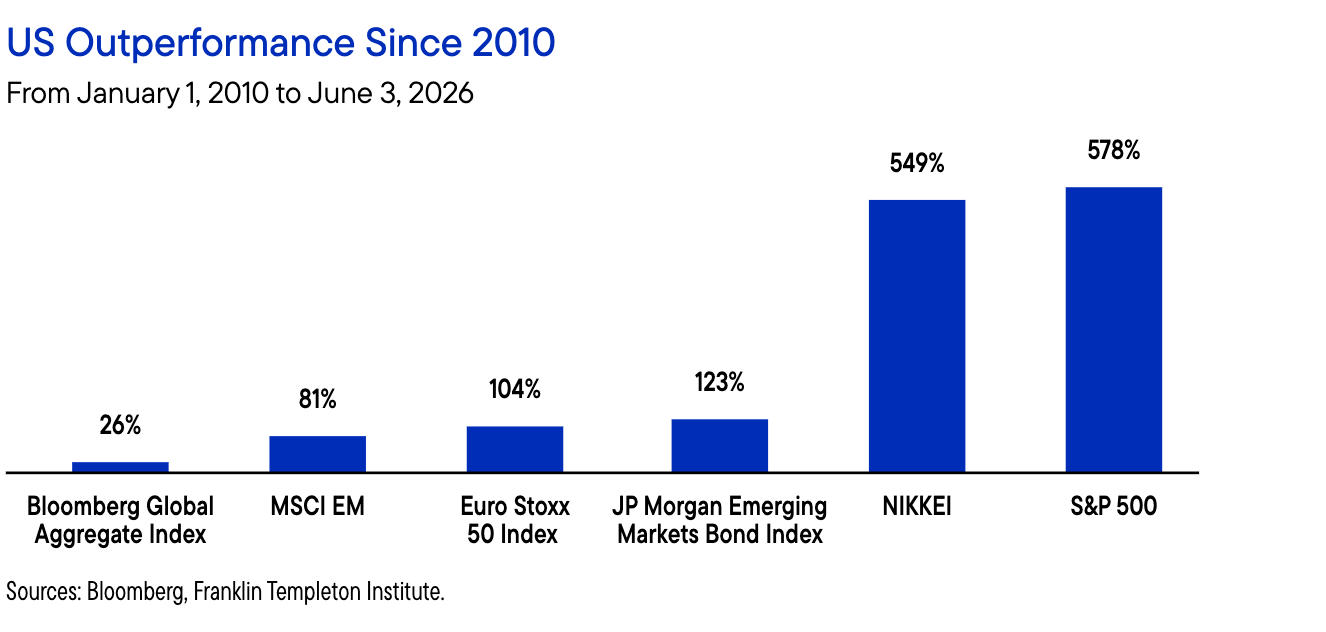
For decades, public markets were where companies grew up. Investors could watch young firms move from small-capitalization (cap) to mid-cap level and, for the rare few, into the ranks of the largest companies in the world. That journey today happens increasingly in private markets. We’re seeing now that by the time some companies list, they can seem to arrive already fully formed.

This shift is testing index construction. The impending listings from the likes of SpaceX, OpenAI and Anthropic have prompted index providers to revisit how quickly very large companies making initial public offerings (IPOs) should enter major benchmarks. Some index providers, including FTSE Russell and Nasdaq, have been racing to ensure benchmarks can capture the next generation of large public listings. Others, including S&P Dow Jones Indices, have preferred to keep established guardrails in place, maintaining a more deliberate approach to eligibility and inclusion.

In our view, this diversity of approaches is healthy. Index providers are trying to balance two important goals: reflecting the investable market as it evolves, while maintaining liquidity, stability and transparent rules. There is no single correct answer. A benchmark that moves too slowly may miss important changes in the economy. A benchmark that moves too quickly may expose investors to companies before trading history, float and fundamentals are well established.

An overlooked aspect of benchmark construction is that headline valuations and index weights are not the same thing. Most major equity indexes rely on free-float-adjusted market capitalization, which means they consider the shares actually available for public trading. FTSE Russell’s own preliminary analysis of SpaceX assumed a total market capitalization of US$1.5 trillion but available market capitalization of about US$70 billion, producing estimated weights of only 0.11% in the Russell 1000 Index and 0.08% in the FTSE GEIS All-World Developed Index.1

A company may dominate headlines yet enter a broad index with a relatively modest initial footprint. Over time, lockup restrictions — which typically prevent founders, employees and early investors from selling shares immediately after an IPO — expire, allowing more shares to enter the public market and potentially increasing the company’s index weight.

Another question investors may not have considered is whether these listings automatically make indexes more growth oriented. At first glance, the answer might seem like a no-brainer. Many of these companies operate in areas such as artificial intelligence (AI), aerospace and cloud infrastructure. Yet index construction is often more nuanced than headlines suggest.

FTSE Russell’s treatment illustrates this. Fast-entry IPOs have generally inherited the style characteristics of their assigned subsector until company fundamentals become available. However, the index provider has also acknowledged that relying solely on industry averages could create what it calls “market misrepresentation,” leaving room for alternative treatment in certain cases. For SpaceX, FTSE’s preliminary classification pointed to telecommunications, where the subsector average was 18% growth and 82% value.2

That may surprise investors who instinctively view anything rocket-fueled as growth. But it is a useful reminder: Index investing is rules-based, not headline-based. Style indexes do not simply ask whether a company feels innovative. They evaluate characteristics such as valuation, earnings, growth metrics and industry classification. As more mature private-market companies list, some may challenge traditional style frameworks.

This is where broader portfolio implications emerge. Broad-market index ETFs remain efficient, tactical tools for gaining diversified equity exposure, and country or style ETFs can help investors express more targeted views. But indexes are not static. New companies enter, sector weights shift, float changes, classifications evolve and concentrations emerge. Index exposure is therefore not necessarily something investors should set and forget. Continue Reading…

Picking up Nickels in front of a Steamroller

Image Pixabay

By Michael J. Wiener

Special to Financial Independence Hub

Suppose a casino offered the following bet.  You roll six fair dice.  If anything but all sixes shows up, you get $20.  But if all sixes show up, you lose a million dollars.

There are a number of practical problems with this game.  The casino would demand a million-dollar deposit in advance, and the odds are way too sensitive to imperfections in the dice and to player skill at not throwing sixes.  But this is a thought experiment designed to shed light on real-world financial events.

Initially, few people would play this game, because losing a million dollars is too scary.  But if you watched someone playing, even all day, you’d likely never see a loss.  You’d just see the player collecting $20 every 10 seconds or so, building up to many thousands of dollars.  The fear of missing out (FOMO) would set in for some and tempt them to play.

Over the long haul, the casino expects to pay out $933,120 for every million dollars it wins.  So playing this game is good for the casino but a bad idea for the player.  However, it’s easy to forget about the losses if you only see everyone winning $20 every play.  Games like this are referred to as “picking up nickels in front of a steamroller.”  The $20 payoffs are the nickels, and the million-dollar losses are when you get flattened by the steamroller.

The yen carry trade

So what does this have to do with real life?  There are many “games” in real life that resemble this hypothetical game more than people would like to admit.  When interest rates were much lower in Japan than they were in the U.S., it seemed profitable to borrow yen at a low interest rate, convert it to U.S. dollars, and collect high interest on U.S. dollar deposits.

This sounds quite profitable, so why did I say it only “seemed profitable?”  Well, all was well as long as interest rates and the exchange rate between yen and U.S. dollars were stable.  However, a rise in the value of the yen and higher Japanese interest rates (the steamroller) could more than wipe out any profits from the interest rate spread (the nickels).

Unlike the hypothetical dice game where the potential loss of a million dollars is prominent, it’s less obvious with the yen carry trade.  You might convince yourself that the value of the yen and Japanese interest rates would change slowly enough that you could exit your positions profitably.  However, many others would be trying to unwind their positions at the same time, each one trying to be among the first to get out.

Excessive leverage

Rather than just invest a fraction of your wages in stock markets, you could borrow extra money to invest more.  The stock markets may gyrate, but they keep rising.  If you can just wait out the gyrations, you’ll be sure to eventually make more money (the nickels) than if you didn’t borrow.

The problem is that if you borrow too much, and your creditors see that you’re in danger of becoming insolvent, they may demand their money back or impose high interest rates that eliminate your profits.  A sudden stock market crash (steamroller) could wipe you out before you get a chance to wait out the market decline.  Modest leverage can be reasonable, but it takes some skill to determine how much you can borrow safely.

The great financial crisis

Many Wall Street firms made apparent profits selling insurance against mortgage defaults in the form of exotic financial instruments like credit default swaps (CDSs) and collateralized debt obligations (CDOs).  In this case, the nickels were the insurance premiums they collected, and the steamroller was the wave of mortgage defaults across the U.S. Continue Reading…