The origin of the so-called 4% rule is WIlliam Bengen’s 1994 journal paper Determining Withdrawal Rates Using Historical Data. Experts often criticize this paper saying it doesn’t make sense to keep your retirement withdrawals the same in the face of a portfolio that is either running out of money or is growing wildly. However, Bengen never said that retirees shouldn’t adjust their withdrawals. In fact, Bengen discussed the conditions under which it made sense to increase or decrease withdrawals.
Bengen imagined a retiree who withdrew some percentage of their portfolio in the first year of retirement, and adjusted this dollar amount by inflation for withdrawals in future years (ignoring the growth or decline of the portfolio). He used this approach to find a safe starting percentage for the first year’s withdrawal, but he made it clear that real retirees should adjust their withdrawal amounts in some circumstances.
In his thought experiment, Bengen had 51 retirees, one retiring each year from 1926 to 1976. He chose a percentage withdrawal for the first year, and calculated how long each retiree’s money lasted based on some fixed asset allocation in U.S. stocks and bonds. If none of the 51 retirees ran out of money for the desired length of retirement, he called the starting withdrawal percentage safe.
For the specific case of 30-year retirements and stock allocations between 50% and 75%, he found that a starting withdrawal rate of 4% was safe. This is where we got the “4% rule.” It’s true that this rule came from a scenario where retirees make no spending adjustments in the face of depleted portfolios or wildly-growing portfolios. So, he advocated choosing a starting withdrawal percentage where the retiree is unlikely to have to cut withdrawals, but he was clear that retirees should reduce withdrawals in the face of poor investment outcomes. Continue Reading…
By Andrew Lo, President & CEO of Embark Student Corp.
(Sponsored Post)
The pursuit of higher education is a cornerstone of personal and professional growth for many young Canadians. However, this pursuit often comes at a hefty price, with student loans being a significant barrier to financial independence. The burden of student debt can haunt graduates for years, affecting their ability to save, invest, and achieve financial stability. But there’s good news: opening a Registered Educations Savings Plan (RESP) can lighten the burden of student loans and help you help your children start their adult life debt-free by encouraging regular and early savings, offering valuable government grants, and harnessing the power of compound interest.
The Student Loan Conundrum
Canada is home to a world-class education system, but the cost of pursuing post-secondary education can be daunting. Tuition fees, books, accommodation, and other expenses can quickly add up, leaving many students with no choice but to turn to the most common method of affording post-secondary: student loans.
What some students don’t fully understand when they use student loans is that they come with interest rates that accrue after graduation. For many young Canadians, this means they start their careers with substantial debt, and few resources to help them repay their loans.
In a recent poll of Canadian students, 79% admitted that the amount of debt taken on to afford post-secondary can be debilitating. This burden of student debt can have a profound impact on a young graduate’s financial journey, with 57% of students surveyed agreeing that graduating with student debt will make it harder for them to become financially independent from their parents.
Unfortunately, the constant struggle to make loan payments often hampers their ability to save and invest in their futures. Despite this, student loans are still the most normalized way of paying for education in Canada.
There’s a better way pay for post-secondary education
One effective way to combat the student loan conundrum is to start saving for education expenses early. It can be hard to think about university and college when a child is a few years old but by beginning to save as soon as possible, families can significantly reduce their need for student loans. You’re probably thinking, “accumulating savings to cover educational costs while managing the rising cost-of-living is no easy feat.” This is where a Registered Education Savings Plan [RESP] comes into play.
RESPs are powerful tools that Canadians can take advantage of to fit the post-secondary bill. They can be opened by the parents or guardians of a child, other family members, or friends, to save over a total period of 35 years. By contributing regularly to an RESP, families can build substantial savings to cover tuition and related expenses. Starting early allows for smaller, manageable contributions over time, reducing the financial stress associated with higher education. The most valuable part of this savings tool is that it opens your savings up to a world of government grants that you can qualify for.
Unlocking “Free Money” with Grants
One of the most compelling features of RESPs is the opportunity to acquire “free money” in the form of grants. The Canadian government provides a generous grant called the Canada Education Savings Grant (CESG) as a reward for saving, allowing you to collect up to $7200.
This grant matches 20% of your contributions on the first $2,500 saved annually. Over the years, if you contribute $2500 annually to an RESP, this works out to an additional 20% being added to your first $36,000 saved without even considering investment gains. By maximizing these grant opportunities, families can alleviate the financial strain of higher education and better prepare for the future. Continue Reading…
In response to rapidly accelerating inflation, central banks began raising rates aggressively at the beginning of 2022. Ever since, wild swings in bond markets have had a tremendous impact on virtually every single asset class.
This month, I examine the recent spike in rates from a historical perspective. Importantly, I will discuss the likely range of interest rates over the foreseeable future and the associated implications for financial markets.
When the Fed and other central banks were confronted with financial disaster in late 2008, they slashed interest rates to zero and deployed additional stimulative measures to ward off what many thought could be another Great Depression. Global rates then remained at levels that were both well below historical averages and the rate of inflation for the next 13 years.
In 2008, the runaway inflation of the 1980s and the painful medicine of record high rates that were required to subdue it were still relatively fresh in people’s minds. At that time, had you asked anyone what would be the most likely result of keeping rates near zero for over a decade, their most likely response would have been runaway inflation. And yet, inflation remained strangely subdued. According to most experts, this unexpected result is largely attributable to a relatively benign geopolitical climate and a related push toward global outsourcing.
This led to the notion of a “new normal” in which inflation was permanently expunged. Over the span of only 13 years, people went from fearing inflation to believing that it was a relic of the past unworthy of serious consideration. This false sense of comfort caused central banks and investors alike to be caught off guard in late 2021 when they realized that inflation had not been permanently vanquished but was merely hibernating.
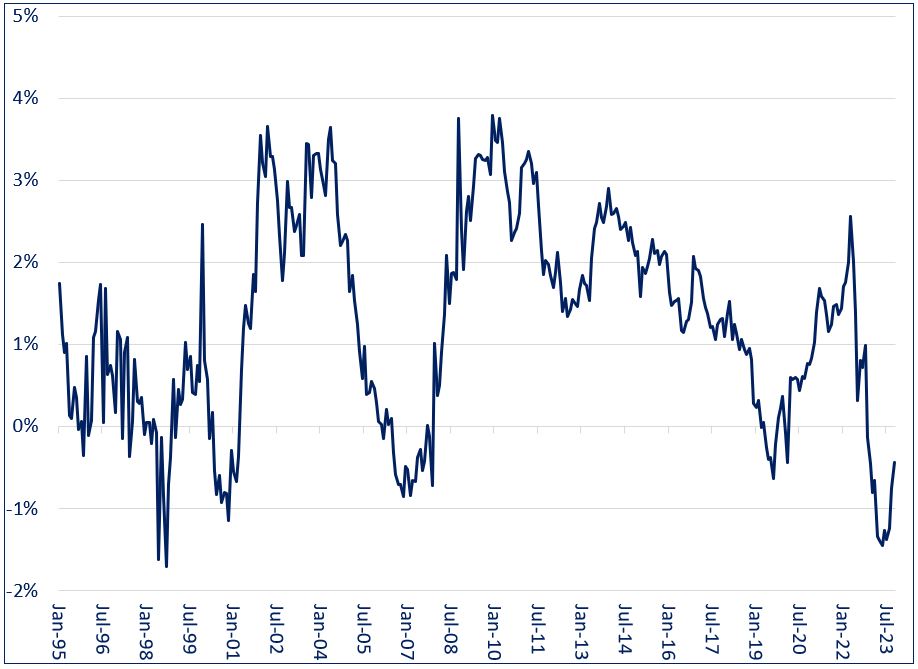
These sentiments were evident in bond markets. After rates were slashed to zero during the global financial crisis, investors were skeptical that they would remain there for long before stoking inflation. Longer-term rates remained well above their short-term counterparts, with the yield on 10-year U.S. Treasuries retaining an average 1.9% premium above the Fed Funds rate from 2009 – 2020.
However, 13 years of ultra-low rates with no sign of inflation allayed such fears, with the yield spread crossing into negative territory late last year and reaching a low of -1.5% in May of 2023. Even the rapid acceleration in inflation in late 2021 failed to fully disavow investors of the notion that the era of low inflation had come to an end, with current 10-year rates falling below their overnight counterparts.
10 U.S. Treasury Yield Minus Fed Funds Rate (1995 – Present)
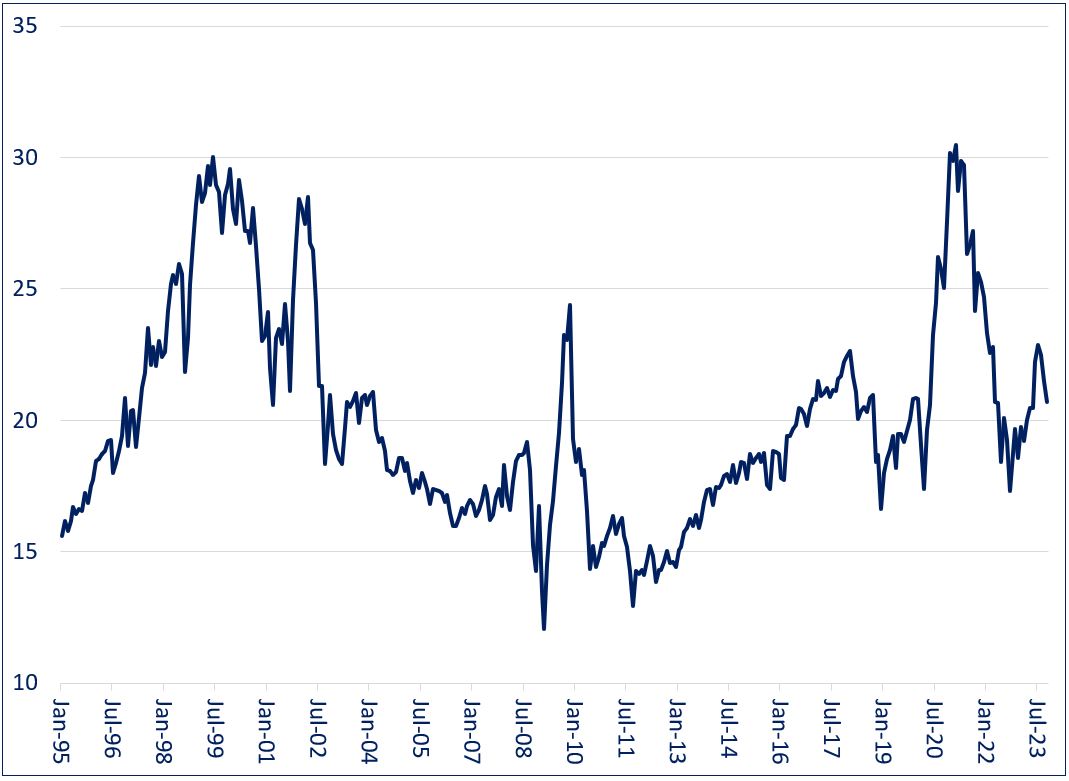
Equity markets danced to the same tune as their bond counterparts. When central banks cut interest rates to zero during the global financial crisis, investors were dubious that inflation would not soon rear its ugly head. Multiples remained relatively normal, with the P/E ratio of the S&P 500 Index averaging 16.4 for the five years beginning in 2009.
Over the ensuing several years, investors became complacent that the world would never again experience inflation issues, with the S&P 500’s P/E ratio climbing as high as 30 by early 2021. Multiples have since remained somewhat elevated by historical standards, indicating that markets have not fully embraced the fact that inflation may not be as well-behaved as what they are used to.
S&P 500 P/E Ratio (1995 – Present)
The Rising Tide of Declining Rates: Not to be Underestimated
According to legendary investor Marty Zweig:
“In the stock market, as with horse racing, money makes the mare go. Monetary conditions exert an enormous influence on stock prices. Indeed, the monetary climate – primarily the trend in interest rates and Federal Reserve policy – is the dominant factor in determining the stock market’s major direction.”
The 2,000-basis point decline in interest rates from 1980 to 2020 not only turbocharged aggregate demand (and by extension corporate revenues), but also dramatically lowered companies’ cost of capital. In tandem, these two developments were nothing short of a miracle for corporate profits and asset prices. Continue Reading…
Oh, I was so smart. I was smarter than the market and all its participants. But I was not, I was delusional. I wasted my time trying to guest the direction of the markets. I had good months in which I felt I was going to be a millionaire, and then in one bad trade I would lose most of my gains.
The one lesson I discovered, and maybe was worth the price of all my losses was that passive investment works.
The strategy create by John Bogle many decades ago is till paying huge dividends. Mr. Bogle was the founder of Vanguard Funds, the inventor of Passive Investing, a strategy created for the masses. Ever since I started passive investing my portfolio has been going up at a staggering rate.
My investments are composed of three main investments:
VFV (Vanguard S&P 500 US Index ETF) XIU (iShares S&P/TSX 60 Index ETF) VIU (Vanguard FTSE Developed all caps ex North America)
Plus other individual stocks that mostly lose me money. Continue Reading…
It’s that time of year. The leaves have started to shift to brilliant shades of crimson, orange, and yellow. The days are getting shorter. And, suddenly, it’s “jacket weather” again. For many Canadian families, the transition into cooler months signals a time to begin the process of reviewing their finances from the past year with the goal of being better prepared in the years ahead.
With the cost of living in Canada incrementally higher than it has been in recent memory, there is a renewed opportunity for families to ask a familiar question: what is a simple, one-step investment strategy that they can use to help stretch the most out of their money, both now and for the long haul?
Well, like the changing seasons, it may be a good time for families to consider changing up a dated investment approach in favour of one that will take their money a little further. That is, using a low-fee, low-touch, robo-advisor in place of costly mutual fund investments … and, here are a few reasons why:
Accessibility
Robo-advisors have ushered in a new era of accessible investing. Designed to be user-friendly from the get-go, they are an excellent choice for both novice and experienced investors. With just a few clicks, investors can select a portfolio that matches their risk tolerance and fund it with little to no hassle.
Diversification
A well-constructed portfolio needs variety. Robo-advisors excel at this by spreading investments across different asset classes, thus reducing risk. Mutual funds, while also diversified, often lack the customizability and personalization offered by low-fee robo-advisors.
Automated Rebalancing
Investing with a robo-advisor provides nimble, automated rebalancing, ensuring that investments stay aligned to goals, even as market conditions shift. Mutual fund investors often need to manually (and worse, reactively) adjust their portfolios, potentially missing out on market opportunities or exposing them to unnecessary risk. Continue Reading…


 Posted By