All posts by Financial Independence Hub

 Timeless Financial Tip #10: Making Legacy Planning more Meaningful


By Steve Lowrie, CFA

Special to Financial Independence Hub

Let’s face it: When families list their favorite financial planning projects, legacy planning rarely makes the cut. It may feel as if you’re putting the emphasis exclusively on death and taxes, rather than your lifetime pursuits such as building a career, pursuing your personal interests, stewarding your kids into adulthood, and retiring in style.

Then again, I believe the term “legacy planning” is misleading to begin with. It sounds so dry and formal — as if it’s only for uber-rich, multigenerational dynasties, or the tail end of your lifespan.

No wonder most people put off planning for it.

In reality, legacy planning can be worthwhile for almost anyone. And it’s not just for later in life; key aspects of it can help you enjoy a more enriched life today. In today’s Timeless Tip, we’ll cover the possibilities.

What is Legacy Planning?

Instead of treating legacy planning as a tedious, end-of-life chore, I like to think of it as being more like a bonus round of lifestyle planning across four core quests:

  1. Family Ties: Legacy planning helps you keep more of your wealth in the family. Importantly, it lets you define who your family is, in a world where multiple marriages and blended families may more often be the norm than an exception to the rule.
  2. You or your Heirs: Legacy planning can also be defined by what it is not. If your top priority is having enough to enjoy your retirement in style, your legacy planning will differ from someone who dreams of leaving the largest possible inheritance to their heirs.
  3. Charitable Giving: Legacy planning also helps you chart out how and when you’d like to support your causes and charities of interest. Hint: You don’t have to wait until you’re gone to leave a legacy.
  4. Tax Reduction: Even if you’re fine with letting inheritance laws guide how your estate will be distributed, most of us would prefer a tax-efficient transfer. Legacy planning strategies abound here.

How do you define “Family”?

First, let’s address the piece most of us associate with legacy planning: Who gets what stuff after you’re gone? If your estate seems perfectly straightforward, you may be tempted to just let your heirs sort it out. Unfortunately, this can leave you and your loved ones uneasy — not just moving forward, but right now.

Unintended Consequences: Check your provincial inheritance laws, and you may be surprised by what will happen to your assets if you die intestate (without a will). Your preferences may differ dramatically from the government’s.

Unresolved Heirlooms: Resolving which loved ones are to receive which treasured heirlooms and other portions of your wealth, can bring you and your family more peace — today, and moving forward.

The Angst of Uncertainty: Most of us also feel better knowing we’ve done what we can to spare our heirs the pain of having to untangle an unplanned estate at the same time they are grieving a profound loss.

The logistics of estate planning need not be extensive. They can range from essential to more advanced:

Wills: A basic will might suffice if you simply want to ensure particular people directly inherit particular pieces or portions of your estate, as permitted by law — especially when your preferences differ from provincial law.

Trusts and Foundations: You may want to up the ante with targeted trusts to cover additional nuances in your life. For example, trusts can provide for underage heirs, an heir with special needs, or other complexities, such as if your family owns a business in which some, but not all family members are involved. Private foundations come into play if you are interested in increasing the scope of your multigenerational charitable giving.

Insurance: Life insurance is also an often-overlooked tool for providing gap funding to cover taxable wealth transfers, especially when family businesses are involved.

Bottom line, making plans today for your wealth transfer to happen with minimal muss, fuss, costs, and complications can free you to better enjoy your assets throughout your life.

Spending or Preserving?

As we covered in “Retiring Reliably, Leaving a Legacy or Balancing Both?, ” another key question is: Do you want to earmark excess wealth for your optimal retirement, an optimal legacy, or a balance of both? Different lifestyles call for different legacy plans.

You may not think of investment management as part of traditional legacy planning. But you’ll be better at both if you combine forces. For example, if you want to emphasize leaving a legacy, your investment portfolio’s average expected return should exceed your withdrawal rate, so inflation doesn’t eat away at the balance. This usually means keeping more of your investments working in the markets, while also arranging for a way to take out cash on a regular, tax-efficient basis. Continue Reading…

In the pursuit of financial security for all, we can’t overlook older widowed women

Image by Pexels: Andrea Piacquadio

By Christine Van Cauwenberghe

Special to Financial Independence Hub

Canada has a bold vision – to build a more accessible, inclusive and effective financial literacy ecosystem for all. The five-year plan, laid out in the National Financial Literacy Strategy 2021-2026, is an important step forward to achieving sweeping financial literacy. But one cohort is noticeably absent from this ambitious strategy – older widowed women.

During Financial Literacy Month in November, we had an opportunity to cast a light on financial education and empowerment for this often overlooked and underserved, but statistically significant, group. In 2022, there were approximately 1.5 million widowed women compared to the roughly 472,000 widowed men, reports Statista Research Department. As our nation nears “super-aged” status, where 20 per cent of our population will be 65 years or older, these numbers will continue to climb.

Longer life expectancies for women, paired with women generally marrying or partnering with older men, leaves them more likely to spend at least some of their retirement in widowhood. As such, it’s estimated that 90 per cent of women will become the sole financial decision-maker at some point in their lifetime, representing a substantial segment of Canada’s wealth management sector.

Lower financial literacy than male counterparts

However, this same group generally reports lower levels of financial literacy than their male counterparts. While many reasons account for this disparity, traditional societal norms play a significant role – older generations of women were more likely to stay home and rear children while men typically joined the workforce, granting them greater financial exposure.

Now, we have an opportunity and a responsibility to change this. Widespread financial literacy matters, but in our effort to educate the masses we can’t leave certain groups behind. By narrowing the knowledge gap, we can empower widowed women from and after the Silent Generation with a voice – we can give them a say in their own financial future.

Women will soon control half of accumulated Wealth

By 2026, women in Canada will control roughly half of all accumulated financial wealth, estimates Strategic Insights, up from one-third a decade earlier. While this is a welcomed shift, many women’s’ lack of core financial understanding and involvement is sobering. Too often, it’s men who assume a leading role in personal wealth management, specifically retirement and estate planning. This despite the fact that women, on average, survive their husbands by roughly five years. Yet, only 17 per cent of women in Canada over the age of 65 have an up-to-date will, according to a survey from LegalWills Canada. Continue Reading…

The Power of Low-Fee Core Bond ETFs in your Investment Portfolio

By Alizay Fatema, Associate Portfolio Manager, BMO ETFs

(Sponsor Blog)

The latest economic data unveils a captivating narrative of a strong and resilient economy in both Canada and the U.S. The current inflation stickiness and robust job market numbers make a solid case for the central banks in both countries to keep interest rates higher for longer.

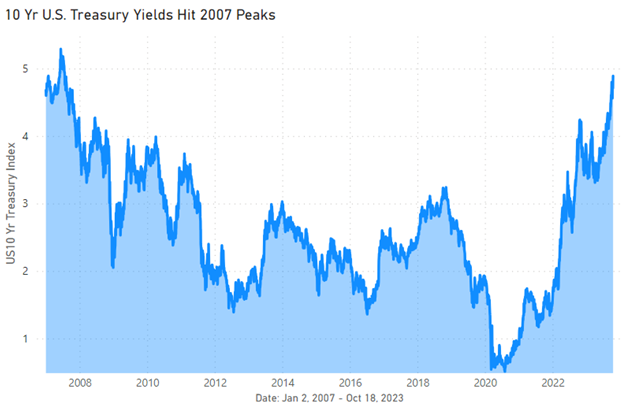
Towards the end of September 2023, markets basked in record-high yields. However, earlier this month, based on the current situation in the Middle East, bond yields fell owing to an increase in demand for safer assets and caused longer-term bond prices to surge.  U.S. consumer prices remained elevated for the month of September and a pullback in demand for a treasury auction pushed longer-term yields higher again, resulting in 10-yr U.S Treasury yields touching their highest point since 2007. On the contrary, the recent CPI printed lower than expectations in Canada, yet the yields remain high as hot economic data continues to build pressure south of the border.

Source: Bloomberg

Given the current two-decade-high interest rates, yields on Aggregate Bond ETFs have surpassed 5%, making them an interesting avenue for fixed-income investors. Before we dive in further, let’s discuss some aggregate bond ETFs in detail along with their benefits.

Aggregate Bond ETFs as the Core of your Investment Strategy

Aggregate bond ETFs are exchange traded funds that aim to track performance of a diversified portfolio of bonds. These ETFs are referred to as core because it reflects their status as a foundational building block of a well-rounded investment portfolio. These ETFs can help investors achieve diversification, steady income & stability within their investment portfolios. BMO currently offers two Aggregate Bond ETFs:

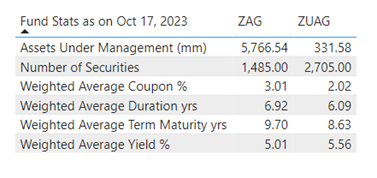
  • BMO Aggregate Bond Index ETF (ZAG) aims to replicate the performance of the FTSE Canada Universe Bond Index. This ETF primarily invests in a Canadian investment-grade fixed income securities consisting of Federal, Provincial and Corporate bonds, with a term to maturity greater than one year.
  • BMO US Aggregate Bond Index ETF (ZUAG) tracks the performance of the Bloomberg US Aggregate Bond Index. It invests in U.S. investment-grade bonds such as U.S. treasury bonds, government-related bonds, corporate bonds, mortgage-backed pass-through securities, and asset backed securities with a term to maturity greater than one year. ZUAG is also offered as hedged to CAD (ZUAG.F) and in USD (ZUAG.U).

Source: BMO Asset Management.

These aggregate bond ETFs have proven to be an extremely viable investment solution owing to their key features:

  • The Symphony of Diversification: Aggregate Bond ETFs provide exposure to a broad spectrum of bond market offering diversification across the curve, various sectors and segments, maturities, issuers, and credit qualities; making them resilient for any market environment.

For example, in the current high-interest rate environment, exposure to short duration bonds might provide some down-side protection. On the other hand, if central banks start cutting rates, then longer duration can provide some upside potential.

Aggregate Bond ETFs can also be considered an equity market hedge. Given the inverse correlation between equities and bonds, they can provide a cushion against market turbulence and can potentially outperform stocks during selloffs.

  • Harnessing Cost Efficiency through Lower Fees: These ETFs are passively managed with the aim to track performance of the aforesaid indices. Their expense ratios are lower as compared to some actively managed funds, thereby reducing overall investment costs and improving net returns for investors. BMO is currently charging a Management Expense Ratio of 0.09% for both ZAG & ZUAG.  
  • Liquidity & Ease of Trading: Like all other ETFs, ZAG & ZUAG are traded on stock exchanges, enabling investors to easily buy and sell shares throughout the trading day, allowing them to see real-time prices. The bid-ask spreads on these products are lower in contrast with the underlying bonds which enhances their liquidity compared to traditional bonds, making them a cost-effective way to attain the exposure to the aggregate bond market.
  • Navigating Risk Management through High Credit Quality: Aggregate Bond ETFs are perceived as a stable and safer investment option as they provide exposure to investment-grade bonds, which are considered to have lower risk as opposed to high-yield or junk bonds. In the current rising interest rate environment, the credit quality & relative stability of the investment grade bonds make them an appealing choice for investors seeking to minimize risk & preserve capital.

Combined with the key features mentioned above, these Aggregate Bond ETFs provide investors with a low-cost core in any investment portfolio. They distribute monthly interest payments, providing a steady stream of income. These ETFs emphasize on preservation of capital and provide transparency and visibility into the funds’ composition and their underlying assets. Continue Reading…

Interview with Harvest ETFs CEO Michael Kovacs on how Retirees can generate income in volatile markets

The following is an edited transcript of an interview with Michael Kovacs, CEO of Harvest ETFs, conducted by Financial Independence Hub CFO Jonathan Chevreau.

Jon Chevreau (JC)

Thanks for taking the time today, Michael. We all know that 2022 was a pretty bad year as markets were impacted by higher interest rates. That turbulence bled into much of 2023, although the last few weeks have seemed much rosier.

How do you respond to unitholders of funds who are currently down year over year? Does your covered call writing protect retirees?

Michael Kovacs

Michael Kovacs (MK)

Thanks for having me, Jon. It is important to remember that we offer equity income funds. That means that you have to look at the total return of the product, which includes the price of the ETF and its accumulating distributions.

Yes, there has been turbulence in 2022 and through much of 2023. However, over that period, products like the Harvest Healthcare Leaders Income Fund (HHL) have paid consistent distributions.

Let’s look at the Harvest Diversified Monthly Income ETF (HDIF). In terms of actual returns, this ETF is down nearly double-digit percentage-wise in the year-over-year period (as of early November). But, when you look at the distributions paid over that same period, HDIF has delivered positive cashflow for its unitholders, which reduces the decline by more than half.

JC

Are you saying that between the covered calls, the distribution and the leverage plus the underlying equity income, that a retiree could expect annual yields as high as 10% or 12% or higher?

MK

Yes. Yields are anywhere from 1.5% to 3%, depending on the equity category. Then you have option writing. We can go right up to 33% on any of those portfolios, which generates additional yield. So, to be able to generate 9-10% is very achievable. And we’ve been able to do that consistently for a quite a few years now.

Jon Chevreau

JC

What is your view on the current interest rate climate? Have we reached a top? If so, when will they start to come down?

MK

Many of us remember the high interest rates of the 1980s, especially some of your readers who were trying to obtain their first mortgages. We have experienced a big jump in interest rates over the past two years. However, we believe that we have probably seen the top for rates for now. Or, if we haven’t, we are very close to the top. That means there are going to be some great opportunities in fixed-income markets. The next move for interest rates may be down by mid-to-late 2024.

That said, there are still great opportunities that will benefit equities and bonds in the current climate. Our first launch in the Bond area is the Harvest Premium Yield Treasury ETF (HPYT). We’ve launched with a high current yield. We are targeting long treasury bonds in this fund. This is about generating a high level of income while owning a very good credit-worthy security like a U.S. Treasury. So, if rates start declining next year, it is a great time to be holding fixed income.

JC

Findependence Hub readers tend to be retirees who want steady cash flow. What is Harvest’s view of cash flow for retirees?

MK

I think cash flow for retirees is essential. Once your employment income has gone, you must depend on your investments, your pensions, your CPP, and so on. The recent increases in interest rates have been good for retirees in the short term. Higher rates allow retirees to keep shorter-term cash and generate a safe yield of 5% or more.

Our longer-term equity products aim to have that heavy bias toward equities. For example, the Harvest Healthcare Leaders Income ETF (HHL) is typically written at about 25-28% average, with the other 70% or so fully exposed to health care stocks. The covered call option writing strategy allows us to generate a high level of income.

Cash flow is the basis behind our name: Harvest. People have spent decades building up capital, sowing the seeds. Our products allow them to harvest the fruits of their life-long labour.

We believe our equity-income and fixed-income products are a fantastic way to do that. If we can help you preserve capital and generate consistent income, we are doing our job.

JC

There is also interest among investors in asset allocation ETFs. Is HDIF essentially your answer to that demand?

MK

You’re correct. Some people prefer to allocate to specific funds, but the idea behind HDIF is to allocate to the best of Harvest’s top products that generate cash flow. In the case of HDIF, you do have a leverage component. You are increasing the yield but at the same time, you do increase your risk as well. Continue Reading…

15 Favorite Frugal Living Tips for Financial Independence

Image by Pexels: Dany Kurniawan

To help you on your journey towards financial independence, we’ve gathered 15 frugal living tips from financial advisors, founders, and other professionals.

From delaying big-ticket purchases, to asking for deals to save money, these experts share their best practices for frugality and financial independence.

  • Delay Big-Ticket Purchases 
  • Master Budgeting and Tracking Spending
  • Align Budget with Personal Values
  • Plan Meals to Control Food Budget
  • Distinguish Between Needs and Wants
  • Prepare Lunch at Home for Savings
  • Leverage “Stoozing” for Mortgage Savings
  • Track Expenses for Financial Insight
  • Eliminate Unnecessary Subscriptions
  • Use Technology for Financial Management
  • Prioritize Spending with Budget Tracking
  • Cut Expenses from Seldom-Used Subscriptions
  • Invest in Experiences, Not Impulse Buys
  • Wait a Month Before Impulse Buying
  • Ask for Deals to Save Money

Delay Big-Ticket Purchases 

When climbing the pay ladder, I purposefully delayed purchasing big-ticket items such as a newer or more expensive home, car, or luxury item. When I review my spending in detail, I’ve found it typically isn’t an $8 latte (or several of them) that puts me over the discretionary-spending edge, but rather something like a luxury handbag that I felt I deserved at the time, yet doesn’t bring me sustained happiness. 

That is to say, in hindsight, it would feel better to see my investment portfolio increase than to have a closet of designer wares. It’s important to build a budget for yourself, but equally or more important, to reconcile your past spending and decide whether to make an adjustment to the budget or your spending to be more accurate moving forward. — Morgan Jarod, Financial Advisor, Royal Private Wealth

Master Budgeting and Tracking Spending

There are many clever ways to cut expenses or generate extra income, but there is no replacement for the discipline of budgeting. A budget is the daily application of your long-term goals. It serves as a compass for your financial journey, making sure you are consistently moving towards your destination. 

There are two parts to every great budget: planning and tracking. First, you need to write out a plan for how you are going to spend every dollar of income you will earn in a given month. Then, you need to track your spending to ensure you are following your plan.

It would amaze most people at how much progress they can make toward their financial goals by simply using a budget to align their spending with their goals.

Luckily, becoming a master budgeter is easier today than it has ever been thanks to several budgeting apps that make the process simple and convenient.

When meeting with someone serious about their financial goals, the first recommendation is almost always a budget. — Ty Johnson, Financial Planner, Peak Financial Management

Align Budget with Personal Values

Review your budget so that it aligns with your values, not what society tells you to value. Many of us get trapped in consumerism and in looking the part. Society tells us that, in order to prove that you are wealthy, you must have an expensive car, home, and wardrobe.

What happens if you value none of those things? You spend more money than necessary, proving you have money. Look at your expenses. Do they truly align with what you care about? If they don’t, change it and be free. — Tremaine Wills, MBA, CFEI, Financial Planner | Investment Advisor, Mind Over Money

Plan Meals to Control Food Budget

Plan your meals for the week on the weekend before. Make your grocery list from your established menu. This habit keeps you from buying groceries you don’t need and helps avoid the late-afternoon query, “What should I make for dinner tonight?” that often ends up with something quick and less healthy, or convenient but more expensive. 

Additionally, planning out your menu helps maintain variety. In our home, we have an outline we tend to follow: Sunday’s meal has pork; Monday tends to be a hearty soup or salad; Tuesday is “Breakfast for dinner” (egg bake, blueberry crepes, etc.); Wednesday is a chicken dish; Thursday’s dinner has fish or sausage as a base ingredient; Friday is Pizza night (make yourself or order out), and Saturday is a beef dish. — Keith Piscitello, Certified Financial Planner, S2 Wealth Planning

Distinguish between Needs and Wants

Frugality is about mindset and intentionality more than deprivation. One of the most impactful practices for me has been to shift my mindset around needs versus wants. It’s easy to fall into the trap of feeling like we “need” the latest technology, furniture, clothes, cars, etc. But most of these are simply wants. Focusing on true needs — food, shelter, basic clothing, transportation to work — frees up a lot of money.

I ask myself, “Do I really need this, or just want it? Will this purchase add value and enjoyment to my life, or am I buying it just to have it?” Distinguishing needs from wants has allowed me to dramatically cut discretionary spending. I buy very few material items now, and focus my time and money on experiences, relationships, and personal growth. — Brian Meiggs, Founder, My Millennial Guide

Prepare Lunch at Home for Savings

Wherever possible, prep your lunch at home if you’re eating at the office or somewhere other than your home. Over the course of a month, the savings really stack up! This could be as easy as batch-cooking at the weekends, ready for the week, or just making a homemade sandwich in the morning. — Jordan White, Financial Planner, A Money Thing Happened

Leverage “Stoozing” for Mortgage Savings

In financial strategies, one unique money-saving hack I’ve employed is using an offset mortgage combined with savings. This approach, popularly known in England as “Stoozing,” can significantly reduce monthly mortgage payments. 

Stoozing involves utilizing the funds from 0%-interest credit-card offers. Instead of spending this money, one deposits it into a bank account linked to an offset mortgage. This approach effectively reduces the mortgage balance temporarily, leading to significant savings on mortgage interest. 

As the 0% period on the credit card nears its end, the “stoozer” then pays off the credit card using the deposited funds, having benefited from reduced mortgage costs in the interim. At one point, I had over £100,000 on credit cards, but this was sitting in my bank account, significantly reducing the interest payments on my mortgage. It accelerated my financial independence by at least 10 years. — Shane McEvoy, MD, Flycast Media

Track Expenses for Financial Insight

As a wealth-management specialist, one frugal-living tip I recommend to new clients is to track and record all your expenses. While this may seem time-consuming, it’s a great way to gain insight into where you are spending your money and how much you’re actually saving each month. 

Making sure you can see exactly where your money goes will help keep it in check and prevent impulse purchases that add up quickly. This is especially important when trying to reach financial independence because every dollar saved means more freedom for the future. — Adam Fayed, CEO, AdamFayed.com

Eliminate Unnecessary Subscriptions

Getting rid of subscriptions and simplifying my monthly budget has played a significant role in speeding up my journey towards financial independence.

Subscriptions might seem harmless, but the costs can really sneak up on you if you’re not careful. For years, I was paying over $100 a month for cable. I also was spending $50 on various streaming services, had an expensive gym membership, and would occasionally try services like meal delivery kits. And I hadn’t negotiated my Internet or phone bills in years.

One day, I realized I was spending well over $350 per month on these services, some of which I wasn’t using. I cut cable out completely, got a cheaper phone plan, and moved to a more affordable gym near me. I also scrapped the meal delivery kits and just cook myself now. This saves me $200+ a month easily, and it hasn’t impacted my quality of life.

I suggest other people take a look at their monthly spending to find sneaky recurring charges they can trim quickly. — Tom Blake, Founder, This Online World Continue Reading…