Good piece in Wednesday’s Financial Post by Morneau Shepell’s Fred Vettese about how even higher-income Canadians may be able to qualify for the Guaranteed Income Supplement to Old Age Security. Normally, those with big RRSPs fret about having OAS benefits clawed back and they don’t even think about the GIS.
But, as writers have been pointing out ever since the Tax Free Savings Account (TFSA, the Canadian equivalent of the U.S. Roth plans) started up in January 2009, a big benefit of the TFSA is that when you pull money out it’ s not only tax-free but also doesn’t result in clawbacks of either OAS or the GIS. Today, it’s common to see TFSAs with balances of $40,000 and in some cases much more. (See the annual MoneySense Great TFSA contest, where some of the “winners” have hundreds of thousands in them. Similar tales have been told in recent issues of the Financial Post.)
Consider that a dual-income couple could by now easily have between $80,000 and $100,000 in a TFSA, even if conservatively invested. Add another $11,000 between them in January 2015 and we’re talking real money.
Vettese’s article is the best I’ve seen even pointing this out. Put this into your “Decumulation” file!
Lots of ink for so-called robo-advisers in the press lately. With the unveiling of several new start-ups north of the border, this is a trend that won’t be stopping any time soon. One of the first pieces on it of which I’m aware was in the June 2014 issue of MoneySense, bearing the headline “Subscription-based Couch Potato.” I should know, since I wrote both the article and the headline.
Late in August, I wrote a piece on this for the Financial Post, and tried to make the case that “light advice” might be a better term since human advisers can and often do get involved in the process. “Light” suggests a half-way point between the “no advice” model of discount broker enthusiasts choosing their own ETFs, and the “full” advice model of full-commission stock brokers or investment counsellors or wrap programs that give plenty of human oversight, but also charge for it one way or another.
Dan Bortolotti of Canadian Couch Potato and PWL Capital also devoted his Index Investor column to robo-advisers in the fall issue of MoneySense. Dan sees plenty of benefits to them, one of them being lower investment costs, but another is that he believes they’ll force investment advisers (humans, that is) to do a better job.
Rob Carrick of the Globe has also weighed in as have, no doubt, a multitude of other personal finance writers and bloggers. In this September piece, Rob wrote that robo-advisers have arrived and “may be just what your portfolio needs.”
The past weekend, David Pett of the Financial Post wrote a good piece on the topic, with full portfolios generated for younger investors and retirees by four of the major Canadian robo-adviser — sorry, I meant light advice — firms.
And finally I wrote a piece on this today (Nov. 14) for the Investor Education Fund’s Getting Smarter About Money site.
I’d like to hear from new users of this model
I’ll certainly be doing more on this topic and would like to hear from readers who have actually used them. As a relatively new service, these early adopters presumably come from one of three camps: brand new money from those starting out in investing; those migrating “down” from higher-cost full-service brokerage, mutual funds, wrap programs or investment counsellors; and those migrating “up” from no-advice rock-bottom costs of choosing their own securities at a discount brokerage.
Presumably in the latter case, the investors have concluded they have done their portfolios a disservice by picking their own stocks, ETFs or sectors: I used to joke about “self-wrecked RRSPs.” For them, moving from no advice at all to “light” advice may be a compromise whereby they’re now willing to give up 1% or so in annual costs in return for some relative peace of mind about the big-picture topics of asset allocation, geographical and sector concentration, and rebalancing.
I’d welcome hearing from investors from any of these categories, although I doubt much new money has gone into these services yet. That may happen though, as lottery winners and those selling their businesses look for a home for a sudden infusion of cash.
If and when we get our commenting capability and discussion forums rolling, that would be one place to give us feedback. In the meantime, I welcome hearing the investor perspective from all three of the camps just mentioned: just email me at jonathan@findependenceday.com or @me at Twitter.
P.S. Have heard from several clients of Wealth Simple. How about clients from some of the other firms?
Like troubled Brazil, Russia is another trouble spot among the four BRIC nations. (Brazil, Russia, India, China). While most investors probably have minimal exposure to BRIC economies (either through BRIC ETFs or mutual funds, or in more diluted fashion, Emerging Markets funds), this is an example of a geo-political emerging event that bears carefully watching.
Sometimes these seemingly limited local eruptions have a way of spreading globally and ultimately impacting markets far beyond. For an example, check out this Wikipedia entry on the 1997 Asian crisis, which began in Thailand. I dare say when investors first heard about trouble with the collapsing Thai baht, they had no idea the trouble would soon spread to the rest of Asia, with possible global repercussions. To contain it, the IMF had to step in with US$40 billion.
So investors should monitor the events in Russia closely. This is a good example of why we need to pay attention to geopolitics and macroeconomics. Right now, ISIS, oil, Turkey and the Middle East is at centre stage of investor concerns but the events in Russia, including the Ukraine, call for scrutiny and caution. Here’s Business Insider’s take on Russsia’s encroachments on the Ukraine.
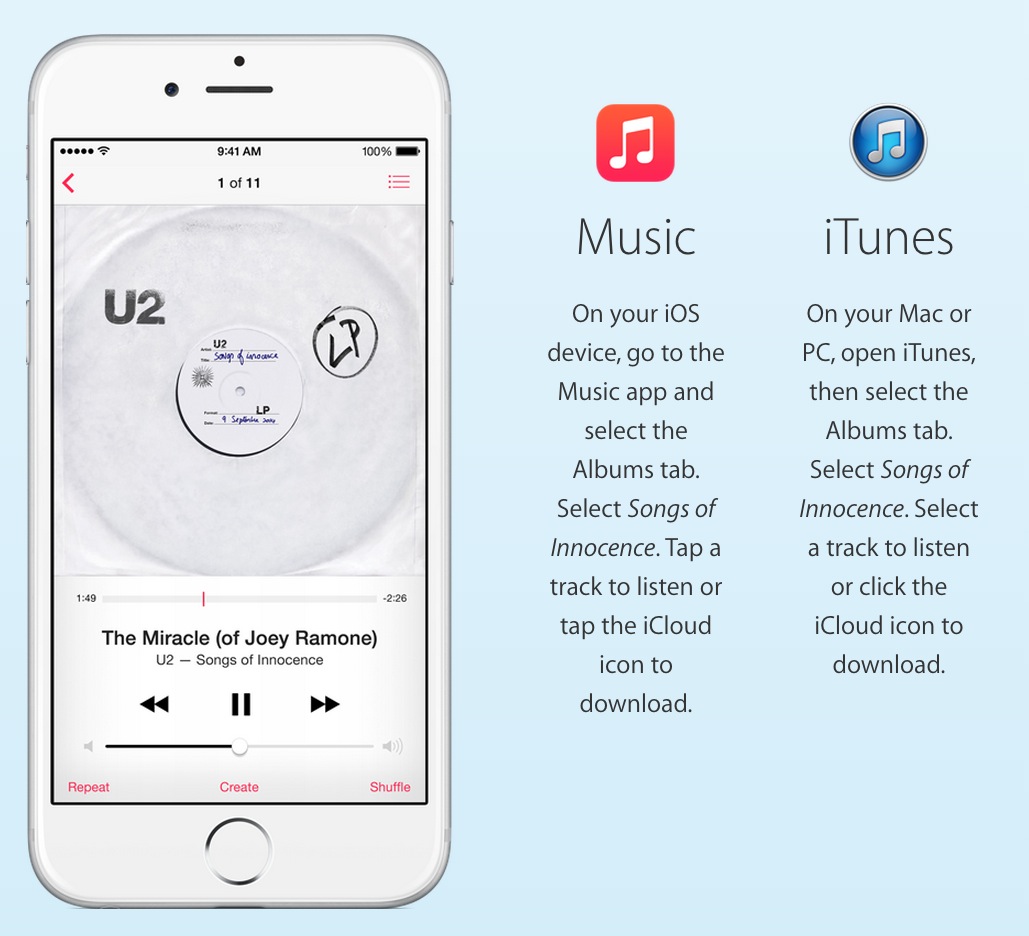
Interesting followup in the New York Times on the weekend to the September 9th release of U2’s album, Songs of innocence and its controversial decision to download it unasked-for on to the playlists of half a billion iTunes users. Despite the blowback, the paper reports that 100 million people have listened to at least a song or two and 30 million people had listened to the whole album.
Including me. In this blog at our sister site a few weeks ago, I argued that U2 is going to be repaid for its experiment with many more paid downloads of its back catalogue. That’s how I justified the Financial Independence angle in the blog: it was more about U2’s ultimate findependence than that of its listeners. Still, I feel richer for the listening exprience.
In fact, after I wrote the first blog on the old site, I confessed I had bought two more U2 albums each for $5.99. Since I posted that, and as I predicted of myself, I’ve purchased most of the other albums I missed. My 23-year old daughter is already berating me for playing nothing but U2: as I said earlier, when it comes to music, I’m a serial monogamist.
Right now, I like No Line on the Horizon the best of all U2’s albums. I had totally missed it when it came out in 2009, its 12th album. Remember, and as the Times points out, it was almost exactly a decade ago that Steve Jobs and U2 appeared on stage together to introduce “an odd-sounding device called the iPod and a marketplace for music called iTunes.”
Good piece in Monday’s Entrepreneur section in the Post by Rick Spence (@rickspence on Twitter.) Rick describes a new series of videos from the Canadian Foundation for Economic Education, which seeks to raise financial literacy. The videos are each five or six minutes, and are entitled Entrepreneurship: The Spirit of Adventure. Initial interview subjects include David Chilton (@wealthy_barber) , Cirque du Soleil founder Guy Laliberte, and Tim Hortons co-founder Ron Joyce.
The new series follows one 20 years earlier, also created by CFEE president and financial literacy guru Gary Rabbior (@cfee1).


 Posted By