Just as the first Covid vaccines are coming into widespread use, Harvest Portfolios Group Inc. has filed a preliminary prospectus for what it says will be Canada’s first Travel & Leisure Index ETF.
Travel and leisure stocks have of course been among the most hard-hit during the Covid-19 pandemic and are among the sectors that have started to move up as optimism over Covid vaccines and economic recovery builds.
When in January it begins trading on the TSX as TRVL, the Harvest Travel & Leisure Index ETF will provide investors with access to some of the most prominent Travel & Leisure companies in the world, says Michael Kovacs, President & CEO, Harvest Portfolios Group Inc.: “The ETF provides a low cost portfolio that will benefit from a rebound in international travel as the global economy recovers, as well as a demographic trend that was well established prior to the recent Industry shut downs.”
The ETF is based on the Solactive Travel & Leisure Index, which invests in large-cap issuers that own or operate travel-related businesses and are listed on regulated North American exchanges.
Clean Energy ETF also in the works
Harvest has also filed a preliminary prospectus for what it says will be “one of” Canada’s first clean energy ETFs: Harvest Clean Energy ETF (ticker HCLN). Kovacs says this is aagrowing space, an area that is “getting the proper political and societal attention it needs as more Canadians look to environmental factors when investing. There are large sources of Government and Private capital flowing into this space at unprecedented levels which we see continuing to grow into the future. With the changes going on in Energy generation, the future is definitely Clean.”
HCLN will invest in large-cap issuers engaged in clean energy related businesses listed on regulated stock exchanges in North America, Developed Asia or certain European countries. The preliminary prospectus has been filed with securities commissions in all Canadian provinces and territories, copies of which are available on SEDAR (www.sedar.com).
The ETFs’ Management Expense Ratios (MERs) have not yet been divulged but are expected to be in the range of .04, a company spokesperson said. That’s in line with its other passively managed index ETFs, and less than its actively managed ones.
Founded in 2009, Harvest is a Canadian Investment Fund Manager managing more than $1 billion in assets for Canadian investors.
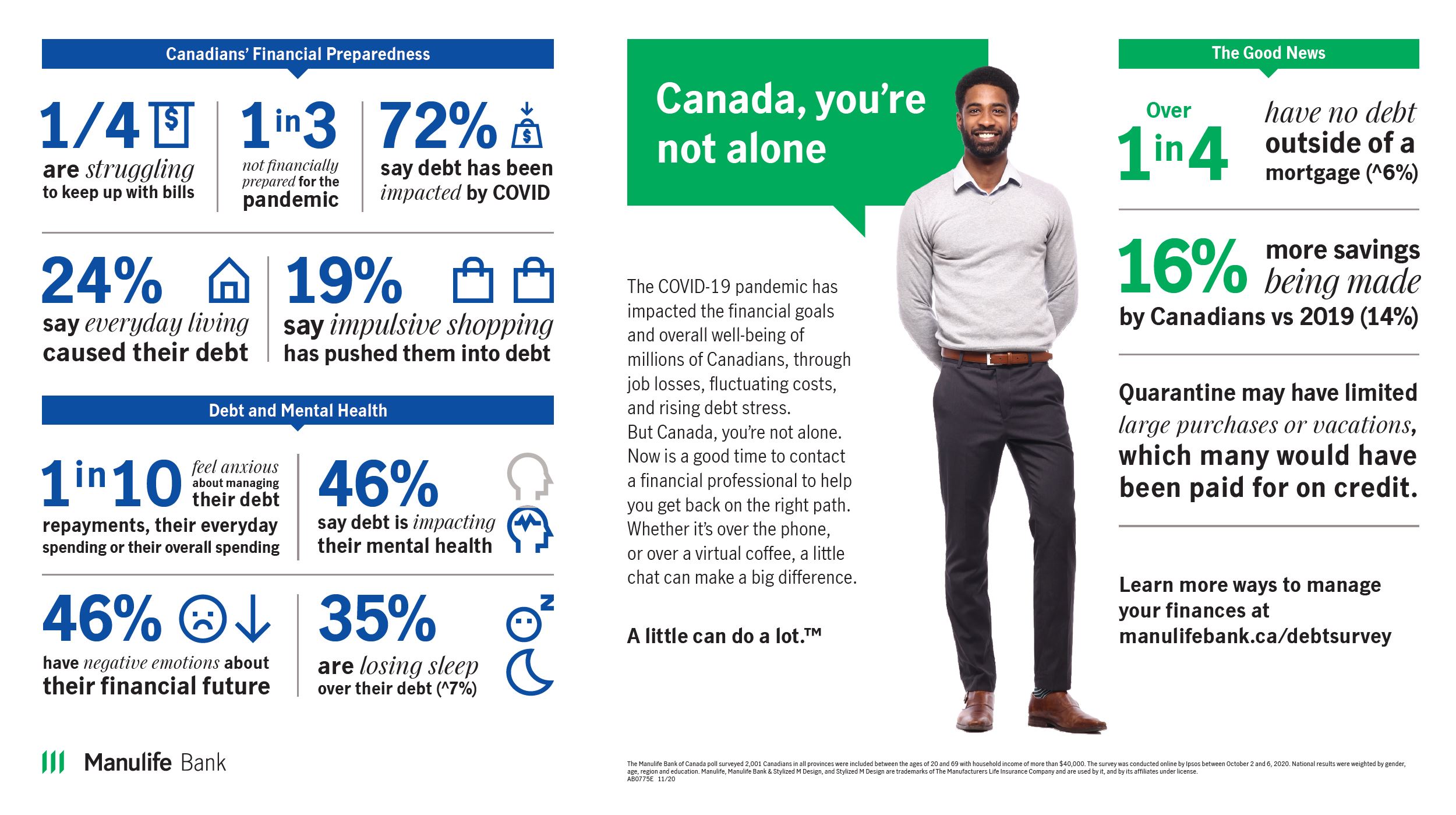
A third of Canadians were financially unprepared for the pandemic, and more than 75% think Covid-19 has impacted their mental health, according to a Manulife Debt Survey released late Tuesday. Young people are particularly concerned that their hopes for home ownership are slipping out of reach: two thirds of Canadians served who do not own a home worry about saving for one.
A whopping 36% said they worry significantly about saving for a home, while 28% are concerned about supporting their children through post-secondary education (28%) and 28% about saving for retirement.
On average, Canadians have been allocating nearly half their income to essentials like food and housing since COVID-19 began, with 58% of homeowners and 54% of renters worry about making payments.
Manulife Bank CEO Rick Lunny
“Debt can negatively impact mental health and leave Canadians feeling like their financial goals are unachievable. The pandemic has made that even more pronounced,” said Rick Lunny, President and CEO, Manulife Bank. “It’s so important to have financial flexibility, especially when one looks at purchasing a home – it’s easy to feel stressed. Financial conversations are essential to identify opportunities, what matters most and help you stay on track, no matter the financial environment.”
A financially unprepared population
The survey found 35% admit they were financially unprepared for the pandemic. 74% believe their financial situation has been impacted as a result of the pandemic and 69% of them say the impact has been overall negative: 42% worry that it may take them over a year to recover to pre-COVID-19 levels.
One in four are struggling to keep up with their bills, with one in six laid off due to COVID-19: an equal number say they would have been laid off had it not been for the wage subsidy provided by Ottawa.
Some have flourished
The survey reveals a sharp disparity in how the pandemic has impacted us, with some flourishing as others have been devastated. Manulife views this as evidence of a K-shaped recovery narrative. On the one hand, while Canadian on average, appear to be saving more compared to a year ago (16% of after-tax income, on avg. vs. 14% in Fall 2019), 24% have been saving absolutely no after-tax income compared to the same period last year. Within the indebted population there has been a significant increase in the proportion of those who say everyday living is the cause of their debt: 24%. This suggests more Canadians who are in debt are struggling to make ends meet, even if fewer Canadians (27% debt-free vs. 21% on Fall 2019) are now in debt overall compared to a year ago.
Earlier this year, the Hub ran a blog by Franklin Templeton Canada entitled A cure for the headaches of Fixed Income investing, written by Ahmed Farooq, Vice President of ETF Business Development for the company. Franklin Templeton is a sponsor of the Hub. Today’s blog is a question-and-answer session between Ahmed’s colleague, Jon Durst, Vice President, ETF Business Development, that picks up where we left off.
Jon Chevreau, Q1: Do you believe active management makes more sense in the fixed-income space versus the equity space? Perhaps it makes sense in both?
Jon Durst, Franklin Templeton’s Vice President, ETF Business Development
Jon Durst: There are merits to active management in both equities and fixed income; however, I feel recently, it has been a heavy skew towards active fixed income in this current market environment, and for many reasons. Early in March 2020, we saw a 50bps cut in interest rates by the Fed in the US: it was the first unscheduled rate cut since 2008 and the biggest cut since the financial crisis. There also appears to be a strong consensus on the street that rates will be “low for longer” going forward. If you own a passive fixed income strategy, the goal is to minimize tracking error to the index and what it cannot do is to adjust or try to anticipate any type of market events, like interest rate changes or changing company fundamentals.
This can certainly be a worrisome event for most advisors if they buy their own bonds directly or passive fixed income products covering different sectors/regions, as they have to scramble and figure out if they should continue with the same fixed income allocations in their portfolio, as the onus of making any changes to their portfolio will be on them.
Active managers with years of experience can focus solely on their investment mandates and can adjust to different types of market events, such as shape of the pandemic recovery or the consequences of the Democrats winning the 2020 US elections.
Outsourcing in this market environment and buying active fixed income exposures that align with your client’s outcomes will hopefully provide a calming effect that is certainly needed. Not to mention, active fixed income ETFs in particular are now often priced very similarly to passive indexed products, which is even more important in this low rate environment to help maximize clients cash flow.
Jon Chevreau, Q2: For income-oriented retirees, do you generally see more opportunity in corporate or government bonds?
Jon Durst: I do see more opportunity in corporates debt, as the yields are higher, they also tend to be less sensitive to interest rate movement, but the risk level and volatility do tend to slightly go up.
A passive aggregate bond strategy that encompasses both corporate and government debt in Canada yields around 2.55%, a pure passive Canadian government bond strategy at 2.11%, and a passive Canadian corporate strategy around 2.77%. On the other hand, for example, an active Canadian corporate strategy FLCI – Franklin Liberty Canadian Investment Grade Corporate ETF, yields 3.12%. An active manager can select certain bonds over others, perhaps looking for higher coupons and/or YTMs, or overweighting certain sectors that will benefit from the pandemic trade or the Biden Presidency.
Jon Chevreau, CFO of Financial Independence Hub
Jon Chevreau, Q3: How much exposure should Canadian investors have in US and international bonds and through what vehicle? On that note, what is your stance on currency hedging?
Jon Durst: We do need to think outside of Canada; even from a fixed income perspective, Canada’s total debt in comparison to the world is about 3-4%. Also, there is no tax incentive to buying solely Canadian debt, unlike the Canadian Dividend Tax credit provided on distributions from Canadian equities. There are many fixed income opportunities to take a look at – a solution based option via a Canadian Core Plus strategy is one – where you would still keep 70-75% in Canadian bonds and have an active manager select the 25-30% in the US and/or globally. You could also consider a more broad-based global aggregate option, having the portfolio manager look for opportunities from a global stand-point, which offers the PM a lot of flexibility to diversify geographically and from a currency perspective. Yields in different countries can vary significantly which can create a lot of opportunity for higher yields and capital appreciation, not to mention diversification benefits.
In terms of buying a pure-based exposure – in other words, buying direct US, EAFE or EM debt, either by purchasing individual bonds or a managed product — I find most advisors are still tippy toeing into pure US, EAFE or EM debt spaces: most still maintain a home country bias and the complexity of selection, weighting, and trading these exposures is difficult, to say the least. Those that see the value in investing outside of Canadian debt usually outsource this complexity by using active fixed income strategies that provide access to the US/Global exposure, in addition to Canadian bonds.
I am for 90-100% in currency hedging fixed income exposures. With interest rates and yields being at historical lows, another level of worry should not be placed on how the global currencies are going to perform relative to the CAD$, especially in fixed income, which is supposedly the conservative component of a client’s portfolio. In my opinion, currencies should be hedged out as much as possible in fixed income.
Jon Chevreau, Q4: Your blog back in February compared bond funds to GICs. Do you see a role for both and in what proportion?
Jon Durst: In this environment, it can get even trickier: do you really want to lock into GICs for a certain period of time at a certain rate? Or want to be nimble and have liquidity? It’s a question on how to balance stable income that is locked in (currently at historically low rates) and/or including a short term bond strategy that can yield a little more in this environment and provide liquidity in the event of a requirement. I am beginning to see a fair number of advisors who have started to allocate to short term bonds funds as client GICs mature. Usually cash, GICs and short-term bond funds make up about 5-10% of a clients portfolio, but GIC investors are being compensated very little, so short term bond funds are being used for those with a higher need for income, and cash now being used for those with a 100% capital preservation requirement (not taking inflation into the equation). GICs appear to be losing some steam.
My latest MoneySense Retired Money column has just been published, and looks at whether speculation has any place in the portfolios of retirees or those almost retired. Click on the highlighted headline to access the full column: Should retirees speculate?
As I confess in the piece, even at the ripe old age of 67, Yours Truly has been known to indulge in the odd speculative investment, not always with positive results. You may have seen the oft-used distinction between “Serious Money” and Play Money, aka Fun Money or Mad Money. Mad Money typically means investing money you “can afford to lose,” which usually means relatively small amounts in individual stocks.
No one wishes to lose money, of course; on the other hand, the inevitable trade-off is risk and return. These days, young Millennial day traders congregate at the Robinhood platform: since the Covid crisis hit many of the most popular trades there would strike retirees as unabashed speculations: betting, for instance, that depressed airlines, hotels and cruise line stocks will soar once a Covid vaccine is available. The operative word with this cohort seems to be FOMO: Fear of Missing Out.
The advisors consulted in my MoneySense column say no more than 10% of your total equity portfolio should be allocated to speculations like penny stocks, marijuana, cryptocurrencies or other flyers. To me, speculations should be managed just like a venture capital fund approaches investing in risky startups: Of five specs, they figure one may go to zero, three break even and you hope the fifth results in the proverbial 10-bagger or even 100-bagger, assuming you’ve identified the next Apple, Amazon or Netflix.
Analogy to Las Vegas
While being governed by the 10% rule — which means the more you have the more you have available to speculate — personally I imagine myself in Las Vegas and set limits on what I intend to gamble with. (Let’s use that word, for in a way that’s what it is). Continue Reading…
The third article of six planned to appear on the BBC StoryWorks website in Canada has now been published. You can find it by clicking on the highlighted headline here: Embracing the Fixed Rate Mortgage.
As explained in the first instalment, the articles look at Covid-19 and the impact on the real estate and mortgage industry. The articles appear weekly and run into November. The last three articles will look at the case for locking the investing experience following Covid, optimum strategies going forward and close with retirement strategies in the age of Covid.
In the second article of the series we made the case for why you might want to go with a variable rate mortgage and keep your interest costs as low as possible at today’s historically rock-bottom rates. In this article — written with my input and sponsored by TD Bank — we take the opposite view and present the argument why you might consider locking in to the safety and security of a 5-year fixed rate mortgage.
After all, there’s a lot more room for rates to rise than fall from here, and staying variable may be especially stressful for those with larger mortgages. True, you may be able to save a few basis points in interest charges by staying short but at what cost in anxiety and sleepless nights?
Variable mortgage rates remain a tad lower than fixed but is it worth taking a gamble with variable to get the absolute lowest rate or is it better to choose the safety and security of a fixed rate mortgage? Today’s record low 5-year fixed rates has made Lethbridge-based fee-only financial planner Robb Engen (and regular Hub contributor) rethink his past strategy of staying variable. He points out any upside with variable rates is largely gone now as the prime rate is likely as low as it’s going to get.
Both variable and fixed rates may be under 2% these days
“Fixed and variable mortgage interest rates [for the same term] are pretty comparable these days,” says fee-only financial planner Jason Heath, managing director of Toronto-based Objective Financial Partners. Continue Reading…


 Posted By
  Talk about nice timing!
 Harvest has also filed a preliminary prospectus for what it says will be “one of” Canada’s first clean energy ETFs: Harvest Clean Energy ETF (ticker HCLN). Kovacs says this is aagrowing space, an area that is “getting the proper political and societal attention it needs as more Canadians look to environmental factors when investing. There are large sources of Government and Private capital flowing into this space at unprecedented levels which we see continuing to grow into the future. With the changes going on in Energy generation, the future is definitely Clean.”