MoneySense.ca: Photo created by senivpetro – www.freepik.com
My latest MoneySense Retired Money column has just been published and looks at CPP survivorship issues. Tucked in there I reveal for the first time my personal decision to take the Canada Pension Plan at age 66, which I did last summer a few months after reaching that
It was more of a cash flow issue in light of the fact that just prior to this, my wife had left her full-time and well-paid job in the transportation industry. But I mention another consideration: the quirky CPP survivorship rules. Now I realize most couples in their 60s don’t dwell on our mortality much if they are in good health and keep care of themselves. And bear in mind my decision was long before the Coronavirus pandemic, which disproportionately affects seniors.
Normally, those ready to retire contact Service Canada to get a record of past CPP contributions. They send you benefit estimates (both for CPP and OAS) some months before you turn 65 but you can also obtain this information before or after by visiting Canada.ca. There you can find a CPP/OAS calculator provided by Ottawa, providing an estimate of expected sources of income.
Doug Runchey and David Field team up on a new CPP calculator
While OAS is straightforward, optimizing CPP is surprisingly complicated, so much so that Doug Runchey (one of the country’s preeminent experts on both programs) provides calculation services to help individuals make optimal decisions on timing the start of benefits. Runchey used to be at Service Canada, so is intimately familiar with the ins and outs of the timing of receipt of these programs. Continue Reading…
Franklin Templeton multi-asset portfolio manager Ian Riach
The following Q&A is between Hub CFO Jonathan Chevreau and Multi-Asset Portfolio Managers Ian Riach & Michael Greenberg of Franklin Templeton. (Franklin Templeton is a Hub sponsor.)
Jon Chevreau: The last few months have seen unprecedented volatility in the markets. How have your portfolios been impacted in this recent drawdown?
Mike Greenberg: Given the speed and severity of this downturn, our Portfolios from an absolute return perspective have been challenged like many others on the street. However, we do believe the current environment and positioning should allow strong returns going forward. We see a scenario similar to 2008 where balanced products suffered, but then rebounded very strongly. We can’t be sure of timing but feel same play book is a realistic expectation.
However, on a relative returns basis, our portfolios have performed better than some of our competitors. This is due to the more defensive positioning we took before the bear market started, where we reduced risk based on what we believed were stretched valuations in a late cycle. We had also reduced credit risk earlier, as we felt risk/reward was not favorable given the spreads. Especially in Canada given the threat of potential illiquidity with some assets. Despite not anticipating the crises, having a lot less credit exposure compared to some peers, worked out very well for us. Within our equity fund selection, we had previously moved more into our core funds, which have held up well in the downturn given their quality bias. We also increased allocations to some of the lower-beta funds/ETFs funded from more cyclical holdings that had more value and small cap bias.
Jon: What effect has this volatility had on your fixed-income allocations?
Mike Greenberg
Mike: There are not many places to hide even in fixed income, as credit and spread products really sold off. Still, being more conservative and selective in our fixed income exposures prior to the downturn has helped us weather the storm quite well. We also feel we are well set up for some good opportunities in fixed income going forward.
We’ve been adding incrementally to credit funded from governments and we see better opportunities in credit but there is still some risk so we are not going ‘all in’ quite yet. We anticipate corporate earnings will crater and bankruptcies rise in the upcoming months. The longer the virus containment goes on, the larger the risk to the global economy, so we are being selective about picking our spots. Given the uncertainty we favour more active exposures in fixed income; even the fixed-income ETFs we hold in our portfolios are more active, and for us, that is important going forward as we are looking to capture some of the opportunities.
We are now a bit more positive on credit, especially in investment grade credit in the US given direct support from the Federal Reserve. Canada has seen some quantitative easing measures, but not direct corporate bond purchases like the US, so we still view this as a very illiquid market in Canada. So, we are bit more hesitant in that space, but we are also aware that there is a tendency to throw the baby out with bathwater, which again highlights why we like active credit management in this space.
Jon: Where do you think the Loonie is going?
Ian: I think the Loonie will continue to remain relatively weak compared to other currencies due to a number of challenges. The Canadian Dollar has been influenced by the economic backdrop of course but also energy prices. The influx of supply from Saudi Arabia and Russia combined with the forecasted decrease in demand due to Covid-19’s effect on the global economy has sent energy prices into a free fall. Canada is feeling it even worse than others. Just a few weeks ago when West Texas Intermediate oil was close to $50/bbls, our price benchmark Western Crude Select (WCS) was around $35 but recently we’ve seen it trade less than $5.00/barrel which is absolutely devastating for parts of our economy and our dollar.
Given the Loonie’s relationship to the oil price it is no surprise we have seen it drop and we feel it could stay weaker until we see some uplift in oil prices. Right now, we believe that current prices are not sustainable for anyone, Saudi Arabia included. They can likely produce a barrel of oil for somewhere around $10 – $11 per barrel, but really, they require oil prices to be around $60-$70 a barrel to balance their budget. Recently we have seen an OPEC deal that will attempt to curb supply to bring better balance to the market, but the demand hit will be large.
That is why we would not be surprised if we see a recovery in energy prices soon, and that will help the Canadian dollar somewhat, but the general economic backdrop of Canada will still keep our currency at low levels compared to the US dollar even in the recovery.
Hub CFO Jon Chevreau
Jon: How will this downturn impact Canada’s commercial and residential real estate markets?
Ian: It will have an effect on both markets. On the commercial side, probably the hardest hit will be hospitality related properties like hotels, restaurants, coffee shops etc. Small office complexes with various service industries will also feel the lack of rent coming in and may face re-leasing problems if certain businesses can’t reopen or chose more remote working arrangements. Industrial properties will probably rebound quicker as the economy starts growing again as physical plants and storage are required for manufacturing and there could be pent up demand building right now.
On the residential side the effects may be shorter term in nature: people can’t decide to live “virtually,” they need a physical home. In the short-term buyers may be hesitant to make a move from rent-to-buy or “move up” due to uncertain employment situation. Sellers, unless they really need to move, say because of work, may be reluctant to accept offers that they feel are below “true value.”
Prices may dip in the short term as forced sellers may have to accept price concessions at least until there is more economic certainty. It also depends on what area of the country we talk about. Major urban centers like Toronto where supply had been limited before the downturn will likely see activity rebound more quickly than in areas like Calgary where the double whammy of the virus and the collapse of oil prices will affect that city more acutely.
How do you see Covid-19 affecting the economy and how would a recovery play out?
Ian: Obviously Covid-19 has already had a big impact on the economy and there remains many unknowns before we start to see a lasting recovery. We don’t know what letter in the alphabet the economic recovery will look like: a “V” or a “U” or “L” as the recovery is so dependent on the virus and the news on that front is still evolving day-to-day.
If we had to pick one now, I’d say we are looking at a “U”: the resolution of the virus will take longer and its impact lasts longer than expected, thus the rebound starts but with lower force and is more drawn out. In fact, it will probably look more like a “W” and we mean a true double “U” not a double “V” like we use conventionally when we write or type. Meaning we get a low and slow recovery, that will likely include fall backs. So it will likely look more like a sine wave than a letter.
Given this view we have been reluctant to aggressively add risk to the portfolio, although we have been adding on a measured basis as the outlook for equity returns over bond returns are much more attractive 12-18 months out. One positive note has been the significant policy responses from governments, which should help soften the blow.
What do you think about all this money printing by the Fed and other central banks?
Mike: The amount of money injected into both economies has been as unprecedented as the market shock itself. Continue Reading…
The Financial Post has just published a podcast about the market impact of coronavirus, via a conversation between me and FP transportation reporter Emily Jackson, host of the weekly podcast Down to Business. You can find the full 19-minute interview by clicking the highlighted text: How Coronavirus market chaos compares to 2008.
While I have been posting almost daily commentaries on the crisis right here on the Hub from various experts, thus far I have refrained from comment myself, but the podcast pretty much covers my views. One thing that came out of the interview was that there may be big generational differences in how this market crash is viewed.
For baby boomers who are retired or thought they were close to it (read “me!”) this crash has been a traumatic experience, especially for those who didn’t pay much attention to risk management and appropriate asset allocation. At our age (I’ll be 67 in a few weeks), we presumably have finished accumulating our nest egg and our time horizon to recoup any losses is shrunken: young people are in quite a different situation: they have less money to lose and have several decades to get it back.
Worried retirees should be at least 50% in fixed income by now
Fortunately, we have been quite conservative: my own advisor has long counselled being somewhere between 50 and 60% fixed income and — having been reminded of the downside risk of the market yet again — I have been selling a few winners where we can find them with the goal of getting our total cash and fixed income to about two thirds of our total portfolio.
We took some profits as the 11-year bull market raged, although of course hardly enough to dodge the storm entirely. As with most investors, Covid-19 was a “Black swan” that seemingly came out of the blue. I guess I was lulled into believing that the US president would keep the markets aloft at least until he was re-elected, by leaning on the Federal Reserve chairman and various other levers he possesses. Fooled us again, Donald!
Some readers and at least one advisor I correspond with probably think 67% fixed income is too conservative, but that’s right in line with the conservative rule of thumb that fixed income should equal your age. That leaves about a third in (mostly) non-registered stocks, although we also hold US dividend paying stocks in our RRSPs, along with fixed income (bond ETFs and laddered strips of GICs). Our selling inside our RRSP has been more along the lines of selling half of big winners and “playing with the house’s money,” a phrase our daughter has happily adopted too.
Emily Jackson, host of Down to Business; BusinessFinancialPost.com
On the other hand, as I remarked to Emily, it’s much less of a disaster for younger people: in fact, I’d argue it’s almost good news, financially speaking (not of course from a health perspective). Finally, younger investors have an opportunity to buy stocks and equity ETFs at reasonable prices, and at the same time as interest rates fall, they are getting a break — or soon will — on variable-rate mortgages.
Certainly if I were 20 years younger I’d be itching to buy at current prices, although even then I’d keep some powder dry just in case the bargains become even more tempting.
A blog the Hub republished on the weekend from Michael James on Money suggested that now is not the time to reassess your risk tolerance. See It’s too late to ‘revaluate’ your risk tolerance. That blog generated a fair bit of discussion on Twitter. Again, this could fall along generational lines. If you believe markets are only half way down and you want some cash to deploy to scoop up bargains at the bottom, then you can sell down some non-registered winners and losers, ideally in equal proportions to make it net tax neutral. Massive up days like Tuesday are an opportunity to do that. Continue Reading…
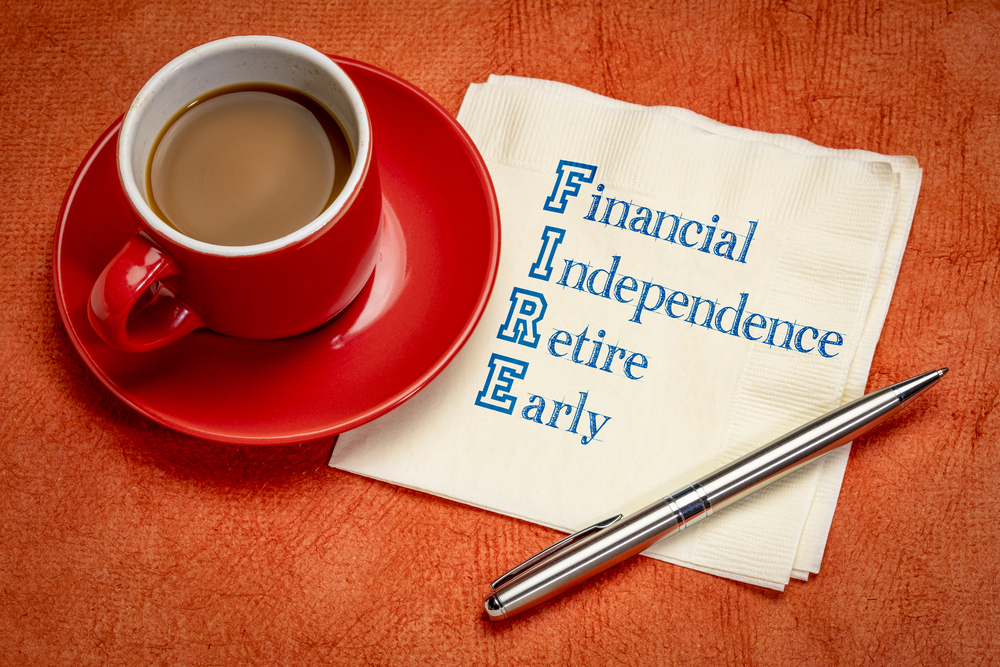
FIRE is of course an acronym for Financial Independence Retire Early. It turns out that Canadian financial bloggers are a tad more cynical about the term than their American counterparts, some of whom make a very good living evangelizing FIRE through blogs, books and public speaking.
The Hub has periodically republished some of these FIRE critiques from regular contributors Mark Seed, Michael James, Dale Roberts, Robb Engen and a few others, including one prominent American blogger, Fritz Gilbert (of Retirement Manifesto).
No one objects to the FI part of the acronym: Financial Independence. We’re just not so enthusiastic about the RE part: Retire Early. For many FIRE evangelists, “Retire” is hardly an accurate description of what they are doing. If by Retire, they mean the classic full-stop retirement that involves endless rounds of golf and daytime television, then practically no successful FIRE blogger is actually doing this in their 30s, even if through frugal saving and shrewd investing they have generated enough dividend income to actually do nothing if they so chose.
What the FIRE crowd really is doing is shifting from salaried employment or wage slavery to self-employment and entrepreneurship. Most of them launch a FIRE blog that accepts advertising, and publish or self-publish books meant to generate revenue, and/or launch speaking careers with paid gigs that tell everyone else how they “retired” so early in life.
How about FIE or FIWOOT or Findependence?
Some of us don’t consider such a lifestyle to be truly retired in the classic sense of the word. Continue Reading…
My latest Financial Post column looks at how Millennials and other young people can create a million-dollar retirement fund if they start contributing $6,000 to a Tax-free Savings Account (TFSA) the moment they turn 18. You can find the full column online by clicking on the highlighted text: The Road to the million-dollar TFSA is getting shorter for Millennials. It’s also in the print edition of Wed., Feb. 26th, under the headline “The road to saving $1 m for millennials: TFSA likely the best way to start.” (page FP3).
I’ve always been enthusiastic about the TFSA since it was first possible to contribute money to them in January 2009. My wife and I, as well as our daughter till recently have contributed the maximum to them from the get-go, always early in January to maximize the power of tax-free compounding. All three accounts have done very well. (I won’t reveal the balances but they’re consistent with heavy equity exposure through most of the bull market we appear to have been in at least until this week.)
Suffice it to say that our daughter’s TFSA has done better than ours, despite her not having contributed in the last two years because she has been working out of the country. She insisted in owning most of the FANG stocks (including Apple) and even Tesla, which was underwater until very recently but began to make headway in recent months.
It’s purely by chance that having been born in 1991, our daughter became 18 just in time for her first TFSA contribution, which naturally we funded in the early years. We viewed this as maximizing our wealth and minimizing taxes for the family as a whole.
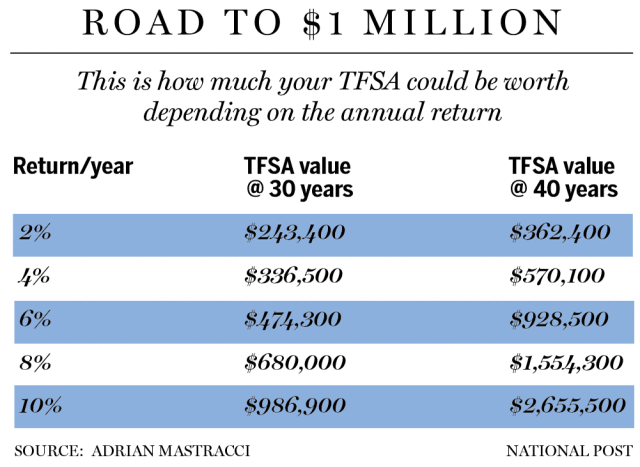
And that’s exactly the thrust of the FP article, which cites several experts who will be familiar to most readers of the Hub: Aaron Hector of Doherty & Bryant Financial Strategies, Matthew Ardrey of TriDelta Financial, Adrian Mastracci of Lycos Asset Management. Mastracci created the chart below that appeared in the FP story:
There was also valuable input from BMO Private Wealth’s Sylvain Brisebois, who created a spreadsheet to estimate the impact of missing contributions in early years. If you can’t start until 25, a six per cent return generates $1,049,000 by age 65, $600,000 less than the $1.63 million earned with the extra $42,000 you’d have saved and compounded starting at 18. Another scenario is contributing for seven years between 18 and 25, then using it to buy a home. Assuming no more contributions the next 10 years and resuming $6,000 contributions at 36, by age 65 you’d have $829,000. Brisebois also created a scenario where you only contribute $3,000 a year, which generates $815,000.
As we experienced in our family, a long time horizon favours Millennials, who can afford to take a little more risk in return for stronger returns. That in turn translates into either a bigger nest egg 40 to 45 years from now, or it means you can get to the magic $1 million mark 5 or even 10 years ahead of schedule. Of course, if you’re even younger than a Millennial (technically they must be age 24 in 2020 to qualify) so much the better, and all these principles apply equally to Generations X, Y or Z.
For that matter, as I have often written, TFSAs are equally attractive for those already in Retirement. Unlike RRSPs, you can keep contributing to your TFSA long into old age: I had a friend who proudly told me she was still contributing after she turned 100!
Mind you, after the Coronavirus fears of the past week, who can really say? Not so good for aging Baby Boomers and retirees but of course if you’re a Millennial any young person with multi-decade time horizons, it should be viewed as good news when stocks go on sale.


 Posted By