When deciding which ETFs to invest in, follow these criteria for maximum success
Image courtesy TSInetwork.ca
ETFs aim to provide broad market exposure with low cost and our Best ETFs for Canadian Investors advisory covers ETFs like no other publication in North America.
Notably, we recently released our top ETF to buy in 2024 in this newsletter. However, you’ll need to subscribe to find out what that top ETF to buy in 2024 is!
This ETF offers a solid 1.4% yield, while at the same time charging you a very low 0.0945% MER. Going forward, the fund — and its investors — should gain from an expanding U.S. economy. Plus, the ETF’s U.S. dollar exposure provides valuable currency diversification for Canadian investors; that’s a long-term positive.
When it comes to ETFs, we take a close look at the following criteria:
6 Important considerations for choosing ETFs to invest in:
Know how broad the ETF’s stock holdings are, so you can determine its volatility. The broader the ETF, the less volatility it may have. A sector-based ETF, like one that tracks resource stocks, may be more volatile.
Know the economic stability of countries that an international ETF invests in. It’s also worth mentioning that foreign leaders may not be your ally when it comes to passing laws or imposing regulations that can affect your investments
Know the liquidity of ETFs you invest in; look at the volume of shares that trade hands on a daily basis.
Consider buying ETFs in a lump sum rather than with periodic small amounts, so you can cut down on brokerage fees.
ETFs can still be volatile, even with the diversification they offer.
Don’t invest in ETFs that show wide disparities between the stocks they hold and the investments that the sales literature describes. Despite the increased attention for ETFs, many ETF managers continue to describe their investing style in vague (or sometimes misleading) terms.
Meanwhile, rather than using the six criteria above, some investors decide when to buy an ETF using technical analysis.
Technical analysis is a useful tool in deciding when to buy ETFs, but only if you recognize it as one of many tools. Before making any recommendations or transactions in client accounts, I always look at a chart. However, I don’t look at the chart for a prediction of what’s going to happen. I look to see if the pattern on the chart seems to support the view I’ve formed of the stock/ETF based on its finances and other fundamental factors. Continue Reading…
Investing advice when Putin’s at war against Ukraine. Plus, Putin and the Israel-Hamas War
Deposit Photos
Russia launched the war in 2014, during the second Obama term, when it invaded Ukraine’s Crimean Peninsula. At the time, the U.S. and NATO were still unsure about how to react to Russia’s aggression toward its former possessions. Many observers felt Russia was just trying to retrieve some of the stature it lost with the collapse of the Soviet Union in the early 1990s.
When Russia invaded Ukraine in 2022, it expected Ukraine to collapse right away (the way France collapsed under the 1940 German invasion, say). The U.S. and other observers feared/expected the same. They still began sending security aid to Ukraine before the invasion. They also used threats of trade and financial sanctions to try to scare Russia off. These steps failed. However, Ukraine fought back surprisingly well and attracted additional aid from the West.
Putin soon saw that he had guessed wrong. But he assumed the West would quickly lose interest. Instead, the West stepped up its aid. Russia then began a series of veiled threats of military escalation, all the way up to tactical nuclear weapons.
My sense is that after its initial stumble, Russia still hoped/believed that if it kept up the military pressure and escalation/nuclear threats long enough, Ukraine and its supporters would agree to a lengthy ceasefire that would work in Russia’s favour.
It seemed to me and many other people that this was unlikely. In April of that year, I wrote that “Russia could launch a nuclear war, but it would find itself fighting against most of the advanced countries of the world. Putin is vain and may be deranged, but he isn’t stupid.”
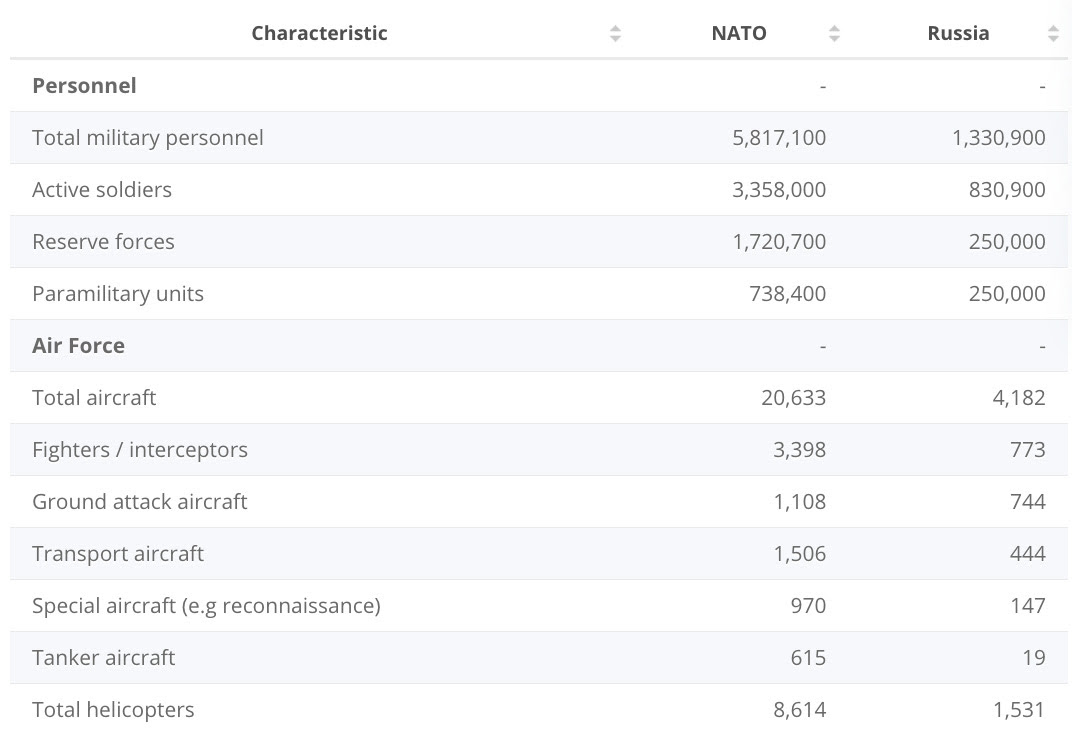
Later I voiced the off-the-cuff view that any nuclear attack on Ukraine would spark a much more lethal response from NATO forces, which vastly outnumber Russia’s.
Just recently I came across the actual NATO-versus-Russia figures (below) from veteran Toronto journalist Diane Francis, writing in her Substack.com publication. (Note: her chart refers to a Military Asset as a “Characteristic.”)
The numbers show an even greater numerical advantage for NATO than I imagined. That’s just the start.
The West is also way ahead of Russia in technology, sanctions, finances, morale, global support and pretty much anything else. Russia’s main advantage in war is its ruthlessness in throwing untrained soldiers — mostly from prisons or Russian-speaking racial/cultural minorities — onto the front lines, until the other side runs out of ammunition.
Putin can only hope that Biden or a successor loses his grip and abruptly pulls out of Ukraine the way the U.S. pulled out of Afghanistan in August 2021, after two decades of hostilities.
As the sarcastic one-liner goes, that’s not likely.
Nobody can predict these things, of course. My sense is that we are seeing the last gasps of Europe’s last empire. I’d guess the outcome won’t be pretty or quick, but it may turn out to be a historical milestone. A worldwide swing back toward democracy and away from authoritarianism just might follow.
Putin and the Israel-Hamas War
My guess is that the Israel-Hamas war is just getting started and will last a long time. I also suspect that Putin had something to do with getting it started, and will do what he can to keep it going. After all, when it comes to running his country, Putin takes a grasping-at-straws approach.
Putin may think that bringing the longstanding Mideast conflict back into the headlines is going to improve his chances of conquering Ukraine and bringing the Soviet Union back from the dead.
He thinks taking a long shot is better than no shot at all. Who knows? He might get lucky.
Early on in his war on Ukraine, Putin seemed to think that Chinese dictator Xi Jinping was going to take pity on him and his country, and offer free money and/or weapons to shore up Russia’s Ukraine invasion. Instead, Xi insists on staying out of the war, while paying discount prices for Russian oil. He takes special care not to let his country get caught up in the economic sanctions that the U.S. and NATO countries and allies are directing against the Russians.
It’s not that Putin is stupid. If a war between Israel and Hamas turns out to be a big drain on the U.S. budget, the U.S. might have less money available to arm Ukraine.
Up until lately, however, Israel has had little to say about Russia’s treatment of Ukraine. Israel may soon take a more active role in helping Ukraine defend itself.
Any war is a terrible thing, and this one is no different. Meanwhile, the stock market seems to be creeping upward. Maybe it knows something that Putin hasn’t figured out. If you’re looking for investing advice related to the wars around us, spend more time learning about the wars themselves.
Meantime, if your stock portfolio made sense to you a week or two ago, we advise against selling due to Mideast fears
No matter what the state of the world, here are three rules you can follow for maximum portfolio success:
Our first rule will help you stay out of high-risk, low-quality investments. These investments are always available, in good and bad markets. They come with hidden risks due to conflicts of interest and other negatives. Every year, they lead many inexperienced investors to substantial losses. Continue Reading…
Discover the Keys to Identifying Dividend ETFs that offer Consistency, Quality, and Long-Term Growth
Image from Pexels/Anna Nekrashevich
Higher interest rates mean dividend-paying stocks must increasingly compete with fixed-income investments for investor interest. However, sustainable dividends still offer an
attractive and growing income stream for investors.
Companies that pay regular and growing dividends have performed very well over the long run when compared to the broad market indices. For example, a simple strategy such as selecting stocks with an extended history of uninterrupted dividend growth, such as represented by the S&P 500 Dividend Aristocrats, has added 11.5% per year over the past 30 years. This compares to the 10.0% annual gain for the S&P 500 Index. And not only did the dividend payers beat the overall market, but they were also less volatile.
The superior long-term performance of the dividend growth companies can be attributed to a combination of several factors: Companies with long histories of regular and growing dividend payments generally have sound competitive business models and growing profits; these are also companies with experienced managements that make disciplined capital allocation decisions, strive for lower debt levels, and operate firms more profitable than their peers.
Notably, though, the Dividend Aristocrats’ performance lagged over the past 5 years against the S&P 500 index.
Most of this underperformance came over the last year and a half, as higher interest rates made fixed-income investments, such as GICs, more attractive for income-seeking investors when compared to dividend-paying equities.
The dividend sweet spot
Income-seeking investors who decide to take on the risk of the stock markets are faced with a wide range of options including “yield enhanced” dividend-paying ETFs, moderate-yielding companies with average growth rates, and low-yielding but fast-growing companies. Then there is also the group of companies that have very high dividend yields and may seem attractive but, unfortunately, come with elevated risk.
In many cases, a high yield may be a warning sign that all is not well with a company and that future dividend payments are at risk of being cut.
As well, a dividend cut, or even an outright dividend suspension, is often accompanied by a steep decline in the share price, as income investors dump their former dividend favourites.
A 2016 study by a group of U.S.-based academics provides some statistical guidelines for sensible dividend-based investing.
In reviewing the performance of almost 4,000 U.S. companies over 50 years, they found that dividend-paying stocks beat non-dividend payers.
In particular, the middle group of dividend yielders (i.e., those with an average yield of 4.3%) surpassed both the low yielders and the high yielders in terms of total return. Equally important, this superior performance was achieved with lower risk, as measured by the standard deviation of returns.
Based on this long-term study, it makes sense to avoid the highest-yielding stocks and rather look for companies with moderate yields and sound growth prospects. This safety-first approach will result in a lower yield but likely provide a better total return (dividends plus capital) at lower risk.
How to spot dividend ETFs worth investing in
When investing in dividend-paying companies through an ETF, here are key factors to consider: Continue Reading…
ADRs (American Depository Receipts) are a great way for investors to invest in foreign stocks
Our view on foreign investing is that for most investors, U.S. stocks can provide all the foreign exposure they need. We also feel that virtually all Canadian investors should have 20% to 30% of their portfolios in the U.S. stocks that we recommend in our Wall Street Stock Forecaster newsletter.
If you want to add more foreign content, you could buy individual stocks. But for most investors, directly investing in foreign stocks can add an extra layer of risk and expense. As well, timely and accurate information about overseas companies is not always available, and securities regulations vary widely between countries. It can also be hard for your broker to buy shares on foreign markets without paying a premium. Tax rules and restrictions on transferring funds between nations add further uncertainty and cost.
Understanding the Ins And Outs of ADRs
All in all, we think the best way to invest in foreign stocks is to buy high-quality firms that trade on the New York Stock Exchange as American Depositary Receipts (ADRs). An American Depositary Receipt is a U.S. traded proxy for a foreign stock and represents a specified number of shares in that foreign corporation.
ADRs are bought and sold on U.S. stock markets, just like regular stocks, and are issued or sponsored in the U.S. by a bank or brokerage firm. If you own an ADR, you have the right to obtain the foreign stock it represents. However, investors usually find it more convenient to continue to hold the ADR and to sell the ADR when it no longer serves their needs. Continue Reading…
We think Now is a bad time to Buy Bonds … Here’s Why
Recently a friend asked, “Pat, I see that several prominent Canadian investor advisors recently wrote articles that said it’s a bad time to buy bonds right now. Do you agree?”
He was surprised when I told him I haven’t bought any bonds for myself since the 1990s. I haven’t bought any for our Portfolio Management clients in the last couple of decades, except on client request.
In the 1990s, I used to buy “strip bonds” for myself and my clients, as RRSP investments. This was the Golden Age of bond investing. Back then, high-quality bonds yielded almost as much, pre-tax, as the historical returns on stocks. In addition, they were more stable than stocks and provided fixed income that simplified financial planning.
Bonds have tax disadvantages, of course. But you can neutralize those disadvantages by holding your bonds in RRSPs and other registered plans.
The big difference back then was that bond yields and interest rates were much higher than usual. That’s because we were still coming out of (or “cleaning up after,” you might say) the inflationary bulge of the 1970s and 1980s.
In the 1980s, government policies pushed up interest rates and took other measures to hobble inflation, and it worked. But interest rates stayed high for a long time after the government policies broke the back of inflation: kind of like finishing the antibiotic prescription after the infection goes away.
Long-time readers know my general view on the stocks-versus-bonds dilemma. When interest rates are as low as they have been in recent decades, high-quality stocks on the whole are vastly superior to bonds. However, you have to understand the differences between the two. For one thing, stocks are more volatile than bonds. But volatility and safety are two different things.
Volatility refers to sharp price fluctuations, often due to short-term uncertainty and the randomness of short-term market movements. Safety refers to the risk of permanent loss.
Bonds improve portfolio stability but cut investment returns
You might say that what you get from bonds is the opposite of what you get from the stock market.
Inflation near-automatically reduces the purchasing power of bonds. Inflation can also hurt the returns you make in the stock market, of course. However, companies you invest in can take steps to cut the costs of inflation. They can pass on cost increases to their customers. They can introduce new processes and equipment to improve productivity and cut their costs. Continue Reading…


 Posted By