


Hub Blogs

Hub Blogs contains fresh contributions written by Financial Independence Hub staff or contributors that have not appeared elsewhere first, or have been modified or customized for the Hub by the original blogger. In contrast, Top Blogs shows links to the best external financial blogs around the world.

What every woman needs to know about Retirement

what_every_woman_needs1
Akaisha Kaderli

By Akaisha Kaderli

Special to the Financial Independence Hub

The other day I read an article about women and retirement. In this piece, the number one premise for motivation was that we should be afraid. Very afraid. It said that for the most part, men did the planning for retirement and that we as women rely on them blindly.

I dislike reading articles such as this, first, because it is fear-based but second, it doesn’t take into consideration the talents women contribute to the mix of partnership and planning. While it might be true that men are “wired to provide for the household,” women have moved into professions which pay grandly. Many marriages today are a different blend of partnership than what our own parents or grandparents enjoyed. Along with their jobs, many women still run the household, so why not get involved in retirement planning in a proactive manner?

Retirement is a boring word

The word “retirement” conjures up images of old people on pensions or perhaps pictures of those who no longer contribute powerfully to society with their expertise and knowledge. I prefer the description “financially independent” for the freedom, influence and self-reliance it implies.

One can choose financial independence at any stage of life and it’s an exciting and worthy goal. The younger a person begins on this path, the more you have in your favor.

Women, listen up

Continue Reading…

SPIVA Scorecard: Canada comeback?

graham-bodel
Graham Bodel

By Graham Bodel, Chalten Advisors

Special to the Financial Independence Hub

“Not to fear, we have found a manager based in our very own Canada that is able to consistently beat the pack.”

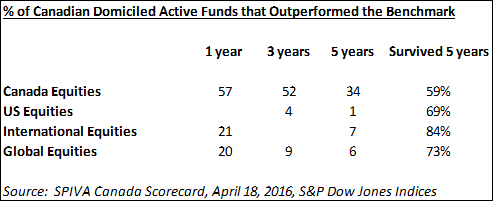
Standard & Poor’s has done a brilliant job over the last few years of shining the light on the fund management industry by publishing its SPIVA (S&P Indices Versus Active Funds) Scorecards,  which report on the performance of actively managed mutual funds relative to their benchmark indices.

We’re not spoiling anything by telling you the results don’t usually come out favourably for active managers:  the performance data has been fairly consistent and compelling for years.

The latest SPIVA Canada Scorecard for the year ended December 31, 2015 came out on Monday and at first glance there may be reason to cheer, especially for those fund managers focused on domestic stocks.

SPIVA Canada Scorecard 2

While 57% might not seem very convincing, it’s certainly a better result than US domestic equity managers, only 25% of whom managed to beat the benchmark last year (Source: SPIVA US Scorecard).

Of course, 2015 was a year where the Canadian stock market performed worse than any other developed market globally in USD terms and was only able to squeak past Russia and Brazil.   If you’d been one of the few lucky Canadians to properly diversify outside of Canada last year, you would have been disappointed with active fund management as only 21% of Canadian funds managing International Equities (outside North America) were able to outperform their benchmark.

The longer the time period, the worse the results

Continue Reading…

Advisors now more likely to recommend ETFs for clients than mutual funds

davenadiq
Dave Nadig

Here’s my latest MoneySense blog, which recaps the two-day  Exchange Traded Forum 2016 in Toronto this week.

You can find the full blog by clicking on this headline: Are ETFs beating out mutual funds in popularity?

Pictured to the left is Dave Nadig, ETF director for FactSet Research Systems Inc. of Norwalk, CT,  who in his keynote address said that since the financial crisis,  net mutual fund inflows were US$61 billion, compared to a whopping US$1.2 trillion for ETFs.

Hockey stick curve

Continue Reading…

Corporate class mutual fund structure still strong despite changes in Budget

Som-Headshot
Som Seif

By Som Seif,  Purpose Investments

Special to the Financial Independence Hub

As many of you have already heard, in its most recent budget, the federal government announced plans to alter the structure of the corporate class model.

Starting in September, switching between corporate class series funds will become a taxable event: just like that of a traditional mutual fund trust.

While this decision will affect retail investors’ ability to compound wealth over the long term and will likely result in some mutual fund manufacturers electing to abandon the corporate class structure, it has very little impact on the true benefit of the structure.

Structure still has tax-efficient distribution yields

Continue Reading…

Will fin-tech disrupt the asset-based model for dispensing financial advice?

Cute RobotMy latest Financial Post blog reports on the Radius Exchange Traded Forum 2016 conference that began on Tuesday and continues Wednesday at the Design Exchange in Toronto.

You can find the full blog by clicking on this highlighted headline: Robo Advisers and ETFs prove it’s time for a new financial advice fee structure. 

That model, described before here at the Hub, consists of taking advantage of the scaling possibilities of so-called “fin tech” (financial technology) like robo advisers and the underlying ETF structures, and moving from an asset-based model based on a percentage of client wealth, and moving to a Netflix-like monthly subscription model.

Needless to say, not everyone in the established financial industry is thrilled by that prospect. To quote one of the experts cited, “Index funds are like garlic to vampires for Wall Street.”