Hub Blogs contains fresh contributions written by Financial Independence Hub staff or contributors that have not appeared elsewhere first, or have been modified or customized for the Hub by the original blogger. In contrast, Top Blogs shows links to the best external financial blogs around the world.
After serving your workplace for years and decades, it’s that time of your life when you can retire in peace and enjoy your retirement years to the fullest. However, does that mean you should ditch your life insurance policy? Think closely before scrapping your life insurance.
Many individuals might think life insurance is required only when they are young, have a family to support and need to pay off their debts. The very first question that comes to their mind is usually “Why do I need a life insurance policy in my retirement?”
Retirement and Insurance
Firstly, you need to know that life insurance is not about you. People buy life insurance in order to protect and secure the future of their loved ones and whoever depends on the insured’s income. It is there to give your family a future that is financially sound and stable.
It’s been said that diversification is the investing equivalent of a free lunch, since it allows you to manage your risk while getting higher returns.
The good news is that according to research, index funds and other passively managed investments like ETFs (Exchange traded funds) have diversification built in.
Yes, we’ve heard of people who were able to buy the right individual stock or sector at the right time, but they are few and far between. You can learn more about the free lunch of indexing by viewing the latest FWB video by clicking on this title: There is such thing as a free lunch and it’s called index investing.
Indexing beats picking individual stocks or sectors
The video, which runs three-and-a-half minutes, points out that using index funds to diversify equity exposure around the world is easier and more effective than attempting to pick individual stocks or even identifying promising industries.
And while it’s possible to buy the entire world’s stock market through a single fund, investors shouldn’t take that for granted. As investment author Lars Kroijer relates, 40 or 50 years ago you would have been hard pressed to be able to buy into most markets outside North America, Europe or Japan.
In every pullback in the stock market, every one of us faces an epic battle with our emotions. Our emotions are often telling us to do something … anything to minimize the damage that is occurring to our stock portfolios.
Here’s the thing. It’s perfectly normal. As humans, we’re wired for it.
Whenever we encounter periods of stress and adversity, we are wired to search, process, and identify solutions to remedy the problem immediately. Sitting on are hands and doing nothing doesn’t seem to make it to the top of our list.
Here’s an example that I recently faced. One night my family was at my sister-in-law’s place hanging out. Later in the evening my wife and I received what looked like a long distance call so we both thought it was spam because we didn’t know anyone from where the area code came from.
We moved along. About a half-hour later I was checking my phone and I saw a number flash up from our home alarm service. Uh-oh. I thought something happened. Ironically I was just at the house to get some PJ’s for the kids and I came back to my sister-in-law’s house when I saw the message. I thought, “did I leave the door unlocked? Did the door blow open and someone ran in ?”
The need to do something … a real-life example
I had a variety of emotions go through me and all of them were involving panic. I told my wife, who then proceeded to ask me if I left the door open or if I activated the alarm. All these questions meant nothing to me at that moment because potentially someone could be in my house trashing it. I was asking my wife what should we do because clearly I didn’t have my wits with me.
We needed to do something. So we called the alarm company and indeed the alarm went off and police were being dispatched. I bolted back in the car and drove like a crazy guy back to the house. I got there. Nothing. The door was closed and locked. I opened the door and inside I could see these balloons from my son’s birthday party float around the house. It must have tripped the motion detector. We were able to cancel the dispatch to the police. All good.
What happened here? I incurred a stressful, emotional moment and instead of staying calm (like my wife), I was jumping around looking to do something because in a way I was feeling helpless and not in control of the situation. This happens to us constantly in investing. When the markets or a specific stock or ETF falls, we feel we have to do something. Sell some of it. Sell it all. We need something to go down to help us regain our security.
Investment coaches can install balance
The reality is times of market stress are times to fully reinforce and execute your investment ideology and investment plan. Instead of feeling woe on the 500-point drop in the Dow Jones Industrials, we need to take control of the situation by not “trading” but instead should be reviewing our Investment Ideology to reinforce the values and criteria we need to implement to make better decisions and we need to clinically and thoughtfully execute our investment plan. Investment coaches are great at instilling this balance and discipline. This concept of being reactive versus proactive is a nemesis to us all.
Another reality is that market pullbacks are the worst time to start running around the house with scissors in your hand. We will most likely make a panicked decision that will often put our portfolio on a worst footing in the long term. This tension is engrained in us and it is so hard to overcome for each and every one of us, yours truly included.
So the next time the stocks in your portfolio are falling collectively and meaningfully (It will happen. Count on it), try to resist that pressure to have to do something immediately. Now I premise this with the exception that if a stock of a company is undergoing a negative Game Changer Moment, and the fundamentals of the business model have truly been impaired then you need to take action to preserve your savings. Just do the homework and due diligence.
Aman Raina, MBA is an Investment Coach and founder of Sage Investors, an independent practice specializing in investment coaching and portfolio analysis services. This blog was originally published on his website on March 21st and is reproduced here with permission.
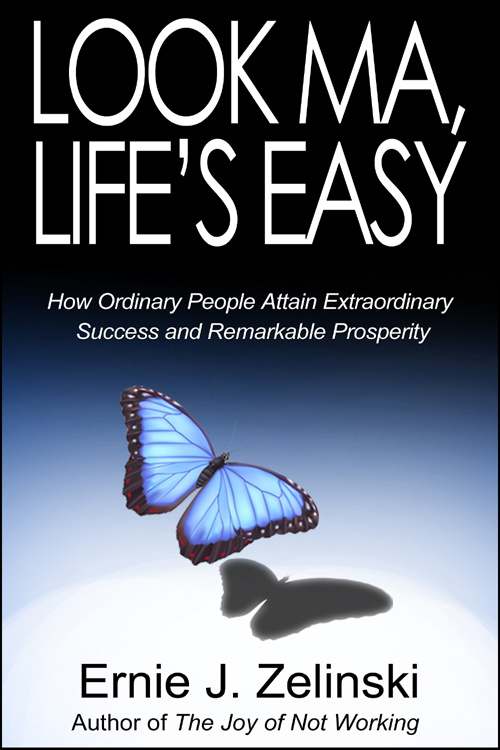
Ernie Zelinski is a successful Edmonton-based author who has sold more than 900,000 books in 29 countries around the world. He has just published his latest book, titled Look Ma, Life’s Easy, which passes on his secrets for success, primarily to the millennial generation. .
The new book takes a pseudo-fictional approach like the one famously used by David Chilton in The Wealthy Barber (or less famously, in my own Findependence Day!).
Zelinski’s subtitle is “How Ordinary People Attain Extraordinary Success and Remarkable Prosperity.” The story revolves around two characters, a young adult named Sheldon and his soon-to-be mentor Brock, described as a successful middle-aged man.
The Easy Rule of Life
Over the 200-plus pages of the book Brock imparts to Sheldon his secret of success, which he calls The Easy Rule of Life.
This is the main takeaway, which has a certain amount of paradox in it: Continue Reading…
I also mentioned the coming May 30 Point of Sale Stage 3 (POS3) regulatory deadline for pre-sale delivery of disclosure documents to mutual fund investors. On that day, dealers and advisors will have to send investors Fund Facts disclosure documents before the investor decides to buy a fund. Until May 30, dealers and advisors still will be able to abide by the previous industry regulation (i.e. POS Stage 2), which gave them two days to provide the Fund Facts document to their clients after the mutual fund purchase. Not so beginning May 30.
Stage 1 was four-pager in 2011
This is part of the industry satisfying the call by regulators to move ahead with POS (Point of Sale) delivery requirements for Fund Facts. Stage 1 of the POS regulation was introduced in 2011 with the creation of the short, four-page Fund Facts document that was in plain English and easily understood. It has since replaced the lengthy, jargon-filled legal prospectus document.
The introduction of Fund Facts at or prior to the Point of Sale means an electronic transaction will take place in most disclosure cases. After all, electronic is instantaneous. We first launched our Fund Facts delivery solution, www.investorpos.com, in 2011. Since then approximately 96% of these transactions have been electronic while only 4% have been going through our printed mail stream.
The document repository contains the universe of most recently filed Fund Facts documents from every mutual fund and ETF manager in Canada, so dealers and their advisors can access these disclosure documents from a single source. These new regulations will result in cost savings for the industry that can be passed on to investors. One of our bank clients requested and received a regulatory exception, and implemented our POS solution well in advance of the regulation date because they could see the cost advantage – both for them and their clients.
CRM2 deadline is July 15
Another date to watch is the CRM (Client Relationship Model) 2 deadline of July 15. The idea behind CRM2 is to provide investors with clear information about the securities fees and commissions they are paying. The idea behind this is to make investment dealers, brokers and portfolio managers more accountable.
In a nutshell, CRM2 means all dealers must provide statements with detailed information about what fees are being charged to the client in actual dollar amounts. This will also include sales incentives and embedded fees. No longer will statements present fees as a simple percentage. Now customers will know exactly how much they are paying for the service, and also how those investments are performing.
There is definitely growing support around the world to eliminate embedded commissions from mutual funds; this has already happened in the United Kingdom and elsewhere. Likewise, there is no doubt that the move to greater disclosure, transparency and focus on the overall cost of investments will only increase in future. The financial crisis of 2008 was the catalyst behind this, and recent market softness has renewed the commitment of those who are intent on educating investors about their portfolios.
Some people may be in for a surprise when they learn they haven’t been paying 1% or 2% as they had thought, and may turn to low-cost discount brokers or ETFs. On the other hand, they may see the value, and feel more comfortable knowing exactly how and what their advisor makes, and in that sense this could improve the advisor-client relationship.
Industry will be more accountable to its customers
Either way, the purpose behind CRM2 and POS3 is to make the industry more accountable to its clientele, and to make that clientele more knowledgeable about their own investments. However, while CRM2 hangs on the July 15 deadline, investors’ statements may continue to appear just as they have for some time yet. Dealers will have up to one year from that date before they have to send investment performance and compensation reports. Thus, most people will likely not receive this data until the first quarter of next year.
The Canadian Securities Administrators (CSA) says these changes bring Canada in line with regulatory standards around the world. And having an easy-to-understand breakdown of fees with CRM2 only leads to a better informed and better educated investor.
Anthony Boright is President and co-founder of InvestorCOM (www.investorcom.com), which leverages technology to address the evolving regulatory disclosure and communications needs of the financial services industry. InvestorCOM helps its clients create and distribute their communications online, as well as through traditional print/mail channels. Clients include banks, asset managers, life insurance companies, large and small IIROC (Investment Industry Regulatory Organization of Canada), and MFDA (Mutual Fund Dealers Association of Canada) dealers and advisors serving investors.


 Posted By



 Posted By