Hub Blogs

Hub Blogs contains fresh contributions written by Financial Independence Hub staff or contributors that have not appeared elsewhere first, or have been modified or customized for the Hub by the original blogger. In contrast, Top Blogs shows links to the best external financial blogs around the world.

Should you help your Adult Children get out of Debt?

doug
Doug Hoyes

By Douglas Hoyes

Special to the Financial Independence Hub

We have all heard the expression “once a parent, always a parent,” so it’s not surprising that you may want to help your adult children with their financial problems.

A young adult may be burdened with student loans and other debts, and may have not yet had success in the job market. As a senior adult, perhaps having already achieved Findependence, is it wise to financially help your adult children?

The first question to consider is: will giving them money truly help them? You won’t be around forever, so at some point your offspring must learn to fend for themselves. Letting them deal with their financial problems now, on their own, while you are still around to provide moral support may be in their long-term best interests.

Such assistance could jeopardize your own financial security

Of greater concern is that financially assisting your adult children could jeopardize your own financial security.

In my firm’s recent Joe Debtor study we discovered that, of people who go bankrupt, seniors and pre-retirement debtors have the highest levels of unsecured debt of all age groups. If the only way you can help your children is by going into debt yourself, you put yourself at risk for serious financial problems. Continue Reading…

How Business Owners can level pension Playing Field with the Public Sector

jplaporte
Jean-Pierre Laporte

By Jean-Pierre Laporte

Special to the Financial Independence Hub

The Great Recession of 2008 had many consequences, but in the world of pensions, it truly highlighted the chasm separating private-sector from public-sector retirement plans.

The “Great Divide” boils down to this: civil servants have back-stopped, defined benefit pension plans that will provide a comfortable level of pension benefits in retirement, whereas the tax payers responsible to fund such great plans are largely relegated to RRSPs with much lower contribution limits and a limited ability to weather financially volatile markets.

For most, this state of affairs is immutable and lamentable. For those who have made pensions their passion or profession, there are solutions. The difficulty is to make them accessible to the majority, who happens to be the marketplace. What are some of these solutions that put the private and public sectors on an even keel?

The Dividend Route

Continue Reading…

Weekly Wrap: “Heightened uncertainties” from the Fed, hedging risk, bear books

yellen
Janet Yellen

I have just returned from a two-week trip to Hong Kong and Taiwan, just in time for the Federal Reserve’s long-awaited decision to delay the first rate hike since the financial crisis.

The key phrase “Heightened uncertainties abroad,” spoke as loudly as the lack of action, as Fed chairwoman Janet Yellen noted the risks of both China and Emerging Markets in generally spilling over into the United States.

Hedging in the Retirement Risk Zone

For those of us who are in the “Retirement Risk Zone,” — including Yours Truly — the caution behind the Fed’s decision could suggest that for some it may be appropriate to dial down portfolio risks. Since late August, I have followed my personal financial adviser’s recommendation to remain invested but to hedge back one third of US and Canadian equity exposure.

Generally, at whatever age, it makes little sense to take more risk than you need to take and the Fed’s decision (or non-decision) underlines that there are still extensive risks out there, certainly in the equity markets as well as fixed income. Fred Kirby, a fee-for-service planner at Dimensional Investment Planning, says it’s time to be cautious and protect profits. As I quoted him earlier this year, he suggests that those who are averse to market timing can consider the newer “low-volatility” ETFs. For Canadian exposure, he suggests the BMO Low Volatility Canadian Equity ETF (ZLB), which holds 40 stocks deemed to have the lowest risk. For U.S. stocks he likes the BMO Low Volatility US Equity ETF (ZLU), which uses the same methodology and holds 100 companies. For international equities, Kirby likes the iShares MSCI EAFE Minimum Volatility Index ETF (XMI). (There’s also an iShares low-vol ETF for Emerging Markets).

“These ETFs automatically position the cautious investor for any additional future gains without having to make a market-timing re-entry decision,” Kirby says. “This could be just the sort of compromise that lets some investors stick with their investment plans even when they do not want to.”

Actively Managed ETFs

On the same subject (ETFs), my latest Financial Post ETF column ran earlier this week, tackling actively managed ETFs. See Why Fund Investors Should Get Active with their ETFs.

Bear books revisited

Continue Reading…

Sudden Retirement Syndrome (SRS)

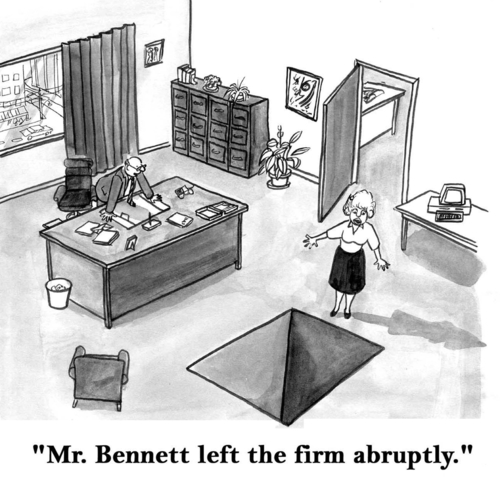
'Mr. Bennett has left the firm abruptly'By Michael Drak

Special to the Financial Independence Hub

Sudden retirement syndrome is not a real medical condition as far as I’m aware but for me it best describes the shock of withdrawal that occurs when a person leaves their corporate job.

This can occur through either downsizing, formal retirement or can even occur when a person is leaving after many years spent with the Corp to do something else.

The shock from going unprepared from a busy work-life to nothing can be very stressful and in extreme cases can even result in premature death. We all have heard stories of people in retirement who lost their motivation to do much of anything, started drinking heavily, and died within a short time.

I’ve known quite a few people who have suffered from SRS. My father suffered through it, a close friend died because of it, and I even had a taste of it after leaving my corporate job of 36 years — which is crazy in itself because I already had a game plan in place for my next move. I clearly remember the ringing in my ears, the feeling of uncertainty, the feeling of living in a fog for a period of time. It’s hard to break away from something that has become a piece of you over the years.

It’s important to note that not everyone will suffer from SRS. People who are able to detach themselves successfully from work when they walk out the door are usually spared. An example would be an assembly line person who is able to leave their job when the whistle blows and not think about work until the next day. While an assembly line worker may be burned out physically and mentally, as they are not challenged intellectually, the Corp does not own their soul, unlike corporate executives who are linked to their work 24/7 and whose self-identity is tied to the job that just ended.

Retirement shock can be hell

Continue Reading…

Investor Toolkit: When useful investment terms lead to costly mistakes

Patrick McKeough, TSINetwork.ca

By Patrick McKeough, TSInetwork.ca

Special to the Financial Independence Hub


Today’s tip: “Investor shorthand can provide a useful guide to investment information, but it can also oversimplify analysis and events and steer investors into bad decisions.”

Investor shorthand can help you think about and talk about large blocks of investment information. But it may also lead you to make associations and come to conclusions that can cost you money.

For example, think about the common investor shorthand term, low-p/e stocks. It encompasses four statistics: price per share; per-share earnings; the p/e (the ratio of a stock’s price to its per-share earnings); and low p/e (which suggests a normal range exists for p/e’s generally, or for p/e’s of stocks of a particular type or description, and that these stocks are near the lower half of the range).

Some investors, beginners especially, see special appeal in stocks with low p/e’s. They jump to the conclusion that the p/e is low because the “p” or stock is low, and that this is a sure sign of a bargain. When you use that term to generalize, however, you can lose sight of the fact that p/e’s can be (or can seem) low for all sorts of reasons.

For example, maybe the “e” or earnings is temporarily high, due to unusual factors that will soon revert to normal or worse. Or, the stock price may be low, and headed lower, due to negative conditions or trends in the company or its industry.

Of course, many experienced investors understand how the use of shorthand investment terms can warp investor perceptions, and lead them to take on unwanted risk. But they fail to see the upside-down version of that risk in newer, poorly-defined terms. One good example is “bubble”.

The long bubble of the automobile industry

Continue Reading…