


Hub Blogs

Hub Blogs contains fresh contributions written by Financial Independence Hub staff or contributors that have not appeared elsewhere first, or have been modified or customized for the Hub by the original blogger. In contrast, Top Blogs shows links to the best external financial blogs around the world.

Sudden Retirement Syndrome (SRS)

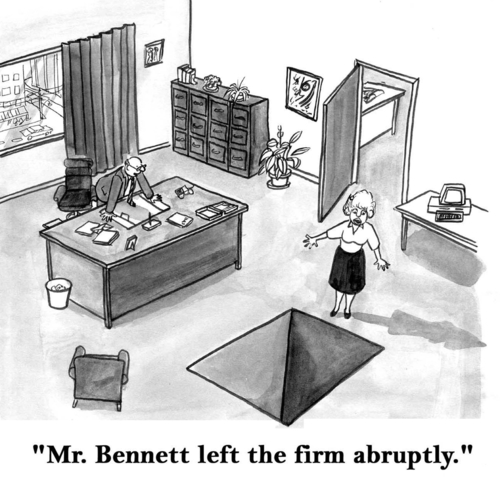
'Mr. Bennett has left the firm abruptly'By Michael Drak

Special to the Financial Independence Hub

Sudden retirement syndrome is not a real medical condition as far as I’m aware but for me it best describes the shock of withdrawal that occurs when a person leaves their corporate job.

This can occur through either downsizing, formal retirement or can even occur when a person is leaving after many years spent with the Corp to do something else.

The shock from going unprepared from a busy work-life to nothing can be very stressful and in extreme cases can even result in premature death. We all have heard stories of people in retirement who lost their motivation to do much of anything, started drinking heavily, and died within a short time.

I’ve known quite a few people who have suffered from SRS. My father suffered through it, a close friend died because of it, and I even had a taste of it after leaving my corporate job of 36 years — which is crazy in itself because I already had a game plan in place for my next move. I clearly remember the ringing in my ears, the feeling of uncertainty, the feeling of living in a fog for a period of time. It’s hard to break away from something that has become a piece of you over the years.

It’s important to note that not everyone will suffer from SRS. People who are able to detach themselves successfully from work when they walk out the door are usually spared. An example would be an assembly line person who is able to leave their job when the whistle blows and not think about work until the next day. While an assembly line worker may be burned out physically and mentally, as they are not challenged intellectually, the Corp does not own their soul, unlike corporate executives who are linked to their work 24/7 and whose self-identity is tied to the job that just ended.

Retirement shock can be hell

Continue Reading…

Investor Toolkit: When useful investment terms lead to costly mistakes

Patrick McKeough, TSINetwork.ca

By Patrick McKeough, TSInetwork.ca

Special to the Financial Independence Hub


Today’s tip: “Investor shorthand can provide a useful guide to investment information, but it can also oversimplify analysis and events and steer investors into bad decisions.”

Investor shorthand can help you think about and talk about large blocks of investment information. But it may also lead you to make associations and come to conclusions that can cost you money.

For example, think about the common investor shorthand term, low-p/e stocks. It encompasses four statistics: price per share; per-share earnings; the p/e (the ratio of a stock’s price to its per-share earnings); and low p/e (which suggests a normal range exists for p/e’s generally, or for p/e’s of stocks of a particular type or description, and that these stocks are near the lower half of the range).

Some investors, beginners especially, see special appeal in stocks with low p/e’s. They jump to the conclusion that the p/e is low because the “p” or stock is low, and that this is a sure sign of a bargain. When you use that term to generalize, however, you can lose sight of the fact that p/e’s can be (or can seem) low for all sorts of reasons.

For example, maybe the “e” or earnings is temporarily high, due to unusual factors that will soon revert to normal or worse. Or, the stock price may be low, and headed lower, due to negative conditions or trends in the company or its industry.

Of course, many experienced investors understand how the use of shorthand investment terms can warp investor perceptions, and lead them to take on unwanted risk. But they fail to see the upside-down version of that risk in newer, poorly-defined terms. One good example is “bubble”.

The long bubble of the automobile industry

Continue Reading…

The Longevity Game Show: Stay Hungry for the Bonus Round

markvenning
Mark Venning, Change Rangers

By Mark Venning, Change Rangers

Special to the Financial Independence Hub

If you thought that getting through the long 2015 federal election campaign — the “spin the wheel for tax dollars” game show – -was more than your attention span could handle; think again. The Longevity game show is in full swing! And by all accounts, we have barely begun to see the peak in audience participation.

As one of over 9 million Baby Boomers playing from home with your finger on the buzzer, your first question is – “What is your longevity expectation?” Quick thinking might suggest to you, based on the last statistical survey you read, that you are an “average Canadian,” so your immediate answer could be 82.

Finger off the buzzer. Depending on what perspective you have from the perch you sit on in your age band, how you envision your life expectancy will depend on so many variables. Living beyond that average 82 may appear like a short or a long game. So the second question is: “How will you feed your longevity?”

Financing your longevity

Continue Reading…

What it means to Retire with Debt

doug
Doug Hoyes

By Douglas Hoyes

Special to the Financial Independence Hub

It’s a reality that Canadians are increasing their personal debt load.

Whether or not the debt levels they are carrying are cause for concern depends on who you talk to and on what day. On one day you will see a story that debt-to-income ratios, now at 163%, are at record highs and households are standing on the precipice. The next day you will read an article about how interest rates are at an all-time low, making debt affordable.

I can confidently say that my opinion doesn’t change from season to season or year to year. In my opinion, debt does not go well with either retirement or Findependence.

Seniors accounting for more bankruptcies

Granted, I’m an insolvency professional: a bankruptcy trustee who sees people who have accumulated an extreme amount of debt. Every two years at my firm, Hoyes, Michalos & Associates Inc., we review all of our client files to determine who is carrying debt and why. In our Joe Debtor study this year we discovered that seniors represent an ever increasing percentage of total bankruptcy filings. Even worse, they have the highest level of unsecured debt of any age group at the time of filing, with over $69,000 of unsecured debt. Continue Reading…

Stop Doing # 6: Stop Trying to Correct for Market Corrections

stevelowrie
Steve Lowrie

By Steve Lowrie, Lowrie Financial

Special to the Financial Independence Hub

Recently, the market has been playing right into an important addition to our financial “STOP Doing” list: Stop trying to correct for market corrections.

The subject is not a new one to us. In August 2014, we posted this Q&A: “Is there going to be a market correction (and, if yes, then what)? In light of current events, we’ve now updated that post with 2014 year-end information.

Just as it takes no special skill to predict some days of sub-zero temperatures this winter, we were not being prescient a year ago, when we said that we would probably experience a correction sooner or later. One need only consider abundantly available evidence to recognize that, viewed seasonally, the market frequently “corrects” itself, sometimes dramatically. It’s only when we take the long view that we can see the market’s overall upward movement through the years.

For example, consider the Dimensional Fund Advisors slide shown below, which depicts the U.S. stock market’s gains and losses over the past 35 years. Continue Reading…