Hub Blogs contains fresh contributions written by Financial Independence Hub staff or contributors that have not appeared elsewhere first, or have been modified or customized for the Hub by the original blogger. In contrast, Top Blogs shows links to the best external financial blogs around the world.
Discover essential strategies and insights into succession planning to ensure a smooth transition and ongoing financial success for your small business.
Adobe Stock: Prostock-studio
By Dan Coconate
Special to Financial Independence Hub
As small business owners approach early retirement, ensuring the continued financial success of their business becomes a top priority. The journey of building a business is filled with hard work, passion, and dedication.
To ensure that successors are prepared to carry on the legacy and achieve ongoing financial success, delve into these essential strategies.
Succession Planning
Succession planning is a critical part of preparing for retirement. Identifying potential leaders within the team early on and providing them with opportunities to grow is key. This includes offering challenging projects, exposing them to various aspects of the business, and involving them in key decision-making processes. An effective succession plan ensures a smooth transition and continuity when the time comes for new leadership to take the reins.
Financial Literacy Training
Financial literacy is indispensable for any leader aiming to drive business success. Investing in comprehensive financial training programs that cover budgeting, financial analysis, risk management, and strategic financial planning is crucial. Developing a strong grasp of financial principles equips future leaders to make informed decisions that positively impact the business’s bottom line.
Executive Coaching
Executive coaching plays a significant role in developing leadership skills and ensuring alignment with business goals. There are several benefits to offering personalized executive coaching sessions, whether led by you or a third party. It’s an easy way to help potential leaders enhance their decision-making abilities, improve their emotional intelligence, and refine their leadership style. Continue Reading…
We recently conducted a “Value of Advice” survey of Canadian investors that reinforced to us how important financial advice really is. We found that while advisors enjoy high levels of client satisfaction and loyalty, younger investors are increasingly opting to manage their assets themselves through online discount brokerages and digital services.
Among Canadian investors, 44% feel their advisor provides high value, and 74% believe their financial advisor is worth every dollar they pay. Additionally, 71% say they plan to remain with their current advisor, with that figure rising to 80% among those aged 55 and over.
While these results were not surprising, the level of trust that financial advisors enjoy is changing with a cohort of younger investors. Among those aged 18-34, 40% use online platforms for investment management, while only 38% rely on financial advisors. By contrast, 70% of those over the age of 55 use a financial advisor, with only 17% turning to online platforms.
A Tale of 2 Investors
It’s clear that Canadian investors highly value financial advisors and the guidance they provide. However, there is a tale of two investors split by age in terms of the duration, method and frequency of financial advice they receive.
This presents both a challenge and opportunity for financial advisors to provide more holistic wealth management services and relationship-oriented advice to younger investors.
While younger investors are more inclined to go digital with investing, they also show a significant level of hesitation. Among younger investors, 35% report not fully trusting their financial advisor. When asked whether they can manage their own investments, many admitted to lacking the time (47%), knowledge (39%), or confidence (42%) to do so effectively.
The study highlighted that financial advisors remain the preferred source of advice for most Canadians, regardless of age. In fact, 89% of investors report that their go-to source for financial information and advice is their financial advisor or bank. Moreover, human advisors are perceived to deliver better investment returns, with 44% of respondents believing that human advisors generate higher returns, compared to only 9% who hold the same view of robo-advisors.
Almost half in regular touch with advisors feel optimistic about their financial future
The data revealed that frequent communication with clients is shown to make a significant difference in client satisfaction and optimism. Among those who communicate with their advisor monthly or more, 46% feel optimistic about their financial future, compared to just 18% of those who communicate only once a year. Additionally, 40% of those who have a financial plan created by an advisor express a high level of optimism about their financial future, compared to only 22% of those without a formal plan.
We have been looking at the impact of financial advice for more than 25 years and the utility and benefits are the same.
As the investment landscape evolves, financial advisors will need to focus on building trust, maintaining regular communication, and emphasizing the value they provide in an increasingly digital world. Doing so will enable them to serve both traditional and younger investors more effectively, today and in the future.
Mario Cianfarani is head of distribution for Vanguard Canada. Most recently, Mario was head of national accounts & institutional sales and was previously head of ETF capital markets. Before joining Vanguard in June 2015, he was a portfolio manager at First Asset Investment Management, responsible for domestic and global equity ETFs and sector-based, North American covered call ETFs. Mario has held senior sales and trading positions with a number of Canadian capital markets teams. His experience includes trading equity derivatives and marketing derivative-related risk management solutions to a broad range of clients.
Mario earned a BA in applied mathematics from York University and is a CFA® charterholder.
2023-2024 HireAHelper Moving Migration Report: Artwork by Esther Wu
By Volodymyr Kupriyanov
Special to Financial Independence Hub
When we released our last study of starting a moving labor company as a side hustle, it was a great time to get into the business. Home sales were at an all-time high, and the number of Americans who moved that year inched up for the first time in a decade.
However, after only one year, the housing market has cooled off. And even though sales of newly built homes are still up 6%, home sales as a whole aren’t as high as last year.
The cost of moving has also grown 4% in 2023 (ahead of inflation rates), and this is actually good news! It means movers’ earnings have most likely also increased. So if you’re interested in adding a side hustle to your income, starting a moving labor company is well worth considering.
Findings from 2023 Study on Moving Labor
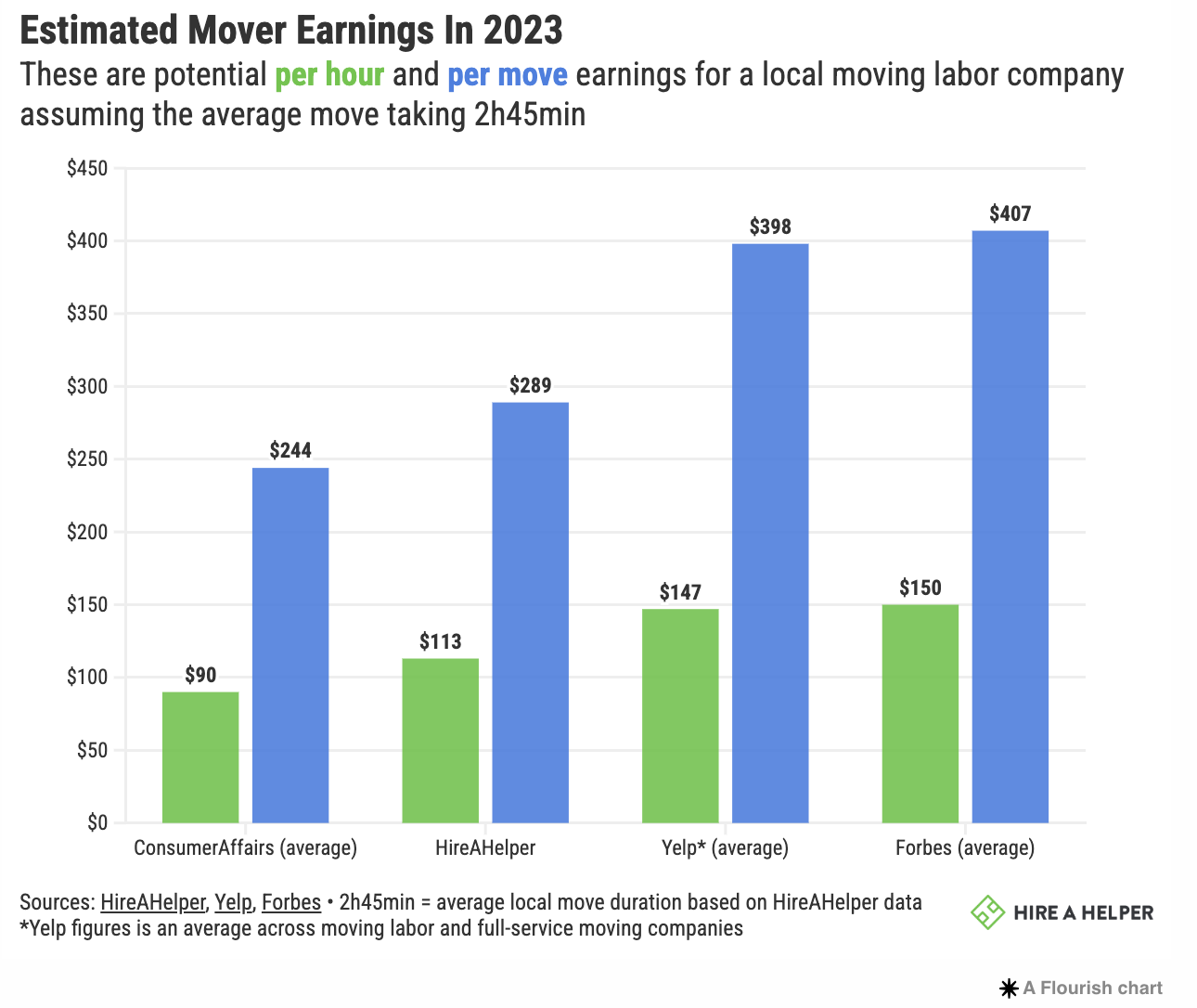
In 2023, a typical moving company earns between US$90 and $150 per hour on average, or from $244 to $407 per move
Mover earnings in 2023 are highest in Birmingham, AL where average hourly earnings on a labor-only move reached $146
The state with the greatest demand is Mississippi, with 434 moves per moving company registered in the state
What is a Moving Labor Company, and can it work as a Side Hustle?
You can start a side hustle as a full-service mover. These are the huge van line companies, and they tend to offer the whole service package and charge significantly more. Moving labor companies are often responsible for loading, unloading, and, sometimes (though rarely), packing up people’s possessions.
Why is labor-only so profitable?
Here are a few more reasons why moving labor is a good choice for a side hustle:
You don’t require a special mover’s license in most states
No need to invest in your own truck or spend money on gas
With almost half (48%) of all moves taking place on the weekend, you can keep this side hustle alongside your main job or your studies
Fast Facts about Moving Company Earnings in 2023
Here are some estimates on moving marketplace earnings:
How much revenue do movers make per hour?
In 2023, the average amount a moving labor company earned on HireAHelper is $113 per hour (after fees). That rate is based on the service of two movers loading and unloading a customer’s belongings and does not include potential tips.
According to Forbes, local movers usually charge between $50 to $250 per hour in 2023. Continue Reading…
In the quest for Financial Independence, digital products stand out as a versatile and scalable source of income.
We’ve gathered insights from nine business leaders, including entrepreneurs, creators, and coaches, to share their success stories.
From pivoting to evergreen design templates to automating market gap solutions with your platform, discover how these professionals have created and monetized digital products.
Pivot to Evergreen Design Templates
Monetize Niche Books via KDP
Break Down Consulting to Manageable Engagements
Sell Bulk Online Training Programs
Create a Recurring Revenue Product
Offer Personalized Digital Journals with Subscriptions
Gamify a Toolkit Subscription
Develop Financial Tools for Entrepreneurs
Automate a Market Gap Solution with Your Platform
Pivot to Evergreen Design Templates
After burning out as a done-for-you service provider, I pivoted my web design expertise into strategic website templates that I created once and sold over and over again! Then, as I learned more about marketing and selling digital products, I went on to teach others how to package up their knowledge, processes, and shortcuts into paid digital products too. These days, I sell digital products directly from my website using a mix of evergreen and live-launch strategies, which make up more than my old service provider income! — Michelle Pontvert, Digital Product Coach & Creator, Michelle Pontvert
Monetize Niche Books via KDP
I’ve built a sustainable revenue stream by creating books through Amazon’s Kindle Direct Publishing (KDP) platform. Each book was tailored to the niche topics of my blogs, offering specific, useful insights to my audience.
As my blogs grew to over 50,000 monthly sessions, I strategically promoted these books within relevant articles, reaching readers already interested in the subject matter. This alignment between my content and products not only increased book sales but also played a key role in supporting my financial independence. — Alexander Weber, Founder, Axlek
Break Down Consulting to Manageable Engagements
We monetized our consulting services by quickly breaking them down into bite-sized, manageable engagements. This strategy helped us generate over $1M in services on platforms like Fiverr Pro. These platforms allow you to build a network and trust in a marketplace while continually testing new offerings.
The key is to take what you know, package it, and start selling. Start small and gradually add layers. The freemium model works well if you can convert digital downloads into meaningful actions that lead to a relationship, sale, or partnership. Always keep the end goal in mind: growing sales and building long-term value. — Mike Zima, Chief Marketing Officer, Zima Media
Sell Bulk Online Training Programs
As part of my training and coaching business, I created an online training program for managers called Manager Boot Camp. It’s a 23-lesson course delivered over 8 weeks to managers of all levels. The key to this program and how it adds substantially to my financial independence is that it is sold in bulk to companies. Bulk sales bring a higher revenue per transaction. Manager Boot Camp is currently 55% of my annual revenue.
Additionally, most online courses have very little overhead and administration required to run them, which boosts their profitability. Manager Boot Camp and other mini-courses have set me up to head into retirement with a ‘passive’ income stream that doesn’t require my time in person to train or coach clients. — Cecilia Gorman, Management Training Consultant, Manager Boot Camp
Create a Recurring Revenue Product
As the founder of Rocket Alumni Solutions, I’ve created digital products to build revenue and support my financial independence. Within our first year, we launched an interactive touchscreen wall of fame that provides schools and athletic organizations a modern way to recognize student achievement. The software generates over $2M in annual recurring revenue through 500+ subscribers.
To gain our initial set of clients, I spent 6 months cold-calling schools to understand their challenges in alumni engagement and student recognition. This research led to building a touchscreen solution to digitize their awards display. We started by offering free on-site consultations where I would showcase a custom demo and propose three package options at $3,000, $10,000, or $25,000 per year based on the school’s needs. Nearly every consultation resulted in a multi-year contract.
Once we had 50 schools signed up, I hired developers to build a scalable SaaS product. We now charge $5,000 to $50,000 per year, depending on the number of touchscreens and features. This shift to a subscription model has created a recurring revenue stream and high profit margins. The key was identifying a need, developing a solution, proving its value, then scaling through a tech-enabled product. My next venture will follow a similar strategy of leveraging digital tools to solve challenges and build passive income. — Chase McKee, Founder & CEO, Rocket Alumni Solutions
Offer Personalized Digital Journals with Subscriptions
When I was transitioning to financial independence, I turned my passion for storytelling into a profitable venture. I started by creating a series of themed digital journals designed to help people track their personal goals and creative ideas. Instead of going the usual route, I integrated interactive features that allowed users to customize their journaling experience based on their interests, from travel to fitness.
To monetize these journals, I adopted a subscription model where users paid a small monthly fee for access to new templates and features. I also offered premium packages that included personalized coaching and exclusive content. Continue Reading…
Over the last few years, discussions around personal finance have been louder – and more confusing – than ever.
Market volatility, rising interest rates, the high cost of living and global unrest have dominated headlines and made life increasingly complicated for most Canadians.
Today (October 9) is World Financial Planning Day, a time to dim the noise and focus on the basics: a financial plan, what it is and how it can help you feel financially prepared for your future. More importantly, it’s an occasion to recognize that working with a financial advisor on a personal plan has many benefits, including greater financial confidence and a higher quality of life.
A financial plan is not just an investment plan: in fact, it’s much more. An investment portfolio is certainly a component of a financial plan, but your investments don’t provide a clear direction for any life plans in the coming years. Your investments can indicate financial returns, but their value is not guaranteed at any point in time and investments alone cannot prepare you for the future.
A financial plan is a goals-based document that provides a road map for what you would like to achieve in the short- and long-term. The goals are not necessarily financial, but they need monetary support (like investment income) to be reached.
Goals within your financial plan may include:
When you want to retire, and the lifestyle you want in your golden years.
Affording major expenditures, including a home, vacations or post-secondary education for dependents.
Preparedness for untimely events, such as premature death, disability or critical illness.
Plans for your estate and the legacy you’d like to leave for your family and charities.
These goals are personal and involve answers to questions that address significant, and sometimes difficult, situations. It can be challenging to determine these responses on your own, so working with a financial planner can help you answer these questions, define your goals and create a strategy to achieve them. Your financial planner will get to know you on a personal level. Then, based on your aspirations, project what needs to happen and create a financial plan for your future. Continue Reading…


 Posted By