Hub Blogs

Hub Blogs contains fresh contributions written by Financial Independence Hub staff or contributors that have not appeared elsewhere first, or have been modified or customized for the Hub by the original blogger. In contrast, Top Blogs shows links to the best external financial blogs around the world.

Exploring Early Retirement Strategies: My Journey towards Financial Independence

Image by Pexels.com: Cotton-Bro Studio

By Abid Salahi

Special to Financial Independence Hub

If you had told me in my early twenties that I’d be already planning for retirement before my first major job promotion, I might have laughed it off.

Like many young professionals, I was more concerned with navigating the beginnings of my adult life and my first ‘real’ job than retirement, far in the future.

However, a deep dive into the financial world revealed the concept of ‘Financial Independence’ or ‘Findependence,’ a state where you have sufficient personal wealth to live without having to work actively for basic necessities. Essentially, what it means is that you can retire way earlier than what society considers ‘retirement age’ and enjoy your retirement while you’re still relatively young.

Today, as I share my experiences and the strategies that I’ve learned along the way, I hope to inspire you to start thinking about retirement sooner rather than later. After all, achieving financial independence is not just a goal; it’s a journey that offers profound peace of mind.

Start Early and Embrace the Power of Compound Interest

Let’s talk about the first and most important strategy I adopted; harnessing the power of compound interest.

Compound interest is like a snowball rolling downhill; as it rolls, it picks up more snow, growing bigger and faster. When you save money, compound interest works by earning interest on both your initial amount and the interest already earned.

This means your money grows faster over time. For example, investing just $200 a month starting at age 25 could grow to more than $500,000 by age 65, assuming an average annual return of 7%.

Diversify your Investment Portfolio

Diversification is key to managing risk and maximizing returns over the long term.

I’m going to say it again … DO NOT invest all of your money in one single asset!

My approach has been to spread investments across a variety of asset classes including stocks, bonds, real estate, and even some alternative investments like cryptocurrencies.

But again, if you spread your investments into too many different assets, the profit you might obtain from each investment could become very small and not that significant. So, not too many but also not too few.

Take advantage of Tax-Efficient Accounts

In both Canada and the U.S., you can take full advantage of tax-advantaged retirement accounts. How? Let me elaborate.

In Canada, utilizing the RRSP (Registered Retirement Savings Plan) and the TFSA (Tax-Free Savings Account) can significantly enhance your savings growth by deferring taxes or allowing tax-free gains.

In the U.S., similar benefits are offered through IRAs (Individual Retirement Accounts) and 401(k)s.

The amazing thing about these accounts is that they not only reduce your tax liability but also allow your investments to grow unhindered by taxes, which can make a substantial difference over the decades.

Consider Real Estate Investments

When talking about investments, it’s impossible to leave out investing in Real Estate.

Real estate can be an excellent addition to any retirement strategy, offering both capital appreciation and potential rental income. Continue Reading…

Franklin Templeton mid-year outlook: Caution lights on Recession

Jeffrey Schulze

The 12 variables used to forecast Recessions are currently “signalling caution,” says Jeffrey Schulze, CFA.

Speaking Wednesday in Toronto at Franklin Templeton’s mid-year outlook, Schulze — Managing Director, Head of Economic and Market Strategy for Clearbridge Investments — told financial advisors and media that as of May 2024,  the 12 variables he tracks have “historically foreshadowed a looming recession … the overall dashboard [shown below] is currently signalling caution.”


Three indicators — Job Sentiment, Money Supply and Yield Curve — have been flashing red since the end of 2023 and continue to be, as you can see in the above chart taken from a presentation made available to attendees. The only green light is Credit Spreads, while the other eight — which include Housing Permits, Jobless Claims and Profit Margins — are all a cautionary yellow.

However, stock valuations do not appear to be too stretched at present. The composition of major stock indexes, such as the S&P500, support higher P/E ratios, Schulze said. “Less-volatile defensive and growthier sectors are typically rewarded with higher multiples. These groups make up a near-record share of the S&P 500 today.” As you can see in the chart below and in the higher purple line of the graph, these Defensive stocks include Tech, Consumer Staples, Utilities, and Health Care.

However, Schulze did note a “troubling” record-high concentration of the largest S&P500 names by market weight. As you can see in the chart below, the five largest-cap components now account for more than a quarter (25.3%) of the index, which is “the highest levels in recent history … While this dynamic can persist, history suggests that a reversion to the mean will eventually occur with the average stock outperforming in the coming years.”


In fact, the combined weight of the so-called Magnificent 7 tech stocks now exceeds the combined market weight of the stock markets of Japan, the U.K., Canada, France, and China!


However, “after behaving fairly monolithically in 2023, the performance of the Mag 7 members have diverged substantially so far in 2024,” Schulze said. A slide of the “Divergent 7”  showed Tesla down 28.3% and Apple flat, while the others were higher, led by the 121.4% surge in the price of Nvidia this year.

A key driver of the Mag 7 outperformance has been superior earnings growth, Schulze said, but “this advantage is expected to dissipate in the coming year,  which could be the catalyst for a sustained leadership rotation.”

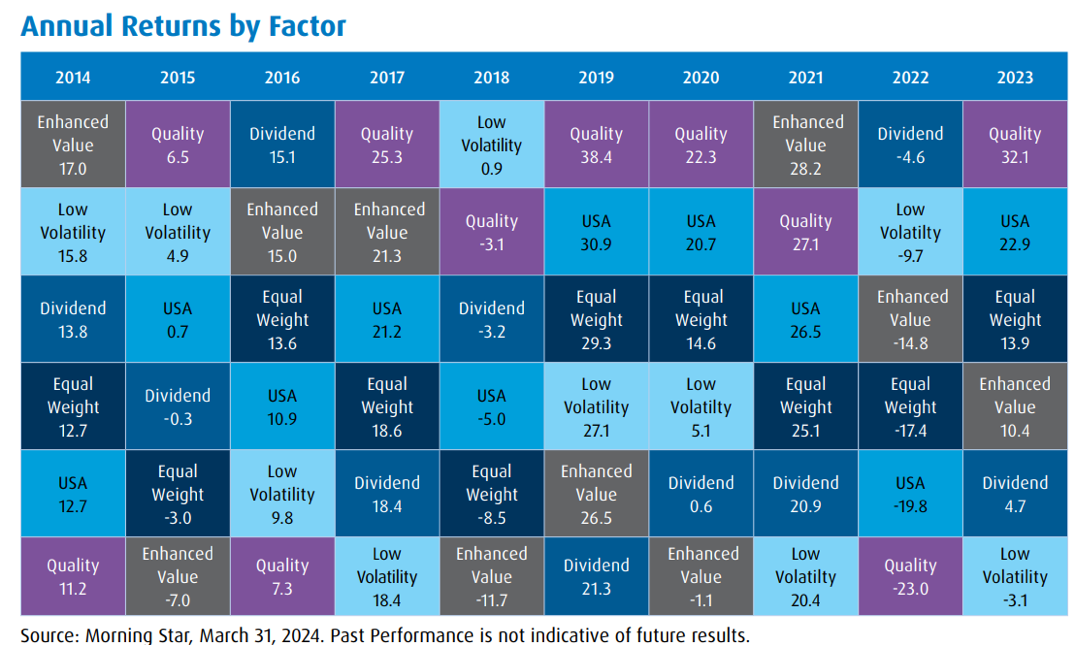
Companies that grow their dividends are overdue to start outperforming. “Over the past year, dividend growers have trailed the broader market to a degree rarely seen over the past three decades … Past instances of similar underperformance have been followed with a strong bounce-back for dividend growers.”

A positive for markets is the “copious” amount of cash sitting on the sidelines and being readied to deploy on buying stocks. After the October 2022 lows, investors flocked into money market funds with a net increase of US$1.5 trillion, or 32%, Schulze said:  “Should the Fed embark upon its widely anticipated cutting cycle later this year, investors may reallocate. This represents a potential source of upside for equities.” Continue Reading…

MoneySense Feature on Rising Fraud: How Seniors and everyone else can minimize odds of being scammed

Deposit Photos

MoneySense.ca has just published a feature article by me that looks at the rising tide of frauds directed at Canada’s seniors, and everyone else.

You can find the full piece by clicking on the highlighted headline here: Canadian Seniors, watch out for these scams.

This Saturday (June 15th) is World Elder Abuse Awareness Day.

Note that while the full 2500-word article at MoneySense is aimed at Seniors, it is not technically my  monthly Retired Money column, which is typically shorter.  And this short summary here at Findependence Hub is only a third as long: hopefully enough to entice readers to hop over to MoneySense for the full article.

So below, I offer only a small fraction of the full column and some of the major links. This is an important topic both for seniors and those who hope to be financially independent seniors one day, so do take the time to click on and read the full article at MoneySense.ca, linked above.

It was a bit of an eye opener researching and writing  this piece but it appears to be the unfortunate reality of the technological world we all now inhabit.  It’s overwhelming and the situation is unlikely to improve any time soon.

In the past MoneySense has covered such topics as getting scammed through e-transfersphishingcrypto schemes, identity theft and more. There’s financial fraud in general that targets bank accounts, credit cards and potentially every other aspect of your financial life. My feature attempts an overview of most of them from a Canadian perspective, with a few new scams I hadn’t known about before researching this article. (Example: “smishing,” which is sort of phishing in the form of text messages on smartphones.)

A.I. is exacerbating the spread of Frauds on all platforms

As I note at the top of the full column, it’s a sad fact that the rise of Artificial Intelligence (A.I.) has exacerbated this problem. While anyone can be prey for technology-linked schemes to separate you from your money, seniors need to pay particular attention, seeing as they tend to have more money to lose and less time to recoup it.

According to Equifax, Fraud is the top crime perpetrated against older Canadians. Sadly, many seniors fail to report these crimes to the police because they feel shame or embarrassment about being duped by scamsters.

Identity Theft

 Identity theft is particularly worrisome for seniors, if not the rest of us. As Equifax puts it, “a scammer may try to get information such as a bank card or personal identity number, credit card number, health card number, or a driver’s license or Social Insurance number. They can then apply for credit cards, take out loans or withdraw funds in the person’s name.”

5 cyber scams targeting seniors

Elder Abuse Prevention Ontario (EAPO) lists 5 cyber scams that target seniors. These include Romance scams targeting the recently bereaved. Here are 5 red flags to watch for if you’re looking for love online. Continue Reading…

Stocks still marching to inflation’s drum

By Elias Barbour, Clearbridge Investments

(Sponsor Blog)

Inflation continues to be the biggest near-term driver for equity markets, given its influence on central bank decision-making regarding interest rates. Inflation rates have moderated from their peak levels; however, they remain above the 2% targets set by the Bank of Canada (BoC) and the U.S. Federal Reserve (Fed).

U.S. and Canada Inflation

As of April 30, 2024


Equity markets entered 2024 with six to seven U.S. interest rate cuts priced in over the course of 2024, with the first cut expected in March. Clearly, that did not happen. Both central banks have remained on hold, which has contributed to higher rates across the yield curve. That number has since moderated to only three cuts, and the timing of the first cut has now been pushed out to June in Canada and even later in the United States.

The effect of “higher for longer” interest rates has been particularly painful for interest rate-sensitive market sectors such as utilities and communication services. Nonetheless, pockets of the market that were expected to continue to grow have continued to advance, undeterred by the yield curve shifts.

Buoyed by hopes for a pivot in monetary policy as inflation trended closer towards the central banks’ targets, Canadian equities had a strong start to the year, although they paled compared to the ongoing boom in U.S. equities, where a large portion of the gains were derived from mega-cap information technology  and related names with less representation in Canadian markets.

Mind the lag

Although decelerating, the economy continues to show sufficient resilience, with customer spending remaining robust since the reopening of economies after the global pandemic-induced shutdowns. Fiscal stimulus has moderated since the immediate aftermath of the pandemic outbreak; however, fiscal policy continues to operate at odds with monetary policy. Labour strength and wage gains have further reinforced this view, fuelling fears of lingering inflation and the potential for a higher-for-longer rate environment. Continue Reading…

Taking steps toward Financial Wellness

Unsplash

By Blair Evans, CFP, CA

Special to Financial Independence Hub

Tomorrow (June 8th) is Global Wellness Day.

The term “wellness” — including emotional, physical, and mental wellness — is finding its way into more and more conversations these days. However, there’s one aspect of general wellness that is often overlooked despite its significant impact: financial wellness.

Given the current economic environment, financial concerns among Canadians are one of the largest sources of stress.  According to a recent study by FP Canada, forty-nine per cent of Canadian adults have lost sleep because of financial worries, which may impact their overall wellness.

Just like physical and mental wellness, there is no one formula to create financial wellness for everyone.

Luckily, there are strategies we can all take to improve our financial wellness. It starts with acting in the present while planning for the future. The path to financial wellness is a personal journey, and a qualified financial advisor can help you take the first step and make important progress.

Prioritizing financial wellness for today

Before working on your financial wellness, it’s important to ask, “What does financial wellness look like for me?”

It can be as simple as creating (and sticking to) a budget or making a realistic and actionable plan to pay off your current debts. Your path to financial wellness can even begin by getting a better understanding of a familiar term: tax.

Whether we like it or not, tax is inevitable, and it impacts nearly every financial decision we make. Therefore, gaining an understanding of your tax situation can provide you with confidence and can help improve your financial wellness.

Depending on your circumstances and stage of life, contributing to your Registered Retirement Savings Plan (RRSP) or First Home Savings Account (FHSA) are two options that may help you prepare for your future, while also reducing your taxable income, meaning you’ll get taxed less come tax season.

Being knowledgeable about the different types of accounts (including RRSPs, FHSAs and Tax-Free Savings Accounts), as well as tax deductions and tax credits available to lessen your tax liability, can also help build financial knowledge and reduce financial stress.

Planning financial wellness for the future

Part of financial wellness is proactive planning so you can feel comfortable and confident in your future. Saving is an important part of building a strong financial future, but financial wellness goes beyond that. Continue Reading…