 By Jonathan Chevreau
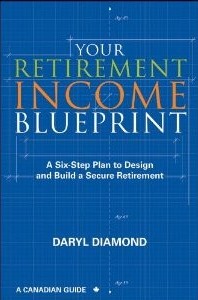
It’s not often I read a book twice and even rarer that I’ve reviewed the second edition of a book. The rare exception is Daryl Diamond’s newly revised Your Retirement Income Blueprint, published by Wiley Canada in 2011 and now in 2014 by Milner & Associates Inc.
A major reason is revealed in the back-cover blurb I supplied for the new edition. When the original came out, I was still fully employed and the idea of retirement or financial independence were just theoretical concepts. But as I say in the blurb, now that I’m transitioning from employment to semi-retirement or self-employment, “I intend to use Daryl’s blueprint as my personal plan for drawing income from a diversified portfolio and other income sources.”
Different skill set for decumulation
Diamond rightly points out that there is a world of difference between wealth accumulation and drawing an income. He’s probably also correct that there are a lot fewer financial advisors who specialize in decumulation, compared to the legions who are focused on wealth accumulation.
Diamond – who like myself was born in 1953 – lays out a six-step plan for creating and implementing a retirement income blueprint. Even on a second read, I still found myself underlining certain passages that must not have penetrated my thick skull originally. Things like the Age Credit and Pension Tax Credit tend not to be top of mind until you actually stand to benefit from them. (And I don’t yet but can see the day fast approaching when I would!)
Where Diamond really adds value is the way he integrates tax planning with a logical order for drawing on various retirement income sources. His “Cash Wedge” or “Floor and Upside” concept seems to me a variation of Asset Dedication: setting up enough cash flow to draw down on for the first two or three years. His discussion of the order in which to draw on government and employer pensions, annuities and registered and non-registered investments is masterful. And his recommendations are not always obvious. For example, he’s generally in favor of taking OAS and CPP benefits relatively early, in part because he has an acute understanding of how higher income later in retirement can impact the aforementioned age and pension credits, or indeed receipt of OAS benefits at all.
In a similar fashion, he advocates using non-registered (or what he terms tax-paid) assets when you move into higher tax brackets.
Sweet spot for age and pension credits
While the editions aren’t hugely different – the blue front cover is virtually identical in both editions — Diamond and editor Karen Milner have done a good job updating everything to 2014. So, for example, you will learn (on page 158) that the tax-efficient net income “sweet spot” in 2014 for someone aged 65 or over is $34,873. Or, a few pages later, that the federal “tax-free zone” is $18,054, which rises to just over $20,000 if the pension credit is generated.
He also makes it clear that letting vehicles like tax-deferred RRSPs grow indefinitely can be tax-inefficient, since that creates what can be a “tax trap” after age 71, when minimum and fully taxable RRIF income starts to kick in. So he shows how you can start withdrawing income from RRSPs or RRIFs to get you to the top end of any given tax bracket, even if the extra (and taxable) income is not required that particular year. He’s also a big fan, as I am, of the Tax Free Savings Account or TFSA.
No doubt I will frequently consult this book personally as I progress to later stages of the “Findependence” journey I’ve been chronicling in these blogs.
All I can say is the $26.95 retail price of the book is trivial compared to the tens of thousands of dollars that could be saved by implementing the steps in the proper order.


 Posted By

 Posted By