By Robb Engen, Boomer & Echo
Special to the Financial Independence Hub
Comedian Louis C.K. closed his 2013 comedy special Oh My God with a hilarious (albeit crude) bit called, “Of course . . . but maybe.” I thought it would be fun to apply the same thinking to personal finance and some of the situations we run into every day.
On sense of entitlement
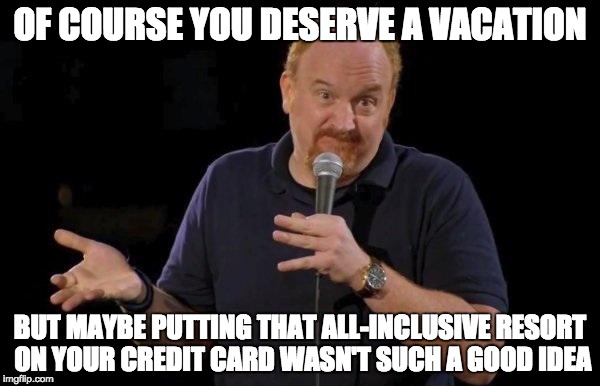
Of course you deserve a vacation. You worked hard all year, and sure, while you didn’t make much progress paying off your credit-card debt, and your New Year’s resolution to reign-in the impulse shopping was busted by February, a week spent soaking up the tropical sun will re-charge your batteries and give you a fresh start on your financial goals.
But maybe you shouldn’t add to your debt-misery by putting that all-inclusive resort vacation on your credit card. Maybe burying your head in the sand won’t make your financial problems go away. Maybe you should hold off on the tropical vacation for a year or two while you get a handle on your finances. Maybe then you can truly say, “I deserve this.”
On education and doing what you love
Of course you should go to University and study whatever you want. Of course you should find your passion, however long it takes. You can be whatever you want. You can do whatever you want. Post-secondary education is an investment in your future.
Related: When doing what you love doesn’t pay the bills
But maybe spending $100,000 and eight-years of your life on that double-major in history and fine arts, only to spend the next few years working as a Starbucks barista, wasn’t the wisest use of your time and money.
On investing in mutual funds
Of course mutual funds offer an easy way for investors to put their hard-earned savings into a diversified basket of stocks and bonds. You can start investing with as little as $25 per month and build up your portfolio without any transaction costs.
But maybe you didn’t notice the annual management expense ratio eating into your returns. Maybe, as Vanguard founder Jack Bogle estimates, the 2.5 per cent a year in fees over a typical investor’s lifetime means that an astounding 80% of compounding returns ends up in the hands of the manager, not the investor. And maybe your financial advisor is really a salesperson in disguise, recommending funds that may not be in your best interest.
On insurance needs
Of course you should buy insurance to protect your loved ones in case something terrible should happen to you. Of course you want to provide for your dependents in case you die or become disabled.
Related: 5 myths about insurance
But maybe asking your insurance broker if you need insurance is like asking your barber if you need a haircut. Maybe if you are single and have no dependents you might not need life insurance. Maybe a simple term life insurance policy that pays off your debts and provides 5-10 years of income for your spouse and children is all the insurance you need. And maybe mortgage life insurance and balance protection insurance really just protect the bank at your expense.
On budgeting and tracking expenses
Of course you don’t need a budget. You have a great handle on your finances. You pay yourself first. You’re debt-free. You live within your means.
But maybe if you spent three months tracking your spending you’d discover several hundred dollars a month worth of unaccounted for expenses in categories such as dining out, gifts, and “miscellaneous.”
On home ownership
Of course you should aspire to own your own home one day. After all, you’re just throwing your money away on rent every month. Why not build up some equity of your own? And with house prices continuing to rise, of course it’s better to get into the market now before you’re priced out forever.
But maybe home ownership isn’t the panacea it’s made out to be. Maybe new expenses, such as property taxes, home maintenance, and lawn care cost more than you thought. A big-fat mortgage means you can’t afford to save for retirement, or even the odd dinner out. It turns out that maybe renting was a lot cheaper and gave you the freedom to pursue and achieve your other financial goals. (See also The Real Cost of Buying Your Home.)
 In addition to running the Boomer & Echo website, Robb Engen is a fee-only financial planner. This article originally ran on his site on August 16th and is republished here with his permission. See also Boomer & Echo’s 5th Anniversary contest, with prizes galore (including a copy of Findependence Day).


 By Robb Engen, Boomer & Echo
 Posted By
 Posted By