As Didi says in the novel (Findependence Day), “There’s no point climbing the Tower of Wealth when you’re still mired in the basement of debt.” If you owe credit-card debt still charging an usurous 20% per annum, forget about building wealth: focus on eliminating that debt. And once done, focus on paying off your mortgage. As Theo says in the novel, “The foundation of financial independence is a paid-for house.”
At the time of this writing, the latest numbers from the Johns Hopkins University of Medicine attribute more than 2.5 million cases and 171,810 deaths worldwide to the Coronavirus pandemic.
In the United States, those figures are 788,920 and 42,946, respectively. In Canada, they are 36,831 and 1,690.
The devastating loss of life due to the COVID-19 virus will continue to get worse in the coming weeks and months. Another consequence of this global pandemic that is also continuing to worsen is the financial damage faced by so many everyday consumers.
As markets plunge at an unprecedented pace and social distancing measures close down countless businesses that have been forced to lay workers off, nearly every person’s personal finance situation is taking on water and managing those finances can be tough.
LendEDU, a personal finance company, tracked how the Coronavirus pandemic is impacting the financial lives of everyday people. The company conducted two surveys, each of 1,000 adult respondents, over the course of two weeks, and the survey-to-survey results painted an increasingly gloomy financial picture for most consumers.
In two weeks, Unemployment due to Coronavirus doubles
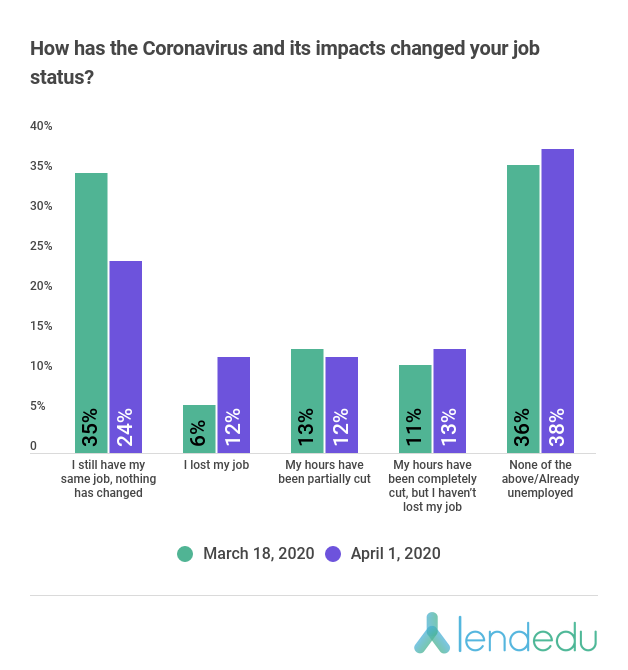
LendEDU’s first Coronavirus survey was conducted on March 18, and it found that 6% of poll participants had lost their jobs due to the Coronavirus, while 35% had seen no changes to their jobs, 13% had their hours partially cut, and 11% had been furloughed.
Two weeks later, LendEDU’s second Coronavirus survey that was conducted on April 1 revealed much different results to the same question. (See graph at the top of this blog). The percentage of people that had been laid off due to the Coronavirus pandemic doubled from survey-to-survey from 6% to 12%. Continue Reading…
Your twenties are often touted as the best years of your life. They’re full of fun, frivolity, and finding out who you are. But it’s easy, as a twenty-something, to surrender any thought of saving for your future.
Now, we aren’t saying that every millennial will squander their chance of buying a house because they spend too much money on smashed avocado toast. There are, however, a few key things that we could all do better in our twenties to manage our finances. Want to know how to save your pennies for the future? Here are some top tips.
1.) Don’t get into (more) debt
Most of us will already have large loans to pay back for college. Avoid saddling yourself with even more debt by buying things you can’t afford. This habit will only lead to a world of pain in the next decade of your life.
So how do you avoid getting yourself into financial trouble by spending carelessly? Firstly, evaluate and reflect whenever you look to purchase items over a hundred or so dollars. It’s not only big-ticket purchases you need to watch out for, either. All those discretionary purchases – a top here, a coffee there – really do add up.
Unsplash
2.) Build your credit history
You also need to build up your credit history carefully and surely. For many banks and mortgage brokers, a total lack of debt signals financial immaturity. Start building a solid credit history by making a small purchase on credit (say, a washing machine), and promptly paying the moneylender back.
3.) Learn to live with less
It might take some philosophising, but it’s time to re-evaluate your attitude toward material things. Young people tend to compare their circumstances with their friends’ more than most. There’s also a tendency to covet the gadgets and homes that we see plastered on social media. But you don’t need to live this way to be happy. Continue Reading…
Some readers have maxed out their TFSA and RRSP. Now what?
Here are some recent reader questions and comments (adapted for site):
Reader 1:
“I’ve finally been able to max out my TFSA and RRSP. I’m 41. Now what? Should I consider investing in a taxable account? If so, what should I own?”
Reader 2:
“Mark, I’ve been reading your site for years. I’ve put a priority on paying down our mortgage for many years now, and striving to max out our kids’ Registered Education Savings Plan (RESP) every year for their financial future. Those have been priorities number one and two for years.
When the TFSA came along, I thought it would be an excellent place to keep our family emergency fund for our house repairs and small renovations in a tax-free way but I’ve since realized by reading your site that I should have thought of this as an investment account (like you did) since day 1. I now invest in low-cost ETFs inside this account and I’ve never looked back! I have a six-figure portfolio thanks to you!
Now, with the mortgage balance down the high-five figures; RESPs maxed for our two kids and now our TFSAs maxed out as well – I’m thinking we should work on maxing out the RRSPs like you have and eventually get into taxable investing if we can.
Thoughts on my approach?”
Reader 3:
“Mark, I have been an avid reader of your blog for the last two years but this is my first intervention 🙂 Better later than never! My question today is how I can diversify my portfolio even more?
I’ve maxed out my registered accounts (RRSP: $32,000 in VEQT and TFSA: $75,000 also in VEQT) and invested significant chunks of money in a non-registered account ($50,000 in VEQT). I’m also helping my cousin with his RESP. I’ve also got an emergency fund with Tangerine.
At only 29, and single, I think I am off to a good start but it would be nice to find more ways to diversify my investments. I still have another $10,000 that I want to invest. What are some options?
Real estate? (not sure about this) Maybe Real Estate Investment Trusts (REITs)?
Crowdfunding?
Peer-to-peer lending? (seems risky)
Other?
Looking forward to your thoughts Mark!”
Wow, great stuff readers.
I mean, people thinking about investing inside your taxable accounts after your registered accounts are maxed; readers paying down their mortgage while diligently investing; folks wondering how to invest in a taxable account now that their emergency fund, TFSA and RRSP are managed and full: amazing stuff!
Purchasing a house is a major investment, and finding one you can afford can feel like quite a puzzle. However, there are some smart, money-stretching strategies you might not know, but that can make all the difference in your financial situation. Read on for tips and tricks to help you land the home you’re dreaming about.
Dealing with Down Payments
One of the big hurdles for home buyers is gathering funds for a down payment. Lenders traditionally require 20 per cent down, which calculates to tens of thousands of dollars that many people don’t have sitting in their bank accounts. There are strategies for gathering those funds, like paying off credit cards and saving your cash, taking on a second job, or selling belongings.
Bear in mind that lenders will look at your bank statements to examine where your funds came from, and if anything looks fishy, such as a sudden large deposit, they might hold it against you. Mortgage lenders want to see financial stability, so big fluctuations, bounced checks, and irregular activity could damage your chances for a loan.
For home buyers struggling to come up with a down payment, there is good news. There are FHA loans available that permit as little as 3.5 per cent money down (in the United States). On top of that, you might be able to use gifted funds, which most lenders do not allow.
A couple other opportunities for special mortgages are available. Veterans can aim for a home loan through the VA, and for low-income applicants in rural areas, the USDA offers 100 per cent financing through Rural Housing loans.
Squeaky clean Credit
No matter where you apply for a loan, the lender will examine your credit history. Chances are you know if you’ve made some mistakes, but sometimes credit reports have clerical errors on them. Thankfully, there are ways you can clean up your credit score, but it can take a little time, so if you plan to apply for a loan, get started early.
Start by requesting a free credit report and give it a thorough once-over. If you find errors, you will need to dispute them with the reporting agency, explaining the problem and documenting the error. After that, there will be a time period in which the error can be substantiated by the appropriate credit institution, and if they fail to do so, it is then removed from your credit report.
It can also help to pay down your debts because lenders will examine your debt-to-income ratio. As InCharge points out, you will generally need a result no higher than 43 percent of your income. Keep in mind the lender will include your potential mortgage payment in that calculation.
Rethink your Search
House hunters often search traditional home listings in hopes of finding the home of their dreams. However, thinking outside the box can mean broadening your search. For example, foreclosures can be a bargain under the right circumstances, but you should weigh the pros and cons carefully. Continue Reading…
With the Canadian Centre for Policy Alternatives warning of unemployment rates that could hit 13.5 per cent this year, the highest level we’ve seen in our country since the Second World War, there appears to be few industries and individuals who will escape the economic impact of COVID-19 unscathed.
As of the writing of this blog (April 2, 2020), one million Canadians have already applied for Employment Insurance benefits; with the federal government estimating close to four million joining the queue for the Canadian Emergency Response Benefit.
The situation south of the border is dire: especially when you consider that the near quarter million number we’re looking at today is likely to skyrocket over coming days, weeks and months tracing the trajectory of the heart-wrenching Italian and Spanish COVID-19 pandemic curves.
On April 1st, in what one wishes were a cruel April Fool’s Day prank, the U.S. Labor Department reported the loss of 10 million jobs in the last two-week period, with 6.6. million Americans filing for unemployment benefits last week alone.
Why does all this matter to Canucks? As the adage goes, when the U.S. sneezes, Canada catches a cold. Our economies, and those of other global entities, are inextricably intertwined.
Your Emergency Income options
Venturing back north to Canada, what follows are some of the options you have to ease your current financial burden. The tried n’ true path, if you qualify, is to apply for Employment Insurance or Sickness benefits. If, however, you don’t meet the criteria for either of these benefits, all’s not lost. You may still be eligible for the Canadian Emergency Response Benefit (CERB). Eligibility standards for this benefit, lasting 16 weeks and paying out $2000/ month, are arguably much less stringent.
Can I apply for CERB?
You can apply for CERB if you had an income of $5,000 (this can be self-employment, employment or parental benefit earnings) in 2019 or the 12 months prior to the CERB application; and, you expect to be without employment or self-employment income for at least 14 consecutive days in the initial four-week period identified in your application.You’re also potentially eligible for CERB if you:
live in Canada and are at least 15 years of age
were laid-off from your job, or your hours have been drastically reduced to zero and you lack any other form of employment income
were let go from your job because of COVID-19 and are eligible for regular Employment Insurance or sickness benefits (consult the FAQS at the bottom of the CERB page to get a better handle on when and how to apply for which benefit)
still have a job, but have been temporarily laid off
are sick, quarantined or are the primary caregiver for someone with COVID-19
are a working parent who now must stay home, without pay, to care for your child/children whose school/ daycare is now closed
are self-employed or a contractor and wouldn’t otherwise qualify for EI
Tricks, Tips & other considerations
How much will I receive?
Preet Banerjee, keynote speaker and founder of MoneyGaps, has launched the COVID Calculator to help estimate how much income support (via the Canada Child Benefit (CCB), GST and CERB) you can expect during the pandemic.
It’s worth noting CERB will not be taxed at source. That means it’s up to you to squirrel away anticipated tax money that will come due in 2021. To get a sense of how much you might want to sock away, experiment with different income tax scenarios within the Turbo Tax calculator or Simple Tax calculator.
If you’re ambitious, you can model a myriad of tax scenarios in the 2020 and 2019 Canadian Income Tax Calculator. As I mentioned earlier, you can begin applying for CERB on April 6th. However, the government has wisely (although I would still bet heavily on an overburdened IT network suffering instability with unprecedented pent-up Canadian demans) …. staggered the application process. Patience will, undoubtedly, be a virtue.
If you were born in:
January, February or March, apply April 6th
April, May or June, apply April 7th
July, August or September, apply April 8th
October, November or December, apply April 9th
And if you fancy a weekend date with the application process, anyone can apply on Friday, Saturday or Sunday.
I know, for many of us myself included, many days this all seems too much to bear, but this morning I was reminded by this Scottish Grandma, this too will pass.
Carrie Hunter is the founder and writer of the personal finance blog, PoundWiseandPennyPrudent.com. A passionate advocate for financial literacy, Carrie writes, speaks and facilitates workshops with a singular goal: to simplify the language of money. A self-taught money expert, Carrie is completing her designation as an Accredited Financial Canada Counsellor®. This blog originally ran on April 2, 2020 and is republished on the Hub with her permission.


 Posted By
  By Mike Brown