Most of your investing life you and your adviser (if you have one) are focused on wealth accumulation. But, we tend to forget, eventually the whole idea of this long process of delayed gratification is to actually spend this money! That’s decumulation as opposed to wealth accumulation. This stage may also involve downsizing from larger homes to smaller ones or condos, moving to the country or otherwise simplifying your life and jettisoning possessions that may tie you down.
Midwives play a rather important role in maternal healthcare. They provide crucial support to expectant mothers before, during, and after childbirth. While the focus of midwifery is on delivering excellent care to patients, it’s equally important for midwives to have a financial plan in place for themselves. Here’s a look at how midwives can prepare.
Adobe Stock Image courtesy logicalposition.com
By Dan Coconate
Special to Financial Independence Hub
Retirement planning is a critical step in ensuring Financial Independence and peace of mind after years of dedication to a meaningful career.
For midwives, who are often focused on caring for others, planning for their own future can sometimes take a backseat. This guide emphasizes how to prepare for retirement as a midwife so that you can build a solid plan that focuses on future financial strategies, career development, and truly golden years.
Get Familiar with your Financial Landscape
To plan effectively for retirement, you need a clear understanding of your financial situation, goals, and needs. Start by calculating your current income, savings, and any existing retirement benefits. Many midwives work as independent contractors or part-time employees, which can often mean fluctuating income. Identify what portion of your earnings you can set aside monthly for retirement savings.
Review any benefits offered by your employer, such as pensions or retirement savings programs, such as 401(k). If these aren’t included, consider opening a traditional or Roth IRA. Understanding your financial opportunities and constraints will form the foundation of your retirement strategy.
Explore Savings Plans and Investment Opportunities
Midwives often face unique challenges in saving for retirement due to irregular salaries or periods of self-employment. That’s why exploring diverse savings plans and investment opportunities is critical.
Consider options, such as SEP IRAs, which allow self-employed midwives to contribute higher amounts than personal IRA plans. Diversifying investments can also bolster your long-term savings. Look into index funds, bonds, or low-risk mutual funds to create a balanced portfolio. Remember, the earlier you start, the more time your compounding interest will grow your nest egg. Continue Reading…
I’m just sitting on a fence
You can say I got no sense
Trying to make up my mind
Really is too horrifying
So I’m sitting on a fence
The Rolling Stones
Benjamin Graham and David Dodd are universally regarded as the fathers of value investing. In their 1934 book “Security Analysis” they introduced the concept of comparing stock prices with earnings smoothed across multiple years. This long-term perspective dampens the effects of expansions as well as recessions. Yale Professor and Nobel Prize winner Robert Shiller later popularized Graham and Dodd’s approach with his own version, which is referred to as the cyclically adjusted price-to-earnings (CAPE) ratio.
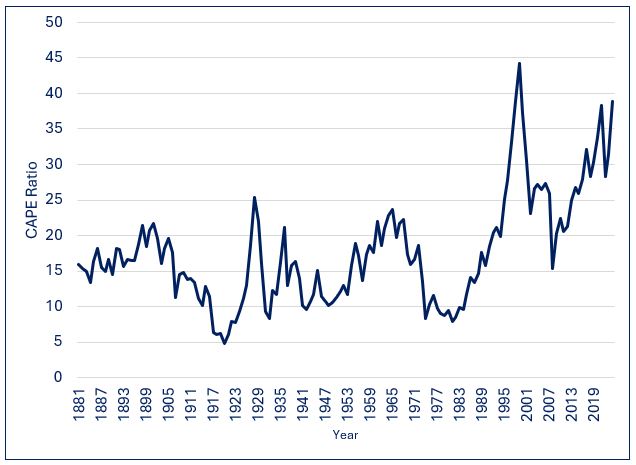
S&P 500 CAPE Ratio: 1881- Present
Since 1881, the CAPE ratio for U.S. equities has spent about half of the time between 10 and 20, with an average and median value of about 16. Its all-time low of 5 occurred at the end of 1920, and its high point of 45 occurred at the end of 1999 during the height of the internet bubble.
What if I told you …. ?
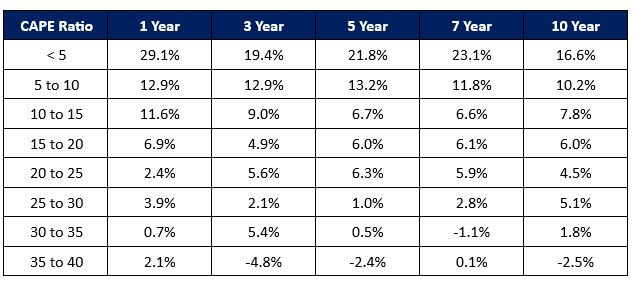
The following table shows average real (after inflation) annualized returns following various CAPE ranges.
S&P 500 Index: CAPE Ratio Ranges vs. Average Annualized Future Returns (1881 Present)
What is abundantly clear is that higher returns have tended to follow lower CAPE ratios, while lower returns (or losses) have tended to follow elevated CAPE levels. An investment strategy that entailed having above average exposure to stocks when CAPE levels were low, below average equity exposure when CAPE levels were high, and average allocations to stocks when CAPE levels were neither elevated not depressed would have resulted in both less severe losses in bear markets and higher returns over the long-term.
By no means does this imply that low CAPE ratios are always followed by periods of strong performance, nor does it imply that poor results are guaranteed following instances of elevated CAPE levels. That would be too easy!
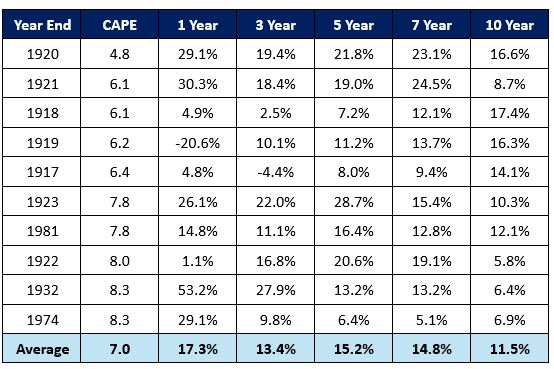
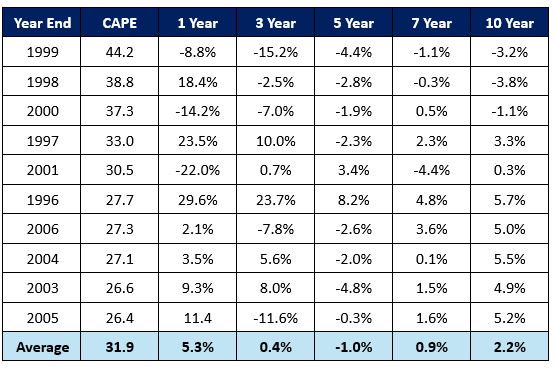
S&P 500 Index: Lowest CAPE Ratios vs. Future Real Returns (1881 – Present)
S&P 500 Index: Highest CAPE Ratios vs. Future Real Returns (1881 – Present)
Looking at the performance of stocks following extreme CAPE levels, it is clear that valuation is best used as a strategic guide rather than as a short-term timing tool. It is most useful on a time scale of several years rather than a shorter-term timing tool.
Although there have been instances where low CAPE levels have been followed by weak performance over the next 1-3 years, there have been no instances in which average annualized returns over the next 5-10 years have not been either average or above average. While it sometimes takes time for the proverbial party to get started when CAPE levels hit abnormally depressed levels, markets have without exception performed admirably over the medium to long-term.
Similarly, although there have been instances where high CAPE levels have been followed by strong performance over the next 1-3 years, there have been no instances in which average annualized returns over the next 5-10 years have not been either below average or negative. Whenever CAPE levels have been extremely elevated, it has only been a matter of time before the valuation reaper exacted its toll on markets. This brings to mind the following quote from Buffett:
“After a heady experience of that kind, normally sensible people drift into behavior akin to that of Cinderella at the ball. They know that overstaying the festivities — that is, continuing to speculate in companies that have gigantic valuations relative to the cash they are likely to generate in the future — will eventually bring on pumpkins and mice. But they nevertheless hate to miss a single minute of what is one helluva party. Therefore, the giddy participants all plan to leave just seconds before midnight. There’s a problem, though: They are dancing in a room in which the clocks have no hands.”
Be the House, Not the Chump
There have been (and inevitably will be) times when equities post strong returns for a limited time following elevated CAPE levels and instances where stocks post temporarily weak results following depressed CAPE levels.
However, successful investing is largely about playing the odds. If you were at a casino, wouldn’t you prefer to be the house rather than the chump on the other side of the table? Although chumps occasionally get lucky, this doesn’t change the fact that the odds aren’t in their favour and that they are playing a losing game. Over the long-term, investors who refrain from reducing their equity exposure when CAPE levels are elevated and don’t increase their allocations to stocks when CAPE levels are depressed will achieve satisfactory returns over extended periods. That being said, I sure wouldn’t recommend such a static approach for the simple reason that it involves suffering severe setbacks in bear markets and leaving a lot of money on the table over the long-term.
Given the historically powerful relationship between starting CAPE levels and subsequent returns, what if I told you that the CAPE ratio currently stands at 38, putting it at the top 98th percentile of all year-end observations going back over 150 years, and the top 96th percentile over the past 50 years? Presumably you would at the very least consider taking a more cautious stance on U.S. stocks.
Let’s Pretend ….
Let’s pretend that you knew nothing about the historical relationship between CAPE levels and subsequent returns. A combination of behavioural biases, speculative fervour, and FOMO (fear of missing out) might lead you to adopt an “if it isn’t broken, don’t fix it” stance of inertia.
Recency bias can give people a false sense of confidence that what has occurred in the recent past is “normal” and is therefore likely to continue in the future. Moreover, the strong returns which have occurred since the global financial crisis can exacerbate FOMO, thereby prompting investors to stay at the party (and perhaps even to imbibe more intensely by increasing their equity exposure). Lastly, the potential of innovative technologies such as AI to revolutionize businesses can capture investors’ imaginations and incite euphoria to the point where they believe that there is no price that is too high to pay for the unlimited profit potential of the “shiny new toy.”
Standing at the Crossroads
So here we stand at a crossroads, caught between the weight of history and the possibility that this time it may truly be different. What is an investor to do? One can never be 100% sure. The “right” answer will only be known in hindsight once it becomes a matter of record, at which point it will be too late for investors who get caught on the wrong side of the fence. Continue Reading…
My latest MoneySense Retired Money column looks at a variety of tax and savings limits changes that are effective early in 2025. Click on the highlighted headline for the full column: What retirees need to know about tax brackets for 2025.
As the column notes, at or near Retirement taxes and inflation are the two big threats to preserving enough wealth to last a lifetime. The tax burden hits home with the annual tax-filing deadline in April, but the time to start thinking about the yearly ordeal is before year-end.
The complexity of this task is compounded by almost-annual changes to tax brackets, the Basic Personal Amount, OAS thresholds, inflation adjustments and much more. For starters, I recommend reading an excellent article by CIBC Wealth’s tax guru, Jamie Golombek, which appeared in the Financial Post here on Nov. 23rd, shortly after the Canada Revenue Agency released its new tax numbers for the year 2025.
Let’s look first at inflation, the second serious scourge retirees face if they live long enough. Here, a useful tool suggested by certified financial planner Morgan Ulmer is Statistics Canada’s Personal Inflation Calculator, which lets you compare your personal inflation rate to the general CPI.
Ulmer, of Toronto-based Caring for Clients, sees the higher tax brackets and inflation adjustments as an “opportunity for retirees to build a savings reserve.” CPP is indexed to inflation yearly while OAS is indexed quarterly. So “if a retiree is able to increase their spending at a rate that is less than CPI, the difference could be saved as an emergency reserve or invested in a TFSA.”
Inflation and Tax Bracket changes
Back to some key data cited by Jamie Golombek. The inflation rate used to index 2025 tax brackets and amounts will be 2.7%: just over half the 4.7% in effect in 2024. The good news is that the Basic Personal Amount (BPA) on which no federal tax is levied rises to $16,129 in 2025: It was $15,000 in 2023.
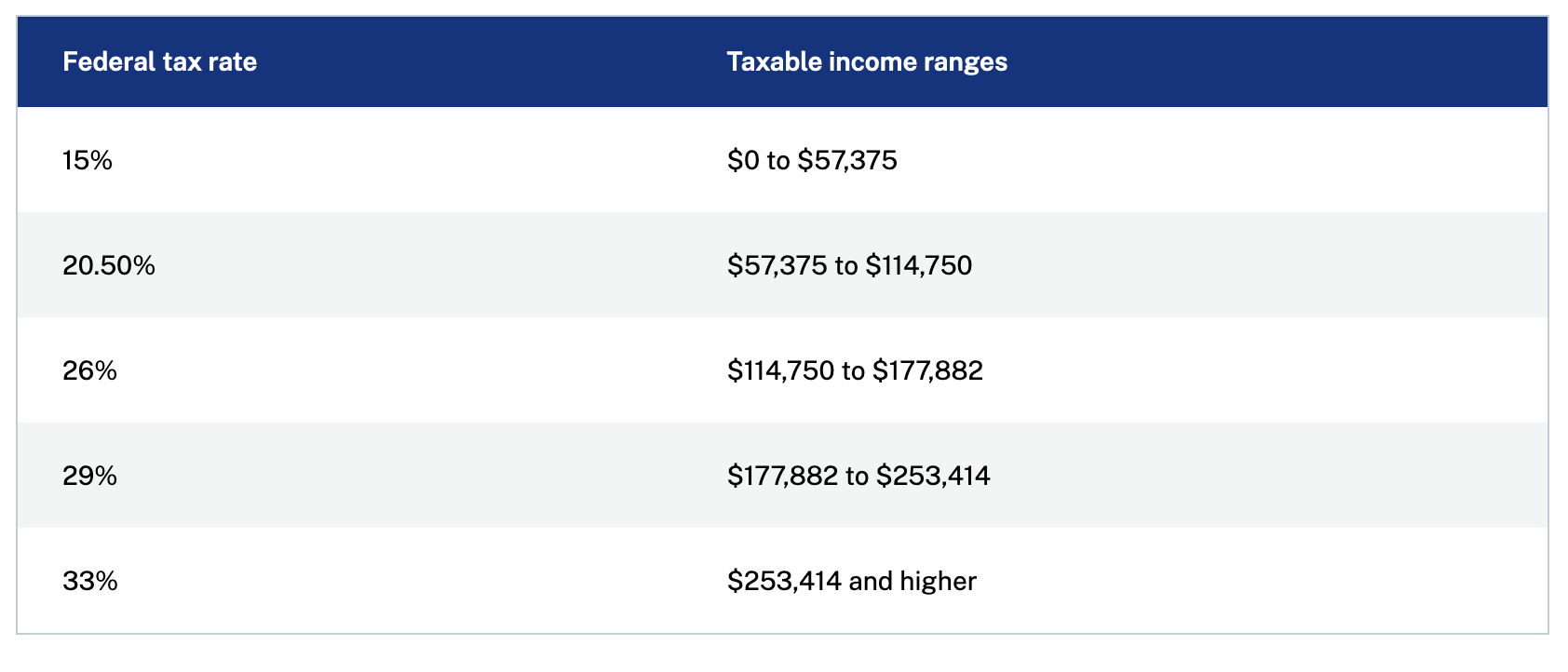
All five federal income tax brackets are indexed to that 2.7% inflation rate. In 2025, the bottom federal tax bracket of 15% will apply to incomes between zero and $57,375. The second lowest bracket of 20.5% will apply to incomes between $57,375 and $114,750. The 26% bracket applies to income between $114,750 and $177,882, while incomes between $177,882 and $253,414 will attract a 29% federal tax. After that the federal rate will kick in at 33%.
Below is a table summarizing that information prepared for MoneySense:
MoneySense.ca
Don’t forget there will be additional provincial taxes on top of the federal haul, also indexed to inflation at various provincial rates.
What is relevant for those in the Retirement zone is the higher threshold on Old Age Security: in 2025, according to Canada.ca, OAS begins to get clawed back for taxable income of $90,997. OAS benefits disappear entirely at $148,451 for those aged 65-74 in 2025, and at $154,196 for those 75 or over. Note the OAS clawback is based on individual incomes, not household income.
Deferring CPP and OAS till 70
Matthew Ardrey, portfolio manager and Senior Financial Planner for Toronto-based TriDelta Financial, agrees that tax brackets, whether federal or provincial, “become more of a consideration in retirement.” For many Canadians receiving employment income on a T-4, there is little we can do as retirees to keep income in the lower tax brackets. But there’s plenty to think about when considering tax minimization and decumulation strategies. Referring to Golombek’s article, Ardrey says that using federal brackets only, taxpayers can receive $57,375 of income and pay very low rates of taxation, especially when the $16,129 basic personal amount is considered.”
Retirees under age 70 can defer CPP and OAS until 70 and try to live on withdrawals from their registered plans instead. With no other income, taxpayers could have almost $50,000 of after-tax income, or $100,000 for tax-paying couples. Continue Reading…
Retirement planning may not be at the forefront of every twenty or thirty-something’s mind. However, starting early could mean the difference between a retirement spent in comfort or want. With social security’s uncertain future and the rising cost of living, the sooner you embark on saving for retirement, the better. Managing your retirement savings wisely will ensure a peaceful and fructiferous future. Learn the strategies now for building a substantial 401(k) balance [United States.]
Image by Adobe Stock/ juliasudnitskaya
By Dan Coconate
Special to Financial Independence Hub
Today, a robust 401(k) plan is more crucial than ever for securing your retirement. Understanding how to manage your contributions and investments effectively can set you on the path to Financial Independence. As the traditional employer-sponsored pension system becomes less common, individuals are increasingly responsible for their retirement savings.
By taking advantage of employer contributions, understanding investment options, and reviewing your plan, you can cultivate a retirement savings strategy that prepares you for the future and helps you build financial confidence. These strategies for building a substantial 401(k) balance will ensure it becomes a strong pillar of your retirement portfolio.
Choose the Right Investment Options
Most 401(k) plans offer various investment options, and selecting the right mix can directly impact your retirement savings. Investments fall primarily into stocks, bonds, and mutual funds or ETFs, all carrying different risk levels and potential returns. A balanced portfolio that reflects your risk tolerance, investment timeline, and financial goals can better weather market fluctuations. Review your options regularly and consider rebalancing your portfolio to adapt to any changes in the market or your personal situation.
Gradually increase Contributions
If you’re hesitant about contributing a significant portion of your salary to your 401(k) from the outset, consider implementing a gradual increase plan. Many employers allow you to set up automatic annual increases in your contribution percentage. Taking advantage of raises or bonuses to boost your contributions ensures that you consistently increase your savings without feeling the financial strain of a sudden change.
Regularly Review your Plan
Conducting annual reviews of your 401(k) to ensure it remains aligned with your financial objectives is vital. Life changes, such as starting a family or changing careers, can shift your needs and goals, requiring adjustments to your retirement strategy. Continue Reading…
Steps to Retire the Way you Want: Set Your Retirement Goals, Put your Money in the Right Places, and Optimize your Withdrawals
Graphic by Steve Lowrie: Canvas Custom Creation
By Steve Lowrie, CFA
Special to Financial Independence Hub
Most of us feel young well into our 60s (or even later) and retirement seems like a faraway concern for the distant future. However, thinking about your retirement early allows you to comfortably enjoy your later years no matter what your priorities are – leaving a legacy for your loved ones, travelling, spending time on hobbies close to home or any combination. Putting together a retirement income plan early gives you the best path to safeguard your financial freedom post-retirement.
Retirement income planning doesn’t mean constant worrying and going without today. It just means taking stock of where you are financially, where you want to be in the future, and setting up a plan to get there. That retirement plan could include setting up the right investment strategies now to allow you the flexibility you’ll need in the future to generate cashflow from the right places and pay the least amount of tax. It also could mean contributing regularly and consistently now so you don’t have to make up for lost ground in the future.
Let’s get into what retirement investment vehicles and strategies you have, how to think about your retirement priorities and goals, and how you can plan a decumulation strategy for the retirement you want and deserve.
Your Retirement Vehicle Options
When thinking about retirement vehicle options, I like to visualize pots or buckets of money; each of those pots represent a savings vehicle from which you can withdraw retirement cash flow. Whether it’s pots or jars or briefcases filled with cash that you imagine, here are the labels you can put on them:
Real Estate Equity – Your primary residence and any secondary real estate holdings (vacation home/cottage, investment/rental property, etc.) can hold a significant amount of equity for those planning to downsize in retirement.
Anticipated Inheritance – Although an unpleasant thought, if there is a significant amount of money you expect to receive upon a loved one’s death, an expected inheritance can be taken into account during your retirement planning process. Of course, it’s important to have conversations with your loved ones to understand their legacy plan and how it could impact your retirement. Additionally, no one can predict the future so you cannot depend on the timing of an inheritance. It’s also important to keep in mind that, even if you have a good idea of the amount of an anticipated inheritance, other factors can come into play to dwindle it down before you receive it, e.g. at-home support of poor health, long-term care, etc.
Business Owner’s Corporation – The focus of today’s post is to provide insight into retirement vehicles that apply to most people. However, if you are a business owner, we’ve written a blog just for you: you have the additional option of leveraging your corporation for retirement savings and withdrawal.
It’s crucial to consider all of the different retirement “pots” you currently have or need set up. For couples, it’s also important to remember these options apply to both spouses which can be extremely advantageous for your retirement withdrawal plan.
Your Retirement Priorities & Goals
Once you’ve explored your retirement savings vehicle options, you’ll want to determine your priorities and define your goals.
It’s a bit of a balancing act where you might need to make some decisions to prioritize your goals. Do you:
Maximize your retirement income and fun (lifestyle needs, travel, etc.) OR
Leave a financial legacy for your family and loved ones OR
Focus on charitable donations
To help you prioritize your goals, we’ve got some great blogs on this topic to get you thinking:
Remember, it doesn’t necessarily need to be one goal vs. the other. However, you may need to consider how you can achieve all your goals, perhaps by weighting their importance (my retirement fun: 60, legacy for the kids: 30, charity: 10). Or you could consider how to distribute your specific investment “pots”, for example, you may choose to spend all financial assets and leave the kids the real estate.
A few more tips to help with your retirement goal prioritization:
Keep your retirement goals realistic – you’ll want to ensure you have the ability to reach your goals with highest probability.
Balance your spending, savings, and withdrawals to align with goals.
Review the location of your savings in the necessary “pots” to ensure you can meet your goals optimally.
Focus on minimizing tax – determine the best strategy for your priorities today and tomorrow. You can pay tax now or later (estate timing) or your plan can be to smooth out your tax outlay over time. This is a key consideration when allocating your savings into your investment vehicles.
Timing – as the old adage goes, timing is everything and I don’t mean market timing. From an investment perspective, the best approach is systematic and consistent contributions and properly planned withdrawals.
Be flexible – the longer you have between now and retirement, the more that things can change, including your goals and financial circumstances.
Retirement Decumulation Strategies in Action
Let’s look at how people just like you can implement these retirement decumulation strategies to reach their retirement goals.
The Accumulators: Suzie and Trevor Hall (When We First Met Them)
In their late 40s
Still deep in their accumulation years
Two teenage children
Own a home, which is almost fully paid off
Have been good about living within their means and diligently saving
Hope to retire within 15–20 years
Want to fully fund their children’s education
Plan to complete home renovations before they retire
During their accumulation years, Suzie and Trevor followed advice from their independent financial advisor:
Start with planning, not investing.
Establish a spending plan.
Invest systematically.
Do a lifeboat drill.
Remember that it’s priced in.
Established an appropriate emergency fund and lifestyle reserve. Continue Reading…


 Posted By

 Posted By