Decumulate & Downsize

Most of your investing life you and your adviser (if you have one) are focused on wealth accumulation. But, we tend to forget, eventually the whole idea of this long process of delayed gratification is to actually spend this money! That’s decumulation as opposed to wealth accumulation. This stage may also involve downsizing from larger homes to smaller ones or condos, moving to the country or otherwise simplifying your life and jettisoning possessions that may tie you down.

Estate Planning Checklist for Entrepreneurs

Photo courtesy Pexels/Featured.com

By Robert Theofanis

Special to Financial Independence Hub

Estate planning is like going to the dentist. Everyone knows they should do it. But whether it’s getting your teeth drilled or contemplating your mortality, we’d all rather fill our time with just about anything else.

For entrepreneurs, this problem is even more acute. Your business depends on you, and high-priority items constantly appear at the top of your to-do list.

What I’ve found as an estate planning attorney is that my clients can get more done when we approach estate planning in a systematic way. This post contains an actionable plan for entrepreneurs like you to design and implement an estate plan.

I’ve organized the list by priority, with the most critical items first:

Obtain Term Life Insurance

If you have minor children, life insurance is the most important component of your estate plan. Most parents of young children simply haven’t had enough time to accumulate sufficient wealth to sustain a family without any additional income.

I like term insurance for this baseline protection because it’s cheaper than a permanent policy.

I also recommend that both parents have policies. Irrespective of who earns the income, both parents contribute to the household.

For the benefit amount, err on the side of more coverage and consider purchasing separate policies (e.g., two $1 million policies rather than one $2 million policy). This allows you to scale back the coverage amount without dropping coverage entirely.

If you don’t have children yet but are planning to, I still suggest getting coverage now. Life insurance premiums increase with age and pregnancy-related health issues may make it difficult to secure coverage later.

Create a Revocable Living Trust

A basic revocable living trust is the foundational legal document for an estate plan. Its purpose is to keep you and your property out of conservatorship and probate proceedings.

Included in this step is creating the other estate planning legal documents:

  • A pour-over will ensures that all property is distributed in accordance with the terms of your living trust, even if it’s inadvertently left out of the trust;
  • A durable power-of-attorney authorizes a financial agent to conduct transactions on your behalf if you’re incapacitated;
  • A medical directive authorizes a healthcare agent to make medical decision for you if you are unable to and specified your healthcare and end-of-life wishes (in some states, two separate documents are prepared for this purpose);
  • A guardian nomination appoints a guardian to raise your minor children if you are unable to.

Be sure to actually fund the trust! This is one of the biggest mistakes people make. This involves transferring title to real property, opening new financial accounts (bank, brokerage, etc.), and updating beneficiary designations.

Establish and Implement a Written Financial Plan

Estate planning is more than just creating a set of legal documents. It’s a multifaceted plan to achieve positive outcomes for you and your loved ones. So, while the first two items on this list are about limiting your downside, this item concerns your upside. Continue Reading…

How to Maximize Retirement Income with Hobbies

In retirement, hobbies, believe it or not, can seamlessly transition into income-generating ventures: thus presenting an opportunity for older adults to monetize their passions. Whether it’s woodworking, photography, gardening, or crafting, the key lies in recognizing the market demand for these skills or products and strategically positioning oneself to capitalize on it. Here’s a quick look on discovering how collecting and small businesses can boost your finances in your later years.


Image Adobe Stock/Pikselstock

By Dan Coconate

Special to Financial Independence Hub

Retirement offers a perfect time to turn hobbies into profitable ventures. Many retirees seek ways to supplement income through hobbies that provide both enjoyment and financial rewards.

Choosing hobbies with financial benefits allows you to maximize retirement income with hobbies while staying engaged in activities you love. The right hobby can provide personal fulfillment and a steady income stream that supports your retirement goals.

Explore Collecting as an Investment

Collecting serves as one of the most effective ways to generate income. Collectibles like vintage items, rare artifacts, and diecast car models can appreciate over time. Market trends and knowledge about item values help collectors make smart investment decisions.

Limited-edition diecast car models typically increase in value, offering a return on investment. Collectors who stay informed about market demand can identify items with the most potential for appreciation. Adopting eco-friendly collecting practices for diecast model cars enhances the long-term value of your collection and supports environmental conservation.

Turn Hobbies into a Small Business

Starting a small business based on a hobby provides another income source. Retirees can transform passions like crafting, gardening, or baking into profitable enterprises. Selling handmade goods, plants, or homemade treats on platforms like Etsy or at local markets offers a steady income stream.

Consider expanding your hobby-based business by offering workshops or classes. Teaching others how to create or maintain their own collections or crafts can generate additional income. For example, a retiree who enjoys gardening can teach a course on growing and maintaining a garden.

Monetize Knowledge and Expertise

Sharing knowledge and expertise related to your hobbies can also generate income. Retirees can offer workshops, create online courses, or write e-books to teach others about their hobbies.

This method monetizes your passion and keeps your mind active and engaged. For example, if you have extensive knowledge of vintage car models, you could create an online course or write a book about the history and intricacies of collecting these items.

Invest in Appreciating Assets

Hobbies that involve acquiring appreciating assets, such as art collecting, antique restoration, or wine collecting, offer financial rewards over time. These assets often gain value as they age, providing an additional source of income in retirement. Staying informed about market trends and seeking expert advice ensures that your investments yield the best possible returns. Continue Reading…

What Fritz Gilbert learned writing 400 blogs on Retirement

By Fritz Gilbert, TheRetirementManifesto

Special to Financial Independence Hub 

On April 12, 2015, I published my first post.

In the nine years since I’ve kept writing… and writing…and writing.

I’ve published 428 articles about retirement (see my Archives page).  If you do the math * …

…I’ve written the equivalent of 11 books over the past 9 years. *

(* The Math: 1,500 words per post x 428 posts = 642,000 words.  The average 200-page book is 60,000 words, so that’s ~ 10 books.  Add in the actual book I wrote, and it’s equivalent to 11 books in 9 years.)


And yet, with all of the writing, I’ve missed something.

I’ve never taken the opportunity to step back and think about what I’ve learned from all of my writing.

During our recent RV trip to the Ozarks, I took some time to reflect, and today I’m sharing the most important things I’ve learned through my years of writing articles about retirement.

I suspect the most important lesson may surprise you.  But I’m getting ahead of myself…

I’ve written the equivalent of 11 books in the past 9 years, all on retirement. What’s the most important thing I’ve learned in the process? Share on X


What I’ve Learned Writing 400 articles about Retirement

Reflecting on the past 9 years of writing has been an interesting trip down memory lane.

  • The first 3 years, as I was preparing for retirement.
  • The middle 3 years, as I was making the transition.
  • The final 3 years, as I figured it out.

It’s all there.

The 428 articles are like pebbles I’ve sprinkled on the trail, helping those in my footsteps find their way.  I’m thankful I decided to experiment with blogging.  It’s turned into something I love.

But what have I learned?


Image created by Fritz Gilbert on Pinterest

What I’ve Learned about Retirement

  • Retirement is Complex:  Any topic that can fill 11 books has more layers than an onion. Don’t underestimate how complex retirement is.  Yes, we all expect the financial complexity (Bucket Strategies, Roth Conversions, Safe Withdrawal Rates, Estimated Quarterly taxes, Asset Allocation, etc.).  What’s been more surprising to me is the complexity behind the non-financial aspects of retirement.  Working through your experiments to determine how to replace all those non-financial aspects you once received from work (Sense of Identity, Purpose, Structure, Relationships).  As complex as the financial issues are, I would argue the non-financial aspects are more so. Be prepared for ebbs and flows as you go through your retirement transition, you’re entering a maze that’s more complex than most people realize.
  • Retirement can be Difficult:  I’ve gotten hundreds of emails from readers telling me their stories, and I’ve read every one.  Many are stories of the difficulties you’re having adjusting to retirement.  Your stories led me to research the Four Phases of Retirement and realize how blessed I was to be in the 10-15% of retirees who skip the dreaded Phase II.  As you’ll read in the next bullet, I’m convinced there’s a proven way to make retirement less difficult, and I’m fortunate that I chose the right path.
  • There are Proven Ways to Make it Easier:  I was 3 years from retirement when I started this blog.  I’d seen some of my friends struggle with the retirement transition, and I was obsessed with learning why some people have great retirements, whereas others struggle. I was motivated to find the path that led to success and was fortunate to discover it. I’m convinced it wasn’t merely luck, but rather a result of the extensive planning my wife and I did in my final few years of work.  If there’s one trick I’ve learned to make retirement less difficult, it’s the importance of putting in the work to prepare for the transition before you cross The Starting Line. Focus on the non-financial aspects as much (or more) as you do the financial ones.  To understand how I approached the challenge, check out The Ultimate Retirement Planning Guide, which lays out all the steps starting 5 years before you retire.
  • Retirement Changes with Time:  I’ve often said that retirement is like marriage – you never really know what it’s like until you do it.  As I thought about what I’ve learned from writing so many articles about retirement, I realized there’s another parallel between marriage and retirement.  Just as your marriage will evolve over the years, so too will your retirement.   The honeymoon is great, but it doesn’t last forever.  Working through the challenges that surface is one of the fun parts of both marriage and retirement.  No retirement (or marriage) is perfect, but there’s a lot you can do to make it the best experience possible.  Learn to experiment, learn to follow your curiosity, and learn to maintain a positive attitude.  If there’s one piece of advice I’d give to help you deal with the changes that occur throughout your retirement, it is to embrace, nurture, listen to, and follow your curiosity wherever it leads.
  • Retirement can be the Best Phase of your Life:  We all want great retirements, right?  I’m grateful that retirement is the best phase of my life.  Many of you can say the same.  But …. there is a large percentage of folks who can’t.  If you’re struggling, I encourage you to study those in the first camp.  Listen to what they talk about, and observe what they do.  Chances are good you won’t hear much talk about money.  As I wrote in The 90/10 Rule of Retirement, if you’ve done your planning correctly you won’t worry much about money after you retire.  By studying the 72% of happy retirees,  you’ll find the common themes of Curiosity, Purpose, Relationships, Fitness, and Planning.   Focus on doing those things well, and you’ll find, like many others, that retirement can be the best years of your life. It’s interesting to realize how many of those commonalities relate to the non-financial aspects of retirement.  In my experience, it’s in those areas where you’ll find true joy. Continue Reading…

Retired Money: Sun Life enters the Decumulation market

My latest MoneySense Retired Money column looks in-depth at a new “Decumulation” offering from Sun Life, unveiled late in September. You can find the full column by clicking on the highlighted headline: What is Sun Life’s new decumulation product?

As you can see from image below taken from MyRetirement Income’s website, the emphasis is on providing regular income to last to whatever age a retiree specifies. That income is not, however, guranteed as a life annuity would be.

The Globe & Mail’s Rob Carrick first wrote about this shortly after the Sun announcement. My column adds the opinions of such varied Canadian retirement experts as author and finance professor Moshe Milevsky, retired actuary Malcolm Hamilton, Caring for Clients’ Rona Birenbaum and Trident Financial’s Matthew Audrey, as well as Sun Life Senior Vice President, Group Retirement Services, Eric Monteiro.

Some of the more cynical takes are that this is a way for Sun Life to continue to profit from client financial assets gathered during the long accumulation phase, rather than seeing them migrate to other solutions, such as annuities provided by either one of its own life insurance arms or that of rivals.

Aiming for Simplicity and Flexibility

As Sun’s Eric Monteiro told me in a telephone interview, the company’s preliminary research found that rival products that were first on the market (see full MoneySense column) were often perceived as complicated, and as a result uptake of some of these pioneering Decumulation products have been underwhelming. It sought to create a solution that was relatively simple and flexible.

In essence, it is not dissimilar to some Asset Allocation ETFs, such as Vanguard’s VRIF, which is 50% equities and 50% fixed income. But Sun’s product may and probably will have different proportions of the major asset classes. In fact, it lists 16 external global money managers who deploy up to 15 different asset classes, which include Emerging Market Debt, Liquid Real Assets, Direct Infrastructure, Liquid Alternatives and Direct Real Estate. Managers include BlackRock Asset Management, Lazard Asset Management, Phillips, Hager & North, RBC Global Asset Management and its own Sun Life Capital Management. Continue Reading…

To Hedge FX Risk, or not to Hedge


To Hedge FX Risk, or Not to Hedge: Currency markets are notoriously difficult to call but can meaningfully impact portfolio returns. ETF Strategist Bipan Rai provides a detailed framework for investing outside the Canadian market.

Image Getty Images courtesy BMO ETFs

By Bipan Rai,  BMO Global Asset Management

(Sponsor Blog)

Admittedly, using a spin on a famous Shakespeare quote to start a note on currency hedging1 is verging on trite. Nevertheless, if Hamlet were running a portfolio of overseas assets, his primary concern would have to be the “slings and arrows” of currency markets — which are notoriously difficult to call but can meaningfully impact portfolio returns.

For Canadian investors, looking abroad provides several benefits. The most important is diversification, whether it’s through access to other regions that are less correlated with Canadian markets or to other products that aren’t available domestically.

However, investing abroad also means taking on foreign exchange risk given that international assets are priced in currencies other than the Canadian dollar (CAD).

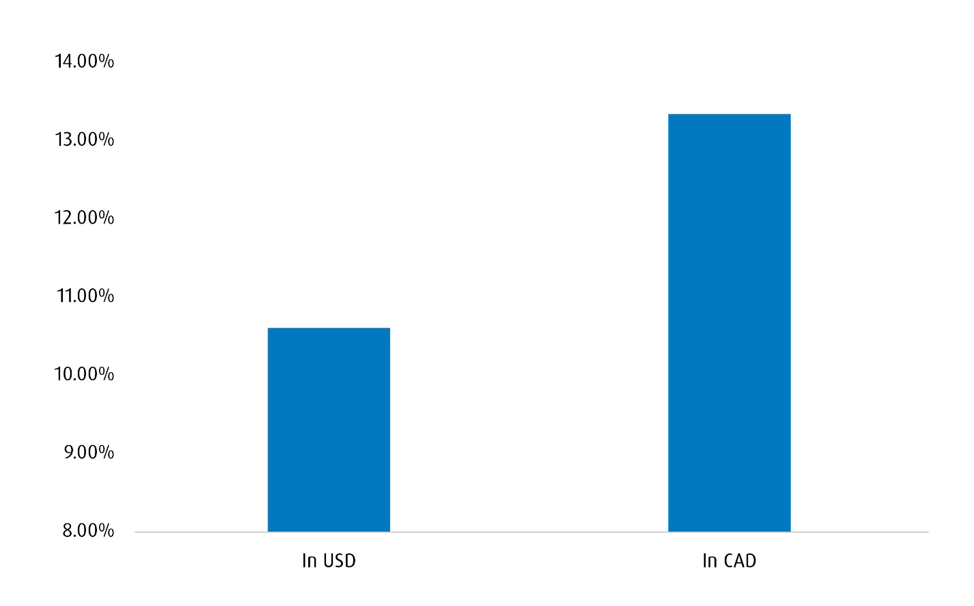
For illustrative purposes, consider Chart 1, which shows the total return for the S&P 500 in U.S. dollars (USD) and in CAD terms for Q1 of this year. In USD terms, the index was up 10.6% over that time frame, but since that period also corresponded to weakness in the CAD relative to the USD (or USD/CAD moved higher) the index outperformed in CAD terms (up 13.3%). That means that Canadian investors would have fared much better leaving their USD exposure unhedged ex ante.

Chart 1 – S&P 500 Total Return for Q1 2024

Source: BMO Global Asset Management

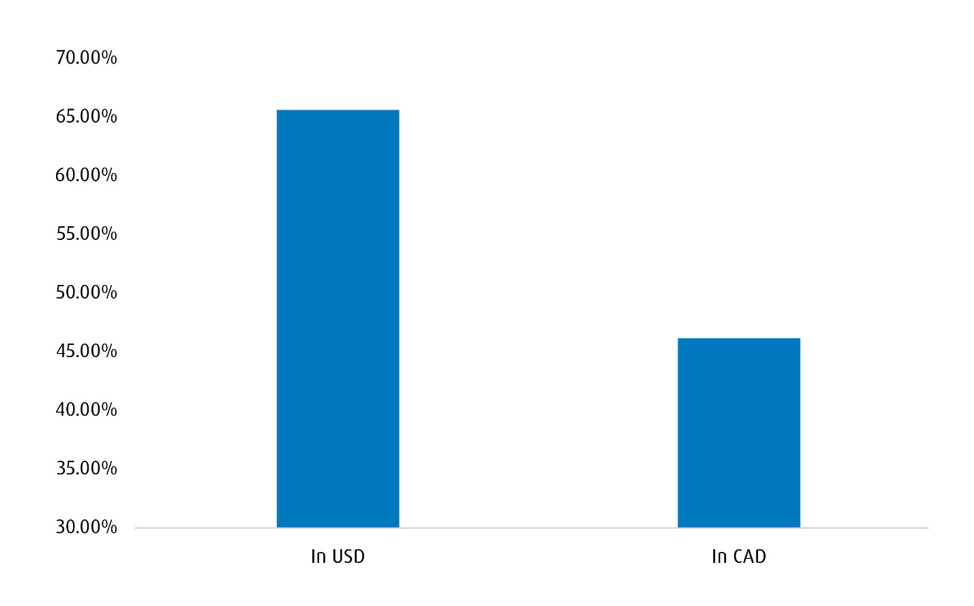
Now let’s look at an alternative period in which the CAD strengthened against the USD. Chart 2 shows a comparison of the total return for the S&P 500 from April 2020 to April 2021 (in which USD/CAD was lower by over 11%). During that period, the total return index outperformed in USD terms by close to 20%. In this scenario, an investor who had hedged their FX risk would have been in the optimal position.

Chart 2 – S&P 500 Total Return Between April 2020 – April 2021

Source: BMO Global Asset Management

As these examples show, currency risk is a key consideration for any investor who wants to look beyond Canada for diversification. That risk can cut both ways, which amplifies the importance of hedging decisions. In our minds, the decision to hedge foreign exchange (FX )risk (including the degree to which foreign exposure is hedged) comes down to the following:

  1. An investor’s view of the underlying currency pair
  2. Whether the currency pair is positively or negatively correlated2 with the underlying asset

In this note, we’ll make a brief comment on the first point but focus largely on the second one. as we feel that should be given more weight for hedging decisions.

FX Markets are Tough to Call

Taking a view on the underlying currency pair is easy to do — but difficult to capitalize on.

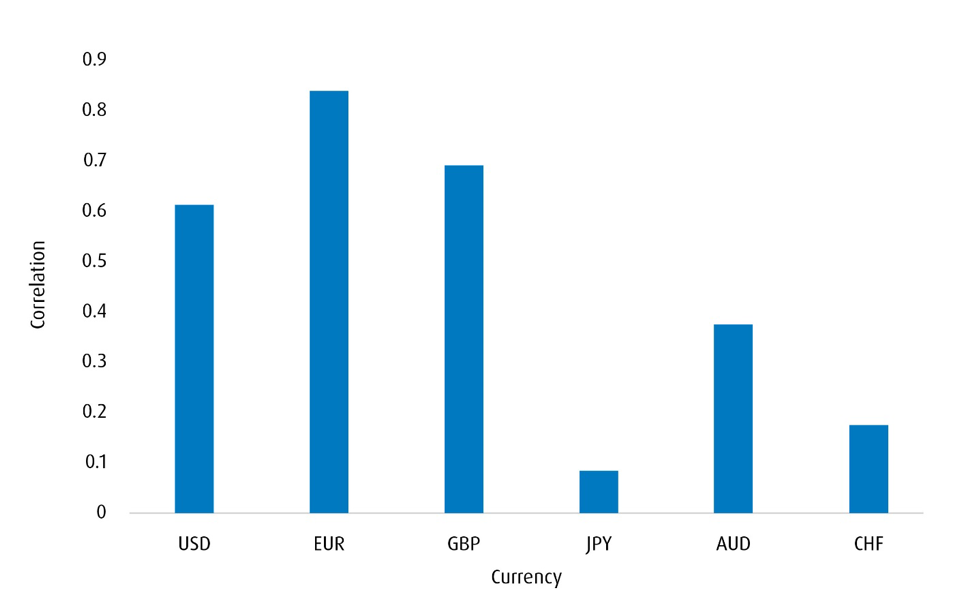
Indeed, foreign exchange markets are notoriously fickle. One reason why is the relationship between predictive factors and currency pairs is rarely stationary. For instance, a lot of market participants tend to use front-end (2-year) yield spreads as a proxy for central bank divergence in the spot FX market. Chart 3 shows the current correlation between those spreads and the different CAD crosses, and as expected, the relationship isn’t consistent from a cross-sectional perspective.

Chart 3 – Correlation Between Two-Year Spreads and the CAD Crosses

* * Correlation window is 2 years. The CAD is used as a base currency for this analysis. The spread is tabulated by subtracting the foreign 2-year yield from the CAD 2-year yield. Source: Bloomberg, BMO Global Asset Management.

We can also see this by looking closer at the relationship between a factor and a currency pair over time. Chart 4 shows the rolling 100-day correlation between USD/CAD and the price of oil (proxied by the prompt WTI contract3) going back ten years. Note how frequently the strength of the correlation (as well as the sign) changes over time. Continue Reading…