Decumulate & Downsize

Most of your investing life you and your adviser (if you have one) are focused on wealth accumulation. But, we tend to forget, eventually the whole idea of this long process of delayed gratification is to actually spend this money! That’s decumulation as opposed to wealth accumulation. This stage may also involve downsizing from larger homes to smaller ones or condos, moving to the country or otherwise simplifying your life and jettisoning possessions that may tie you down.

A Failure to understand Rebalancing


By Michael J. Wiener

Special to the Financial Independence Hub

Recently, the Stingy Investor pointed to an article whose title caught my eye: The Academic Failure to Understand Rebalancing, written by mathematician and economist Michael Edesess.  He claims that academics get portfolio rebalancing all wrong, and that there’s more money to be made by not rebalancing.  Fortunately, his arguments are clear enough that it’s easy to see where his reasoning goes wrong.


Edesess’ argument

Edesess makes his case against portfolio rebalancing based on a simple hypothetical investment: either your money doubles or gets cut in half based on a coin flip.  If you let a dollar ride through 20 iterations of this investment, it could get cut in half as many as 20 times, or it could double as many as 20 times.  If you get exactly 10 heads and 10 tails, the doublings and halvings cancel and you’ll be left with just your original dollar.

The optimum way to use this investment based on the mathematics behind rebalancing and the Kelly criterion is to wager 50 cents and hold back the other 50 cents.  So, after a single coin flip, you’ll either gain 50 cents or lose 25 cents.  After 20 flips of wagering half your money each time, if you get 10 heads and 10 tails, you’ll be left with $3.25.  This is a big improvement over just getting back your original dollar when you bet the whole amount on each flip in this 10 heads and 10 tails scenario.  This is the advantage rebalancing gives you.

However, Edesess digs further.  If you wager everything each flip and get 11 good flips and 9 bad flips, you’ll have $4, and with the reverse outcome you’ll have 25 cents.  Either you gain $3 or lose only 75 cents.  At 12 good flips vs. 12 bad flips, the difference grows further to gaining $15 or losing 94 cents.  We see that the upside is substantially larger than the downside.

Let’s refer to one set of 20 flips starting with one dollar as a “game.”  We could think of playing this game multiple times, each time starting by wagering a single dollar.  Edesess calculates that “if you were to play the game 1,001 times, you would end up with $87,000 with the 100% buy-and-hold strategy,”  “but only $11,000 with the rebalancing strategy.”

The problem with this reasoning

Edesess’ calculations are correct.  If you play this game thousands of times, you’re virtually certain to come out far ahead by letting your money ride instead of risking only half on each flip.  However, this is only true if you start each game with a fresh dollar. Continue Reading…

Harvest launches HRIF – a multi-sector income ETF with no leverage

Image courtesy Harvest ETFs/Shutterstock

By Michael Kovacs, President & CEO of Harvest ETFs

(Sponsor Blog) 

The Harvest Diversified Monthly Income ETF (HDIF:TSX) was built to meet Canadian investors’ need for income and sector diversity. We built it with a straightforward thesis, by holding an equal weight portfolio of established Harvest Equity Income ETFs, we could deliver growth potential and high monthly income. That made it one of the most popular Canadian ETFs launched in 2022.

Each of the ETFs held in HDIF captures a portfolio of leading large-cap businesses. They also each employ an active and flexible covered call option strategy to generate high income yields, offset downside, and monetize volatility. HDIF combined those ETFs with modest leverage at approximately 25% to deliver an enhanced income yield.

In April of this year, we launched the Harvest Diversified Equity Income ETF (HRIF:TSX). It holds the same equal-weight portfolio of Harvest ETFs, but without the use of leverage. Put simply, leverage adds a level of risk that some investors are not comfortable with. Therefore HRIF can deliver that same diversified portfolio of underlying ETFs and a high income yield in a package that more risk-averse investors may want to consider.

A truly diversified portfolio

At Harvest ETFs, we always start with portfolios of what we see as high-quality businesses. The ETFs held in HRIF capture companies that lead their sectors. By combining those portfolios into a single ETF, HRIF delivers a very diverse exposure to these companies.

The equal-weight portfolio held by HRIF at launch holds the following six ETFs.

Each ETF holds a portfolio of leading companies in their particular sector and market area. We define that leadership through quantitative and qualitative metrics such as market cap, market share, performance history and — in the case of certain underlying ETFs — dividend payment history. The companies selected in each ETF’s portfolio demonstrate leadership across those metrics.

HRIF also delivers a diverse set of performance drivers. Tech has been a market growth leader for over a decade and remains a key allocation for investors. Healthcare shows significant defensive qualities, especially during inflationary and recessionary times. The brand leaders in HBF and Canadian leaders in HLIF are selected in large part due to their resilience across market cycles, market shares, and dividend payment history. US banks have faced headwinds lately but have long-term positive exposure to interest rate increases and remain structurally important to the global economy. Utilities are an almost textbook definition of defensiveness, providing stability and ballast for the ETF.

Taken together, HRIF delivers leadership from a wide set of companies which, combined with its high income yield, makes it an attractive ETF for many investors.

HRIF’s High Income Yield Explained

HRIF launched with an initial target yield of 8.0% annually, paid as monthly cash distributions. That yield is earned by combining the underlying yields of its component ETFs, each of which employ an active & flexible covered call option strategy.

Covered call option ETFs effectively trade some upside potential for earned income premiums by ‘writing’ calls on a percentage of the ETF’s holdings. Where many covered call option ETFs use a passive strategy, writing calls on the same percentage of holdings each month, the Harvest ETFs held in HRIF use an active strategy. Continue Reading…

Why my goal to live off dividends remains alive and well

Image myownadvisor/honestmath.com

By Mark Seed, myownadvisor

Special to Financial Independence Hub

Some time ago…yours truly wrote a controversial post about the intent to live off dividends and distributions from our portfolio.

Well, a great deal of time has passed on that post by my thinking and goals remain the same – as least in part for semi-retirement!

Read on to learn why my approach to live off dividends remains alive and well this year in this updated post.

Why my goal to live off dividends remains alive and well

First, let’s back up to the controversy and offer a list why some investors couldn’t care less about my approach and why dividends may not matter at all to some people:

  1. The trouble with any “live off the dividends” approach is that you’d need to save too much to generate your desired income. Fair. 
  2. Dividends are not magical – there is nothing special about them. Sure.  
  3. A dollar of dividends is = a one-dollar increase in the stock price. True, a dollar is a dollar. 
  4. Stock picking (with dividend stocks) is fraught with under performance of the index long-term. I’m not convinced about that. 
  5. You can never possibly know long-term how dividends may or may not be paid by any company. Fair. 

In many respects these investors are not wrong.

You do need a bunch of capital to generate income.

Dividends are part of total return. [See image at the top of this blog.]

Stock selection can open up opportunities for market under performance.

And the negativity doesn’t stop there …

Some financial advisors will argue your investing world starts to shrink if you demand 2% or 3% (or more) income from your portfolio, so dividend investing leads to poor diversification.

My response to this: I don’t just invest in dividend paying stocks. 

Further still, some advisors will argue picking dividend paying stocks may lead to negative outcomes and too many biases.

My response to this: while I believe markets are generally efficient, I also believe that buying and holding some dividend paying stocks (while there could be market under-performance at times) does not necessarily mean I cannot achieve my goals. In fact, that’s the entire point of this investing thing anyhow – investing in a manner that keeps you motivated, inspired and helps you meet your long-term goals.

Consider this simple sketch art from Carl Richards, who is far more famous than I will be, and author of the One-Page Financial Plan and more:

Keep Investing Super Simple - Goals and Happiness

Source: Behavior Gap.

From Carl’s recent newsletter in my inbox:

“Pretend you live in some magic fantasy world where all of your dreams (according to the investment industry) come true, and you actually beat an index every quarter for your whole life. Congratulations!

So here’s my question: You landed in Shangri La, according to the financial industry. You beat the index. But you didn’t meet your goals. Are you happy?

The answer is “No.”

Now let’s flip that scenario on its head. The worst thing in the world happens to you (again, according to the investment industry). You slightly underperform the index every quarter for your whole life. But because of careful financial planning, you meet every one of your financial goals. Let me repeat the question: Are you happy?

And the answer is obviously… “Yes.”

Stop worrying about beating indexes. Focus instead on meeting your goals.”

Amen.

Finally, some advisors will argue that dividends and share buybacks and other forms of reinvesting capital back into the business can be equally shareholder friendly.

My response to this: Well of course that makes sense. Dividends are just one form of total returns.

But you know what?

The ability to live off dividends (and distributions from our ETFs) will be beneficial for these reasons:

1. I continue to believe there are simply too many unknowns about the financial future. So, living off dividends and distributions will help ensure our capital remains hard at work since it will remain intact.

2. If we are able to keep our capital intact we don’t need to worry as much about when to sell shares or ETF units when markets don’t cooperate. We can sell assets as we please over time.

3. Living off dividends is therefore just one way I’m trying to reduce sequence of returns risks. See below.

BlackRock - Sequence-of-returns-one-pager-va-us - December 2022 Page 2.pdf

Source: BlackRock.

As such, we’ll try to live off dividends and distributions in the early years of semi-retirement to avoid such risks.

4. I/we don’t necessarily believe in the 4% safe withdrawal rule. It’s impossible to predict next year, let alone 30 or more investing years.

5. I’m conservative as an investor. Seeing dividends roll into my account help me psychologically to stick to my investing plan.

6. Dividends is real money, tangible money I can spend if and when I choose without worrying about stock market prices or gyrations.

7. It is my hope dividends (and capital gains) can work together to help fight inflation. As consumer prices rise, as the cost of living rises, the companies that deliver our products and services will rise in price along with them.

8. I like dividend paying stocks for a bit of the “value-tilt” they offer. 

9. Canadian dividend paying stocks are tax-efficientWith my RRSP growing more with U.S. assets, I tend to keep Canadian dividend paying stocks in my TFSA and inside my non-registered account.

In a taxable account Canadian dividend paying stocks are eligible for a dividend tax credit from our government. This means taxation on dividends are favourable, it is a lower form of tax; lower than employment income and interest income. This will help me in the years to come.

Will I eventually spend the capital from my portfolio?

Of course I will.

But with a “live off dividends” mindset I can sell assets or incur capital gains largely on my own terms during retirement. I plan to do just that.

Why my goal to live off dividends remains alive and well summary

This site continues to share a journey that includes how passive dividend income can fulfill many of our retirement income needs – whether that might be covering our property taxes, paying our utility bills, delivering enough monthly income to cover our groceries, fund some international travel or all of these things combined.

Here was one of my recent updates below.

We’re now averaging over $3,300 per month from a few key accounts.

(Hint: likely more next month!)

We’re trending in a great direction thanks to this multi-year investing approach and I have no intentions of changing my/our overall approach.

I firmly believe our focus on the income that our portfolio generates, instead of the portfolio balance, is setting us up to deliver some decent semi-retirement income.

Our goal to live off dividends and distributions remains very much alive and well for the years ahead.

I look forward to your comments.

Mark Seed is a passionate DIY investor who lives in Ottawa.  He invests in Canadian and U.S. dividend paying stocks and low-cost Exchange Traded Funds on his quest to own a $1 million portfolio for an early retirement. You can follow Mark’s insights and perspectives on investing, and much more, by visiting My Own Advisor. This blog originally appeared on his site on March 27, 2023 and is republished on the Hub with his permission.

Defined Benefit pension plans continue to perform, despite ongoing market volatility

Image Mercer/Getty Images

By F. Hubert Tremblay, Partner, Mercer Canada

Special to Financial Independence Hub

 The last few years have thrown a number of hurdles on the markets. A pandemic and the recovery phase have been accompanied by recent additional uncertainty from the collapse of Silicon Valley Bank and fears of a global banking crash. Canadians looking at their retirement savings realize how volatility can affect their accounts and might have to save more to meet their retirement objectives or delay retirement.

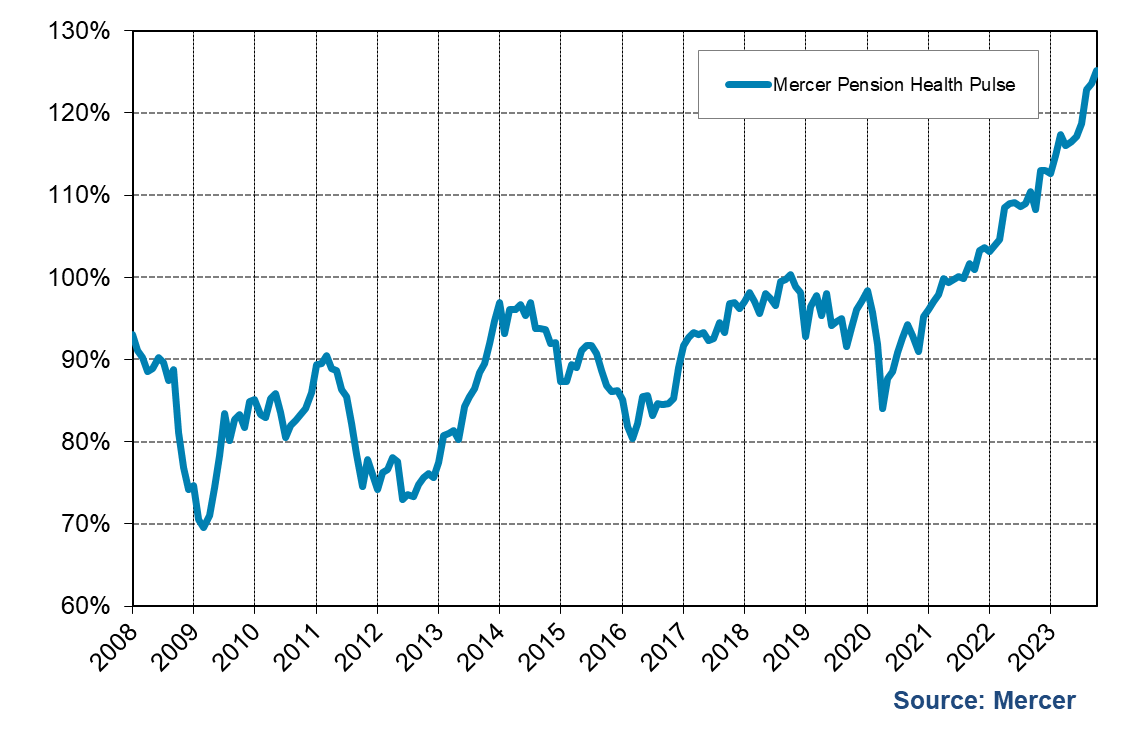
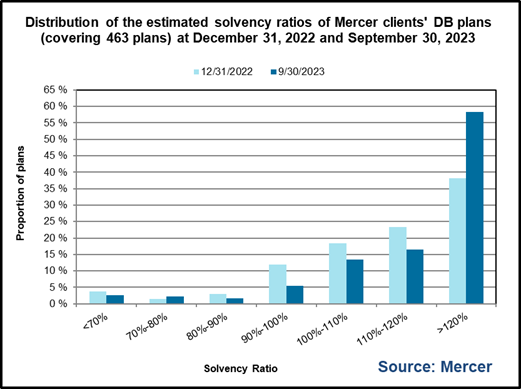
Despite this volatility, the financial positions of defined benefit (DB) pension plans continued to improve over the last quarter, as indicated by the Mercer Pension Health Pulse (MPHP).

The MPHP, which tracks the median solvency ratio of the DB pension plans in Mercer’s pension database, rose in Q1, finishing the quarter at 116 per cent, a jump of 3 per cent from the beginning of 2023. This is on top of a remarkable jump of 10 per cent during 2022.

While the global banking crisis continues to wreak havoc on markets, a strong January and February helped ensure that Canadian DB plans remained unaffected, and most continued to improve. In fact, many plans’ funded positions finished the quarter in better positions than they have been in 20 years. However, looking ahead, there are several factors that may create more volatility and uncertainty for DB plans:

 The global economy at play

The global economy entered 2023 juggling multiple risks. Around the world, central banks were focused on tackling inflation by increasing their policy interest rates and other qualitative tightening activities. On the heels of the failure or takeover of high-profile banks in both the U.S. and Europe, policymakers must now weigh the consequences of continuing these tightening measures with the need to stabilize the banking sector overall.

The war in Ukraine – with no signs of resolution in the near future – could also mean continued global tensions and a reduction in global trade, all of which will negatively impact the global economy.

In North America, there is increased political polarization in the U.S., with the debt ceiling needing to be raised but neither side compromising to reach an agreement. The consequences of the American government debt default would be disastrous for global financial markets.

 The Canada equation

North of the border in Canada, in addition to the inflation scenario, Ottawa’s decision to cease issuing real return bonds (RRBs) and proceed with Bill C-228 caused a stir among pension stakeholders. Continue Reading…

Retired Money: Americans cashing out of employer Retirement plans could benefit from Canadian approach

My latest MoneySense Retired Money column, which has just been published, looks at an interesting study on trends in cashing out Retirement savings when American workers leave their jobs. You can find the full column by clicking on the highlighted text here: Should you cash out your workplace pension when you leave a job?

The paper, titled Cashing Out Retirement Savings at Job Separation, is co-written by a Canadian, Yanwen Wang, associate professor at the University of British Columbia’s Sauder School of Business. The study, which is fairly technical, is also featured in a more accessible version in the Harvard Business Review. The article that ran on March 7, 2023 is titled Too many employees cash out their 401(k)s when leaving a job.

Canada and the United States differ in how retirement plans are treated on leaving jobs, so most of the column applies mainly to the United States. But there may be lessons for the US retirement system that can be drawn from the Canadian treatment.

Average American has more than a dozen jobs over a career

In the US, the average American worker will have 12.4 jobs over a career, prompting the report’s authors to write that “Employers should recognize that most people working for them will change jobs before retirement.” Unfortunately, it’s all too easy for their workers to cash out of their 401(k)s when leaving a job, instead of rolling them over and letting the money continue to grow in a tax-deferred manner.

A UBC press release issued early in April carries the alarming headline that “Americans are cashing out the retirement savings at an alarming rate.”  The study identifies a “key” problem: when they switch jobs, 41.4% of employees are cashing out of those funds — even though the U.S. Internal Revenue Service (IRS) imposes a 10% per cent penalty on anyone younger than 59.5 years old.

Here’s what Wang said via email about the implications for Canadian retirement: “Canada has some different fundamental rules around retirement savings withdrawal. It is hard or probably impossible to speak to the Canadian RRSP withdrawal based on our US-based study.”
Canadian plans have locked-in feature

In particular,  many Canadian RRSPs have a locked-in feature, Wang added: “which means that even at job changing cash withdrawals are not allowed unless the individual becomes non tax resident. The locked-in feature is a key feature not present in most US retirement savings accounts. I don’t have data but I believe the illiquidity feature substantially reduces 401(k) leakage. I think the U.S. can learn from the Canadian retirement system and consider something similar — a locked-in 401(k) on top of an emergency savings plan — to satisfy the long-term retirement needs as well as short-term liquidity emergency.”

Unlike Canada, American employees can cash out at any time whether they’re working or leaving a job: the only developed economy that does. As the article points out, “other countries require many months of unemployment and evidence of clear hardship before allowing someone to tap defined contribution retirement savings.”

 Researchers also found an interesting phenomenon whereby the more a generous employer “matches” employee contributions, the more the departing employee is tempted to cash out and spend what it regards as “house money” or “free money.” Thus, the authors write, “Right now, cashing out is the path of least resistance. People choose what is easy, not what is wise.”

The column closes with some findings from a recent H&R Block Canada survey released on April 3, 2023. It  found nearly half of Canadians are unprepared for retirement and more than a third (36%) between ages 18 and 54 believe they won’t ever retire.