Most of your investing life you and your adviser (if you have one) are focused on wealth accumulation. But, we tend to forget, eventually the whole idea of this long process of delayed gratification is to actually spend this money! That’s decumulation as opposed to wealth accumulation. This stage may also involve downsizing from larger homes to smaller ones or condos, moving to the country or otherwise simplifying your life and jettisoning possessions that may tie you down.
The need for income from investments has become more important than ever given an aging population, higher inflation, and cost of living. There are many ways to earn income from investments, but two distinct pathways emerge: the well-trodden path of traditional income and the emerging use of covered call strategies. Let’s dive a bit deeper into the two methods.
Covered Call Strategy: A Paradigm Shift in Income Generation
The covered call strategy is an investment strategy that involves the purchase of an underlying asset, such as a stock, and the sale of a call option on that same asset. By selling the call option, the investor agrees to sell the underlying asset at the strike price of the option if the option is exercised. Essentially, they involve holding a portfolio of stocks while simultaneously selling call options on those holdings. This approach creates a dual stream of income: dividends from the underlying stocks and premiums collected from the sale of call options.
Balancing Act: Income vs. Capital Appreciation
The allure of the covered call strategy lies in its potential to provide a higher yield compared to traditional income investments. Furthermore, the yield generated by writing call options is taxed more preferably under capital gains accounts while interest income from fixed-income products (such as GICs) is taxed under income.
Traditional Income Investments: The Time-Tested Approach
Classic Income Investments
By contrast, traditional income investments have been around for a very long time and can be reliable sources of income. This category includes bonds, GICs, and dividend-paying stocks. Bonds provide regular interest payments, GICs [Guaranteed Income Certificates] offer fixed interest rates, and dividend stocks distribute periodic income.
Stability and Predictability
The hallmark of traditional income investments is their stability. Bond interest payments, GICs, and dividend distributions are relatively predictable. This predictability appeals to investors who prioritize a steady income stream and wish to avoid the potentially higher volatility associated with other investment options.
Comparing Covered Call Strategies and Traditional Income Investments
Yield Potential
Covered Call strategies typically offer a higher yield due to the combination of dividends and option premiums. This can be especially attractive for income-focused investors seeking higher returns. By contrast, traditional income investments tend to provide more modest but steady income streams. Continue Reading…
It’s never a bad idea to carefully organize your belongings. Discover a few important reasons to make estate planning part of your retirement process.
Adobe Image by Daenin
By Dan Coconate
Special to Financial Independence Hub
Retirement may feel like a distant prospect for many, but it’s never too early to start planning for your golden years.
Many people focus solely on their financial savings and investments when it comes to retirement preparations, but estate planning is another crucial element to consider. Estate planning not only protects your hard-earned assets, but it also ensures they go to your specified loved ones. Explore five essential reasons to incorporate estate planning into your retirement strategy.
Protecting your Legacy and Loved Ones
One of the main goals of estate planning is preserving your legacy after you’ve passed. A proper estate plan safeguards your assets for future generations by outlining your wishes for the distribution of your estate. This includes creating a will, designating beneficiaries for your assets, and even making provisions for minor children. By keeping your estate plan up to date, you’re setting your loved ones up for success and protecting them from legal disputes.
Avoiding Probate and Minimizing Taxes
Probate can be a long, costly, and complicated process, draining your estate’s value and leaving your loved ones in limbo. A well-crafted estate plan can help avoid probate by designating beneficiaries and establishing trusts. In addition, estate planning can minimize or eliminate the taxes your heirs will have to pay. By using smart planning strategies during retirement, such as gifting assets to heirs, you can potentially reduce estate taxes and maximize the wealth passed down to your loved ones. Continue Reading…
When’s the last time someone tried to talk you into chasing a “hot” Treasury bond run — NOW, before it’s too late!
Probably never, right?
Most of us recognize that’s not what fixed-income investing is for. Bonds create stability; stocks and alternatives are where the excitement is at.
And yet, I often see people forgetting this timeless truth, or at least investing as if they have. Plus, to further complicate things, not all bonds are created equal. This can trick you into thinking you’re playing it safe … just before a big blow-out takes you by surprise.
Following are 6 best practices for fixed-income investing across all kinds of markets, whether rates are rising, falling, or in a holding pattern.
1.) Let your Plans Lead the Way
Our first point is the same “play it again” tip we want you to apply across all your investments — from the safest GIC, to the edgiest emerging markets. Even though we’ve said it before, such as in my past post, The Timely and Timeless Roles of Fixed Income Investing, it bears repeating:
“If there’s one principle that drives all the rest, it’s the importance of having your own detailed investment plan … In the absence of a plan, undisciplined investors instead struggle to predict how, when, and if it’s time to react to unknowable events over which they have little control. While there is no guarantee that your plan will deliver the outcomes for which it’s been designed, we believe that it represents your best interests and your best odds for achieving your personal goals.”
2.) Don’t be Distracted by “This Time, It’s Different”
Instead of letting the shifting tides overtake decades of empirical evidence, repeat after me:
Stocks: Stocks have long been a most effective tool for pursuing new wealth over time and preserving your purchasing power by outpacing inflation. However, along with their higher expected long-term returns, they’ve also delivered a much bumpier ride, which increases the uncertainty that you may not ultimately achieve your particular goals.
Bonds: Bonds have been a good tool for dampening stocks’ volatility, giving you a better chance of remaining on track. They can also contribute modestly to your total returns, but that shouldn’t be their primary role.
We’ll undoubtedly see times again, along with the inevitable proclamations that we’re (yet again) in a new financial order, and that (once again) the old rules no longer apply.
At least to date, such pronouncements have been wrong every time. That’s likely due at least in part to our next bedrock assumption, which has ultimately crushed them so far.
3.) Benefit from Bond Pricing Basics
One reason bonds tend to be more stable than stocks is their inherently different pricing processes:
Stock Pricing: Stock prices are cobbled together from the market’s collective and ever-shifting guesstimates. Such pricing is relatively efficient over the long run, but often a hot mess in real time.
Bond Pricing: Bond pricing is different. When a bond is issued, or if it is trading in the open market, you know the price you can pay today, the price you will receive when it matures, and the interest payments you’ll receive along the way. Putting all of that together means you can neatly calculate a bond’s return if you hold it to maturity. In bond speak, this is called “yield to maturity” (YTM). Computers can also calculate the YTM for entire pooled bond investments like bond funds or ETFs.
A bond’s YTM won’t change. What will change is how much it’s worth if traded prior to maturity in secondary markets. There, an existing bond’s resale value will rise and fall relative to rising and falling yields in the marketplace.
The future remains uncertain for stocks and bonds alike. But since upcoming returns are already baked into a bond’s yields, the increased — if still imperfect — pricing knowledge translates into a smoother ride, along with a reduced risk premium.
In other words, breaking news may alter prices, but not the pricing process. In addition, bond holders are creditors, whereas stock holders are owners. In the event of a company failure, creditors are more likely than owners to recover their capital.
Understanding these distinctions, it’s easier to accept the timeless role bonds play in your portfolio.
4.) Understand what Central Banks can (and cannot) Do for Us
Perhaps the most frothy bond market news comes from the rivers of rate changes continuously flowing out of the world’s central banks, especially the U.S. Federal Reserve. Each adjustment is accompanied by a rush of coverage on yields, spreads, curves, short- and long-term rates, and so on. It all sounds important. But is it?
Central bank rate changes are useful data points for understanding how global bond markets operate over time. But they should not be a major influence on your immediate investment activities. A recent Dimensional Fund Advisors paper, “Considering Central Bank Influence on Yields,” helps us understand why this is so. Analyzing the relationship between U.S. Federal Reserve policies on short-term interest rates versus wider, long-term bond market rates, the authors found: Continue Reading…
To shed light on effective wealth-building strategies, we’ve gathered insights from nine experts in the field, including investment specialists, financial advisors, and more.
From the importance of diversifying your portfolio and investing in yourself to the consistent investment in stock indices, these professionals share their top investment opportunities and asset classes that have proven particularly effective in securing financial independence.
Diversify Your Portfolio and Invest in Yourself
Prioritize Exchange Traded Funds (EFTs)
Look into Home Ownership and 401(k) Investments
Make Systematic Progress Across Asset Classes
Generate Passive Income with a Niche Website
Build Wealth through Real Estate
Focus on Healthcare and Nutraceuticals
Seek Rental Property Investments
Be Consistent with Investment in Stock Indices
Diversify your Portfolio and Invest in Yourself
One investment opportunity that has proven particularly effective in building and securing financial independence is a diversified portfolio that includes a mix of equity, bonds, and alternative assets.
This strategy allows for exposure to different asset classes, mitigating risk while aiming for growth. Equities provide the potential for high returns, bonds offer stability and income, and alternative assets such as real estate, commodities, or private equity can add further diversification and potentially enhance returns.
However, it’s essential to emphasize that investing in oneself has been the best investment of all. Personal and professional development, education, and acquiring new skills have consistently yielded substantial returns over time. These investments enhance earning potential, open up new opportunities, and empower individuals to adapt to changing circumstances. — Ahmed Henane, Investment Specialist and Financial Advisor, Ameriprise Financial
Prioritize Exchange Traded Funds (EFTs)
The equity market is the single greatest wealth creator for investors. If someone has 10 years or more as their time horizon for investing, then an equity growth mutual fund or ETF (Exchange Traded Fund) is highly recommended to build wealth.
ETFs are very similar to mutual funds. ETFs typically represent a basket of securities known as pooled investment vehicles and trade on a stock exchange like individual stocks. A growth ETF is a diversified portfolio of stocks that has capital appreciation as its primary goal, with little or no dividends.
One such investment would be the Vanguard Growth ETF (VUG/NYSE Area). This ETF is linked to the MSCI US Prime Market Growth Index, which offers exposure to large-cap companies within the growth sector of the U.S. equity market. Investors with a longer-term horizon ought to consider the importance of growth stocks and the diversification benefits they can add to any well-balanced portfolio. — Scott Krase, Wealth Manager, Connor & Gallagher OneSource
Look into Home Ownership and 401(k) Investments
There isn’t any one asset class or investment opportunity I’d recommend over the other for the general populace. Those types of financial decisions are circumstantial and based on the needs of the client.
Nonetheless, the two ways to “Build Wealth for Dummies” would be to purchase your home and invest in your 401(k). From a behavioral-finance perspective, the automatic contributions to these two vehicles have, more often than not, created better outcomes for clients. — Rush Imhotep, Financial Advisor, Northwestern Mutual Goodwin, Wright
Make Systematic Progress across Asset Classes
A systematic progression across multiple asset classes has been successful in developing wealth and financial freedom. A cash-generating firm provides a stable financial basis for future projects.
Real estate investing offers passive income and property appreciation, boosting financial security. Diversifying the portfolio with equities and other assets follows, harnessing the potential for exponential growth and mitigating risk through a well-balanced mix. However, amidst this multifaceted approach, it is crucial not to overlook the most pivotal investment: oneself.
As Warren Buffett wisely advised, “Be fearful when others are greedy and be greedy only when others are fearful.” Investing in self-improvement, education, and personal development enhances decision-making acumen and emotional resilience, providing the intellectual foundation to navigate the ever-evolving landscape of wealth accumulation. — Galib A. Galib, Principal Investment Analyst
Generate Passive Income with a Niche Website
A few years back, an affiliate website was launched in the personal finance niche. The payoff? Consistent ad revenue and affiliate commissions with minimal oversight, essentially becoming a self-sustaining income stream.
Running a website is not as time-consuming as commonly believed. After the initial setup and content, it just needs occasional updates. Soon enough, it turned into a low-maintenance income source. Continue Reading…
Crazy People is a 1990 American comedy starring Dudley Moore and Daryl Hannah. Moore plays advertising executive Emory Leeson. Leeson experiences a nervous breakdown, which causes him to design a series of “truthful” advertisements that are blunt and bawdy.
By mistake, his ads get printed and turn out to be a tremendous success. One of Leeson’s more memorable campaigns is for Volvos, which includes the tagline “Volvo — they’re boxy but they’re good.”
Dividend-paying stocks are like the Volvos of the investing world. They are not fancy or exciting, nor do they produce windfall profits over the short term. However, they have a lot going for them when you take a deeper look under the hood.
This month, I explore the historical performance of dividend-paying stocks, including the conditions under which they have tended to outperform their non-dividend-paying counterparts. Relatedly I will also discuss whether the current market environment is supportive of future outperformance.
A Caveat to the Volvo Analogy: Having your Cake and Eating it Too
The “Volvo — they’re boxy but they’re good” tagline implies a clear tradeoff: the suggestion being that one needs to sacrifice performance for reliability. However, the historical data imply that this has not been the case with dividend-paying stocks. Not only have they exhibited greater stability than their non-dividend-paying counterparts, but they have also produced higher returns, thereby providing investors with a “have your cake and eat it too” proposition.
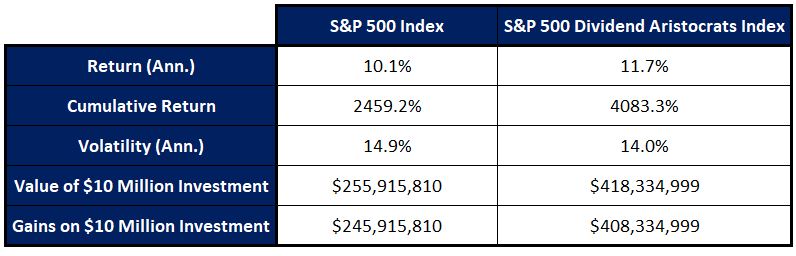
S&P 500 Index vs. S&P 500 Dividend Aristocrats Index (1990 – Present)
Since the beginning of 1990, the S&P 500 Index Dividend Aristocrats Index has produced an annualized total return of 11.7% vs. 10.1% for the S&P 500 Index. This difference in annualized performance has amounted to a tremendous difference in cumulative long-term returns, with the S&P 500 Dividend Aristocrats Index producing a cumulative return of 4,083% vs. a far less impressive 2,459% for the S&P 500 Index. In dollar terms, a $10 million investment in the S&P Dividend Aristocrats Index would have produced $408,334,999 in returns, which is 1.66 times more than the corresponding figure of $245,915,810 for the S&P 500 Index.
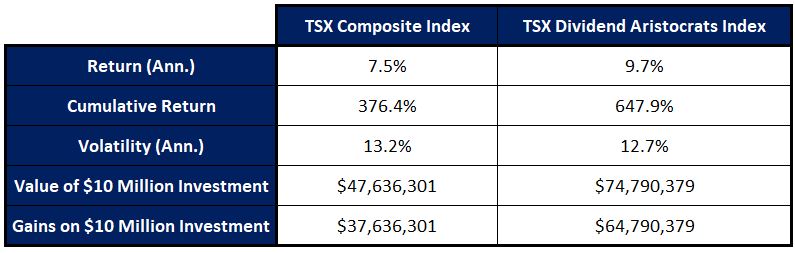
TSX Composite Index vs. TSX Dividend Aristocrats Index (2002 – Present)
The numbers for Canada tell a similar story, albeit over a shorter period due to historical data limitations for the TSX Dividend Aristocrats Index. Since 2002, the TSX Dividend Aristocrats Index has produced an annualized total return of 9.7% vs. 7.5% for the TSX Composite Index. In terms of cumulative performance, the TSX Dividend Aristocrats has produced a total return of 647.9% vs. 376.4% for the TSX Composite Index. In dollar terms, a $10 million investment in the TSX Dividend Aristocrats Index would have produced $64,790,379 in returns, which is 1.72 times more than the corresponding figure of $37,636,301 for the TSX Composite Index.
As an aside, the tremendous difference from 1990 to the present in the 2,459% cumulative return for the S&P 500 Index and that of 1,120% for the TSX Composite Index is largely attributable to the former’s far larger weighting in technology stocks. Between 1990 and 2010, the two markets were neck and neck, with the S&P 500 delivering a total return of 457% vs. 453% for the TSX. Since then, the S&P 500 went on to crush its northern neighbour, with a total return of 359% vs. 120%. During the same period, the mega-cap tech-heavy Nasdaq 100 knocked the lights out, returning 675%.
Tech stocks, and in particular mega-caps, have experienced tremendous earnings growth and trade at premium valuations. Whether their rates of growth continue, or premium multiples will persist, is beyond the scope of this commentary. That being said, there is no guarantee that these trends will persist, and relatedly whether the U.S. stocks will continue to outperform their Canadian counterparts.
Nice to Have in Strong Markets and Essential in Others
Dividends have historically been an integral part of equity market returns. Going back to 1990, a full 52.2% of the total return of the S&P 500 Index since 1990 can be attributed to the power of compounding reinvested dividends. On a relative basis, Canadian dividends have been even more prominent than U.S. ones, with reinvested dividends responsible for an astounding 63.3% of the total returns of the TSX Composite index.
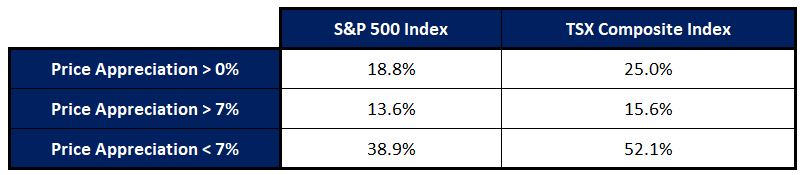
Although dividends’ contributions to total market returns have been substantial over the past several decades, this contribution has tended to vary substantially over shorter sub-periods. As the table below demonstrates, dividends tend to play a smaller role in times of strong price appreciation. By contrast, during periods when capital gains have been muted, dividends play a far more substantial role in overall returns.
Contribution of Dividends to Total Returns: Rolling 12-Month Periods (1990 – Present)
Taking all 12-month rolling periods since 1990 in which the S&P 500 experienced price appreciation, dividends on average accounted for 18.8% of total returns. However, in periods where prices rose by 7% or more, dividends were responsible for only 13.6% of the total return pie vs. 38.9% when prices rose between 0% and 7%.
In Canada, the relative importance of dividends has also varied with capital gains. In all rolling 12-month periods since 1990 in which the TSX Composite Index experienced price appreciation, dividends were on average responsible for 25% of total returns. In those periods where prices rose by more than 7%, dividends’ share of total returns was only 15.6% as compared to 52.1% when prices rose between 0% and 7%. Continue Reading…


 Posted By