Decumulate & Downsize

Most of your investing life you and your adviser (if you have one) are focused on wealth accumulation. But, we tend to forget, eventually the whole idea of this long process of delayed gratification is to actually spend this money! That’s decumulation as opposed to wealth accumulation. This stage may also involve downsizing from larger homes to smaller ones or condos, moving to the country or otherwise simplifying your life and jettisoning possessions that may tie you down.

Were you nervous before you Retired?

I was recently asked that question, and it brought back a flood of memories from my “near-retirement” days.

I suspect most of us were nervous before we retired, but it’s not something we talk about.  I believe there’s value in sharing the psychological journey in those final days before retirement.  For folks nearing retirement, it’s reassuring to know they’re not alone.

Recently I had the opportunity to talk about it with a reader who is on the cusp of retirement. We had a wide-ranging discussion and the conversation became the trigger for today’s post.  I suspect many of the questions he asked are also on the minds of other readers who are approaching retirement.

This one’s for you, Mike.  Thanks for letting me share our discussion with the readers of this blog.  I trust they’ll all benefit from our discussion…


Were you nervous before you Retired?

That’s one of the questions a reader, Mike, asked me on a recent phone call.  Mike’s a month away from retirement and reached out to me a few weeks ago.  I typically decline reader requests for phone calls (unfortunately, a downside of writing a blog with a large following).  If I said yes to every request, I’d be spending far too much of my time helping folks on a one-on-one basis, time that could otherwise be spent writing and reaching thousands of people with the same effort. It’s a “scalability” thing, and I trust you understand.

However…there was something about Mike.

His initial email hit a chord with me.  Here’s what he said:


Good morning Fritz,

Have heard you on several podcasts and just finished your latest discussion with Jason Parker.  I will be retiring in January and your point about helping others hit a cord.  I would love the opportunity to speak with you about your blog.  I’m currently a financial advisor and feel there is a huge need for financial literacy for just about everyone.  As a former teacher, my passion is teaching/sharing.  Would like to understand better how you got started with your blog, what are some of the watch outs, and any other insights you could provide.

Thanks for your consideration and congratulations on living your best life!


What caught my attention?  The fact that he didn’t ask a single financial question and was focused on helping others. He had some ideas about teaching/sharing and he was considering starting a blog.  I appreciate readers applying the lessons I’m sharing in their lives and searching for Purpose in retirement.  I also had a bit more free time than I usually do, so I agreed to a phone call.

Following are some of the highlights of our discussion, in no particular order.  I trust you’ll find them of interest.


how do I retire

Questions From A Soon To Be Retiree


Should I start a Blog In Retirement?

My first reaction to any question that says “Should I start…” is to say yes.  It’s critical, especially in early retirement, to foster your creative curiosity and try anything that interests you.  Many won’t “stick,” but you’ll likely find a few that do.  Once you’ve found one or two, you’re on your way to a great retirement.

Mike has a passion for teaching and is exploring various avenues to reach others.  I strongly encourage anyone who has an interest in starting a blog to give it a try.  7 years ago, I started this blog on a whim.  I’m 100% self-taught and technically inept.  It’s easy to start a blog these days, with Bluehost and WordPress both designed for folks who have never built a website.  Starting this blog is one of the best things I’ve ever done and has become a Purpose of mine in retirement. I hope it works out as well for others who are considering it.

That said, it’s important to consider your motives.  If you’re doing it to make money, I suspect you’ll fail.  For 3 years, I wrote every week without making a dime and only started adding those annoying ads when I retired.  I get some complaints about them but believe I shouldn’t have to incur costs when there’s an option of generating some revenue for my “work.” As blogs grow, the costs increase (Mailchimp costs me $220/month based on my ~13k subscribers), and I felt it was time to at least cover my costs.  Making money has never been my motive, and it shouldn’t be yours.  Even now, after 7 years, the income from this blog basically pays my health insurance.  Nice to have, but not enough to change our life. Unless you’re in the 0.1%, you won’t get rich writing a blog. Continue Reading…

Tawcan: 10 lessons I’ve learned along the FIRE journey

By Bob Lai, Tawcan
Special to the Financial Independence Hub
Although I grew up in a household where my dad retired in his early 40s and a couple of my cousins reached financial independence and/or retired early in their 40s, I had never really put much thought or energy on financial independence retire early (FIRE) in my 20s. While I was living frugally, I wasn’t investing my money efficiently and I lacked a core investment strategy.

This changed just before I turned 30. Someone gave my wife and me a book called Secrets of the Millionaire Mind and our lives were forever changed. We aspired to make changes in our financial plans and how we manage our money. We knew FIRE was a possibility and we started investing in dividend-paying stocks with the plan to live off dividends by 2025 or earlier.

Ten years into our FIRE journey, we’ve made great progress on our goal of becoming financially independent. We are appreciative of this journey and how it has transformed our lives and made us more rounded people. We also have learned many lessons that we wouldn’t have learned if we weren’t on this journey.

I’d like to share with you the ten lessons I’ve learned so far on our FIRE journey.

1. FIRE is not the finish line, it’s a journey

Many see reaching FIRE as the finish line. For them, it means an escape from the rat race. However, I believe we can’t see FIRE as an escape route, the happy ending, a finish line, or the solution to everything. Reaching FIRE certainly doesn’t mean you will magically become happy and live happily ever after.

If you don’t work on yourself during the FIRE journey and improve yourself, you will continue to face the same challenges over and over.

Look at FIRE like a journey. It is very important to enjoy the journey and work on yourself while on this multi-year journey. So take the time to learn new skills, take self-improvement courses, gain new hobbies, make new friends, provide a helping hand in your community, etc.

2. Have a core investment strategy

In my 20s, although I was investing in the stock market, I was trading in and out of stocks frequently. I also invested heavily in high-MER mutual funds and low-interest-rate GICs. In other words, I didn’t have a core investment strategy and my money wasn’t working very hard for me.

Since starting our FIRE journey, I learned to get in line and stay in line. I learned the importance of having a core investment strategy.

For us, it means investing in both dividend-paying stocks and index ETFs. This hybrid investment strategy allows us to have a predictable dividend income every month while staying geographically and asset diversified. By getting rid of high-fee mutual funds and so-called “high interest” GICs, on top of investing in the stock market for the long term, our money is working much harder for us.

Having a core investment strategy also means that we stay focused. We aren’t constantly switching back and forth between different investing strategies and losing momentum. If we want to test out a different investment strategy, we can still do that, but we use a small percentage of our portfolio.

For example, less than 5% of our overall portfolio is invested in growth and more speculative stocks.

3. Ignore doubts and noises around you

The FIRE movement has gained popularity in recent years but it is still a niche movement. The niche nature of the movement means that many of your friends and family do not know about it and will cast doubts when they learn what you’re working on. Unintentionally, they may also try to sabotage your plans.

It is important to ignore doubts and noises around you. Believe in yourself, connect with like-minded people, find support from the FIRE community, and stay focused while on this FIRE journey.

4. Understand your whys

Many people start their FIRE journey because they hate their jobs and because they are not happy with their lives. But FIRE isn’t the magic pill, it will not make you happy all of a sudden.

It is important to dig deep, cut through the BS, and really understand why you want to become financially independent and one day retire early.

Perhaps it’s because you want to have more time to spend with your kids. Perhaps it’s because you want to have the ability to go skiing on a Tuesday morning. Perhaps it’s because you want to be able to volunteer at the local soup kitchen without having to worry about money.

Find your reasons.

5. Stop comparing

Becoming financially independent in less than five years doesn’t make you more successful and taking 20 plus years to reach financial independence doesn’t make you a failure either.

Because we are all different individuals, our FIRE journey will never be alike. Therefore, we need to stop comparing our journeys with each other. Instead, support each other and help each other along the way.

And remember, financial independence retire early does not define success in life.  Continue Reading…

Lessons learned in diversification: Reducing Canadian home country bias

Image by Pexels: Mihail Nilov

By Mark Seed, myownadvisor

Special to Financial Independence Hub

Many financial advisors, analysts and investing gurus alike tout the merits of portfolio diversification. In this updated posted, you can read on about my recent lessons learned in diversification, including reducing my Canadian home bias since becoming a DIY investor well over a decade ago.

Theme #1 – how many stocks are enough?

This answer depends on who you ask but there are some experts who claim owning about 30-40 individual stocks, in various industry sectors, will provide modest diversification to mitigate portfolio risk. Here are some examples:

Lowell Miller author of The Single Best Investment:

“In our portfolios for individuals and institutions we tend to carry thirty to forty stocks.”

“The more stocks you have, the more your group will behave like an index.”

“If you don’t want to hold the thirty to forty stocks that satisfy my personal comfort level, you can reduce the number – bearing in mind that each reduction increases the risk that a single bad apple in your bushel will have an excessive impact on results.”

Gary Kaminsky author of Smarter Than The Street:

“Holding 100 stocks is yet another myth of the great Wall Street marketing machine.”

“If you’re going to do your own work/research, you should feel comfortable that with 25 to 30 names, you have enough diversification and you have enough skin in the game.”

Gail Bebee author of No Hype – The Straight Goods on Investing Your Money:

“A popular rule of thumb asserts than an individual stock should represent no more than 5% of a portfolio.  This would mean owning at least 20 stocks.”

“Some studies of past stock market performance have concluded that owning about 15 to 20 stocks provides the best return for the least risk.”

Stephen Jarislowsky, Canadian billionaire and author of The Investment Zoo:

“Out of the many thousands of stocks I can choose from worldwide, I therefore really only need to look at 50 at most.”

Those estimates seem about right to me as a practising DIY investor.

When it comes to individual stocks though, dedicated readers of this site will know I’m a fan of portfolio diversification myself and practice the following personal rules of thumb to avoid individual stock risk:

  • I strive to keep no more than 5% value in any one individual stock, and
  • I’m working on increasing my weighting in low-cost ETFs over time to avoid my bias to Canadian dividend payers in my portfolio while generating total returns. Read on…

You can always review some of my current stock holdings on this standing page here.

Theme #2 – why diversification?

Portfolio diversification aims to lower the volatility of my portfolio because not all asset categories, industries, nor individual stocks will move together perfectly in sync. By owning a large number of equity investments in different industries and companies, and countries, those assets may and do rise and fall in price differently; smoothing out the returns of my portfolio as a whole.

“There is a close logical connection between the concept of a safety margin and the principle of diversification.” – Benjamin Graham

While I/we continue to hold no bonds in our portfolio at this time, as I contemplate semi-retirement in the coming years, I am seriously considering ramping up our cash on hand to counter any bearish equity markets when we’re not working full-time.

Theme #3 – how can I reduce my Canadian home bias with ease?

During the pandemic, I decided to make a few portfolio changes to simplify my portfolio more as semi-retirement planning continued. These were my decisions related to asset location and further diversification. Continue Reading…

Why Retirees own cash, bonds & GICs


By Dale Roberts

Special to Financial Independence Hub

Imagine retiring, and then you have to head back to work, or you cancel your planned trips and greatly curtail your lifestyle. That’s what happened to too many who retired at or near the recesssions created by the dot com crash and the financial crisis. Risk in retirement is perhaps the flipside of risk in the accumulation stage. In the accumulation stage, lower stock prices can be very good. Lower prices in retirement can impair retirement. The equity risk in retirement is called sequence of returns risk. Poor stock market returns early in retirement can create a situation where the portfolio value has decreased, and selling more shares at lower prices might be hazardous to your retirement health. That’s why retirees own bonds, cash and GICs.

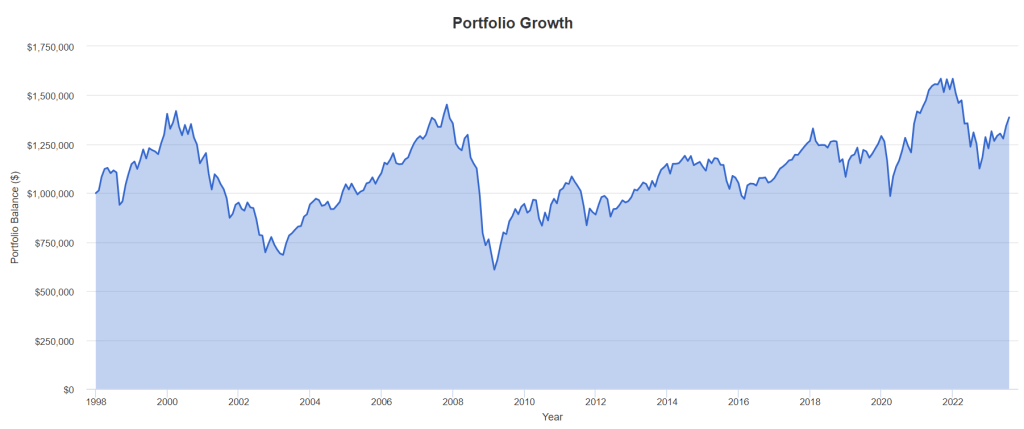
I will start off with a few charts that demonstrate the path of a retiree’s portfolio who retired at the start of the dot com crash (late 90s) and the financial crisis (2007-2009).

Here’s the drawdown history in recessions using the U.S. market as an example.

Yes, two of the most recent major corrections were epic and extraordinary. In the dot com crash and the financial crisis, stock markets were down 50%. In the early 2000s U.S. stock markets were down 3 years in a row.

The “average” decline in a recession is close to 25%. But as we know, average rarely happens when it comes to investing and stock markets.

The dot com crash retirement scenario

In the following scenario the retiree has a  C$1,000,000 portfolio and spends 4.2% of the portfolio value in year one. The $1,000,000 creates $42,000 of income. The spending rate then increases, adjusted for inflation. If inflation is 3%, the retiree gets a 3% raise.

The portfolio is 50% U.S. stocks and 50% global.

Portfolio Visualizer

We can see that it was “over” quickly for the equity portfolio in this scenario. Even the strong market returns from 2003 to 2008 could not bring the portfolio back to health. In late 2007 the portfolio value was $870,000 but the spend rate would have been considerable. We have a portfolio value much lower than $1,000,000 and the amount taken out of the portfolio has increased at the rate of inflation. It is a dead portfolio walking, even in 2007. The financial crisis essentially finished it off, and was limping through the 2010s. 2024 would be its final year.

Unfortunate start date

The retiree was a victim of bad luck. They strolled into a very unfortunate start date – at the beginning of a recession and a severe stock market correction.

Let’s head back two years to see what happens to a retiree who retired in 1998.

What a difference two years makes. That said, I would suggest that the portfolio was impaired in 2003 and 2008. It was outrageous stock market gains that brought the portfolio back to the land of the living. There is no guarantee that after 40% and 50% portfolio declines that 30% and 20% annual stock market gains will ride to the rescue.

It’s also likely that a retiree who has watched 30% to 40% of their portfolio value disappear is not comfortable keeping up the spend rate. They have cancelled trips, dinners, gifting and more. They might have self-imposed retirement withdrawal.

Risk is different and feels different in retirement.

That self-imposed retirement withdrawal may have occurred during the financial crisis as well.

Who is going to keep the spend rate when the portfolio is down over 50%? I’d suggest no one. And I’d count that as a retirement failure, having to change your retirement plans.

Are you feeling lucky?

Now, let’s give the retiree a very fortunate start date. 1991.

The portfolio never sees new lows. And obvioulsy, the retiree could have treated themself to a much higher spend rate of 4.2% inflation-adjusted. That’s called a variable withdrawal strategy. You spend more when times are very good. And you spend less during recessions. More on that later. Continue Reading…

Starting a Business to attain Findependence

Unsplash: Chris Liverani

By Devin Partida

Special to Financial Independence Hub

Many people seek the life Findependence [aka Financial Independence] can bring. While there are many ways to achieve this status, one great way is to start a business.

Building a company can be daunting, but it’s vital to consider if it’s something you really want to do.

How does starting a Business help you reach Findependence?

Many business owners trying to obtain findependence implement an exit strategy. This is where the company still operates normally but doesn’t rely on the person who started it to do the work. In other words, the company is automated to function without intervention from the owner. Other people prefer to sell their organization and live on the profit they get from it.

Instead of selling the enterprise, another route is to invest the capital in different areas. Some entrepreneurs use the profit their business generates to create additional passive-income streams.

You can invest your money in many different areas to reach findependence. Here’s a summary of a few popular avenues:

● Roth IRA: This individual retirement account [in the U.S.; similar to Canada’s TFSA] offers the investor tax-free growth and withdrawals. To withdraw money from an IRA, the owner must own the account for at least five years and exceed the age of 59 and six months.

● Property: Many entrepreneurs decide to invest their capital into real estate to sell or rent it again. Buying property could be an excellent chance to obtain passive income, which can aid with the end goal of reaching findependence. However, real estate might have additional costs, such as hiring someone to manage the investment for you.

● The stock market: You can’t talk about investing and not mention stocks. Most people are already familiar with this option, where someone purchases a portion of a company and receives shared ownership. Stocks can also generate monthly passive income via dividends, but many consider them high-risk investments.

If investing company profits to reach financial goals is something you’re interested in, there are other opportunities to look out for. Consider researching bonds and index funds to determine if they’re something you want to invest in.

What kind of Business should you start?

The type of organization you should start comes down to personal preference. Consider looking at your interests and what excites you. Many entrepreneurs create a company around what they already know. For example, if they have coding experience, they could build a business offering customers web development services. Whichever idea you choose, ensure you conduct sufficient research to know what it will take to make it a success.

Here are a few popular business ideas: Continue Reading…