Family Formation & Housing

For young couples starting families, buying their first home and/or other real estate. Covers mortgages, credit cards, interest rates, children’s education savings plans, joint accounts for couples and the like.

The worst markets for the Land Transfer Tax

By Penelope Graham, Zoocasa

Special to the Financial Independence Hub

It’s no secret that purchasing a home is the largest financial investment for many households, and having a realistic budget is key to maximizing affordability. However, despite the years of careful saving and planning most prospective buyers undertake, there’s one closing cost that can present considerable sticker shock: land transfer tax.

Charged by the provincial government (as well as at the municipal level in the City of Toronto), this levy is calculated based on the total purchase price of the home. It must be paid in cash before the transaction can be completed, and cannot be covered by a home loan or rolled into a mortgage.

Because LTT is based on home price, this means buyers in Ontario’s priciest markets shell out much more for it than others. In fact, according to a recent cost analysis by Zoocasa, a buyer in Toronto would be taxed $27,521 for a home priced at the September average of $864,275. That’s an additional 3.2% of the total purchase price.

In Sault Ste. Marie, however, where the average home price clocks in at a relatively more affordable $164,853, said buyer would pay only $1,374 in tax, representing just 0.8% of the total home price.

However, buyers in the majority of Ontario’s more moderately-priced markets can expect to pay between $5,000 and $7,000 in LTT; someone perusing Kitchener homes for sale, which come at the average price of $479,904, would pay $6,073 in LTT. A buyer of Hamilton real estate would be taxed $6,482 on the average home price of $500,365.

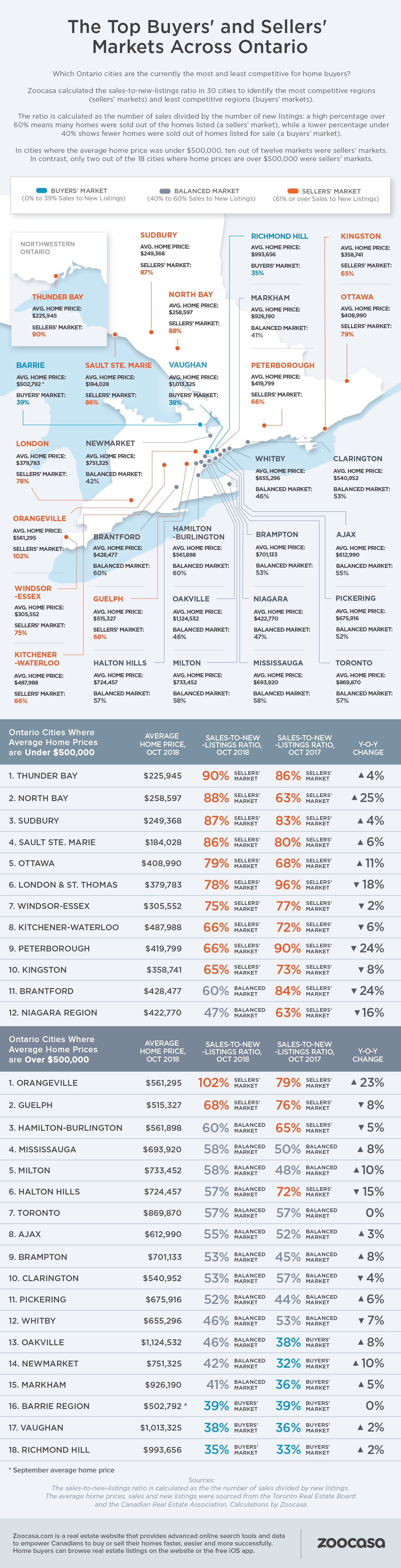
Check out the infographic to the left to see how LTT can vary in housing markets across Ontario:

LTT rebates available for first-time home buyers

Fortunately for those climbing onto the property ladder for the first time, there is some relief from land transfer tax in the form of rebates: The Ontario government will refund $4,000, while the City of Toronto offers $4,475. As well, first-time home buyers paying less than $368,360 on their home – the provincial threshold for LTT – will avoid paying it altogether, a reality in markets such as Saut Se. Marie, Thunder Bay, North Bay, Sudbury, Windsor-Essex, and Kingston.

Top 5 Ontario cities where you’ll pay the most Land Transfer Tax

1 – City of Toronto: $27,531

2 – Oakville: $17,750

3 – Richmond Hill: $16,571

4 – Vaughan: $16,369

5 – Markham: $14,424 Continue Reading…

How the USMCA affects Canadian homebuyers

By Jordan Lavin, Ratehub.ca

Special to the Financial Independence Hub

Goodbye NAFTA, hello US-Mexico-Canada Agreement (USMCA).

The new trade deal with our neighbours to the south will have wide-reaching effects across all areas of our economy, and housing is no exception. While the agreement is said to be good for our economy overall, it’s not necessarily good news for your ability to afford a home.

What is the USMCA?

Canada recently reached an agreement with the United States and Mexico to replace NAFTA, the decades-old trade agreement that has stood since it was signed by Brian Mulroney, Bill Clinton and Carlos Salinas de Gortari.

The new agreement looks much like the old one, with some changes. Key differences include changes to the way the three countries approach auto manufacturing, fewer restrictions on trade of dairy products, and stronger measures against counterfeiting and media piracy. Like NAFTA, the USMCA makes it possible for the three countries to exchange goods without barriers.

For now, the US, Mexico and Canada will continue trading under the rules of NAFTA. The USMCA will come into effect once it’s ratified by its members, a process that could take months. In the United States, congress won’t vote on ratification until some time next year due to that county’s mid-term elections. Here in Canada, the looming Federal election means that if the USMCA isn’t made official by June, it could be delayed until 2020.

How does this affect Canadian housing?

If you’re wondering how having access to American milk at your local Superstore can possibly affect how much mortgage you can afford, you’re not alone. The implications for home affordability are driven by the market’s reaction to the uncertainty of the negotiation period, the removal of uncertainty brought by a signed agreement, and the actual economic growth that’s expected to occur because of the USMCA once it’s in force.

When the Trump administration demanded to renegotiate “the worst trade deal” ever, the market got spooked. As the trade war intensified, the US threatened to (and did) impose significant tariffs on imports from Canada. With repeated threats from our largest trading partner, there was a real chance that the Canadian economy could be jeopardized. Even though our economy was growing during that time, the Bank of Canada (BoC) was reluctant to raise interest rates, which it would normally do in that situation. Continue Reading…

You’ll need to earn more than average to own a home in Ontario

By Penelope Graham, Zoocasa

Special to the Financial Independence Hub

Where in Ontario are buyers most out of pocket when trying to purchase a home? Toronto invariably comes to mind as the province’s least affordable market – but new numbers reveal a pricey GTA suburb actually takes top spot.

New income and price data compiled by online brokerage Zoocasa finds that, when it comes to unaffordable housing, half of Richmond Hill buyers would find themselves a whopping $47,962 short on a home priced at the city’s average. That’s because the median income earned in the municipality clocks in at $88,535, when a total of $136,315 would be required to purchase and carry a property priced at $999,311.

Toronto comes in at a close second, with half of buyers falling $41,282 short of affording the average home price of $785,223.

Incomes must support housing prices

To determine the extent of affordability, Zoocasa collected the average August home price in each of Ontario’s 23 major markets, as reported by their local real estate boards, and calculated the minimum household income required to actually afford such a property (assuming a 30-year mortgage at a rate of 3.14 per cent). This amount was then compared to the actual median incomes earned in each municipality, as reported by Statistics Canada.

Whether or not a market falls within the realm of affordability for buyers depends on a few factors. For example, among the top five least affordable markets (Richmond Hill, Toronto, Vaughan, Markham, and Oakville, each had an average home price of at least $700,000 and, with the exception of Toronto, had pricier detached houses make up the majority of their August sales.

Northern Ontario takes top affordability spot

In contrast, the most affordable markets (Thunder Bay, Sudbury, Ottawa, Whitby, and Waterloo) were each supported by unique resource or service-based economies and higher median wages, with an average home price under $500,000.

For example, a prospective home buyer perusing Ottawa real estate or London, Ontario real estate would enjoy greater purchasing power in relation to their household income, compared to a household in Mississauga who would incur a $10,000-gap in their budget. Meanwhile, those making the move to Hamilton in search of relative affordability will find it, as the local median income of $67,298 remains perfectly in line with the average home price of $501,073. Continue Reading…

Stock portfolio management and planning for your Heirs

Our work with stock portfolio management clients sometimes gives us a window into problems that can arise with the death of parents and the distribution of their personal belongings and financial assets.

For instance, siblings may assume they were supposed to get particular items of jewelry or furniture. When they learn that somebody else asked first, they can harbour a grudge that can last for decades.

Planning for your heirs: Head off sibling conflict with frank discussions

The best way to spare your family this problem is to head it off while you’re still alive. Tell your kids that you want to be fair to everybody. Ask them to send you a note or an email to express interest in any particular article. But don’t put too much emphasis on who asked first, and don’t feel you need to rush into making a list of who gets what. Some of your children may be slow to think of what items matter most to them. Or they may feel shy about asking for them.

Everybody should understand that if one child gets valuable household items from the estate, they may wind up receiving less cash.

Unpaid loans from parents can also cause dissension. Sometimes adult children run into money problems and wind up having to sell their home, for instance. Later, they may want to borrow the down payment to buy another home. If you grant that request, don’t simply write a cheque.

Instead, have a lawyer register a mortgage on the new home for the full amount of the loan. Explain to your child that this protects the money from attachment by creditors if new money problems come along, and keeps it in the family. You should also be aware (no need to mention it to your child) that this step also keeps the money in the family in the event of divorce.

Dissension can also arise when a child stays in the family home long after his or her siblings have moved out. Living at home and taking care of a parent can hold a child back from career advancement, and may get in the way of the child’s social or romantic life. But siblings may see it as simply taking advantage of free room and board. If you think it’s appropriate, you may want to add a line or two in your will that acknowledges the personal contribution of the stay-at-home child.

It’s hard to avoid all tension that grows out of these all-too-human conflicts. But if you think about them and talk about them with your children, things will go much more smoothly than if you leave them for the kids to sort out on their own.

Planning for your heirs: Invest based on your heirs’ timelines

If you have substantially more money than you’ll need for the rest of your life, and you plan to leave the excess to your heirs as part of your retirement planning, it makes sense to invest at least part of your legacy on their behalf. That is, invest based on their time horizon, not yours. And above all, choose investments with our Successful Investor philosophy in mind.

For instance, if your heirs are in their 40s, your retirement planning should involve holding at least part of your portfolio in a selection of investments that would suit investors in their 40s, and that follow our Successful Investor approach. Of course, you’d still want to invest conservatively. But you’d want to take advantage of the many years that 40-somethings have till they reach retirement age. Continue Reading…

7 tips for earning extra money from your Driveway

By Sarah Kearns

Special to the Financial Independence Hub

Do you want to earn a quick extra buck or two with items that are just lying around the house? How about making money off your handyman skills? And, oh, did you know that it’s also possible to earn extra money from your unused driveway space?

If you’re looking to earn some extra cash by running your own business right on your very own driveway, then you might want to consider these seven money-generating tips.

1.) Hold a garage sale

The first thing that comes to mind when you think of earning money from your driveway is the garage sale. Aside from earning a few hundred dollars, you also get to clean out the clutter in your home. A garage sale is also a good weekend family activity and is a great exercise to learn about the basics of entrepreneurship.

2.) Set up a concession stand

Remember those lemonade stands kids put up during summer break? You can set up a concession stand on your own driveway too! It’s even better if your street has lots of foot traffic. Of course, different countries, states, or territories have different laws regarding this; so, always check your local regulations first before you set up.

3.) Rent out your tools

If you have tools that are seldom used, you can rent them out to neighbors and contractors in your area for extra cash. There are websites like ToolMates that let you post your for-rent tools and equipment online. These services let you make some extra money off your tools; which is always better than letting these expensive items just gather dust in the shed.

4.) Start your own handyman business

Since we’re already on the topic of tools, you can also set up your own, independent, handyman business. If you have handyman (or handy woman!) skills like carpentry, ceiling repair, car maintenance, and such, then it might be good to put those skills into work and earn some extra money. Sites like AirTasker allow you to post your services online so that people in your area can get in touch with you whenever they need your skills.

5.) Share your car with neighbors

Now, this is a fairly new concept and companies like Lyft and Uber have taken this innovative idea to the next level. However, if you don’t like driving around that much, it’s also possible to rent out your car to your neighbors when you’re not using it. CarNextDoor is a service that allows neighbors to ‘share’ their cars with each other, thereby offsetting the cost of ownership.   Continue Reading…