


General

MoneySense Feature on Rising Fraud: How Seniors and everyone else can minimize odds of being scammed

Deposit Photos

MoneySense.ca has just published a feature article by me that looks at the rising tide of frauds directed at Canada’s seniors, and everyone else.

You can find the full piece by clicking on the highlighted headline here: Canadian Seniors, watch out for these scams.

This Saturday (June 15th) is World Elder Abuse Awareness Day.

Note that while the full 2500-word article at MoneySense is aimed at Seniors, it is not technically my  monthly Retired Money column, which is typically shorter.  And this short summary here at Findependence Hub is only a third as long: hopefully enough to entice readers to hop over to MoneySense for the full article.

So below, I offer only a small fraction of the full column and some of the major links. This is an important topic both for seniors and those who hope to be financially independent seniors one day, so do take the time to click on and read the full article at MoneySense.ca, linked above.

It was a bit of an eye opener researching and writing  this piece but it appears to be the unfortunate reality of the technological world we all now inhabit.  It’s overwhelming and the situation is unlikely to improve any time soon.

In the past MoneySense has covered such topics as getting scammed through e-transfers, phishing, crypto schemes, identity theft and more. There’s financial fraud in general that targets bank accounts, credit cards and potentially every other aspect of your financial life. My feature attempts an overview of most of them from a Canadian perspective, with a few new scams I hadn’t known about before researching this article. (Example: “smishing,” which is sort of phishing in the form of text messages on smartphones.)

A.I. is exacerbating the spread of Frauds on all platforms

As I note at the top of the full column, it’s a sad fact that the rise of Artificial Intelligence (A.I.) has exacerbated this problem. While anyone can be prey for technology-linked schemes to separate you from your money, seniors need to pay particular attention, seeing as they tend to have more money to lose and less time to recoup it.

According to Equifax, Fraud is the top crime perpetrated against older Canadians. Sadly, many seniors fail to report these crimes to the police because they feel shame or embarrassment about being duped by scamsters.

Identity Theft

 Identity theft is particularly worrisome for seniors, if not the rest of us. As Equifax puts it, “a scammer may try to get information such as a bank card or personal identity number, credit card number, health card number, or a driver’s license or Social Insurance number. They can then apply for credit cards, take out loans or withdraw funds in the person’s name.”

5 cyber scams targeting seniors

Elder Abuse Prevention Ontario (EAPO) lists 5 cyber scams that target seniors. These include Romance scams targeting the recently bereaved. Here are 5 red flags to watch for if you’re looking for love online. Continue Reading…

Stocks still marching to inflation’s drum

By Elias Barbour, Clearbridge Investments

(Sponsor Blog)

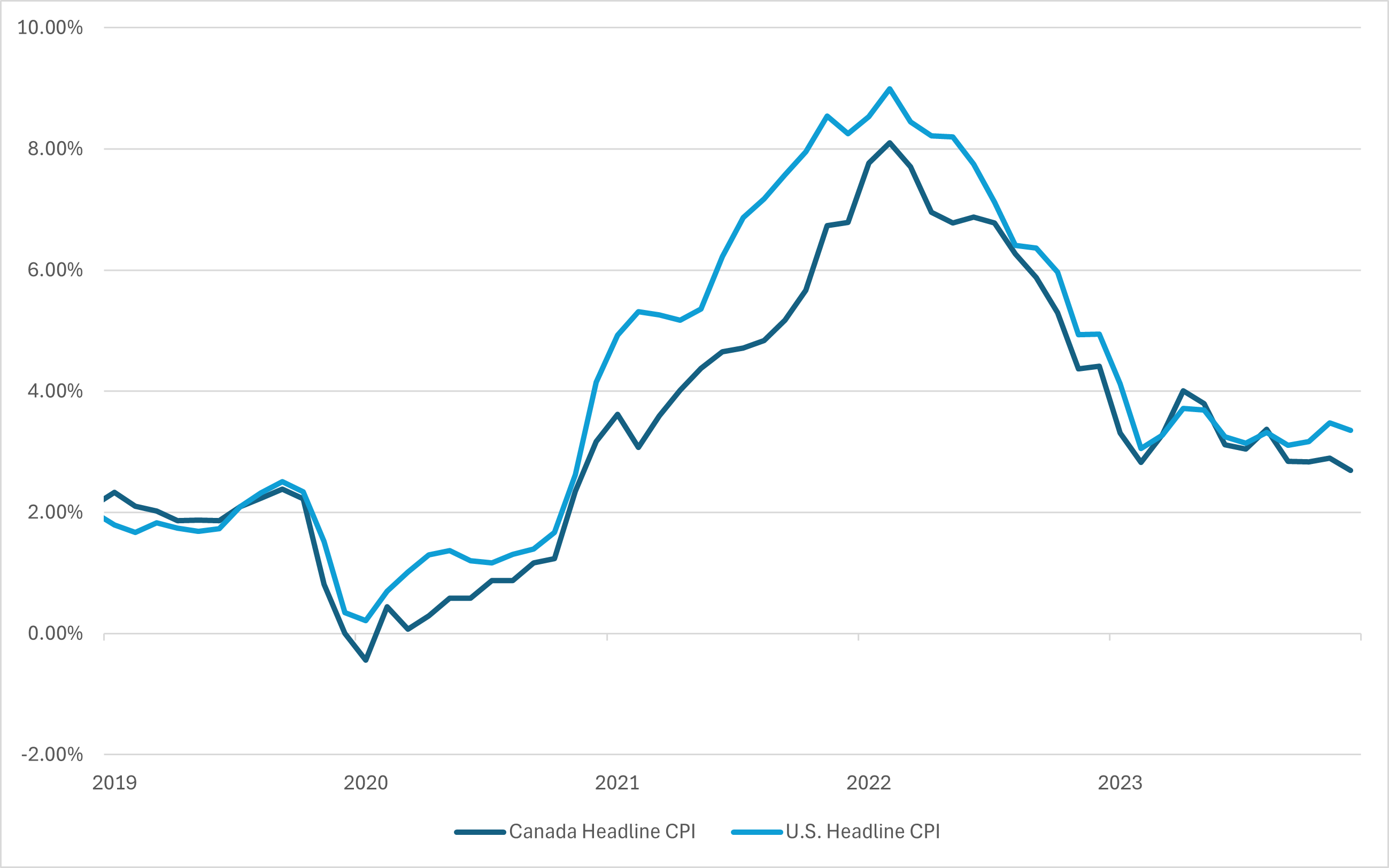
Inflation continues to be the biggest near-term driver for equity markets, given its influence on central bank decision-making regarding interest rates. Inflation rates have moderated from their peak levels; however, they remain above the 2% targets set by the Bank of Canada (BoC) and the U.S. Federal Reserve (Fed).

U.S. and Canada Inflation

As of April 30, 2024


Equity markets entered 2024 with six to seven U.S. interest rate cuts priced in over the course of 2024, with the first cut expected in March. Clearly, that did not happen. Both central banks have remained on hold, which has contributed to higher rates across the yield curve. That number has since moderated to only three cuts, and the timing of the first cut has now been pushed out to June in Canada and even later in the United States.

The effect of “higher for longer” interest rates has been particularly painful for interest rate-sensitive market sectors such as utilities and communication services. Nonetheless, pockets of the market that were expected to continue to grow have continued to advance, undeterred by the yield curve shifts.

Buoyed by hopes for a pivot in monetary policy as inflation trended closer towards the central banks’ targets, Canadian equities had a strong start to the year, although they paled compared to the ongoing boom in U.S. equities, where a large portion of the gains were derived from mega-cap information technology  and related names with less representation in Canadian markets.

Mind the lag

Although decelerating, the economy continues to show sufficient resilience, with customer spending remaining robust since the reopening of economies after the global pandemic-induced shutdowns. Fiscal stimulus has moderated since the immediate aftermath of the pandemic outbreak; however, fiscal policy continues to operate at odds with monetary policy. Labour strength and wage gains have further reinforced this view, fuelling fears of lingering inflation and the potential for a higher-for-longer rate environment. Continue Reading…

Canadian stocks are better than you think


By Dale Roberts

Special to Financial Independence Hub

For all of the headwinds and bad press for the Canadian economy, you’d think that the stock market was in a tailspin. But surprisingly, that’s not the case. The TSX Composite and TSX 60 are threatening to make new highs, eh. That’s as U.S. stocks make new high after new high. Given that, balanced portfolios and all-in-one asset allocation ETF portfolios are sailing. Canadian stocks are better than you think.

I am back after a week off. Late in March, I was driving to Florida and I had to change my Sunday morning travel plans, leaving early from Knoxville to make it to Clearwater for fun in the sun and taking in some Blue Jay spring training games.

My $2500 Jays Jersey – true story

Here’s the poster child for poor-performing big-dividend Canadian stocks.

A good summary of the struggling Bell Canada (BCE). Investors might have to wait 2 or 3 years to see that debt under control – and the dividend covered. Rate cuts would/will help the cause. Bell has been a victim of poor to unfair regulation, increased competition and higher borrowing costs.

Even perma Bull Brian Belski of BMO is cautious so say the least. From a Globe & Mail piece:

“We believed sentiment was resoundingly negative and becoming worse. As we approach the end of the first calendar quarter of 2024, we maintain the view that analysts and investors remain overly cautious – fundamental metrics such as earnings, valuation, and operating performance in several areas are showing definitive signs of troughing.

There has been a lot of negative sentimenet towards the Canadian economy, and we likely transfer that emotion to our opinion of the Canadian stock market.

And while the big-dividend space in Canada has been struggling, or at least lagging, the TSX Comp and TSX 60 is on a very nice run. Here are the 5-year returns.

Quite often, stocks like to climb that ‘wall of worry.’ That’s why market timing simply does not work. The markets can have a mind of their own, and they are forward looking. It would be like planning your day’s activities based on next week’s weather forecast.

That’s a total return of over 60% over the last 5 years, and 118% over the last 10 years. Hardly struggling.

Vanguard VDY vs the market

And while the big divs are struggling thanks to the higher rate environment, this long-term chart shows investors have still been rewarded, handsomely.

The returns are almost identical from VDY inception, just over 10 years ago. And surprisingly, from 2020 (when the world changed with the first modern day pandemic that unleashed an inflationary period) VDY is outperforming the market.

There may be another lesson here in consistency and staying the course. That said, readers will know that I am a big fan of the broader Canadian Wide Moat stock model, compared to an exclusive big-dividend model. And look to the more-moats option that includes lower-yielding grocers, railways plus picks of Brookfield and Couche-Tard.

In ETF form the wide moat model follows closely to the BMO Low Volatility ETF – ticker ZLB. That may be Canada’s best option for covering the Canadian space. It has much more sensible sector allocation, and that has contributed to the market beat. I promise to update the returns for the ZLB post shortly.

Another low-volatility stock model

Norman Rothery tracks some wonderful Canadian portfolio models at the Globe & Mail. Here are the current holdings for his market-crushing low-volatility stock portfolio.

ATCO, BCE, Bank of Nova Scotia, CN Railway, Canadian Utilities, Dollarama, Enbridge, Fortis, Great-West Lifeco, Hydro One, Intact Financial, Metro, Power Corp, Pembina Pipeline, Rogers Sugar, Royal Bank of Canada, Sun Life Financial, TD Bank, Waste Connections, TMX Group.

That is a very good stock mix, and with lots of overlap to the wide moat and BMO Low Volatility models. I will be adding Waste Connections as a “pick” for the wide moat model.

More Sunday Reads

At MoneySense Jonathan Chevreau is getting ready to convert his RRSP to a RRIF. That’s mandated of course, at age 71. A Canadian then has to start receiving payments at age 72. If you miss the conversion, your RRSP will be liquidated and you’ll likely face a massive tax bill. Jon provides a very good RRIF overview in that post. Continue Reading…

Taking steps toward Financial Wellness

Unsplash

By Blair Evans, CFP, CA

Special to Financial Independence Hub

Tomorrow (June 8th) is Global Wellness Day.

The term “wellness” — including emotional, physical, and mental wellness — is finding its way into more and more conversations these days. However, there’s one aspect of general wellness that is often overlooked despite its significant impact: financial wellness.

Given the current economic environment, financial concerns among Canadians are one of the largest sources of stress.  According to a recent study by FP Canada, forty-nine per cent of Canadian adults have lost sleep because of financial worries, which may impact their overall wellness.

Just like physical and mental wellness, there is no one formula to create financial wellness for everyone.

Luckily, there are strategies we can all take to improve our financial wellness. It starts with acting in the present while planning for the future. The path to financial wellness is a personal journey, and a qualified financial advisor can help you take the first step and make important progress.

Prioritizing financial wellness for today

Before working on your financial wellness, it’s important to ask, “What does financial wellness look like for me?”

It can be as simple as creating (and sticking to) a budget or making a realistic and actionable plan to pay off your current debts. Your path to financial wellness can even begin by getting a better understanding of a familiar term: tax.

Whether we like it or not, tax is inevitable, and it impacts nearly every financial decision we make. Therefore, gaining an understanding of your tax situation can provide you with confidence and can help improve your financial wellness.

Depending on your circumstances and stage of life, contributing to your Registered Retirement Savings Plan (RRSP) or First Home Savings Account (FHSA) are two options that may help you prepare for your future, while also reducing your taxable income, meaning you’ll get taxed less come tax season.

Being knowledgeable about the different types of accounts (including RRSPs, FHSAs and Tax-Free Savings Accounts), as well as tax deductions and tax credits available to lessen your tax liability, can also help build financial knowledge and reduce financial stress.

Planning financial wellness for the future

Part of financial wellness is proactive planning so you can feel comfortable and confident in your future. Saving is an important part of building a strong financial future, but financial wellness goes beyond that. Continue Reading…

How Regular People can become Debt-Free with some simple Life Changes

Image Unsplash

By Alain Guillot

Special to Financial Independence Hub

Becoming debt free is, for many people in the country, virtually a dream. It’s basically impossible if we’re barely living from paycheck to paycheck, and the debts we accumulate aren’t always unavoidable. However, there are definitely a few things that we can do as individuals to reduce our debts and eventually become debt-free.

In fact, it’s a life goal for many people to just get rid of their debts. Once that happens, they can finally enjoy a life of financial security and be more free with their hard-earned money. So without further ado, let’s take a look at some simple life changes you can make to become debt-free.

Start taking responsibility for your finances

One of the things you have to learn early is that you need to start taking responsibility for your finances.

This all starts by actually looking at your incoming and outgoing money and creating a budget. Start by looking at what you spend your money on, where you can cut down, and also look at how much you’re paying in subscription fees. A lot of people bleed money because they’re not aware of how much they’re actually spending, and this can be an incredibly dangerous habit.

Aim to actually pay off your debt

Lots of people will see the long debt repayment terms and just let it go. They’ll wait several years just to pay off something, and in that time, they’ll have paid a huge amount of interest that could’ve been avoided.

So aim to actively pay off your debt. Reduce expenses from other places (such as entertainment costs) and put all of that into your debt. Continue Reading…