Canada is about to experience an unprecedented transfer of wealth across generations that will transform household balance sheets, life plans, and the role of financial advisors. Experts estimate that roughly $1 trillion will transfer between generations over the next decade, and this shift is discussed weekly.
As someone who advises families across multiple generations, I see three key implications. First, the amount of capital shifting hands is significant, but equally important are the who and the how: younger recipients seek different things than their parents. Second, the timing and structure of transfers (gifts made during life versus testamentary bequests) are driven by family dynamics as much as tax considerations. Third, the industry itself must modernize to stay relevant: advice now goes beyond portfolio selection to include income architecture, behavioral coaching, private-market access, values alignment, and digital delivery. The landscape is changing more quickly than I have experienced in the past 25 years.
Understanding what each generation needs and why they want it is the foundation for giving meaningful advice.
Baby Boomers: stewardship, income, and legacy
Baby Boomers still hold a disproportionate share of wealth in Canada, and their priorities have shifted from accumulation to preservation, predictable income, and legacy planning. The questions they ask are practical and existential: Will I outlive my money? How do I leave a legacy without causing family conflicts? How do taxes and health-care risks affect my plan? In practice, this means structuring retirement income to address longevity risk, incorporating tax-efficient solutions, and creating estate plans that minimize friction at death.
At Trans Canada Wealth, an advisory group of Harbourfront Wealth’s independent platform, we integrate investment strategies with our in-house CPA tax specialist and estate planning expertise so clients can see the full chain of outcomes, cash flow, taxes, and transfer, rather than isolated portfolio returns. This comprehensive approach is what gives Boomers the peace of mind they value most. We walk clients through our “Atlas” system to ensure they have peace of mind that no stone has been left unturned and that they have a structure and plan that works for their unique situation.
Gen X: the bridge generation demanding clarity
Generation X is in the middle, often financially squeezed, supporting aging parents while raising children, yet they are likely to be the most active people in managing wealth transfers. Many Gen X clients will inherit significant wealth but usually don’t plan for it; instead, they seek control, transparency, and practical plans that address debt today, catch up on retirement savings, and fund education. Unlike parents of previous generations, they have a stronger desire to help their children buy their first home and ensure they start their financial journey on solid footing.
An important role for advisors is facilitation: helping families have clear conversations about intentions and timing. We frequently counsel Boomers on the merits of lifetime gifts versus estate transfers because earlier transfers can increase intergenerational utility and allow parents to witness the benefits. Equally, Gen X wants straightforward, independent advice that filters noise, ensuring one poor decision doesn’t derail a 20- or 30-year plan.
Millennials: aligning performance with purpose
Millennials prioritize differently when they invest. While performance remains important, purpose and fees are now key factors. Studies and industry reports reveal that younger investors are highly interested in sustainable and impact strategies; they seek access to alternative investments and ESG-informed allocations as part of a diversified portfolio.
For advisors, this means providing institutional-grade access and clear discussions about costs alongside values-based solutions. Millennials are well-informed but have limited time; they expect advisors to add value by curating investment opportunities, conducting thorough due diligence, and explaining trade-offs: such as how an ESG focus might affect risk/return, liquidity, and fees. When advisors excel at this, they not only retain inherited capital but also build lifelong relationships.
Gen Z: digital-first, early adopters and learners
Gen Z approaches wealth conversations with a different relationship to money. They are digital natives, comfortable transacting and learning online, and many start their investing journey earlier than previous generations. Research shows a significant rise in early retail investing and financial literacy among Gen Z, and their expectations for digital access, education, and transparency are high. Continue Reading…
Here’s what we think about real estate investing in Canada — and it may surprise you
TSInetwork.ca
We’re constantly asked about real estate investment in Canada (or investment in Florida real estate, for that matter), and we understand the appeal. Even though today’s house prices still remain high in most markets (i.e., Toronto and Vancouver) mortgage interest costs are expected to fall as inflation comes back down. And owning your own home has a number of advantages.
In terms of real estate investment, owning your house is a great tax shelter. That’s because gains on your principal residence are exempt from capital-gains taxes. Note, though, that this benefit only applies to your principal residence, and not investment in Florida real estate as a second home or income property. You must still pay tax on gains on the sale of a recreational property, such as a cottage or a ski chalet. But these properties generally appreciate at a much slower rate than, say, a home in a major urban centre. That’s a key consideration with any real estate investment.
What are the best real estate investment strategies in the current market?
Given Canada’s diverse real estate landscape in 2025, the most effective strategy is to focus on suburban multi-family properties in growing secondary markets like Hamilton, Halifax, or Kelowna, where prices remain relatively affordable while offering strong rental demand and potential for appreciation.
What are the potential risks of investing in real estate right now?
The primary risks include rising interest rates affecting mortgage payments, potential market corrections in overvalued areas, and stricter regulations on foreign buyers and short-term rentals in major Canadian markets.
Capital-gains taxes are also applicable to gains on real estate investment, such as rental properties you buy for investment purposes. Moreover, this type of real estate investing in Canada (or investment in Florida real estate) involves a number of other commitments that can make it feel more like running a small business than, say, investing in stocks. With stocks, you only have to tell your broker to buy: everything else is done for you.
By contrast, when you own rental property, you have to spend time finding and dealing with tenants, arranging for maintenance, doing the accounting and so on. You can hire others to do these tasks for you, but that can get very expensive.
Moreover, real estate investing in Canada can entail higher levels of risk than stocks. That applies to investment in Florida real estate and other U.S. sunshine destinations. Simply put, all real estate investment must contend with the fact that real estate is less liquid, more expensive to manage and to buy or sell, and highly geographically concentrated. Rising crime, unpleasant neighbours and other changes on the street or in your property’s neighbourhood can make it hard to find tenants or buyers. So can physical problems, like adverse traffic patterns, backed-up sewers and zoning changes that allow undesirable development, or limit what you can do with your real estate investment property.
Many real estate investing enthusiasts say that if you buy a property with a 20% down payment (which is the Canadian government’s proposed new minimum to qualify for government-backed mortgage insurance on a property that is not your principal residence), then a 20% rise in the property’s value means you have doubled your money.
However, that claim neglects the costs of selling (up to 5% or 6% for real-estate commissions, plus lawyer’s fees and related costs). It also overlooks any negative cash flow you may have experienced while you owned the property, because rents failed to cover expenses. When you’re less familiar with the market, such as with Canadian investment in Florida real estate, that kind of unfavourable outcome is more likely.
How can I prepare my real estate investments for potential economic downturns or unexpected events?
Maintaining substantial cash reserves (ideally 6-12 months of expenses per property), keeping conservative loan-to-value ratios, and diversifying across different property types and locations provides the strongest protection against market volatility.
What is the best long-term investment strategy for building wealth through real estate?
The most reliable strategy is buying and holding cash-flowing multi-family properties in growing metropolitan areas while systematically paying down the mortgages to build equity over time.
We continue to believe that ownership of a primary residence is all the real estate exposure most investors need. Still, we get many questions about real estate investment beyond that. If you want to add to your real estate holdings, one good way to do it is through real estate investment trusts, or REITs.
Real estate investment trusts invest in income-producing real estate, such as office buildings and hotels. Some may even focus on investment in Florida real estate or other key U.S. markets for vacationers. Generally, that’s a segment of the market that is difficult for most investors to access through direct ownership of property. Moreover, real estate investment trusts save you the cost, work and risk of owning investment property yourself.
If you’re interested in real estate investing in Canada through a REIT, we still recommend RioCan Real Estate Investment Trust (symbol REI.UN on Toronto). It, like all REITs, continues to suffer fallout from the COVID-19 pandemic. Still, RioCan continues to benefit from an increasingly solid portfolio of properties now focused on Canada’s biggest markets. It is also working to diversify its portfolio beyond malls (these malls feature large stores that are usually part of a chain). We cover RioCan in our Successful Investor newsletter. Continue Reading…
It’s that time of year again. Holiday shoppers know the secret: start with a meaningful primary gift that makes an impression. Add smaller delights for a personal touch. Asset allocators can do the same: anchor portfolios with a broad emerging market (EM) core and use dynamic tilts1 for the perfect stocking stuffers.
The broad EM equity rally has now entered a more structurally supportive phase rather than a pure sentiment bounce. EM equities have advanced for 10 straight months, now up more than 30% year to date, outpacing U.S. large caps, which returned slightly less than half that over the same period.2 We believe this outperformance is likely to continue through year‑end amid a weaker US dollar, improving earnings and growing demand for geographic diversification.
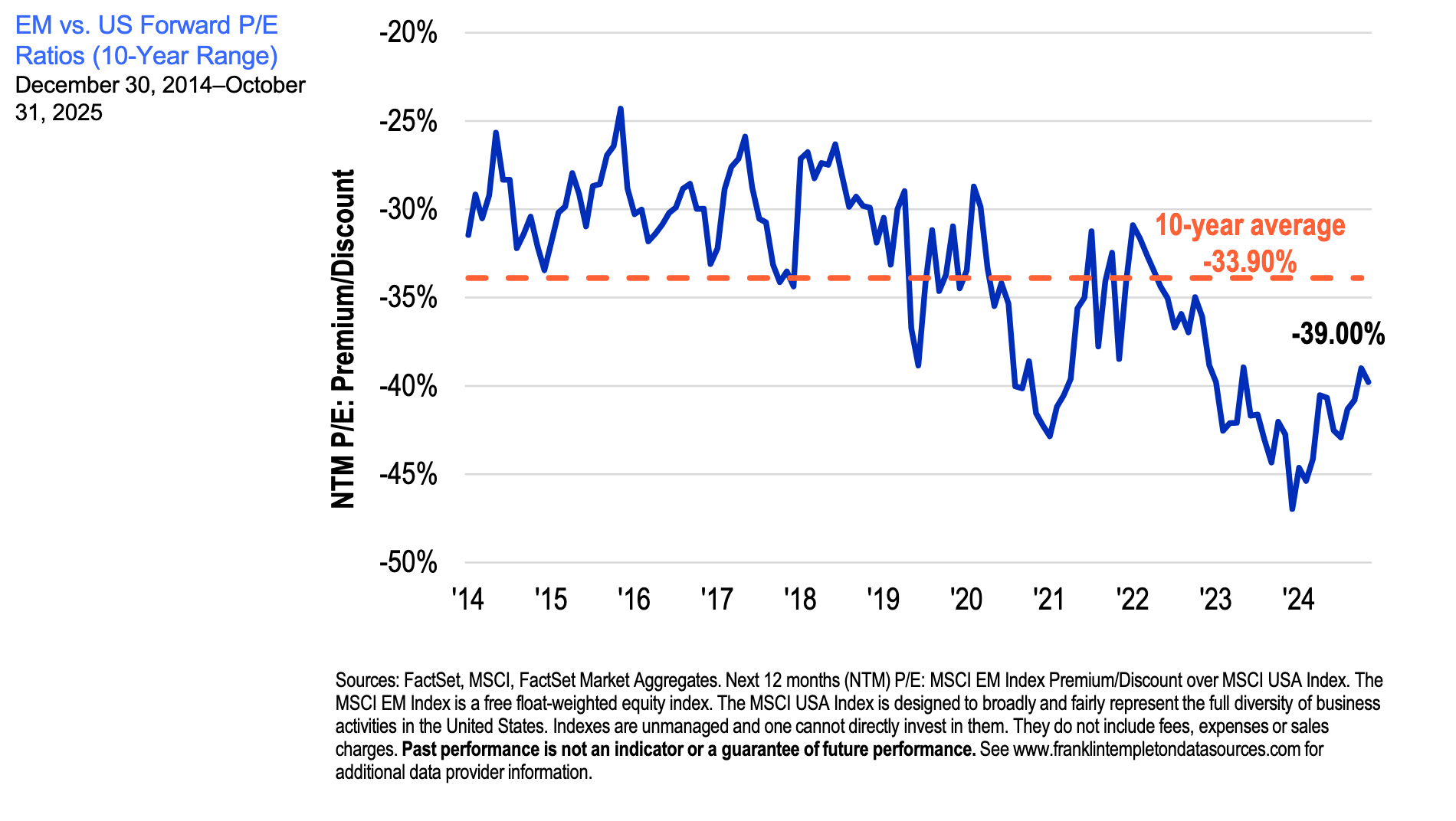
Valuation gaps remain wide: EM equities recently traded at nearly a 40% discount versus US peers: one of their lowest forward price-to-earnings (P/E) differentials in over a decade. Meanwhile, early macro indicators suggest modest expansion among EM manufacturing sectors.
Adding to this tailwind, the recent decline in the US dollar is easing financial conditions across EMs. The weaker greenback makes it cheaper for EM borrowers to service dollar-denominated debt, while the Federal Reserve’s pivot toward interest-rate cuts is fueling renewed demand for local-currency bonds that still offer attractive real yields. Meanwhile, deepening trade and manufacturing linkages between the United States and Mexico underscore how supply-chain rerouting is boosting multiple EM hubs — not just one market — reinforcing the case for a broad EM core. These forces of less dollar pressure, falling US rates and stronger regional trade flows are creating what we see as a more favorable backdrop for EMs.
In terms of portfolio construction, a diversified EM allocation anchors exposure to global easing, demographic growth and digital transformation, while selective country tilts reflect conviction-driven opportunities. Such an approach helps investors look beyond short-term noise and stay invested through the macro cycle. With valuations still moderate, we believe the risk-reward for EMs broadly remains compelling.
Why broad core + dynamic tilts works now
Global supply-chain remapping triggered by tariffs has created more stark standouts and laggards across the EM universe and we believe a broad EM core can help capture the multiplicity of growth vectors, while dynamic tilts allow investors to capture standout growth pockets when dispersion widens. South Korea’s equity market, for example, has emerged as a clear leader this year, up nearly 70% year-to-date: the strongest returns for any major market globally.3 Continue Reading…
As you know, I have frequently expressed concerns about high valuations for stocks. The concern has been expressed vehemently, yet so far, no serious risk has presented itself in terms of market drawdowns.
The narrative of U.S. public markets being risky has not proven to be accurate over the past few years. That said, what was once a minority view is becoming increasingly mainstream, as valuations remain stretched. The adage of ‘markets can remain irrational for longer than you can remain solvent’ has proven to be prescient and problematic for those who raised their cash positions. It has also caused certain commentators (including myself) to feel like Chicken Little. Despite our breathless admonitions, the sky has not fallen: yet.
Reallocate to more reasonably priced Asset Classes
Some people chose to exit public securities, but not capital markets. Private assets where there are likely to be pockets of more realistic valuation, as well as traditional inflation hedges like infrastructure and gold, have all performed relatively well in 2025. Rather than engage in market timing, this approach is more akin to an active reallocation toward being fully invested in asset classes that are more reasonably priced.
Below we canvassed more than 20 retirement experts and financial planners in both Canada and the United States about how they and their clients can use new AI Tools to help investors pick stocks or ETFs and plan their retirement.
These experts were gathered by Featured.com, which has been supplying Findependence Hub with quality content for several years now. It has changed its procedure so that editors like myself can request input on particular topics we think will interest our readership. The sources are all on LinkedIn, as you can see by clicking on their profiles below.
Here’s what we asked:
What is your top recommendation for using AI tools like Grok or ChatGPT to enhance the investing experience or financial planning process for retirement?
Their answers are below, which have been re-ordered by me and in some instances edited down, using an ellipsis (…) to indicate cut passages.
“AI doesn’t replace financial advisors: it elevates investors to think and plan like one.”
One of the most powerful ways investors and retirees can use AI tools like Grok or ChatGPT is to transform information overload into clear, actionable insight not just faster, but smarter. These tools allow individuals to run scenario-based retirement models, stress-test investment ideas against historical data, and translate complex financial language into plain English they can actually act on. What I recommend most is using AI as an always-available financial co-pilot a tool that helps you ask better questions, explore tax and withdrawal strategies, and stay disciplined when emotions run high. Of course, AI should enhance, not replace, professional advice; but when paired with fiduciary guidance, it becomes a force multiplier for better decision-making. The future of retirement planning is not just automated: it’s augmented, where every person can access institutional-grade research and personalized planning at a fraction of the cost. — Justin Smith, CEO, Contractor+
Use AI for Grunt Work & Routine Analysis
I use AI to handle the grunt work for my finances. It’s great for automating my investment tracking and finding savings opportunities. For my SaaS business, I have ChatGPT audit expenses and run tax simulations. It catches small details I would definitely miss, but I always double-check with my accountant before making any big moves. — Cyrus Partow, CEO, ShipTheDeal
Running a fintech team, I use AI like Grok to track portfolios and summarize complex financial statements. I have it monitoring global trends that might affect Canadian retirement planning. Integrating these tools took some time, but the process is way less stressful now. My rule is to let AI handle the routine analysis while I double-check any critical decisions myself. — Sreekrishnaa Srikanthan, Head of Growth, Finofo
A good way to use AI tools like Grok or ChatGPT for investing and retirement planning is to treat them as helpful guides that explain financial topics, summarize current market information, and assist with planning choices. These tools can make complex financial ideas easier to understand, break down how different investment options work, and help create scenarios based on your retirement goals. You can ask questions to check your knowledge about topics like spreading your investments or tax rules related to retirement accounts, getting clear answers that fit your situation.
These AI tools also provide updated summaries of financial news and alert you to changes that could affect your retirement plans, like new laws or required withdrawals. While they do not replace a human financial advisor’s insight, they give you useful information that helps you talk to professionals with more confidence. Regular use helps keep you informed about your progress and reminds you of important details, making managing your retirement plan easier. — Richard Dalder, Business Development Manager, Tradervue
Use to summarize Market Trends
I work in tech marketing, so I’ve started using ChatGPT to research retirement investments. I’ll have it summarize market trends in telecom or healthcare IT, then cross-check with mainstream financial sources. This saves me hours of initial screening time. My advice is to never act on an AI’s take without fact-checking it first, but it’s a great way to get the lay of the land quickly. — Andrew Dunn, Vice President of Marketing, Zentro Internet
Use AI as a Personalized Planning Engine
My top recommendation is to use AI as a personalized planning engine. Feed it your retirement goals, income range, expected timeline, and risk comfort. Ask it to build draft scenarios, compare tax-advantaged account strategies, summarize differences between contribution options, or outline the impact of shifting a portion of your portfolio into metals, equities, or fixed income. This gives you a structured starting point before you meet with a licensed advisor.
AI also helps people evaluate items of value they already own. Many Americans keep gold or silver tucked away because they are unsure where to start or who to trust. Ask AI to walk you through how precious metal markets move, how payouts are typically calculated, and what reputable U.S. buyers offer. When people understand what their gold is actually worth, they make smarter decisions about whether to sell, hold, or incorporate it into their retirement strategy.
Using AI this way puts you in control. It speeds up research, cuts through noise, and helps you prepare with confidence before talking to a financial professional. — Brandon Aversano, CEO, The Alloy Market
I work with AI and financial data, and here’s what I’ve found: nobody reads those static retirement planning sheets. We switched to interactive simulations using tools like ChatGPT, letting people play out different investment choices and actually see the results. Engagement went way up. If you’re planning retirement in the U.S. or Canada, this gives you a much better feel for your financial future than any document. — John Cheng, CEO, PlayAbly.AI
Use to plan Retirement and support Financial Literacy
AI tools like Grok and ChatGPT shine brightest in retirement planning when used to simplify complex financial decisions. One powerful approach is creating personalized scenario models: quick projections that show how small adjustments in savings, expenses, or timelines can change long-term outcomes. This turns retirement planning from an abstract, overwhelming challenge into a set of clear, data-driven choices.
Another strong use case is ongoing financial literacy support. AI assistants can distill dense market insights, tax rules, or investment updates into plain-language summaries tailored to an individual’s stage of life. From my experience building learning systems at Edstellar, the real value comes when AI acts as a translator: cutting through jargon and helping people understand the “why” behind decisions. That level of clarity dramatically improves confidence, especially for long-horizon goals like retirement. — Arvind Rongala, CEO, Edstellar
An on-demand Analytical Partner
In my opinion, the best use of AI tools like Grok or ChatGPT when it comes to retirement planning is to enlist it as a personalized, on-demand analytical partner. When you present an AI with your financial data (savings, trajectory, risk profile, retirement age), it has the ability to remit stress testing of your assumptions at a breadth and speed most people will never do for themselves. I have even gone a step further and even asked the AI model to create a variety of long term simulations: good markets, flat markets, inflationary periods, tax shifts, and a few unexpected life surprises here and there. This is when you will feel a much better understanding of what the reality will look like on your retirement path versus static projections.
Where I do think AI can take the planning to another level is the rigor of thinking it is going to force on you. It will find blind spots you didn’t even know to look for, it will challenge your assumptions, it will allow you to show up to your advisor meeting with the potential to be prepared. In the U.S. and Canada—complex situations in retirement planning to say the least, not to mention personal—AI will present a great utility. It won’t replace your financial professional, but it might very well allow you to ask better questions and gain confidence in your decision making. — Kevin Baragona, Founder, Deep AI
AI is NOT a financial advisor
Running a finance team, I’ve found AI like ChatGPT is great for the first pass at retirement planning. It can explain jargon or summarize options way faster than reading a 20-page PDF. But here’s the thing: it’s not a financial advisor. Use it to get the lay of the land, but always talk to a licensed professional before you put any real money in. — Edward Piazza, President, Titan Funding
Treat AI tools as a Scenario Partner
One of the most useful ways I’ve leveraged AI tools like ChatGPT and Grok in the investing and retirement-planning process is by treating them as a “scenario partner.” Not a financial advisor, not a spreadsheet replacement, but a way to explore the assumptions behind long-term decisions.
When I was first building Zapiy, I didn’t have the luxury of long planning sessions with advisors. I needed quick clarity on questions like how much I should be contributing, how aggressive my allocations should be, or how different timelines would reshape my retirement targets. What I found was that AI excels at helping you pressure-test your thinking before you make any commitments.
I’d feed ChatGPT a basic profile — income, savings rate, intended retirement age, preferred account types like a Roth IRA or TFSA — and ask it to model a few “what if” versions: what if I increase contributions by five percent, what if I shift to a more conservative allocation in my forties, what if I retire earlier but maintain the same lifestyle? The answers weren’t perfect, but they gave me a clearer sense of how small behavioral changes compound over time.
The real value is that this preparation makes every conversation with a human advisor more productive. You walk in understanding your own priorities, trade-offs, and risk tolerance instead of starting from zero. For many investors in the U.S. and Canada, this hybrid approach — AI for exploration, experts for validation — seems to strike the right balance.
If I had to give one recommendation, it would be this: use AI to sharpen your financial instincts, not to substitute professional judgment. Let it help you see the landscape more clearly so you can plan with confidence and ask better questions when it’s time to make real decisions. — Max Shak, Founder/CEO, Zapiy
Large-language models aren’t crystal balls
With new AI tools, the first impulse is always to ask for a prediction. People want to find the next winning stock or time the market perfectly. I’ve seen this happen for decades with every new wave of technology.
But these large language models aren’t crystal balls. They’re incredibly good at synthesizing information and finding patterns in past data, but they also have a tendency to invent things with absolute confidence.
The hardest part of long-term investing isn’t about finding more data. It’s about managing your own psychology, your biases, and the emotional urge to react to every bit of market noise. This is where AI’s real, and more subtle, value comes in.
My top recommendation is to stop treating these tools like an analyst and start using them as a sparring partner to challenge your own thinking. Instead of asking something simple like, “What are the best Canadian dividend stocks for 2025?”, give it a much more powerful prompt.
Try something like this: “Act as a skeptical financial advisor. My plan is to invest 30% of my retirement portfolio in Canadian dividend stocks for income. Poke holes in this strategy. What are the biggest risks I’m ignoring, what behavioral biases might be at play, and what alternative approaches should I consider?”
What this does is force the AI to act as a “red team” for your own ideas. It uses its vast knowledge of economic principles and market history to find the flaws in your logic before you commit real capital.
This reminds me of a brilliant young engineer I once mentored. He had designed this complex, theoretically perfect trading algorithm and was in love with its elegance. Instead of telling him it would fail, I just spent an hour asking questions.
What happens if this data source is delayed by two seconds? How does the model behave in a flash crash? What’s the single point of failure? He came back two days later and scrapped the whole thing, starting over with a simpler, more resilient design.
The AI can be that patient questioner for you. True financial security isn’t built on finding the perfect answer, but on developing the wisdom to question your own. — Mohammad Haqqani, Founder, Seekario AI Job Search
Use for Stress Testing Assumptions
My top recommendation for using AI tools like Grok or ChatGPT to enhance retirement planning is not to use them for advice, but for stress testing assumptions. Never take financial advice from a large language model. That is a path to financial ruin. Instead, use the AI to aggressively challenge the core numbers you are already getting from a human financial advisor.
The effective use is feeding the AI a series of complex, negative scenarios based on your existing US or Canadian retirement plan. Ask the AI: “If inflation averages 5% over the next ten years, and my portfolio only returns 4%, where does the system fail?” or “If I move to a high-tax state and health care costs double, how does the plan survive?”
This approach works because it turns the AI into a powerful, objective risk auditor. It exposes the hidden vulnerabilities in your human-designed plan without the emotional filter of your advisor. This is the only high-value application: using AI to force clear, honest conversations about competence and failure points in your retirement strategy, ensuring you have the strongest system possible. — Flavia Estrada, Business Owner, Co-Wear LLC
Use to get a head-start on when to retire
Use AI tools like Grok or ChatGPT to get a head start on how to retire. These services will evaluate the state of your finances and most can administer a wide array of retirement and other accounts then recommend investments that fit your criteria. They demystify complicated financial subjects. They can help you with budgeting, monitor progress and shift plans as markets change. Ask questions in a frame where hopefully will receive clear and good advice. Bots driven by AI help save you time, reduce mistakes and change the way you think about money. It makes retirement planning much simpler and more straightforward. — Keith Sant, Founder & CEO, Kind House BuyersContinue Reading…


 Posted By
 Posted By


 Posted By