General

How to get the better of the big Canadian banks

By Larry Bates

Special to the Financial Independence Hub

The big Canadian banks, and by extension the entire Canadian financial industry, occupy a position of paternalistic authority that too many individual investors respect unquestioningly, and even appreciate to some extent. The industry brilliantly capitalizes on a combination of poor understanding of fees, deep loyalty, and misplaced trust by charging Canadians the highest mutual fund fees in the world. This leaves most Canadian retirement investors with 100% of the market risk but only about 50% of market returns.

The impact of these high (and often unseen) investment fees on Canadian retirement accounts is more than a consumer issue, it is a major social issue of our time.

Government pensions will not be nearly enough to provide a satisfactory retirement lifestyle for most Canadians, and guaranteed employer pensions are rapidly becoming a thing of the past. In order to live well in retirement, you now likely need to build significant savings and make those savings grow through investment. So,while previous generations of Canadians with guaranteed pensions could casually observe the markets from the sidelines, most of us today must participate directly in the markets to secure a comfortable retirement.

In other words, you, and only you, have the burden of responsibility to get investing right. But the structure and practices of the investment industry continue to conspire against the ability of the average investor to succeed, to maximize that retirement nest egg. This compromises not only the financial well-being of individual Canadians, but also the health of our retirement system and of our society as a whole.

But there is good news. There are a growing number of very efficient, low-cost investment products such as index ETFs and services such as online discount brokers and “robo-advisors” that enable Canadians to keep a much larger share of their investment returns where they belong … in their retirement accounts. And these lower-cost products and services are offered by the big banks as well as several independent institutions. But you need to know the basics in order to take advantage of these opportunities and build bigger nest eggs. Continue Reading…

Planning an epic Boomer adventure? Don’t forget these 5 pre-travel tips

By Neil Henderson

Special to the Financial Independence Hub

It’s no secret that many Canadians think about escaping the cold winter months for some place warmer. While some may like to spend their vacation days relaxing beside the beach or pool, boomers are increasingly seeking out unforgettable travel experiences.

While embracing bucket list travel might mean trying new things off the beaten path, like driving a Ferrari in Italy, hiking the Inca Trail or helping build clean water wells in Africa, there’s always a risk that adventure could turn into misadventure. A recent TD Insurance survey revealed more than a third of Canadian boomers who travel annually say they or someone they’ve travelled with has had a travel emergency, such as an injury that required a trip to the doctor.

The survey also revealed many boomer travellers report they don’t purchase travel insurance because they’re already covered under their work benefits or credit card. Although existing travel insurance plans may cover certain travel emergencies, it’s important to take the time to review them for any gaps in coverage, especially if you’re planning activities you haven’t tried before, and purchase supplementary coverage if needed.

For Boomer travellers setting out to check off their travel bucket list items, here are a few more pre-travel tips, so your epic adventure can be exactly that:

1.) Follow your interests

What’s on your travel bucket list is very personal and will vary widely depending on your interests. Do you want to test your physical limits by hiking along the Great Wall of China? Do you dream of seeing the annual migration on the Serengeti Plains? Bucket list travel are trips of a lifetime, so take the time to not only decide what you want to see or do, but also properly prepare in advance of your travels.

2.) Pre-departure prep

Proper preparation is key to making your bucket list trip terrific. Prepay or set up autopayments for bills that will be due while you are away. Verify whether you need any vaccinations for where you’re travelling to. Ensure you have enough prescriptions to last the trip. There’s lots to be done ahead of time so that your bucket travel is as dreamy as imagined. Check out TD Insurance’s Travel Checklist for more tips. Continue Reading…

The hidden dangers of online trading

It doesn’t get as much play in the media as it did a decade ago, but even in the volatile market of 2018, online trading carries hidden dangers that aren’t always evident at first.

The main risk comes from the fact that online trading may seem deceptively easy. The lower costs and higher speeds of online trading can lead otherwise conservative investors to trade too frequently. That can lead you to sell your best picks when they are just getting started.

The apparent ease of online trading may even prompt conservative investors to take up short-term trading or day trading. That’s just another danger of trading stocks online: there’s a large random element in short-term stock-price fluctuations that you just can’t get away from.

Lower costs attractive, but Investment Quality makes money

This random element can be profitable for short periods. But you can’t reliably profit from it over the long term. In fact, most short-term traders wind up losing money. By the time their beginners’ luck fades, many are trading in dangerously large quantities.

Frequent trading can also lead you to buy lower-quality, thinly traded stocks. The danger arises from the fact that the bid and ask spreads of many of these investments can be so wide that the share price will have to go up significantly before you’ll even begin to make money on a sale.

You can make trades quickly in online trading, and that cuts your commission costs. However, for successful investors, this is a bonus, not the object of trading stocks.

It is far more important to focus on high-quality, well-established companies and how they fit in your portfolio. The longer you hold these stocks, the greater the chance that your profits will improve, as well.

Here are two other dangers to avoid in online trading. Both can seriously hurt your long-term returns:

1.) Practice accounts can breed false confidence

Some investors are nervous about trading stocks online. So, instead of jumping right in, they start off by using the “practice accounts” or “demo accounts” that the online brokerage industry initiated several years ago. Practice accounts are supposed to be identical to real accounts in all but one respect: you buy stocks in them with imaginary or “play” money, rather than the real thing.

The brokerage industry says this gives would-be traders a free opportunity to learn how to trade online without risking any money. Using an online broker’s practice account, you can learn online trading essentials, such as how to enter an order to sell or buy stocks; how to double-check your order before submitting it, so you avoid obvious but common mistakes, like buying 10,000 shares when you only meant to buy 1,000; and so on. The big risk with practice accounts is that you’ll try out a risky and ultimately unwinnable investment approach, like day trading or options trading, and hit a lucky streak. This could embolden you to put serious money at risk just when your results are about to regress to the mean. This will deliver losses instead of profits.

2.) Automated stock-picking systems can backfire

Some investors who trade stocks online use automated stock-picking systems to help them make investment decisions. These systems are typically marketed with impressive-looking performance records designed to make investors think they are sure to make guaranteed profits. However, those records are typically derived by “back-testing” the program against past data. In other words, the promoters go back through old trading records and see what would have worked in the past.

Automated stock-picking systems essentially do two things: First, they narrow down the data you use when you make investment decisions. Second, they apply a fixed rule, or rules, to draw a conclusion or an investment decision from that selection of data. Unfortunately, the market’s key concerns continually change. Today’s good investments can turn into tomorrow’s dead ends. For a time, these systems seem to work, but that’s usually coincidental. If the market is going up and the system tells you to buy volatile investments, it automatically generates profitable trades. But they can just as quickly turn around and begin pumping out unprofitable trades. Often this happens just when they can do the most damage to the investor relying on the system.

Bonus Tip: Building a “Buy and watch closely” portfolio

Of course, there are a variety of ways to build an investment portfolio. Some work better than others. But our Buy and watch closely approach has done well for our portfolio management clients over the past few decades. We recommend this approach for our readers as well.

We start by applying our three-part Successful Investor rule for portfolio construction:

  1. Invest mainly in high-quality, well-established companies, with a history of earnings if not dividends;
  2. Diversify across most if not all of the five main economic sectors (Manufacturing & Industry; Resources & Commodities; Consumer; Finance; Utilities);
  3. Downplay or stay out of stocks that are in the broker/media limelight. This limelight raises investor expectations to dangerous levels. When stocks fail to live up to those heightened expectations, share-price slumps can be swift and brutal.

We advise selling particular stocks when we feel the situation has changed and they no longer qualify as high-quality investments. We also sell if we decide that a stock isn’t as high-quality or well-established as it needs to be, to cope with the challenges it faces. Of course, many of our sales are due to a successful takeover of a company’s stock, which generally results in a major profit for our clients.

Pat McKeough has been one of Canada’s most respected investment advisors for over three decades. He is the founder and senior editor of TSI Network and the founder of Successful Investor Wealth Management. He is also the author of several acclaimed investment books. This article was originally published in 2012 and is regularly updated, most recently on July 9, 2018. It is republished on the Hub with permission. 

 

Electric Scooters providing a buzz, but is there any profit in this Fad?

By Aaron Burdick

Special to the Financial Independence Hub

Are electric scooters the future of urban transport?

Only time will tell, but at this point, the buzz is huge about these cool vehicles gaining mileage around city streets and sidewalks across the United States and as far away as China.

Bird, Skip, Scoot, Lime and Spin are some of the popular electric scooter rental services giving cars, SUVs and trucks a run for their money, and talk about the economic advantages.

It’s simple, fast and done from your cell phone app. For instance, the Bird company will charge $1 to start each ride and 15 cents per minute after that. The dockless scooters are activated and unlocked via your smartphone, and you get billed by credit card.

Dockless bike and electric scooter rental businesses seem like no-fail methods for big companies and investors to make an easy buck, lots of them. However, oversaturation could become a problem for these modern, eco-friendly modes of urban transportation, and China is one example.

Oversaturation in China?

According to an item in the BBC, in the country that launched the dockless bike phenomenon it has possibly become too much of a good thing. Two of China’s leading bike-sharing companies have yet to turn a profit there, and mountains of abandoned bicycles piled along city sidewalks show that maybe the fad is wearing off.

Some in sunny San Diego, CA, are not worried though and see the investment in scooter and bike share programs as an excellent approach to creating more accessible and livable cities.

LimeBike, based in San Mateo, is being funded by Silicon Valley’s leading VC firm Andreessen Horowitz. The brand is also branching out to Europe and deploying electric scooters, electric-assist bikes and the standard pedal bike. LimeBike is currently available in 46 markets. Continue Reading…

Positive if muted returns for most major asset classes in 2019, Franklin Templeton forecasts

Despite Tuesday’s 3% plunge in US stock markets, Franklin Templeton money managers are optimistic most major asset classes will deliver positive if muted returns in 2019.

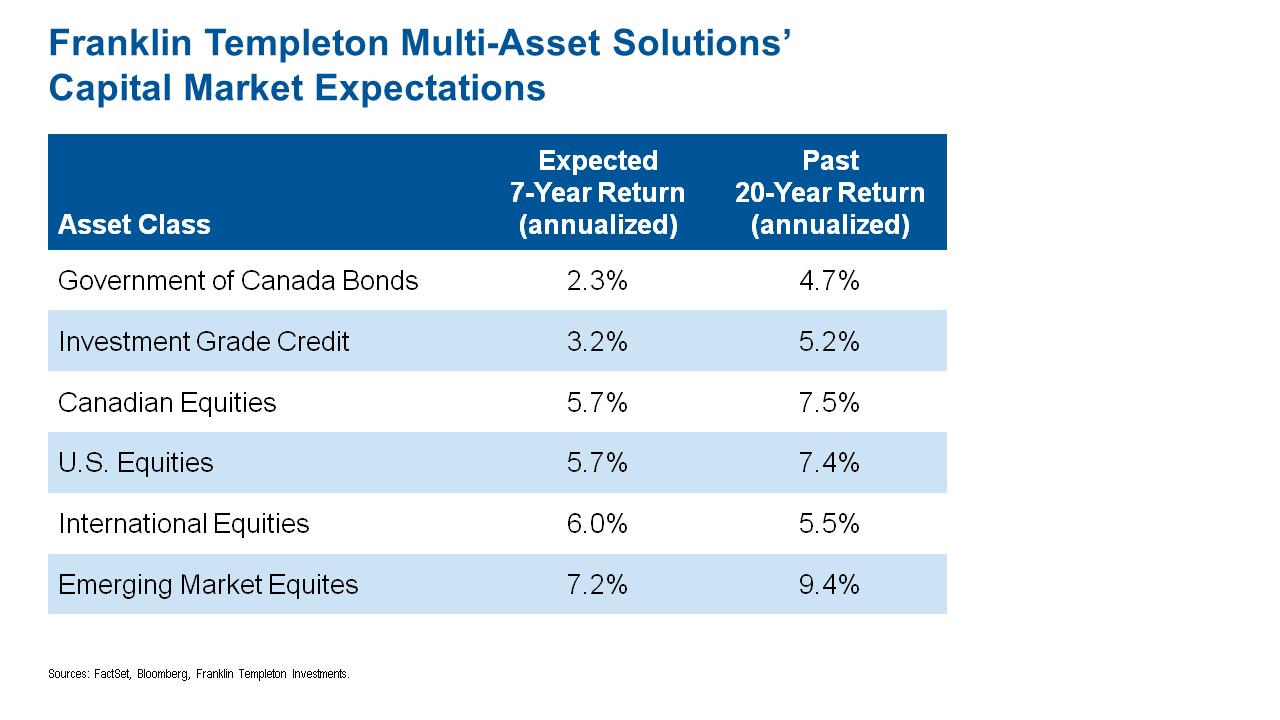
At the 2019 Global Market Outlook event in Toronto, William Yun, New York-based executive vice president for Franklin Templeton Multi-Asset Solutions, projected 7-year annualized returns for Canadian equities of 5.7%, compared to a 7.5% average the last 20 years [as shown in above chart]; 5.7% for U.S. equities (versus 7.4% historically), 6% for international equities (versus 5.5%), and 7.2 versus 9.4% for Emerging Markets. On the fixed income side, he is projecting 2.3% annualized 7-year returns for Government of Canada bonds (versus 4.7% historically the last 20 years), and 3.2% for investment grade corporate bonds (versus 5.2%).

All this is in an environment of continued desyncronized global growth (of 3%) and moderate inflation expectations. Long term, Yun is particularly optimistic about the long term growth of Emerging Markets equities, which at 5% is two-and-a-half times the 2% growth expectation for developed market equities. This optimism is based on positive population growth and labor productivity in Emerging Markets. Globally, inflation “remains muted” and “we don’t see many excesses in the global economy generally.” There are however, some excesses in the U.S. labor market.

More normalized interest rate environment

William Yun, Franklin Templeton Multi-Asset Solutions

Capital spending growth patterns are supportive and trending upwards since the 2016 US election, with the transition from very low interest rates post the financial crisis to a “more normalized interest rate environment.” The opportunity is to reinvest capital to more productive assets, as opposed to allocating to corporate share buybacks.

With respect to central bank balance sheets, markets are normalizing around the world, transitioning from excessive Quantitative Easing to Quantitative Tightening and shrinking balance sheets. Assets quadrupled at the Fed between US$1 trillion in 2008 to $4 trillion today as the Fed committed to buying bonds, with liquidity tapering off. He has similar expectations for the ECB, which has announced the ending of its QE programs, and it’s the same with Japan and China. “Central bankers are pulling back on Quantitative Easing.” There is a “restart of normalization in interest rate policy.”

Rising volatility 

Even as the Dow Jones Industrial Average was in the process of tanking almost 800 points Tuesday, Yun predicted rising volatility after a period of relative calm. In that environment, “investing passively [in index products] has been the way to go but we anticipate volatility returning.” With higher interest rates and more volatility, it may be a time for active management, Yun said, acknowledging his own firm’s expertise in active security management.

Emerging Markets gross domestic product (GDP) continues to rise relative to the rest of the world, from 40% in 1990 to 60% in 2017, and Yun expects that percentage to move higher still. The trend is driven by rising consumption growth for the middle class, which benefits industries like consumer staples and consumer discretionary stocks, technology and even investment management.

Emerging Markets are showing reduced reliance on developed markets, which are slowing. Whereas in 2007 eight of the top trade markets were with the United States, in 2017-2018 China has supplanted the US, with 8 of the top 14 destinations.

In short, Yun sees  a supportive global market for risk assets but lower returns: positive growth and moderate inflation, with increased volatility.

Ian Riach, Fiduciary Trust Canada

Ian Riach, Chief Investment Officer for Fiduciary Trust Canada and a senior vice president of Franklin Templeton Multi-Asset Solutions,  says it makes sense in this environment to make some “dynamic” (i.e. tactical) shifts to long-term Strategic Asset Allocation. Currently, the firm is underweight Canadian equities and Canadian bonds, because the loonie has been getting weaker and Canada is facing a number of challenges ranging from trade to energy to a shrinking manufacturing base, all of which “affects growth going forward.” In the short term, Riach expects short-term interest rates in the United States will be higher than in Canada, “given that they are growing more quickly than us.”

Flat yield curve

Even after the recent rate back-up, “we think Government of Canada bonds are expensive, Continue Reading…