


General

Canadian Trade Relations: The wrong place at the wrong time

By Jeff Weniger, CFA, WisdomTree Investments  

Special to the Financial Independence Hub

The 24-year-old North American Free Trade Agreement (NAFTA) has never been this close to death, but a resolution could be behind the storm clouds.

Souring trade relations with the U.S. are a shame, because Canada got caught in the wrong place at the wrong time. Consider figure 1. President Donald Trump wants to make a dent in the US$388 billion annual trade deficit with China and, to a lesser extent, the yawning gaps with Mexico, Germany and Japan. But to show strength to them economically and North Korea militarily, he believes he has to treat even friendly actors such as Japan and Canada like hostile players. That became apparent when the U.S. administration imposed global steel and aluminum tariffs, and Canada wasn’t exempted.

Figure 1: Monthly U.S. Trade Deficit/Surplus (USD in Millions)

Monthly U.S. Trade Deficit/Surplus

Talks are starting to get personal, with U.S. President Donald Trump accusing Prime Minister Justin Trudeau of making false statements at a June news conference after G7 leaders met amicably. The Canadian leader then got relatively tough, responding that “Canadians … will not be pushed around.”

With the world’s two best friends in a lovers’ quarrel, the US$13 billion annual U.S.-Canadian trade gap, a rounding error, is somehow a political issue. It could have been resolved over golf.

But not all is lost. Ottawa would be wise to consider — if it is legal — scrapping NAFTA for a bilateral trade agreement with Washington.

Canada ill-advised to sit at table with Mexico

That’s because Canada is ill-advised to sit at the table with Mexico to try to strongarm the U.S. Not now, in 2018, given Mexico’s own specific troubles. Frankly, Mexico’s negotiating calculus is much weaker than Canada’s. The country went to the polls July 1, and leftist Andrés Manuel López Obrador (AMLO) won.  He won’t help Canada one bit because it isn’t politically palpable for him to shoot for a quick resolution. Hostility to the U.S. — or at least standing ground against Washington — has been a political winner for the Latin American “pink tide”1 for years. Playing the tough-talk game with Trump will be one of AMLO’s key rallying cries, and it can only cripple NAFTA. Continue Reading…


Staying on track financially: best practices

By Gloria Martinez

Special to the Financial Independence Hub

Many North Americans have trouble staying on track financially; there are so many things that can derail even the best-laid plans, from unexpected medical expenses to home repairs or a dip in credit.

However, there are some simple ways you can help keep your finances in check so you aren’t left with a nasty surprise down the road, and it will ensure that your retirement, college funds, or other savings are left untouched.

It’s important to start with a good plan. Sit down, look at your expenses and current income, and create a budget that will be easy to stick to. Don’t cut back on too many things at once; that’s a recipe for failure that will leave you feeling unmotivated to keep trying. It’s also a good idea to keep communication open with your spouse or partner so everyone is on the same page.

Read on below to find out the best ways to stay on track financially.

Buy a Life Insurance policy

The right life insurance policy isn’t just a way to protect your family in the event of your death; it’s also an investment that you can sell down the road should you need to free up cash. Many people do this in order to pad their nest egg a bit for retirement, but it’s important to find the right policy for your needs: both now and in the future.

Set a Budget

Setting a budget is essential when it comes to staying on track with your finances. Create a spreadsheet online that can be shared with your spouse or partner, and update it every day with each new purchase or checking deposit. It’s also a good idea to set an allowance for spending for the week and stick to it as closely as possible, whether it’s for groceries or eating out. You can look for ways to save, as well, such as carpooling, making eco-friendly changes to your home to reduce your utility bills, and trading cable for a streaming service. Continue Reading…

6 steps to avoiding a bear market near Retirement

By Fritz Gilbert, TheRetirementManifesto.com

Special to the Financial Independence Hub

Did you know a looming Bear Market Crisis is approaching?!

I just read it on the internet, so it’s got to be true!

To make matters worse, I just retired a month ago.

Uh Oh!  (Am I screwed?)

Today, some reality about Bear Markets, along with 6 steps to consider as you structure your retirement portfolio.

A Looming Bear Market

Ok, I’m having a bit of fun with the “read it on the internet” line, but the reality is that a Bear Market WILL happen. I’m not being prophetic, just stating the facts.  Since before the days of the tulip mania in 1637, bear markets have always been will us, and they always will.  We’ve benefited from a very nice bull run. We’re being naive if we think that it will never end.

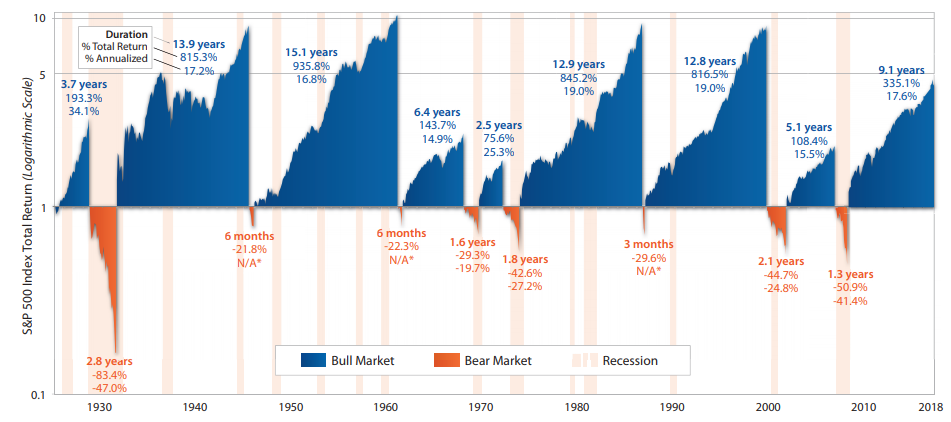
Since 1900, we’ve had 32 Bear Markets, defined as a correction of 20% or more.  Do the math, and that averages out to a Bear Market every 3.7 years.  The average bear market lasts 367 days (the longest was 34 months!). Here’s what they look like graphically:

The Looming Bear Market Will Drive A Retirement Crisis

I actually did read an article on the internet about the looming bear market crisis.  In “The Next Bear Market In Stocks Will Drive A Retirement Crisis,“ the author states:

“A recession could decimate even substantial retirement portfolios.”

Further, the author goes on to say that Social Security and Medicare, and the resulting increase in taxes, increase in eligibility age and reduction in benefits “would be a disaster” for those dependent on the safety net.

Add to that the Voices Of Worry over the global debt pile up and the underfunded status of many state & local pension funds and things could get really, really ugly.

Maybe I shouldn’t have retired early. 

Too late now, I guess I’d better get to work on building a Bear Market Crisis Prevention Plan.

The Looming Bear Market Crisis

We all know a Bear Market is coming. It’s been an increasing theme in the blogosphere, with even the esteemed Financial Samurai taking risk off the table. America’s wealthy are moving to cash.  Ben Carlson of A Wealth of Common Sense has 36 Obvious Investment Truths to remind folks that you should protect yourself.

I’m not a panic-driven investor, screaming a scare tactic headline to drive traffic (tho, if you’re reading this, I guess it worked, right?).  Rather, I’m reminding folks of the reality of how the markets work and encourage you to think about it as you develop your retirement portfolio strategy.  Yes, stocks have historically outperformed over the long-term, and will likely continue to do the same.  Just recognize that the road can be bumpy, and plan accordingly to avoid getting bitten by a bear when you can least afford it.

A Bear Market Crisis Contingency Plan

The reality is that bear markets have always been with us, and always will.  Unfortunately, we never know when that snake is going to strike, so it’s best to wear snakeproof boots along the path of retirement.  Following are some steps I’m taking, as an early retiree, to defend our portfolio against the risk of a bear attack.  View them as suggestions, and pick and choose as appropriate for your situation.

6 Steps To Bear Market Protection Continue Reading…

Boosting Retirement Savings during your final Working Years

Whether you’re a late starter or seasoned saver, the five years or so leading up to retirement just might be the most crucial time to get your finances in order.

Most retirement-ready checklists suggest your final working years is a time to double-down on retirement savings. The idea being that major financial burdens, such as paying down the mortgage and raising children, should be behind you and those savings can be parlayed into big contributions to your retirement nest egg.

High-income earners should look to their unused RRSP contribution room and contribute as much as possible in their final working years. This has the added benefit of generating big tax returns, which can be reinvested into your RRSP or used to pay down any outstanding debts.

Procrastinators have a final chance to break any bad spending habits and set their finances straight. The first step is to draw up a financial plan. Make it a top priority to pay down any remaining debt and get spending under control. You should then have a rough idea when debt-freedom is in sight and from there decide how long to continue working to meet your retirement savings goals.

Retirement income target

The often-used retirement income target is 70 per cent of your final pay, meaning if you earned a $100,000 salary in your final working years then you should aim for a retirement income goal of $70,000 per year. But new research suggests a more realistic retirement income target may be closer to 50 per cent.

Regardless, you’ll need to find YOUR retirement number and determine whether you can reach your income goals through some combination of workplace pension, personal savings (RRSP, TFSA, non-registered investments), CPP, OAS, and/or GIS.

Piecing that puzzle together takes a lot of planning (and still plenty of guess work). No wonder choosing a retirement date can seem like such a daunting challenge!

Taking advantage of your final working years

Continue Reading…

Motley Fool: If you like FANG stocks, you should love Chinese BAT stocks in correction mode

My latest Motley Fool Canada blog was published Tuesday. It takes a look at the Chinese equivalents of America’s FANG (or FAANG) technology stocks. The FANGs have been surging ever higher this year although most came down Monday with Netflix as the latter’s subscriber growth disappointed somewhat. You can find the full MotleyFool blog by clicking on the highlighted (and self-explanatory) headline: If you like FANG stocks near their highs, you should love BAT stocks while China’s in a bear market.

Credited to Mad Money broadcaster Jim Cramer and RealMoney.com analyst Bob Lang early in 2013. FANG famously stands for Facebook, Amazon, Netflix and Google although some have added Apple to make it FAANG.

BAT stands for Baidu, Alibaba and Ten Cent. The influential weekly British newspaper, The Economist, recently had an interesting article comparing the BATs to the FANGs. (See FAANGs v BATs in the July 7, 2018 edition). The magazine described a titanic battle between these American and Chinese tech giants, which it said have a combined stock market capitalization of more than US$4 trillion.

Since the Motley Fool demands that writers disclose all their holdings mentioned in articles, I don’t mind stating here that I’ve long owned the FANGs as well as Apple, if only because my Millennial daughter twigged me to some of the names. I also bought Ali Baba on its IPO in 2014 but only bought into Baidu and Ten Cent this summer, in part as I researched this article (or was it the other way round?). As a rough analogy, I think of Ten Cent as China’s equivalent of Facebook, with a gaming kicker. Baidu is more or less a Google-like Chinese search play and Ali Baba has been characterized as being a type of Chinese hybrid of Amazon, Facebook and Google.

I would have to characterize these investments as speculations, so as the old saying goes, don’t invest more than you’re prepared to lose.