


General

Retired Money: How to avoid pre-retirement financial stress syndrome

My latest MoneySense Retired Money column looks at how near-retirees can avoid what author Patrick McKeough calls “pre-retirement financial stress syndrome.”

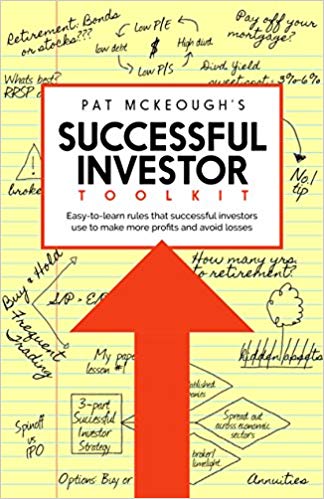
That’s a syndrome he identifies in his new book, Pat McKeough’s Successful Investor Toolkit. McKeough is a regular contributor here at the Hub and you can find the full MoneySense review of his book by clicking on the highlighted text: Investing tips for retired Canadians.

The book is a distillation of McKeough’s long investment career, honed first at The Investment Reporter, and in recent years his own firm, The Successful Investor, and its stable of newsletters. As a member of his Inner Circle and TSI Network, I have long been a proponent of his common-sense approach to investing. He is remarkably consistent in his insistence that investors of any age rely mostly on a conservative portfolio of quality dividend-paying stocks spread among the five major economic sectors (Manufacturing & Industry, Resources, Finance, Utilities and Consumer). And, he never fails to remind you, steer clear of stocks in the crosshairs of what he calls the “broker/media limelight.”

His newsletters are focused variously on Canadian stocks and U.S. and international stocks, and in recent years he has increased his coverage of ETFs.

A cure for PRFSS: Work longer or refine your spending

So what is“pre-retirement financial stress syndrome,” or PRFSS? PRFSS strikes when mature investors realize they may not have enough savings to generate the stream of retirement income they’d been counting on. While some investors are searching for one last desperate “hail Mary” gamble, McKeough advises the opposite: aiming for safer investments.

And while it may not be what some may want to hear, he suggests those suffering from PRFSS adopt one or both of these two solutions: work longer and/or refine your spending. He challenges them to “turn frugality into a game.”

With his focus on stocks, it’s no surprise that McKeough is not keen on bonds, even for retirees and those on the cusp of it. Continue Reading…

How to pay off your mortgage in 10 years

By Karren Smith

Special to the Financial Independence Hub

Owning a home without a mortgage is something of a dream for many, and an important step in financial independence. Paying off a mortgage in 10 years can seem like a massive task, but with some simple financial strategies and planning, it’s possible.

While you will need to make some sacrifices, the benefits of owning your home as soon as possible is worth it for many people. By paying off your loan more quickly, you and your family will save thousands of dollars in interest and have more money to put towards the things you love, such as overseas travel, or perhaps a second home for holidays. Owning your house can help your life become freer and more flexible. So how can you escape the shackles of your mortgage and pay off your home in 10 years?

Create a simple plan

Assuming you’re debt free, aside from your mortgage, you can make a simple plan that will help you pay off your home within 10 years. For example, let’s say you have a $300,000 loan at a 5% interest rate. If you have a single income of $95,000, you can pay off your loan in 6-7 years with $2,000 fortnightly payments.

If you’re a couple, with an income of $140,000, you can pay your mortgage off in 5-6 years with $2,600 fortnightly payments.

Of course, these numbers are just a starting point to illustrate what’s possible if you focus on paying your home off. Bigger loans will require more time or bigger repayments. Obviously, the higher your fortnightly payments are, the more quickly you’ll pay off your loan; however, at the same time, it’s important that you have enough money to cover your expenses and live comfortably. Continue Reading…

If an investment sounds too good to be true, check these four things

We recommend that investors follow an “evidence-based approach” with their investments.  What does the evidence tell us?  Investors should maintain globally diversified portfolios, keep costs low and select a mix of risky and safe investments that is suitable for their risk tolerance and financial goals.

Once a sensible portfolio is in place, holding on through the roller coaster ride of the market’s ups and downs is key to having a positive long-term investment experience.  One of the biggest reasons investors underperform market benchmarks or even the funds in which they invest is their inability to control the emotional urges which can easily lead to bad investment decisions which knock them off course.

Too good to be true

One temptation to which we often see investors succumbing is the “too good to be true” investment product pitch.  For example, many investments are sold as “equity-like returns with bond-like safety.” Upon closer examination a better explanation for such products is often “equity-like or higher risk with very uncertain returns.”

There are four key criteria that you can use to assess every investment opportunity that comes across your path:

  1. Expected Return
  2. Costs and Fees 
  3. Risks
  4. Liquidity (how quickly you can get your money back when you want it)

The only reason we invest is to earn a rate of return.  The rate of return compensates us for letting someone else have use of our capital rather than just leaving it in a high-interest savings account in the bank.  What type of return is reasonable?  Well, you shouldn’t be surprised to hear that the answer is “it depends!” And what it depends on is the other three criteria: the more risk, the higher the costs and fees and the more locked-up your money is, the higher rate of return you should expect. Continue Reading…

5 things to consider when buying a new car

By Sia Hasan

Special to the Financial Independence Hub

It’s easy to buy a car without giving the purchase much thought. Every car dealer in town is ready to roll you off the lot in a brand new car today. If your credit score presents a problem, they’ve got a cheaper used model for you. Should your credit preclude that, there are any number of “buy here pay here” stores ready to roll you off the lot no matter what’s on your credit report.

But are you making a wise investment? People with lots of money got it by asking themselves that question before every purchase, be it a car, a house, or a hamburger. When it comes to a car, the answer to that question takes some research into the vehicle and a hard, truthful look at your financial situation.

If you are like most people, the first part of the answer is much easier to obtain. Ratings and reviews can tell you about the reliability, safety, and warranty. Armed with that information, it’s fairly easy to pick a car that’s not likely to cost you your left kidney. The second half of the equation requires putting the wishful thinking on the shelf and giving yourself an honest answer as to what you can afford.

Here are five important considerations when investing in a vehicle:

1.) Run the numbers

Before you even step onto a car lot or start reading the auto ads, know your budget. To figure this, add up the cost of all of your basic needs, like housing, utilities, food, cellphone, etc. Be sure to include the less basic but important needs, like saving for retirement, taking a vacation, saving for emergencies, going on a date, etc. Be honest with yourself. When you add in the cost of your new car, remember it’s not just the payment. How much it will cost for gas, insurance, maintenance, and repairs must also be included. Once you know what you can afford on a monthly basis, any number of online calculators can show what purchase price is in your range.

2.) Buy or lease

Most consumers are better off buying because they can gain equity in the car and eventually pay it off. With leases, the payments never end. The lease term expires and then you need another car. Also, mileage caps are restrictive and terms can be confusing. If you drive very little and don’t need the car for the long-term, leasing may make sense. Also, if you plan to drive a new car every two years, leasing may work better because, unless you’re a cash buyer, you’ll always have payments anyway.

3.) New or used

New cars drop a third of their value as soon as the proud new owner drives off the lot. Some of the best car deals out there are for 1- to 3-year-old cars. They’ve taken the initial depreciation but are still in good shape. Continue Reading…

Poll finds most wonder how friends or neighbours can afford lifestyles

It’s one thing keeping up with the Joneses but a poll from Edward Jones finds that 61% of Canadians wonder how their friends or neighbours can even afford their lifestyles. This is especially so among Millennials (aged 18 to 34), 71% of whom felt this way, while 66% of Gen Xers aged 35 to 44 were curious to understand how those around them finance their purchases.

Seems to me this gives new meaning to the phrase The Millionaire Next Door, a popular book on how frugality is a key trait in building wealth. Typically, the kind of millionaires in the book live modestly and their net worth may not be obvious merely observing the size of a given home and/or what’s parked in the driveway. Conversely, it can also be that an apparent “millionaire next door” has no net worth at all but is fuelling their conspicuous consumption merely with debt.

Either way, it appears many of us are influenced by what our associates are spending their money on.

Sadly, the Edward Jones poll found that the pernicious practice of looking at the purchases of others may influence consumers to buy beyond their own budgets: a whopping 93% said they experienced buyer’s remorse after such purchases and admit to regrettable spending habits. Among Millennials, 96% experienced buyer’s remorse but so did 90% of baby boomers.

Among the types of purchases most likely to generate regret were tangible purchases, which were cited as a source of regret in 83% of cases. Clothing or shoes were regretted by 35% polled, jewelry by 28% and electronics by 26%. Millennials regretted spending on clothing/shoes in 47% of cases, while boomers were more likely to regret spending on jewelry (34% of them did).

While Millennials famously are supposed to value experiences over stuff, across the Canadian population, 83% regretted making impulse tangible purchases, versus 71% for experiential purchases.

Build spontaneous spending into your budget

So what lessons does this survey furnish for those seeking ultimate financial independence? “If you know you enjoy spending money spontaneously, build this into your monthly budget,” said Roger Ramchatesingh, Director, Solutions Consulting at Edward Jones in a press release issued on Monday, “When it is unplanned for, it can add up over time and hurt other long-term goals such as retirement or the purchase of a home.” Continue Reading…