General

Four ETFs to play the modern gold rush

Pixabay/olenchic

• Gold is shining again; prices have surged to record highs this year and are forecast to climb further.

• Central banks are buying at a record pace, while investors seek protection from rising debt and currency debasement through gold ETFs.

• BMO’s gold ETF suite offers choice: ZGLD for stability, ZGD for growth, and ZJG for high-octane exposure.

Gold shines in 2025

By Erin Allen, Director, Online Distribution, BMO ETFs

(Sponsor Blog) 

Gold’s reputation as an ancient store of value has rarely felt more modern.

The metal has been one of 2025’s standout performers among major asset classes, surging to record highs of around US$3,900 per ounce as of September 2025. The rally has been fueled by central bank buying, rising fiscal concerns, and investors seeking protection from a weakening U.S. dollar.

BMO Capital Markets recently lifted its gold price forecasts to an average of US$3,900 for the final quarter of 2025 and US$4,400 for 2026, reflecting what analysts describe as structural changes in the geopolitical and financial landscape¹.

The key driver: debt. With deficits in the U.S., Japan, and Europe ballooning, gold is increasingly being viewed not just as a safe haven, but as a strategic hedge against long-term currency debasement.

In this piece, we unpack what’s driving gold’s renewed strength, assess whether it’s sustainable, and outline ways investors can gain exposure through BMO ETFs from the physical metal itself to large and small-cap miners.

Central banks are quietly building reserves

One of the biggest tailwinds for gold has been record levels of central bank buying.

According to Reuters, central banks now hold 36,000 tonnes of gold, having added more than 1,000 tonnes annually for three consecutive years². This surge reflects a broad reassessment of what constitutes a safe asset.

Geopolitical instability and questions over the long-term stability of U.S. Treasuries have prompted central banks to diversify reserves. Gold has even overtaken the euro to become the second-largest global reserve asset, and for the first time since 1996, represents a larger share of reserves than Treasuries².

Chart 1: Foreign central banks hold more gold than Treasuries
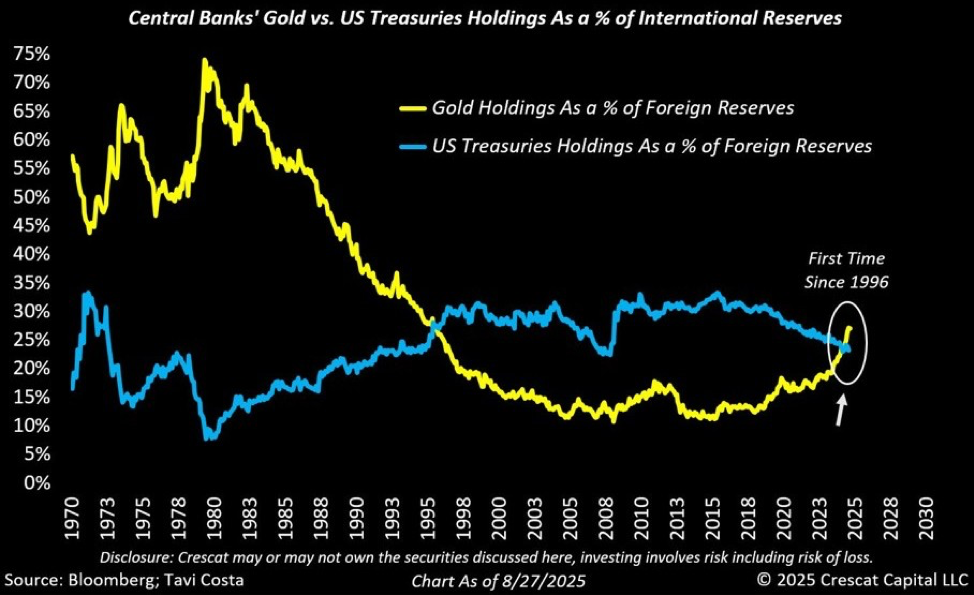
Gold fell from 75% to 15% of reserves; Treasuries rose and surpassed gold holdings around 2023 for central banks.

The World Gold Council notes that while emerging markets typically hold 5–25% of their reserves in gold, developed economies hold more than 70%³. This steady official-sector accumulation underscores the global shift to tangible assets amid growing fiscal and political uncertainty.

Trade tensions and currency debasement fears

Gold’s strength also reflects what Bloomberg calls the “debasement trade.” As government debt piles up and fiscal discipline erodes, investors are moving out of major currencies and into alternative stores of value such as gold, silver, and Bitcoin⁴.

The U.S. dollar is down roughly 8% year-to-date, while gold continues to post record highs. Bloomberg notes that the current cycle echoes previous bouts of U.S. dollar weakness following the global financial crisis and periods of aggressive monetary easing⁴.

As George Heppel, Vice President, Commodity Research at BMO Capital Markets, explains, both cyclical and structural forces are converging¹:

“What we’re really seeing this year is the combination of a short-term thesis and a long-term thesis for holding gold, which has created a perfect storm for the metal. And naturally all of this increases concerns around sticky or growing inflation and the potential for negative real rates next year, which makes gold an attractive asset to be holding as an inflation hedge,” he says.

With U.S. debt climbing and political gridlock persisting, investors have reason to question the durability of fiat currencies. Gold, with no counterparty risk and a finite supply, has reasserted its role as a monetary anchor.

According to the Congressional Budget Office (CBO), the recently passed One Big Beautiful Bill Act (OBBBA) – also known as the “Trump tax cuts” – will add an estimated US$19 trillion to U.S. debt over 30 years as written, or US$32 trillion if made permanent⁵.

“The passage of OBBBA will put tremendous pressure on the nation’s fiscal and economic health. Layered onto an already unsustainable outlook, the new law increases the risk of higher interest costs, slower growth, volatile markets, and reduced capacity to respond to future crises or invest in national priorities,” the CBO warned.

Chart 2: Debt soars under OBBBA
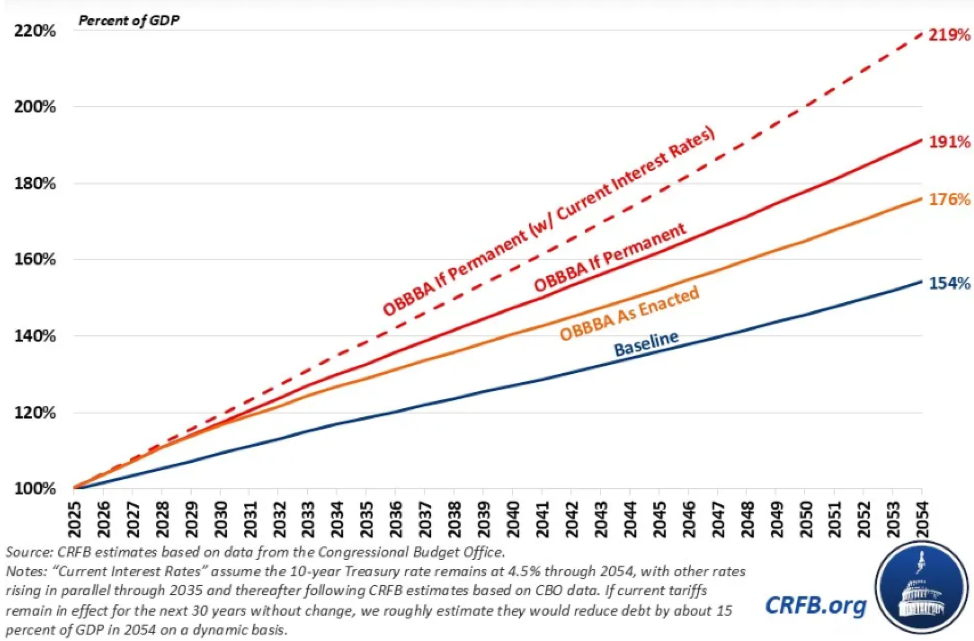
Projected U.S. debt-to-GDP rises sharply from 2025 to 2054, peaking at 219% under the highest scenario in the chart.

All logos and trademarks of other companies and/or organizations are the property of those respective companies and/or organizations.

Gold ETF demand surges to near-record levels

While central banks are leading the charge, investors are not far behind.

According to ETF.com, global gold ETFs have attracted US$44 billion in inflows this year, equivalent to roughly 443 metric tonnes of the metal⁶. That puts 2025 on track to rival the record US$49.5 billion set in 2020: the strongest year ever for gold-backed funds. Canada alone saw over $1B flow into commodity ETFs, largely driven by gold, according to National Bank of Canada’s September flows report.

Gold ETFs have become the preferred way to access gold, offering liquidity, transparency, and simplicity: all without the complications of physical storage.

Investment banks turn bullish

Institutional sentiment has followed suit.

BMO analysts believe the gold market is undergoing profound structural change, driven by debt, inflation, and de-dollarization. The bank has raised its long-term gold-price assumption to US$3,000 per ounce, up from US$2,200, placing it near the top of sell-side consensus¹. Continue Reading…

Almost six in ten Canadians worry they’ll run out of money in Retirement: especially women and young people

The majority of Canadians are afraid they’ll run out of money in Retirement, especially women and young people, according to a survey released Wednesday morning by the Canada Pension Plan Investment Board (CPPIB).

The 2025 CPPIB Retirement Survey  (for Financial Literacy Month) says 59% of all Canadians are afraid of running out of money during Retirement, with the percentage jumping to 63% for women, compared to just 55% of men. It also found a whopping two thirds (66%) of Canadians aged 28 to 44 share the same fear. As the CPPIB graphic  below illustrates, those who have a financial plan are slightly less worried.


As you’d expect the CPPIB to point out, the Canada Pension Plan (CPP) helps protect retired Canadians from this risk: as it says above, CPP “benefits are payable as long as you live and [are] indexed to inflation.”

Indeed, CPP and the other main government retirement income program, Old Age Security, are both valuable sources of inflation-indexed retirement income. CPP is available as early as age 60 and OAS at 65 but a staple of Canadian personal finance commentary is that the longer you wait to receive benefits, the higher the benefits will be. In the best of all worlds, you’d wait until 70 for both programs to start paying out, even if you have to keep working longer and/or start withdrawing money from your RRSP before it’s mandated at age 71/72. (While the CPPIB doesn’t mention it, retirees with no other savings may also benefit from the Guaranteed Income Supplement to the OAS: and the GIS  is tax-free.)

The second graphic reproduced below is less straight-forward: it appears to present various excuses for delaying the creation of a proper financial plan to help get to Retirement. Roughly half of younger Canadians cite their need to advance their careers and make more money, and to buy their first home as priorities.


While it’s true that if nothing else, the future arrival of CPP and OAS benefits should put minds partially at ease about covering off basic Retirement expenses, it seems to me pretty obvious that at least for those who lack a generous employer-sponsored pension plan (ideally an inflation-indexed Defined Benefit pension), that it will be necessary to maximize savings in RRSPs and TFSAs as soon as possible.

Because of the Time Value of Money and the magic of compounding investment returns (especially when tax-deferred in RRSPs and TFSAs), the sooner you start saving in these vehicles the better. There’s no excuse not to make RRSP contributions from the get-go, ideally as soon as you land your first real job, since it reduces your income tax. Yes, decades from now when RRSPs become RRIFs you’ll have to pay some tax on the ultimate withdrawals, but that’s more than made up by the tax-deferred investment growth. Continue Reading…

Resist the Urge to Make a Quick Profit on your Best Stock Picks

Investors often go for the easy gains, but resist the urge to dump your best stock picks for a quick profit

Image courtesy TSInetwork.ca

Here’s a quote from one of the first highly successful investors I ever had the privilege of meeting. While talking about the stock market, he casually mentioned, “I’m a rich man today because I was smart enough to buy Canadian Tire stock at $0.50, and too stupid to sell when it hit $2.00.”

The quote deserves to be repeated more often, since it simplifies a key rule for successful investing and preserving your best stock picks: Don’t be too quick to sell a winner. Unfortunately, this rule gets broken all the time. Many investors buy a particular stock, often a junior stock, because they like a number of things about it: the business plan, the experience and achievements of the management, the outlook for the industry the company is targeting, the general economic environment, and so on. Before too long, however, other investors are likely to discover the same stock.

They may like it so much that they bid up its share price. When that happens, it can spur the early buyers to take profits.

These early buyers may lose interest because they fear the stock has burned up its near-term potential. Worse still, they may fear the rise is a “last gasp” and that the stock may suddenly go into a deep setback. Or, they may decide they found one good stock before the rest of the market did, so they can sell their latest winner and go on to invest the proceeds in something better.

Their initial good fortune may give them the urge to sell their first winner, in hopes of finding something else just as good, but with more profit potential because it has not yet caught the market’s attention.

Before you yield to this urge, it’s better to consider what else has changed about the stock, other than its rise in price. Did its business plan change? Probably not. Chances are that few if any of its attractive industry aspects have changed. Good management, good industry opportunities, a positive economic outlook and so on can persist through long periods of adversity.

That’s why you need to overcome the intermittent but all-too-human urge to take a quick profit on your best stock picks.

Mind you, before selling the stock and buying something else, you need to contemplate a related rule: Resist the urge to declare a junior investment a winner, just because of its novelty, or its uniqueness, or its frequent appearance in the broker/media limelight.

Lots of good-sounding investment ideas turn out to be poor investment performers.

Think long-term when it comes to maximizing gains on your best stock picks

The goal of an investor, particularly if you follow the Successful Investor approach, is to make an attractive return on your investments over a period of years or decades. Failure means making bad investments that leave you with meagre profits or losses.

Unsuccessful investors can still make some profits. They just don’t make enough to offset the inevitable losses and leave themselves with an attractive return. If you focus on the idea that you never go broke taking a profit, you may be tempted to sell your best investments whenever it seems the investment outlook is clouding over.

On occasion, you may succeed in selling just prior to a major downturn, and buying back at much lower prices. More often, prices will soon hit bottom and move up to new highs. If you buy back, you’ll pay higher prices. If you had followed this investment belief with Canadian bank stocks, for example, you could have missed out on some big gains over the years.

In hindsight, market downturns are easy to spot. Spotting them ahead of time is much harder, and impossible to do consistently. After all, if you could consistently spot market downturns ahead of time, you could acquire a large proportion of all the money in the world, and nobody ever does that.

The problem is that you’ll foresee a lot of market downturns that never occur. All too often, the market-downturn clouds disperse soon after skittish investors have sold. Good reasons to sell do crop up from time to time, of course, even if you follow a long-term conservative investing approach. But “You’ll never go broke taking a profit” is not one of them.

So, when is it the right time to sell your best stock picks?

Investors often ask, “When do I sell?” There is no simple, fits-on-a-t-shirt answer to the question. But there are some helpful guidelines. Continue Reading…

Avoid being trapped by a Mortgage as a FIRE Retiree: 5 Tips

Can you really achieve Financial Independence when you still have a mortgage looming over you? Our insights will help you avoid feeling trapped by payments.

Image: Iryna for Adobe

By Dan Coconate

Special to Financial Independence Hub

Achieving Financial Independence early brings freedom, flexibility, and opportunities. But entering this new chapter requires thoughtful planning, especially when it comes to housing.

Avoid being trapped by a mortgage in early retirement by adopting a strategic approach that aligns with your financial goals. Whether you plan to downsize, relocate, or stay put, being proactive can preserve your hard-earned independence without a mortgage becoming a financial burden.

Below are five essential tips to guide you through managing your mortgage while protecting your financial independence.

Prioritize Paying off your Mortgage

Carrying a mortgage into Financial Independence can feel like dragging a heavy anchor. If you can, aim to own your home outright before retiring early. This eliminates one of the largest monthly expenses, giving you greater control over your budget. Many Canadians find success by accelerating their payments or making lump-sum contributions when possible. Debt-free living provides immense peace of mind and opens up new possibilities for pursuing the lifestyle you envisioned.

Consider Downsizing

Scaling down your home can offer financial and lifestyle benefits. Downsizing can free up home equity, reduce maintenance costs, and even lower property taxes. However, a well-thought-out plan ensures you don’t trade your current home for another financial burden.

It is possible to buy a new home before selling yours: you just need to be strategic about it. You also don’t have to limit yourself to smaller square footage; consider homes in less expensive areas or those better suited to your needs.

Explore Passive Income from Real Estate

Turning your property into a source of income can significantly offset costs. For instance, renting out a portion of your home or owning a rental property can transform your mortgage payment into a cash-flow opportunity. Many pursuing Financial Independence have increasingly tapped into short-term vacation rentals or long-term tenants to supplement their budgets. Proper research and planning ensure this approach aligns with your goals while providing notable financial advantages. Continue Reading…

Gold’s Shiny Moment — But I’m still not buying it

Special to Financial Independence Hub

It’s all over the news. The price of one ounce of gold is over $4,000

Millions of people — and even some governments — consider gold to be an investment. Good for them.

Ever since I became interested in investing, I’ve always dismissed the idea of owning gold. I still haven’t changed my mind, but I must admit: the gold bugs are having a good moment.

As of October 22nd, gold was trading at $4,067. That’s a 48% increase from one year ago when it was $2,744. Congratulations, gold bugs. Especially to my friend Michael who has been telling me to buy gold for the past 10 years.

It’s been an amazing run. If you had put your money into gold at the beginning of the millennium, in January 2000, you would have ended up with more money than if you had invested in the S&P 500. A lot more. About three times as much, as you can see from this chart.

And remember: the S&P 500 represents real businesses. Companies producing goods and services, generating profits, paying dividends, and giving you a claim on future cash flows — cash flows that are much larger today than 25 years ago. Gold, on the other hand, is — as British economist John Maynard Keynes put it — a barbarous relic. It produces nothing. It just looks shiny.

Yes, it has some industrial use in electronics, and millions of people all over the world wear it as jewelry. But economically speaking, it’s just a shiny object.

So how does this shiny object — which does nothing except sparkle — outperform one of the greatest bull markets in U.S. history? It boggles my mind.

Why I still prefer stocks

First, let me tell you why I prefer stocks.

The reason I prefer stocks over gold is simple: cash flow compounds.

When you own productive assets:

Companies earn profits.
They reinvest those profits to grow.
They pay dividends or buy back shares.
Your slice of the economic pie keeps expanding — even while you sleep.

That compounding effect is relentless. It’s like planting a tree that keeps bearing fruit year after year. Gold, on the other hand, just sits there. It doesn’t grow. It doesn’t reproduce. It doesn’t innovate. You’re entirely dependent on the next buyer being willing to pay more for it than you did.

That’s not investing. That’s speculation.

Why some like Gold

I admit it, gold does have a legitimate purpose:  it serves as insurance against currency collapse or geopolitical disasters. Imagine for a second that you live in a country with high inflation, like Venezuela. If you have gold, you don’t care that the local currency, the Bolivar, collapses. You are good, you have gold.

One possible reason for gold’s recent rise is central banks. Many of them have been buying gold as part of their foreign exchange reserves. Traditionally they buy U.S. dollars, but some of them are switching to gold because their relationship with the U.S. has been deteriorating. Continue Reading…