


General

Lending to Spouse at Prescribed 1% rate ‘Best Before’ April 1

“Never spend your money before you have it.”
—Thomas Jefferson

I can’t emphasize enough that time is truly of the essence if you benefit from implementing this simple family lending practice. Interest rates are expected to inch up again and will alter the value of this tactic. Hence, I revisit the benefits of one of the few remaining family income splitting strategies.

It is commonly known as the “prescribed rate” loan. The procedure needs these components:

  • One spouse is in a lower tax bracket than the other, or earns little income.
  • The higher tax bracket spouse has cash to lend to the other spouse.

“The benefit of the prescribed loan strategy is a bigger family nest egg.”

Examine your family benefits from this income splitting opportunity. All loan arrangements and documentation must be in place by March 31, 2018 to derive maximum benefit. The key is to charge interest at least at the prescribed rate on cash loaned to a spouse/partner. That prescribed rate is now set at 1% for loan arrangements made by March 31, 2018.
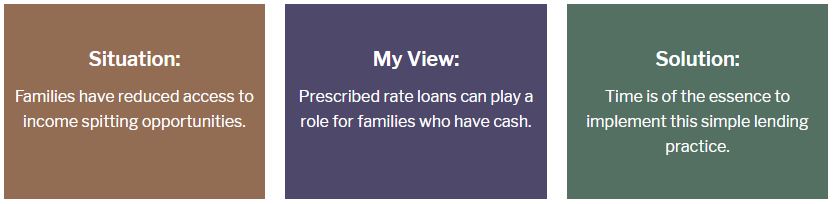
The lower income spouse aims to accumulate a larger nest egg while the family pays less tax. The good news is that loans don’t have to be repaid for a long time, say 10 to 20 years or more.

My sample case highlights the income splitting strategy (figures annualized):

  • The higher tax bracket spouse lends $200,000 to the other at the 1% prescribed rate.
  • The recipient spouse invests the cash, say at 4% ($8,000) and reports the investment income.
  • The recipient must pay 1% annual interest ($2,000) to the lender spouse.
  • The lender spouse is taxed on the 1% interest, while the recipient deducts it.
  • The recipient is taxed on the net income generated ($8,000-$2,000).
  • This results in annual income of $6,000 shifted to the lower income spouse.
  • A promissory note is evidence for the loan.
  • A separate investment account is preferred for the recipient.
  • These loans are best made for investment reasons, such as buying dividend stocks.
  • A new 1% loan can also deal with an existing higher rate prescribed loan.
  • Multiple prescribed loans can be made at 1% while the rate does not change.
  • Business owners can investigate the viability of prescribed loans to shareholders.

Prescribed Rate Loan – Sampler

Here is a simplified method to think of such loans:

Cash Borrowed at 1% rate:  $200,000
Assumed Investment Income (4%): $8,000
Less: Prescribed Loan Interest (1%): $2,000
Taxable Income for Borrower Spouse: $6,000
Taxable Interest for Lender Spouse: $2,000

The benefit of the prescribed loan strategy is a bigger family nest egg. Your mission is to shift investment income into the hands of the lowest taxed spouse.

Need for speed

Today’s prescribed rate, which is set quarterly, is as low as it can be. However, it is most likely to rise at the next setting later this month. The prevailing expectation is a jump to 2% from the current 1% rate on April 01, 2018. Such an increase reduces the net value of the loan arrangement. Further, we may not enjoy a 1% rate for a long time, perhaps never again. Continue Reading…

Choose investments carefully when building dividend portfolios for long-term gains

A dividend portfolio should focus on high-quality stocks with a proven record of paying dividends

High-growth dividend stocks offer investors a measure of security. Dividends, after all, are much more stable than earnings projections. More important, dividends are impossible to fake: either the company has the cash to pay them or it doesn’t.

It’s important to make sound moves while building a dividend portfolio. That’s why we recommend looking for dividend stocks that have a strong position in their market and have a history of building revenue and cash flow.

The best stocks for your dividend portfolio dominate their markets

When we suggest dividend stocks for a portfolio we look for dividend stocks that have industry prominence, if not dominance. Our reasoning, besides brand recognition, is that major companies can influence legislation, industry trends, etc. to suit themselves. Minor firms can’t do that.

How to avoid sabotaging your dividend portfolio

You may decide to vary how much money you invest every year, depending on your view of the market outlook. But nobody can consistently guess right about the market outlook. Trying to do so is likely to cost you money about half the time.

If you invest more money in years when you’re confident about the economy or market, you may wind up buying more shares when prices are high. If you cut back on your investing in years when the outlook is uncertain, you’ll buy fewer shares when stock prices are low.

Investors may go so far as to try to improve their returns by taking money out of the stock market when they feel risk is high. They often get this urge after a few weeks or months of bad financial news or unsettling political developments. By then, however, the market may have already dropped enough to offset any negative developments.

Often, these temporary sellers wind up buying their way back into the market when the news has improved and stock prices have gone above the price where they sold.

Some brokers encourage this costly practice. From time to time, they may advise clients to “take some money off the table,” setting up a false analogy between investing and gambling. That’s in a broker’s interest. Continue Reading…

Longevity, marital breakdown are 2 big reasons women need to take charge of their finances

By Kathleen Peace, CFA, CFP

Special to the Financial Independence Hub 

A recent poll by IPC Private Wealth among 400 affluent Canadians with at least $500,000 in investable assets revealed that 74% of men say they are the lead financial and investment decision-makers in their household. Among women, only 46% say they are the lead decision-makers.

Ladies, listen up! You are probably going to live longer than your male partner. On top of this, there is a 50% possibility that you will divorce your partner (with financial conflict being one of the reasons why). In either case, you will experience a large inflow or outflow of both investment assets and income. This eventuality means that being 100% cognizant of your family’s current financial situation is a must. Waiting to figure this out until after a spouse’s passing or marriage breakdown is at best reckless, and at worst, an enormous imposition on what will already be an emotionally taxing situation.

Let’s get on top of this. A Masters degree in Finance is not required. Gather information and open up a regular dialogue with your spouse. Both will go a long way to getting on top of your family’s pecuniary situation. Here’s how to get started.

Communicate, Communicate, Communicate

Enlist your partner’s help in becoming more aware of your financial situation. Given that money issues are among the top friction-areas for couples, keeping an open dialogue about how money is run in your family will benefit your marriage both fiscally and emotionally. Opening up this discussion is not always easy.

For many families, money is a taboo subject; in fact, many feel that the most difficult topic to discuss with loved ones is their personal financial situation (apparently they would rather discuss death, politics or religion!) An incredibly helpful resource for starting the money conversation with your partner: Breaking Money Silence: How to Shatter Money Taboos, Talk More Openly about Finances and Live a Richer Life, by Kathleen B. Kingsbury.

Know your Advisor

If you don’t know your family’s financial planner/advisor, change this! Continue Reading…

Does downsizing to a secondary housing market really save money?


By Penelope Graham, Zoocasa.com

Special to the Financial Independence Hub

Despite the efforts of new rules and regulations, real estate prices continue their upward trajectory across the nation; according to the Canadian Real Estate Association, the HPI Index rose in nine of 13 markets in January by an average of 7.7 per cent, while the average home price increased 2.3 per cent, to $481,500.

However, CREA noted that excluding Canada’s largest housing markets – Toronto and Vancouver – would strip a whopping $107,500 out of the national sale price, with the remaining markets contributing to an average of $374,000.

While it has always been more expensive to live in a main city centre than in a rural market, excessively hot price growth over the last few years has increasingly prompted buyers to explore their options in secondary real estate markets, fuelling the migration to further-flung communities with comparatively affordable housing. And, as new stress-testing mortgage rules designed to squeeze affordability are now in place, this big-city exodus won’t slow any time soon.

Savings offered by secondary Real Estate markets

This trend is perhaps most evident in Ontario’s Greater Golden Horseshoe region, home to the City of Toronto and surrounding markets that stretch as far as Niagara, Peterborough and Windsor. Prices have ballooned in Toronto over the last two years and – while slightly softer following the implementation of the Fair Housing Plan last year – remain firmly out of reach for many prospective home buyers. For perspective, the average sale price in the Greater Toronto Area fell 4.1 per cent to $736,783 in January, yet a buyer earning the city’s median household income of $78,280 would qualify only for a maximum mortgage of about $545,692.

One of the most popular real estate destinations for these displaced buyers is the City of Hamilton, located to the west along the shores of Lake Ontario. At a roughly one-hour’s drive from Toronto’s downtown core, and boasting beautiful natural features in addition to a rapidly-gentrifying downtown, home seekers have been drawn to the Hammer in droves.

However, affordability is clearly their main motivation, as freehold Hamilton real estate can be had for a relative bargain compared to its Toronto counterparts, with the average home costing $549,546 in January. That’s a whopping $734,435 less than the average Toronto detached price of $1,283,981.

Is It worth moving to another city?

Such savings are tempting – but there are considerations all buyers should mull over before booking a long-haul moving truck. Continue Reading…

Online Fraud: 7 simple ways to protect yourself from a #clicktastrophe

By Rob Fodor

Special to the Financial Independence Hub

If you’re like most people, you have a phobia about phishing. In fact, as we found in a recent Interac survey, almost one quarter of Canadians have clicked on a link that resulted in a phishing scam.

It’s no wonder Canadians are more likely to be worried about payment fraud scams such as phishing and skimming than they are about having their homes broken into or their cars stolen. Fortunately, just as you can take steps to protect your home and car, there are things you can do to protect yourself from online scams, too.

Beware Phishing trips

Phishing is a scam where fraudsters try to get your personal or financial information – such as passwords or card numbers – by masquerading as a trusted person or business, usually through email, text or an instant message, but also sometimes by phone. Continue Reading…