General

Aman Raina’s 3-year review of his Robo Advisor portfolio

By Aman Raina, Sage Investors

Special to the Financial Independence Hub

PLEASE NOTE: This review was written in early February before the big correction started in the market.

I can’t believe it has been three years since I opened up my Robo Advisor account. For those new to investing, a Robo Advisor is a new wave of wealth management companies that invest on behalf of others using an online platform and a combination of algorithms and computer coding to identify and manage portfolios. About three years ago these firms were in their early days, but since then they have mushroomed and even traditional investment companies are now offering some flavor of online investment  management services. It seemed quite appealing; however, there was one thing that many marketing materials, blogs, and mainstream media were avoiding (and still are I might add) … do these types of services make money for investors?

Three years ago I decided to try an experiment and find out for myself. I set up an account with one of the big Robo Adviser firms and invested $5,000 of my own money into it. My goal was to go through the process and blog about my experience and more importantly, the results. I said that we need a good five years to really get a handle on how effective these services are compared to traditional wealth management services. Well, we’ve now crossed the 3-year anniversary of my ROBO account, so let’s take a look at how it’s doing now. Continue Reading…

Response to an investor who frets “the markets are going to crash”

With recent market volatility, many investors have been voicing legitimate concerns about the future direction of markets and what they might do about it.  What direction are we headed for the remainder of the year?  How can we avoid the crash?  Below we present a question and answer that we hope investors might find helpful.

From a concerned investor with impressively good timing (question received January 8 of this year):

Looking at the investment and political scene now – Trump, NAFTA, Dow at record highs, bull market into it’s 8th year, Iran protests — we think the chance of a significant pull-back on the stock market is imminent.

We are beginning to feel, with what’s going on today, that a major pull back could be on the books: like 2008.

What do you think?

Our response:

Dear concerned investor,

To begin with, you are not the only ones expressing those concerns to us. It does seem the market has been on a strong trajectory for quite some time although we usually recommend investors not worry about the market hitting an “all time high” despite how often it’s cited as a signal of sorts by the financial media/analyst community.

The market is always hitting all time highs (Graham wrote this piece on the topic recently that we’d recommend reading: “I’m nearing retirement and the stock market is at an all-time high….what should I do? It is relevant for this discussion generally). We have also noticed an uptick in the volume of negative market commentary.

Doom and gloom reporting became an industry in itself after the last market downturn! This commentary did seem to become more fervent beginning about a year ago (with the US election maybe?) although with hindsight of course it would have been unfortunate to divest at that point or at several other points during the year when news flow seemed particularly grim.

As you know, stock markets are volatile: sometimes that volatility is coincident with changes to the surrounding political and economic environment, sometimes the market anticipates those changes and sometimes it lags. Without the risk of volatility and downturn and uncertainty generally, markets would not deliver the strong long-term returns we seek as investors.

Success comes from riding out volatility, not timing it

In fact, evidence would suggest that investment success is driven more by riding out volatility than by trying to time it. The data on mutual fund returns and money flows shows very clearly that investors actually earn returns significantly lower than the funds they invest in due to poor timing decisions. When markets turn down, investors tend to pull money out. Investors also tend to pile in during times of market euphoria. I think we’re just not hard-wired psychologically to deal with market volatility. The “fight or flight” instinct doesn’t serve us well in this case. The evidence does not support market timing as a successful investment strategy. Continue Reading…

Regain portfolio control amid market mayhem

“To conquer fear is the beginning of wisdom.”
—Bertrand Russell (1872–1970), British philosopher

Investors have been enjoying the fruits of rising markets. A nine-year upside since the March 2009 lows, to be more precise. Conventional wisdom expected that stocks continue to deliver as economic conditions are likely to remain healthy.

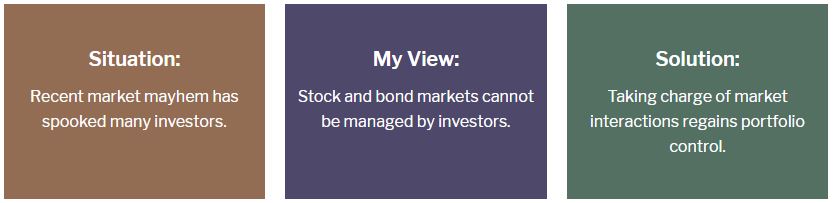
Suddenly, everyone is wallowing in fears. Worries about global economies, recurring volatility and market jitters are back on stage. Investors are wondering what to do with the nest egg amid the crazy mayhem.

“Markets can’t be managed, so focus on your interaction with the markets.”

I recommend that you act wisely. Move slowly. Don’t give up. Don’t throw in your towels. The solution is simpler than you think.

Repeat after me: “I am not in control of my nest egg – the stock and bond markets are.” This is your first and most important admission.

Expect market corrections and surprises any time. Market mayhem is a normal occurrence, in both directions. You’ll be afforded little time, if any, to react. Fretting and worrying about the volatility does not help anyone. Your task is to regain as much control as possible.

Recent market haircuts are graphic reminders of the curve balls of investing. Zeroing in on simple practices reduces the hazards of stepping in a sink hole along your investing roadway.

Adopted Wisdom

I have adopted these timeless steps. You should too:

  • What matters most is how the portfolio fares, not the market outcomes.
  • Markets can’t be managed, so focus on your interactions with the markets.

Continue Reading…

Federal budget 2018: Just what you’d expect from a Liberal government well into its mandate

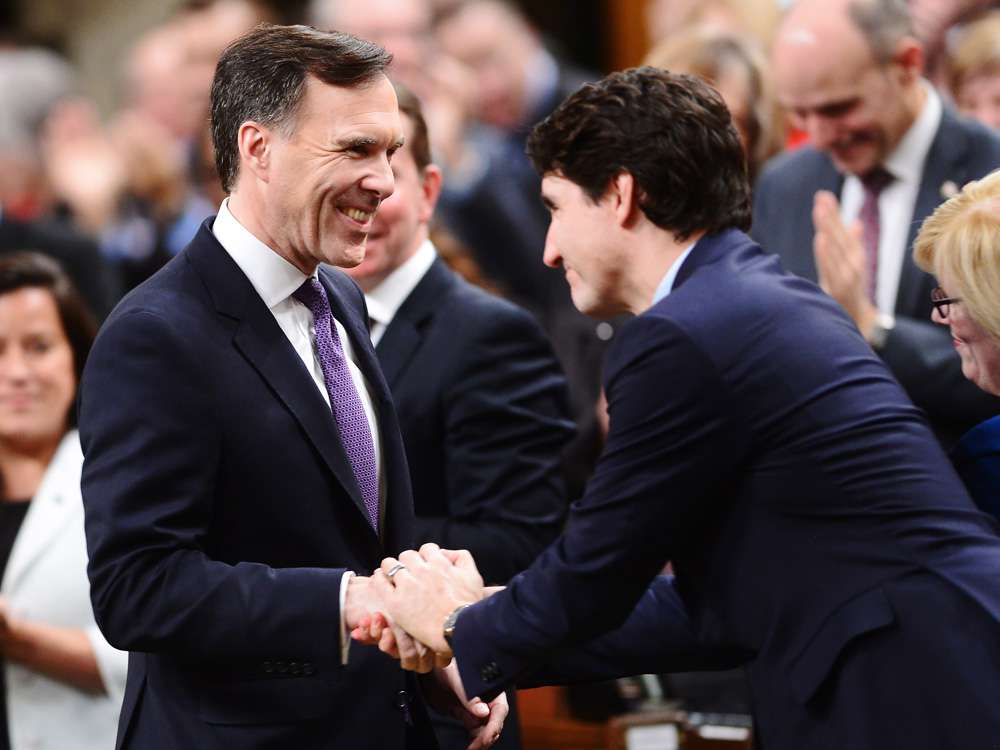
The Liberals’ 2018 federal budget that descended on us on Tuesday afternoon is pretty much what you’d expect from the Justin Trudeau administration at this slightly-past-the-midway point of its mandate: lots of spending on things like gender pay equity, parental leave, native rights. Another stab at sin taxes, with a carton of 200 cigarettes going up by $1 and a proposal for excise duties on cannabis if and when marijuana becomes legal in July. A bit of business tax reform scaled down from the measures that so incensed small business last fall. As for balancing Ottawa’s books? Not so much.

The CBC’s web site provides this overview: Liberals spend billions to close gaps for working women, indigenous families. If you want to do straight to the source, click on the Finance Canada site here.

Here’s the Globe & Mail’s overview that went up soon after 4 pm:  Federal budget highlights: 12 things you need to know. In case you’ve met the paywall limit on free views, it reports that the budget is in line with previous estimates from Finance Canada, which means deficits for the “foreseeable future.”  Pay equity legislation is proposed for federal government employees and federal regulated sectors. And $447 million will be spent over 5 years to create a new indigenous Skills and Employment Training Program (replacing the Aboriginal Skills and Employment Training Strategy).  And another $1.4 billion or more over 6 years is proposed for First Nations child and family services.

A National Pharmacare program is being “consulted” on. More detail on passive income and private corporations: companies with more than $150,000 in passive income will no longer be eligible for the small business tax rate, while those with under $50,000 oil passive income will not be affected. In between is a formula. Also more than half a billion will go to Cybersecurity, and $3.8 billion over 5 years will go to “support science.”  And journalism has not been forgotten: the budget proposes $50 million over 5 years to support journalism in “underserved communities.”

At the National Post, this piece looks at 5 ways average Canadians could be impacted by the federal budget. MoneySense‘s Julie Cazzin totes up 15 ways Budget 2015 will impact your wallet. There’s something for everyone, Cazzin writes, but no real showstoppers. Julie also looks at 5 measures that directly impact Canadian families. Another MoneySense writer looks at the implications for small business owners.

Carrick sees 7 changes affecting personal finances

Here’s Rob Carrick’s piece on 7 changes that could affect your finances. Carrick writes in the Globe that Ottawa will be modernizing deposit insurance, replace the Canada Working Income Tax Benefit with the introduction of a Canada Workers Benefit, which raises benefits by up to  $170 a year in 2019 for single parents and couples, while raising the level at which the benefit is phase out from $32,339 to $36,483. The Sears bankruptcy appears to have stimulated consultation on pension security, while as of June 2018 an extra five weeks of parental benefits will be available when parents share parental leave. (Yes, Justin Trudeau’s government wishes to encourage more men to take pat leave!) There is also an expansion of the medical expense tax credit and a move to strengthen the oversight of bank sales practices by the federal Financial Consumer Agency of Canada.

Coyne: Budget has nothing to do with budgeting; Ivison: Liberals show their cunning

Back at the National Post, you can get useful video insights from columnists Andrew Coyne, John Ivison and William Watson here. Coyne’s column is titled Liberals deliver a federal budget that has nothing to do with budgeting, or the economy.  In it, he wryly observes that the Liberals are pandering “to every conceivable Liberal client group and policy cult: environmentalists, seasonal EI recipients, multiculturalism, official language groups, regional development, all the way to the media … And, of course, feminists.”

John Ivison’s column is headlined “In their third federal budget, Trudeau’s Liberals show their cunning.”

Finally, for a sober look from the tax and accounting pros at KPMG, read this overview.

My take? How about addressing pension inequity between public and private sectors?, not just gender pay inequity?

Continue Reading…

Where did the Retirement idea come from?

I was reading an article on retirement in The Atlantic. The article discussed the earliest concept of retirement, dating back to Otto von Bismarck of Prussia in 1881.

The concept was to provide financial support to “older members” of society. The idea was radical because people did not retire: if you were alive you worked. At the time the majority of people were employed in agriculture to feed the masses.

The struggle for payment continued for 8 years and finally with pressure from the socialists, legislation was introduced for the state to take care of those disabled from work. Social security was later introduced for those over 70 years old; however, 70 was well above life expectancy at the time.

Soldiers were paid pensions for years prior to social security; however, virtually all worked after their military service. In the late 1800s pensions were paid to many public servants in major US cities  and in 1875 American Express started to offer pensions,  followed by major industrial companies that started paying pensions in the early 1900s.

US Social Security in 1935

All this culminated with the Social Security Act of 1935, with a retirement age of 65 and a life expectancy of 58. Research at the time suggested mental capacity started to decline at age 60 and it was time to pass work onto the younger generation. In Canada, the Old Age Security Act was passed in 1927.

It is interesting to see the history of retirement,which was designed to not pay or pay very little since no one was supposed to live past the age of qualification. In the 1960s people started to live past Social Security age and had the money/savings to actually retire. This led to the problem we see today, which is the strain to fund payouts from government pension plans.

This problem will need to be addressed before it becomes a problem for our children, but that is a discussion for another day. You might have seen this before on this blog, so here again financial and lifestyle planning are critical to ensuring that you enjoy retirement on your terms: expecting anyone else to take care of you, even the government, is not wise.

People are living longer and want to work longer

Our current reality is that people are living longer and want to work longer. You might say we are going back in time. Continue Reading…