Building credit is a curious process. To be approved for a most credit cards you really need to have an established credit history already in place. For young adults or people who just never had a need to borrow money, trying to get their first credit card is going to result in a lot of denials. In short, establishing or re-establishing your credit depends on what type of credit you can be approved for and how well you maintain it.
Here’s a guide that will help you to qualify for the best credit cards with minimum approval requirements so you can establish yourself as a responsible borrower.
Secured credit cards and limitations
Normally, when you are approved for a credit card, you are outright given a credit limit. This is the total amount of money that you can spend without being penalised or charged over-the-limit fees, but there’s a catch. Each month there is a minimum credit card payment due. You also get charged interest on your total amount of purchases.
Secured credit cards require cardholders to send the issuer a deposit that is equivalent to their credit card limits. This protects the card issuer and helps you to establish credit at the same time. The best credit cards for people building credit are those that can shield you from falling into a pit of debt.
Why get department store credit cards?
One type of credit card for which you should pretty easily be approved is the kind offered by department stores. Continue Reading…
By Richard Eisenberg, Work Editor, Next Avenue.org
Special to the Financial Independence Hub
Mike Drak and Jonathan Chevreau, authors of the new book, Victory Lap Retirement, are on a crusade to change the way society thinks about retirement. Their book is actually, as Drak says, “a retirement book about not retiring.”
A Victory Lap Retirement — Drak, 62, coined the term — means spending years combining work and leisure between the time you quit a full-time job and stop work entirely. In the book, the authors say a Victory Lap Retirement lets people change from a “surviving mentality” to a “thriving mentality.” The Toronto-based duo would know: They’re both taking Victory Laps right now.
Previously, Drak spent nearly 40 years working in commercial banking. He quit in 2014 to protect his health and personal well-being. Now, when he works, he is a retirement coach, public speaker and writer (next up: a retirement transition guide). Chevreau, 64, is a veteran financial columnist, blogger and author of the book Findependence Day; I interviewed him for Next Avenue in 2013 about “findependence” — his term for having enough money so you can work because you want to, not because you have to. He still writes about personal finances, but on his schedule.
I recently spoke with Drak and Chevreau about how and why to have a Victory Lap Retirement. Highlights: Continue Reading…
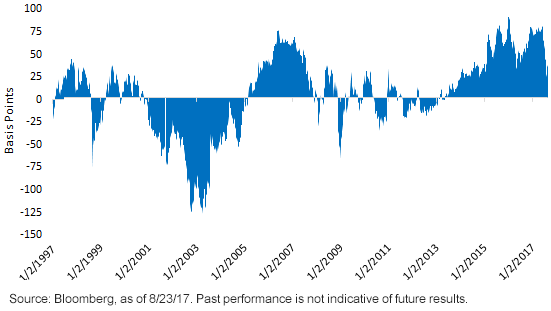
With the calendar turning to September on Friday, we’re all sitting back and lamenting the end of another summer. Well, for fixed-income investors, any possible summer doldrums could quickly change, as a number of potentially headline-making events are looming directly ahead, specifically on the central bank front. While the markets do not appear to be anticipating any surprises, the next few weeks look to be busy.
For the G5 developed market world, the Bank of Canada (BOC) is set to kick things off next week with its formal policy meeting, slated for September 6. After hiking the overnight lending rate by 25 basis points (bps) in July (the first rate hike since 2010), expectations as of this writing are not looking for a follow-up move.
Bank of Canada unlikely to move on Sept. 6
Indeed, the implied probability for a rate hike next week is at only 21.7%. It is interesting to note that an integral reason behind the July increase was the BOC’s belief that it needs to focus on future price pressures and not be complacent even though inflation readings, up to that time, had been on the soft side. Thus, when the July year-over-year inflation gauge jumped .2 percentage points to +1.2%, the policymakers may have felt some vindication. Looking ahead into the fourth quarter, the probability of a rate hike for the October policy meeting jumps to 69%.
The European Central Bank meets the following day, September 7, while the Bank of England and Bank of Japan are on the docket for September 14 and 21, respectively. That leaves the Federal Reserve (Fed) on September 20. As of this writing, market expectations not only don’t see the Fed raising rates at its next meeting, but the outlook is for no hikes at all for the rest of 2017. Continue Reading…
Finances can become challenging when adding — or removing — a new partner, stepchild or extended family member into a household. The instances of blended or multigenerational families are becoming more and more common in Canada as the number of multigenerational families has grown in the last 15 years – rising 37.5 per cent. In addition, 12.3% of families in Canada are stepfamilies, according to recently-released 2016 Canada Census data.
A recent TD survey found 66% of Canadians living in a blended family say they face financial challenges because of their household situation. Additionally, 47% find juggling these challenges stressful. The top three financial challenges they faced are determining who pays for ongoing household expenses (25%), having different views on managing the household budget (23%) and determining household saving priorities (21%). Take a look at this infographic here for more survey findings, tips and advice.
No matter your family situation, money matters can get tricky. To guide you through the process, there are some simple steps blended families can implement to help create a more stable financial future for everyone involved. Continue Reading…
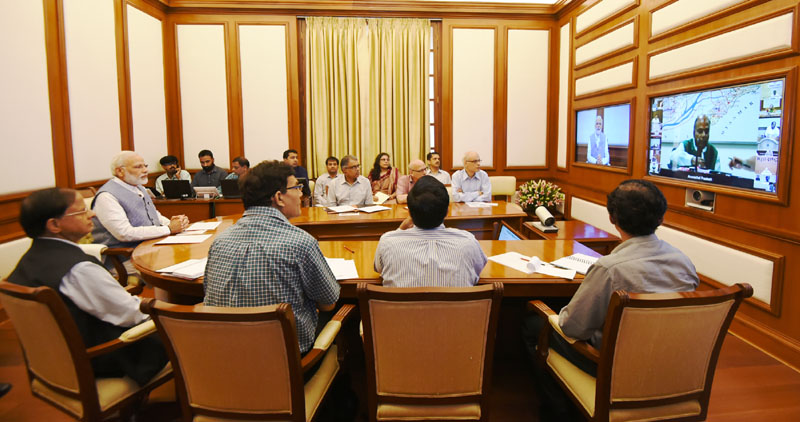
India Prime Minister Shri Narendra Modi chairing the ICT-based, multi-modal platform for Pro-Active Governance and Timely Implementation, in New Delhi on July 12, 2017.
By Caroline Grimont
(Sponsor Content)
The Narendra Modi government has made enormous strides in transforming project execution in India, enhancing the momentum of country’s growth.
Modi’s success is largely premised on his principle of “Minimum Government, Maximum Governance,” which has been the Prime Minister’s mantra for transforming project execution in India.[i]
Shortly after assuming power, Modi announced that India’s government systems suffered from two weaknesses: “They are complex. And they are slow.” He noted that this had to be changed and that government systems must be sharp, effective, fast and flexible.[ii]
Government has no business being in business
To do this, India needed a policy-driven state, with simplified processes in which the government needed to focus upon the things that are required of the state, which must in turn deliver on the things it sets out to do. He emphasized that government “has no business to be in business” and must instead focus on policy formulation and execution.” [iii]
Modi also noted that in 20 years of liberalization the government has not changed “its command-and-control mindset,”[iv] which is exactly what he set out to do in transforming project execution in India.
An earlier McKinsey report identified what Modi referred to. It stated: “Inefficiencies in implementing infrastructure projects in India occur at all stages. This includes awarding projects as per plan targets, securing financial closure, and executing projects within cost and time.”[v]
Cutting through red tape
In accelerating project execution Modi has personally taken on India’s notorious red tape to clear tens of billions of dollars in stalled public projects, hoping that his hands-on intervention can bend a vast, dysfunctional bureaucracy.
He has focused on improving governance and introducing changes to legislations, rules and procedures wherever necessary to make processes more efficient; and cut down on multiple clearances those choke investment.
To keep track of project execution Modi holds a meeting with top state and central bureaucrats once a month, to check why projects have not got off the ground: leading to the revival of tens of billion dollars in value of central government and state projects in a wide range of areas.[vi]
Central and state bureaucrats are linked by video to Modi’s office for the meeting, usually held on the fourth Wednesday of each month. They are typically from the finance, law, land, environment, transport and energy ministries whose clearances are needed for many projects. [vii]
The agenda is set the previous week and usually has about a dozen stalled projects, public grievances and other governance issues.
By empowering government officials to execute on project implementation and managing the process on a monthly basis, Modi has effectively been able to remove the policy paralysis that has plagued India for decades.
“Modi has won plaudits for the initiative that has chipped away at a $150 billion backlog of planned roads, ports, railways, power stations and other projects.”[viii]
He has also taken major steps to eliminate corruption and transparency that have in the past paralyzed project execution. Continue Reading…


 Posted By
  (Sponsored Content)