“If you can dream it, you can achieve it” is a saying more often seen on an inspirational Instagram account than in a financial blog. While I am loath to agree with the sentiment of a mere bumper sticker, dreaming really can be an excellent tool for those struggling to get their financial futures in order.
I began to think about the value of dreams in achieving financial freedom a few months ago. From there I decided to do some research on the subject. What is it about having defined dreams that can help solidify steps needed to achieve goals? When, if ever, is dreaming going to hurt instead of help?
I came across this blog post from ‘The Lady in the Black’ site, which includes a variety of guest bloggers all chiming in with that they consider the true value of using our daydreams to achieve our financial goals.
It’s safe to say we all love a good daydream once in a while. It can be an excellent way to escape the day-to-day uncertainty in our lives. More importantly, however, daydreaming can be an opportunity to really discover what is most important to your future financial wellbeing, and can even help you plan a concrete goal for that future.
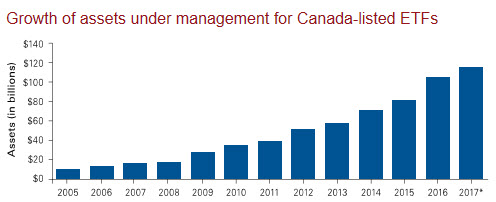
Source: Strategic Insight data as of December 31 of each year. As of April 30th for 2017.
By Atul Tiwari
Special to the Financial Independence Hub
With summer in full swing, along with warmer weather and blooming gardens, it got me thinking about cycles in investing. In particular ETFs, which have been taking root in Canada over the past few years.
When Vanguard entered the Canadian market in December 2011, we were one of only eight ETF providers. Our own evolution illustrates how much has changed in just over five years: We started with six index-based ETFs and currently offer a lineup of 33 ETFs, including four actively managed equity factor-based ETFs launched in June 2016.
Industry-wide more than 500 ETFs now vie for the attention of investors and advisors. And it’s not just products that have proliferated; new ETF providers enter the industry every month. More than $130 billion in Canada-domiciled ETF assets is now divided among 24 ETF providers. And there’s room to grow. ETFs make up only 8% of Canadian investable assets while capturing 25% of industry flows for the first quarter.1
Investors have clearly grown more comfortable adding ETFs to their portfolios. While I’m not one to make predictions about whether the pace of expansion will continue, I do see three trends that tend to favour it.
1.) Greater fee transparency
Thanks to the second phase of Canada’s Client Relationship Model reforms (CRM2), investors are starting to see — in dollar terms on their account statements — what they’re paying their advisory firms. Canadian regulators are also considering a potential ban on embedded trailing commissions. This will surely generate discussion and shine an even brighter light on investment fees.
No less an expert than billionaire investor Warren Buffett extolled the long-term benefits of low-cost investing in his 2016 letter to Berkshire Hathaway shareholders. Cost plays a critical role in total investment return. The less investors pay in fees, the more of the potential returns they can keep. This is true whether you are investing in an ETF, mutual fund or any other investment vehicle.
2.) Fee-based advisors are on the rise
Driven partly by regulatory changes and heightened awareness of investment fees, many financial advisors are moving to fee-based business practices. We favour this transition as we believe it better aligns advisors with the needs of investors and creates full transparency. Continue Reading…
A question that frequently comes up is what books we would recommend people read to help prepare themselves for a successful VL (Victory Lap). I think this happens because many of our talks are held at libraries and people there are accustomed to doing their own research. There are a lot of good books out there, including Victory Lap Retirement, but the following four will do the job getting you both mentally and financially prepared to launch your own VL.
This is the book that helped convince me it was ok to leave my stressful banking job. If you are in a similar position, you know it is hard to leave a well-paying job late in your career. However it is just as hard staying in a job that makes you miserable just to save some extra money for a retirement that you have no idea what it will look like. When you are in a job you hate, something has to give and I hope it’s not your health. If you lose your health, does it really matter how much money you have? You might want to think about that one a little before it’s too late.
We give out a copy of Ernie’s book at our presentations, as there is usually at least one person in attendance who is willing to admit they are struggling with the “should I stay or should I go?” decision.
Having been there myself I feel for them and know Ernie’s book will help them, just like it helped me.
I like to sleep at night and after reading this book I was able to sleep a lot better. Most of us are stressed out about the possibility of running out of money in retirement. I can’t speak for any of you but I worried about money, making the mortgage payment, getting the kids through school for most of my life and I’ll be damned if I’m going to waste any more of my life worrying about money during my Victory Lap. Life is too short for that and I have better things to do with my time.
Have you factored rising Healthcare costs into your retirement planning? Here’s my latest MoneySense Retired Money column, which you can access by clicking on the highlighted headline: One huge cost to factor into retirement plans.
That huge cost is of course unexpected medical expenses, which tend to escalate the further along you go in your golden years. Typically, the early years of Retirement (say, in your 60s) are dubbed “Go-Go” years, which are the healthy ones during which you can travel, and medical costs tend to be minimal.
Costs rise as you go from Slow-go to No-go years
But as time goes on, often between the late 60s and early 70s, you can expect a few medical problems to emerge for at least one member of a senior couple, if not both. That’s why they some dub the middle period the “Slow-go” years.
And of course, the last few years is where costs can really mount up: the so-called “No-go” years, especially if you no longer “stay in place” in your home, or require extensive in-home care, or are forced out of the family home altogether to go to a retirement home or nursing home.
“Excellence is not a skill. It is an attitude.” — Ralph Marston
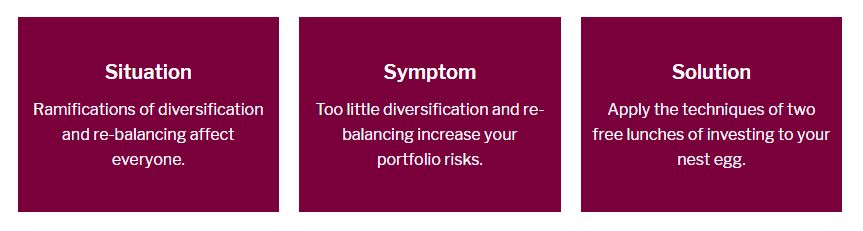
Diversification and Rebalancing strategies are two essential, time-tested portfolio tools. They improve your chances of achieving better consistency of long-term returns. Tasty free lunches are still being served in your investing patch.
Diversification spreads your risks among a variety of investments. Rebalancing makes periodic adjustments to bring allocations back in line with targets set within your road map. I assume that your road map is in place.
Experience shows that asset mix decisions have the greatest impact on your portfolio returns than any other factor. The foundation of investing your nest egg requires patience, discipline and clear investment policies.
Diversification is one necessary safeguard. You don’t want problems arising in any asset class to ruin your well designed portfolio. Diversification increases the odds of you being right more often. If some selections are suffering, others can help cushion the rest.
Initial allocations and weights of your portfolio selections will drift over time as markets rise and retreat. When drift becomes significant, it affects your investment profile and typically requires some re-balancing.
Periodic rebalancing strategies sell some assets and buy others within your asset mix. My preferred time to rebalance is when you inject new money into the portfolio or withdraw some. Use rebalancing techniques as portfolio tweaks, not for wholesale changes.


 Posted By
 “If you can dream it, you can achieve it” is a saying more often seen on an inspirational Instagram account than in a financial blog. While I am loath to agree with the sentiment of a mere bumper sticker, dreaming really can be an excellent tool for those struggling to get their financial futures in order.
 Posted By
 Posted By
 Posted By

 Posted By