General

Banks, Blockchain & Economic Liberty: A follow-up

By Adam Goldman

I wrote a piece last September titled Why Our Economic Liberty Depends on the Blockchain, providing an analysis on why I am certain distributed ledger technology is important to securing our rights under the law in the digital age.

In an ever-increasing realm of technology that is meant to improve (in positive ways) facets of our lives, the imperfection of humanity still exists while greed heavily plagues the banking world. As a firm advocate for the rule of law, I find recent revelations by CBC’s Go Public , that highlighted rampant fraudulent activity occurring amongst Canada’s largest financial institutions (TD, BMO, RBC, CIBC, and Scotiabank) disturbing to say the least.

‘This is why the only solution really is to have government step in and look after the Canadian people.’ says lobbyist Stan Buell as quoted in the CBC article.

Ultimately directives from above led to not only immoral, but also illegal tactics that chased their bottoms lines. Adding more bureaucracy at a government level will only exacerbate the climate.

Blockchain is the answer, not government

In my previous article I had given several broad examples of current institutions that could improve themselves, one being quasi-relevant to the financial fraud currently being exposed in Canada.

Continue Reading…

How Small Businesses can leverage SEO & the Internet for marketing

By Mike Carroll

(Sponsored Content)

Big company or small, marketing isn’t what it used to be. In fact, it isn’t what it was last week. Marketing and sales are so tied to technology that they are evolving almost faster than you can manage.

So businesses move quickly to find the consultant or manager to assume the demands of SEO, SEM, social media, and more of the contemporary tools available. Businesses simply don’t have the time or experience to optimize the business’s branding and identity.

What to look for?

Small businesses, perhaps through cost concerns, make the mistake of leaving these issues to an employee with some internet experience or some third party tech-savvy freelancer.

What they need is a full service consultancy, experienced in the intricate and specific tools and capabilities. You want experts who are ahead of the curve in technology and content. You want the firm with a demonstrated history of building and optimizing traffic to a company’s website.

What you want is a higher ranking for your website that sells candy. You want your Sweet Services online store to appear early when people use their browsers. The higher it appears, the more likely your site is to sell. Boosting your ranking takes skill and real time management.

Search Rankings

Adam Heitzman wrote in Inc.com that no one and no SEO firm can guarantee you #1 rankings. You can’t take the SEO firm’s word for it, but you can demand they show proof of what they have done for other customers.

Expertise

Continue Reading…

Rockstar Finance’s review of Victory Lap Retirement

By Hélène Massicotte, Rockstar Finance

Mike and Jonathan walk the talk. They both have made sound financial decisions that enabled them to leave their corporate lives (either through retirement or redirection), allowing them to shift their focus toward what they wanted to do next without having to have money be the primary driver.

How can we start stacking the deck in our favor to do the same? By:

  1. Following the “Seven Eternal Truths of Financial Independence”
  2. Focusing on one important formula
  3. Forgetting traditional notions of retirement

#1. The “Seven Eternal Truths of Financial Independence”

When it comes to managing money, most of us want to improve our odds of success. That means ensuring we behave in a way that reduces the financial obligations that work to limit our personal and professional choices. The authors suggest the following behaviors can do a great deal to help us increase our financial flexibility:

  1. Live below your means
  2. Pay yourself first
  3. Get out of debt
  4. Buy a home and pay it off as soon as possible
  5. Be an owner, not a loaner
  6. Never say no to free money from your employer
  7. Take the government up on its few offers of free money

Two of these include interesting twists on the theme beyond what is usually covered in what’s considered mainstream financial advice:

#4. Buy a home and pay it off as soon as possible. This is great advice for those among us who want to own a home, but the authors take it one step further: we should look at our home as part need and part want. Need is the bare minimum of what we need in a home: shelter, basic utilities, safety, minimum square footage, proximity to other needs, etc. Want are the extras beyond what we need: extra space, extra features, better privacy, less noise, better outdoor space, better-than-needed neighborhood, etc.

Looking at housing this way can help us consider the appropriateness of the largest physical asset class we’re likely to ever own. It’s easy to justify buying too much house, thereby turning a good purchase into a bad one, and this “need vs want” can help us keep the inflation in check.

#5. Be an owner, not a loaner. This suggests that, though bonds are lower-risk investment vehicles, they won’t offer the returns that equity can, even when these are risk-adjusted. The authors suggest a diversified portfolio that includes high-quality dividend paying stocks and stress that qualifying dividend-paying stock income also offers some tax advantages over bond-related income for investments that are held in non-tax-sheltered accounts.

#2. The Freedom Formula

Mike and Jonathan managed to increase choice in their lives by focusing on one important formula:

PASSIVE INCOME > NON-DISCRETIONARY EXPENSES = FREEDOM

Continue Reading…

The Price of Security

By akaisha-in-a-longboat-on-the-mekong-riverBilly and Akasha Kaderli, 

RetireEarlyLifestyle.com

Special to the Financial Independence Hub

Security is mostly a superstition. It does not exist in nature, nor do the children of men as a whole experience it. Avoiding danger is no safer in the long run than outright exposure. Life is either a daring adventure, or nothing.” —  Helen Keller

Recently I have been reading a book called Daring Greatly by Brene Brown. You may have heard of it. The theme of the book is about being vulnerable, taking risks and being willing to expose ourselves to possible failure. It’s an enlightening read.

I bring this up because what I want to share with our readers is that security has a price. Everyone speaks about how risk is dangerous and sometimes unthinkable. It seems that everyone wants unmitigated surety – the 100% guarantee.

But security never makes one courageous nor does it make a person’s heart sing.

We all want our bases covered, and none want to be starving or out in the land of the lost. But there is an energy about taking a risk with the possibility of failure that adds dimension to our lives and creates memories that we share with our children and grandchildren and we can ruminate over when we become old. Having everything laid out, fully unchallenged with no adversary to overcome makes for a dull story.

Personal examples

To make my point, I want to share with you a couple of big risks I took with my life direction over the years.

In 1971 was 19 years old and my then 20-year-old boyfriend wanted to make an extensive summer motorcycle trip across the country from the Midwest through a semi-southern route, up the coast of California to Alaska and back again via northern roads. This sounded like the most exciting thing I could imagine in my life at that time.

Continue Reading…

Emerging Market local debt: a seasonal opportunity

EM Asset Returns and U.S. Benchmark Average Returns over Rolling Three-Month Calendar Windows for Horizons Ending 3/31/06–12/31/16

For definitions of indexes in the chart, visit this glossary.

By Rick Harper, Head of Fixed Income & Currency, WisdomTree

Special to the Financial Independence Hub

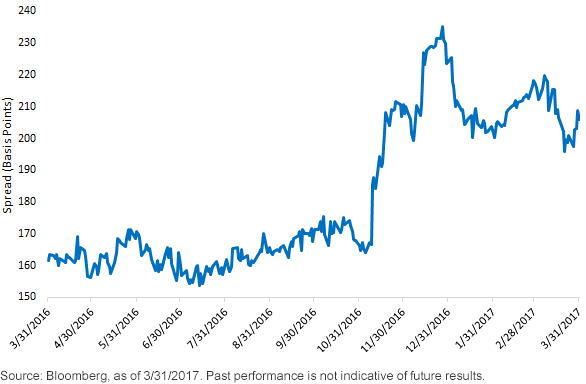
So far this year, emerging market (EM) bonds, currencies and equities have outperformed many corresponding U.S. asset classes. The EM rally stands in marked contrast to EM disappointments in January the past three years and is all the more surprising given struggles in both Mexico and Turkey. Investors can now look forward to an investment window that recently has been characterized by EM outperformance and strong absolute returns. Over the last 11 years (the inception of the local debt index1), the three-month investment window from February 1 through April 30 has, on average, produced the strongest returns for EM assets, in particular EM local debt and EM equities,2 and generated the fewest and the smallest shortfalls.

As seen in the table above, EM performance within the February-through-April window is distinct from other three-month investment windows. EM local debt, corporate,3 USD-based sovereigns4 and equities all post their most consistent performance during the window. While other windows tend to be lifted by greater one-time gains, the gains during the early spring period tend to be consistent, and losses are less frequent and shallower in scope.

A Spotlight on EM Local Debt

Among the bond sectors, EM local debt shines brightest during this period, generating substantial excess returns versus EM corporate and EM USD sovereigns. Positive contribution from foreign exchange (FX) is a significant piece of this excess return performance. The local bond returns are robust but still lag both EM corporate and USD-denominated sovereign bonds in isolation. In particular, the falling rate environment has been a very supportive tailwind for much longer-duration USD sovereign debt market proxies. The estimated 3% boost from FX gains pushes local debt to the fore. Continue Reading…