Inflation

Inflation

Why it might be time to rebalance the 60/40 Rule


Investors follow the 60/40 rule because they are told bonds will protect capital while equities grow it. Why recent drops in bond prices should make us reconsider that rule. 


By Paul MacDonald, CIO, Harvest ETFs

(Sponsor Content)

From the moment they start putting money in the market, investors are told to follow the 60/40 rule. It is the broadly accepted wisdom that, for an average retail investor, a 60% allocation to equities and a 40% allocation to bonds will result in a robust portfolio. Equities should deliver growth prospects in the long term while bonds will offset downsides in equities by delivering uncorrelated returns. Bonds preserve capital, and equities grow capital. That’s the accepted wisdom. 

Countless investment fund issuers have packaged this logic into their balanced funds. These funds offer a specific allocation to equities and bonds, usually in line with the 60/40 rule, forming the core of a retail investor’s portfolio.

The problem with accepted wisdom is sometimes circumstances turn it upside down. In the past months we have seen volatility in equity markets and a significant drop in bond prices. That is because the investment landscape has changed. 

Why are bond prices dropping? 

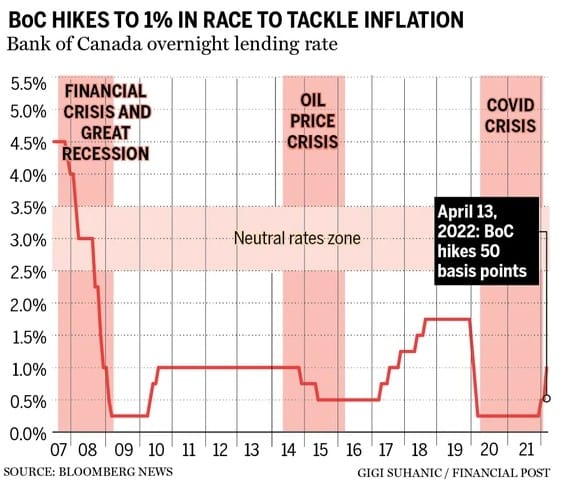
After over a decade of historically low interest rates, followed by massive rate cuts by central banks at the onset of the COVID-19 pandemic, inflation has begun to set in. With rising inflation comes pressure on central banks to raise rates and market expectation that rates will rise, which is itself pushing interest rates higher.  Continue Reading…

Death of Bonds or time to buy short-term GICs?

My latest MoneySense Retired Money column looks at a recent spate of media articles proclaiming the “Death of Bonds.” You can find the full column by clicking on the highlighted headline: Do bonds still make sense for retirement savings?

One of these articles was written by the veteran journalist and author, Gordon Pape, writing to the national audience of the Globe & Mail newspaper. So you have to figure a lot of retirees took note of the article when Pape — who is in his 80s — said he was personally “getting out of bonds.”

One of the other pieces, via a YouTube video, was by financial planner Ed Rempel, who similarly pronounced the death of bonds going forward the next 30 years or so and made the case for raising risk tolerance and embracing stocks. The column also passes on the views of respected financial advisors like TriDelta Financial’s Matthew Ardrey and PWL Capital’s Benjamin Felix.

However, there’s no need for those with risk tolerance, whether retired or not, to dump all their fixed-income holdings. While it’s true aggregate bond funds have been in a  de facto bear market, short-term bond ETFs have only negligible losses. And as Pape says, and I agree, new cash can be deployed into 1-year GICs, which are generally paying just a tad under 3% a year;  or at most 2-year GICs, which pay a bit more, often more than 3%.

One could also “park” in treasury bills or ultra short term money market ETFs (one suggested by MoneySense ETF panelist Yves Rebetez is HFR: the Horizons Ultra-Short Term Investment Grade Bond ETF.) It’s expected that the Fed and the Bank of Canada will again raise interest rates this summer, and possibly repeat this a few more times through the balance of 2022. If you stagger short-term funds every three months or so, you can gradually start deploying money into 1-year GICs. Then a year later, assuming most of the interest rate hikes have occurred, you can consider extending term to 3-year or even 5-year GICs, or returning to short-term bond ETFs or possibly aggregate bond ETFs. Watch for the next instalment of the MoneySense ETF All-stars, which addresses some of these issues.

Some 1-year GICs pay close to 3% now

Here’s some GIC ideas from the column: Continue Reading…

Inflation in Retirement

By Billy Kaderli, RetireEarlyLifestyle.com

Special to the Findependence Hub

First things first, what is inflation? Inflation is when too much money is competing for a finite number of goods. This causes a general increase in prices and a fall in the purchasing value of money.

The US Real-Estate market is a prime example, and we have all witnessed the rising home values. Translate this to food and energy, and this is the effect we are feeling today.

Current inflation numbers

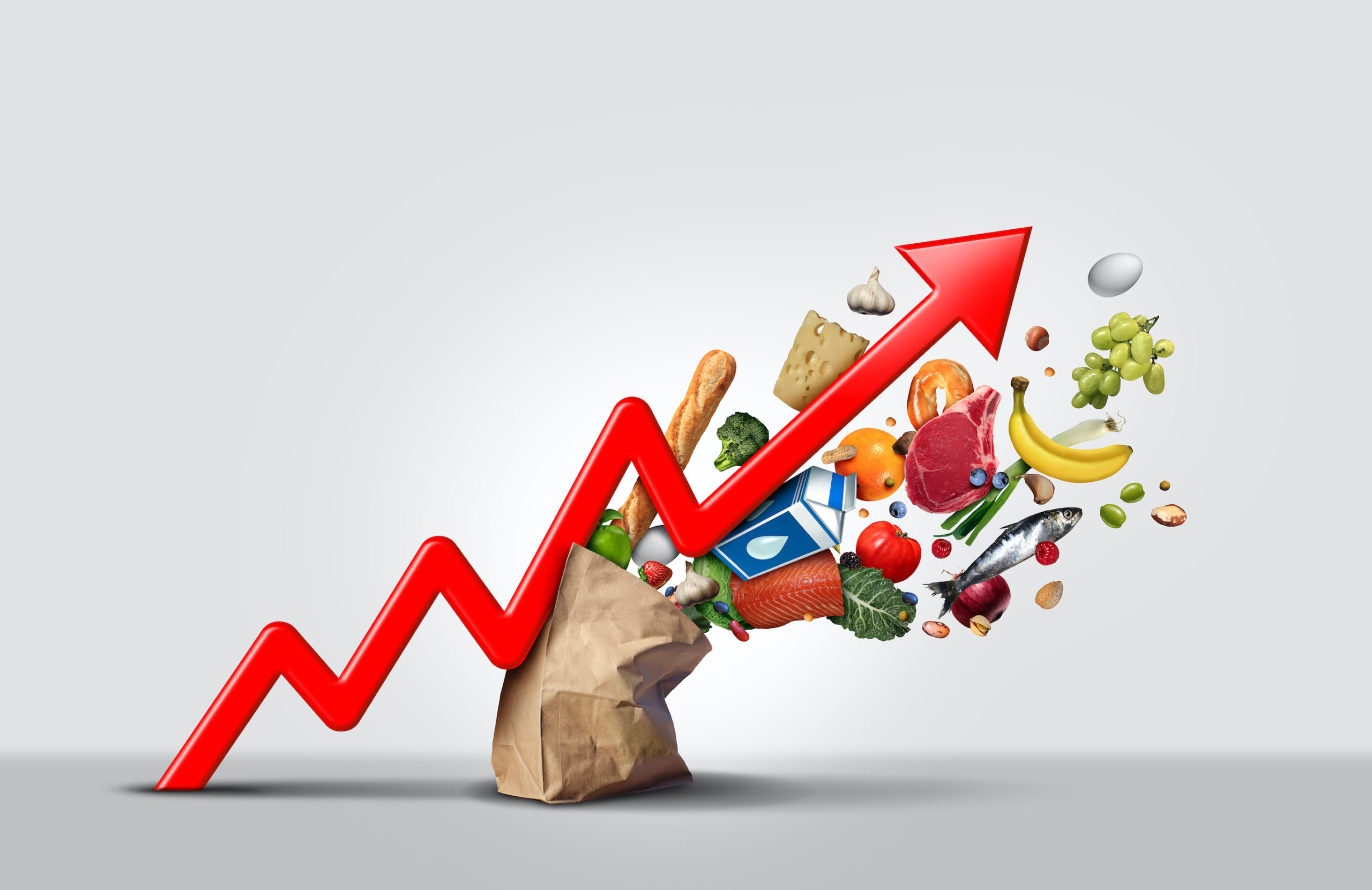
Recent inflation numbers came in at 8.5% year-over-year. The producer price index (PPI) came in higher at 11.2% which means it is costing more for the producers to manufacture products.

These increases get passed on to you and me, the consumers, and we are going to be feeling these increases now and on into the future.

How can you protect yourselves in retirement?

Perhaps you are living on a fixed income such as Social Security. [or in Canada: CPP and Old Age Security.]  Your annual Social Security adjustment doesn’t keep up with grocery and fuel costs; thus, you are slipping backwards.

This is not a good position to be in.

One answer is to own equities. Continue Reading…

How Investors can respond to Ukraine Invasion

By Sa’ad Rana, Senior Associate – ETF Online Distribution, BMO ETFs

(Sponsor Blog)

It has been almost two months since Russia invaded Ukraine. During this time, we have been witnessing the dramatic impact the war has had on global markets and economies. There is also concern with how these events will impact our portfolios and investments. 

Economic Impact

Inflation numbers are expected to continue rising higher and this war will put more upward pressure on inflation. Russia is a large global oil exporter. Increased sanctions on Russia will undoubtedly cause a supply squeeze in the oil market, which will lead to higher oil prices. In addition, Russia and Ukraine both account for about 25% of total wheat exports, which will now be limited. This can drive up food costs on a global scale. The war will also continue to restrict supply chains. For example, planes are being diverted because Russian air space is closed to more than 35 countries. Having to go around Russia leads to longer travel, resulting in increased fuel consumption and trip costs.  Continue Reading…

The all-weather portfolio. Ready for almost anything

By Dale Roberts

Special to the Findependence Hub

I recently posted a portfolio concept for the all-weather portfolio for 2022. The idea behind an all-weather portfolio is that it can prosper during periods of sun, rain, storms, hurricanes, earthquakes and tsunamis. Of course, in the above analogy weather serves as a proxy for the economic conditions that might arrive. The all-weather portfolio is ready for most anything.

On Seeking alpha I posted the all-weather portfolio for 2022. The portfolio is designed for U.S. investors, though Canadians can certainly mimic the approach or apply the greater concepts. The big idea of the all-weather portfolio is to hold assets in four buckets. It is an extension of the Permanent Portfolio.

There is a bucket of investment assets ready to thrive no matter what the weather offers (economic conditions). For example, for the last 40 years or so we’ve had favourable weather. Inflation has been low and economic growth has been modest, but positive. We’ve been in a disinflationary environment. Inflation has been low and mostly falling.

The weather has been nice

Stock markets and bond markets perform quite well during these disinflarionary periods.

To view some longer dated returns have a look at the RBC Select Balanced Fund. Of course, you could do better by way of an all-in-one asset allocation ETF.

Stocks have performed quite well over time. That said, investors needed to be armed with some very impressive umbrellas (and risk tolerance) to withstand the Great Financial Crisis (2008-2009) and the dot-com crash of the early 2000’s. Stock markets declined in spectacular fashion in both of these events.

Given that we were still in the midst of a mostly disinflationary period, bonds did the trick in lowering the volatility of the typical balanced portfolio. Bonds will mostly go up when stocks go down, offering that useful inverse relationship. We can think of bonds as portfolio shock absorbers.

These two major stock market corrections came and went, and we returned to our mostly fair-weather disinflationary times. Modest economic growth returned as well.

And now for something completely different

Yes, the above subhead is referencing a catch phrase made famous by Monty Python’s Flying Circus.

Monty Python’s Flying Circus

The comedy troupe was certainly different. And so is today’s economic environment. We have inflation, real inflation. It might even turn into stagflation when most everything fails for the investor. Stagflation is a period of persistent inflation that is accompanied by economic decline. The worst of all worlds you might say. Some nasty weather.

What works during stagflation or unexpected inflation (persistent inflation above those central bank 2-3% targets)? It’s not stock markets; it’s certainly not bonds. Oooops. That’s the traditional balanced portfolio. Continue Reading…