Longevity & Aging

No doubt about it: at some point we’re neither semi-retired, findependent or fully retired. We’re out there in a retirement community or retirement home, and maybe for a few years near the end of this incarnation, some time to reflect on it all in a nursing home. Our Longevity & Aging category features our own unique blog posts, as well as blog feeds from Mark Venning’s ChangeRangers.com and other experts.

OAS clawback secrets for the high-net-worth

By Aaron Hector, RFP

Special to the Financial Independence Hub

I’m going to start this off by saying that I’ve searched high and low for an article, website, blog – anything – that backs up some of the planning concepts I’m about to share with you on the subject of Old Age Security (OAS). I couldn’t find anything, so it’s with a certain degree of hesitancy that I find myself writing this. Even though I believe the concepts are factually correct, they’re largely unproven in practice.

I’ve come to realize that the majority of writing, thinking, and media coverage surrounding government pensions like OAS and CPP (QPP in Quebec) are targeted towards households in the middle-to-upper-middle-income or net-worth range, and the planning opportunities for high-income and high-net-worth households are often overlooked. With this article, I’m going to try and change that.

I’ll start with a bit of background information.

OAS deferral enhancement: choosing your start date

The introduction, in July 2013, of deferral premiumsfor Old Age Security has given Canadians and their financial planners a lot to think about. What was once a fairly standard ‘take it or leave it’ choice at age 65 has become a more complex decision. The complexity stems from the fact that for each month you delay the payment of your OAS past the age of 65, your lifetime monthly payment will be increased by 0.6%. This enhancement is maxed out at 36% if you postpone it to age 70. Don’t overlook the planning options available to you when choosing your start date. When you do the math, there are sixty potential start dates, and sixty potential payment amounts: one for each month between ages 65 and 70.

Choosing an effective start date: immediate vs. retroactive

Here’s another wrinkle. If you apply for OAS after age 65, you can choose a start date that’s up to one year earlier than the current date on your application. So, if you’re applying in January 2020, you could choose your OAS payments to begin as early as February 2019. All payments will be based on whatever age you were as of February 2019, and you’ll be paid a retroactive lump sum for the period between February 2019 and January 2020 (or whenever your application is approved and processed). Following the lump sum, you’ll get the regular ongoing monthly OAS payments, again, which will be based on your age as of February 2019.

Another important fact is that the retroactive lump sum payment is included on your T4A (OAS) slip in the year that it’s received. So, if you apply for a retroactive start date that reaches back to a prior calendar year, it will still be income for the current year when received. This is important because it lets you shift your initial OAS income from a less desirable tax year to a more desirable tax year. This would be of value if you retired in one year (while in a high marginal tax bracket), and shifted your OAS for the first year into the following year when you’re fully retired and in a lower tax bracket.

Understanding the clawback

It makes sense that most people would dismiss OAS planning for high-income and high-net-worth Canadians. After all, OAS is famously clawed back by 15 cents for each dollar that your net income exceeds a certain annual threshold and is entirely clawed back when it reaches another. The stated clawback range on the Government of Canada’s website for 2019 income is $77,580 to $125,937. I refer to these limits as the clawback floor ($77,580) and the clawback ceiling ($125,937). For a Canadian whose income is expected to always exceed $125,937, one might conclude that there’s nothing that can be done to preserve any OAS. That would be an incorrect conclusion.

OAS secret number 1 – the clawback ceiling is NOT $125,937 for everyone

Let’s review the math of OAS clawback. OAS is eroded at a rate of 15 cents for each dollar your net income exceeds the clawback floor in any given tax year. If you started your OAS at age 65, then in 2019 you would expect to receive OAS payments which total $7,253.50 (assuming OAS is not indexed in the fourth quarter of 2019, which is yet to be confirmed). The clawback ceiling is $125,937 because with a clawback floor of $77,580 and an erosion rate of 15 cents per dollar, your $7,253.50 of OAS is fully eliminated by the time your income reaches $125,937 ($125,937 minus $77,580 = $48,357, and $48,357 x 0.15 = $7,253).

I get frustrated when I see a reference to the OAS clawback ceiling because every article or resource that I’ve seen completely ignores the deferral enhancement. Due to the method with which the OAS Recovery Tax or clawback is calculated, a more robust OAS pension will result in a higher OAS clawback ceiling. So, while the clawback floor is a fixed number which is set each year by the CRA, the clawback ceiling is not a fixed number. Rather, it’s a sliding number based on the amount of OAS that you actually receive. Sure, if you take OAS at age 65 (like most people), your clawback ceiling for 2019 is going to be the stated $125,937. But if you’re receiving higher payments due to postponing your start date, you’ll have a higher clawback ceiling. For example, if you delay your OAS to age 67, you’ll actually have a ceiling of nearly $133,000, and if you delay your OAS to age 70, your clawback ceiling will exceed $143,000.

Source: Aaron Hector, Doherty & Bryant Financial Strategists

This enhanced clawback ceiling provides opportunities for some very interesting planning. Retirees who don’t expect to keep any of their OAS because they forecast that their retirement income will be in the $125,000 range might need to reconsider and potentially wait to start their OAS until 70. For others, it may be best to take OAS at age 65 because when their RRSP is converted to a RRIF, their income will exceed even the $143,000 range. Perhaps an early RRSP melt-down strategy combined with OAS postponement to age 70 will achieve the best result.

Ultimately, the right decision will depend on various individual metrics, such as your projected income in the years between ages 65 and 70, and into the future. The size of your RRSP and eventual RRIF will also be a factor, as well as your health and expected longevity (and that of your spouse, if applicable). There are truly too many factors to determine the best course for the broad population; my point here is simply that the enhanced clawback ceiling should be one factor to consider within the mix.

As an aside, the clawback ceiling is similarly lowered for those who do not qualify for a full OAS pension. This would be the case for those who have not met the full residency requirements. For example, someone who only receives half of the full OAS pension for 2019 ($3,627) will have their OAS fully clawed back when their income reaches $101,758.

OAS secret number 2 – how to create an OAS “super-ceiling”

Now that we’re all experts on OAS clawback, and we acknowledge that the OAS ceiling is not a fixed number but actually a range, we can consider some further niche planning opportunities.

For example, is there any way for someone with an expected retirement income of $150,000 per year to ever take advantage of OAS? This level of income exceeds the $143,000 upper ceiling range for someone who starts their OAS at age 70. The answer is yes. Continue Reading…

Financial Planning & the Retirement Earworm: Focus should change to Financing for Longevity

By Mark Venning, ChangeRangers.com

Special to the Financial Independence Hub

At last, a headline that helps us progress, moving us to change the later life narrative with respect to the issue of financial planning.

“Longevity planning will be a central mission for advisers of the future.” In a brief July 22, 2019 article in Investment News with this headline, Ryan W. Neal cites their recent roundtable discussion on the Future of Financial Advice, where “industry leaders agreed longevity planning will increasingly play a role in how advisers work with clients, especially in the face of fee compression and automated investing.”

This is a welcomed repeated echo, from my persistent suggestion to financial planners since 2011 that the replacement phrase for “retirement planning” should be “financing for longevity.” My presentation at the Canadian Institute of Financial Planners 16thAnnual Conference in June 2018 was titled around just that: Changing Client Conversations Mind-set Shift. Financing for Longevity.

One of my key points for this audience was that this means a recognition of changing patterns in client conversations, related to money and financial management. Conversations need to reflect shifts in generational experiential differences and thus the need to help clients re-frame their attitudes and expectations. The future of financial planning is no longer exclusively a Boomer-centric market.

Financing for Longevity, more echoes  

Neal in his article refers to Joseph Coughlin, founder of MIT’s AgeLab and author of The Longevity Economy (2017). In another 2019 Investment News article comes one more echo in this call – from Coughlin, “(the financial planning)profession is at a new frontier to create an entirely new business around longevity planning …. We are done with retirement – the word, the idea, the products, the conversations were really good, for my father. But not for the next generation.”

Another echo from Lynda Gratton & Andrew Scott in their book The 100-Year Life(2016). In chapter 7 on Money, they talk about “financing a long life.” Earlier chapter 2 on Financing, part of this longevity planning is geared around “working for longer.” Pensions or no pensions aside, they submit,“The simple truth is that if you live for longer then you need more money. This means either saving more or working for longer.”

Continue Reading…

Cascades retirement planning software: a case study

By Ian Moyer

(Sponsor Content)

The task of retirement income planning can be overwhelming for Canadians as they get closer to leaving the workforce. Making the right decisions can be difficult with all the possible sources of income they might have, including Old Age Security (OAS) and Canada Pension Plan (CPP), and of course, Canada’s complex tax codes don’t make it any easier. People need help.

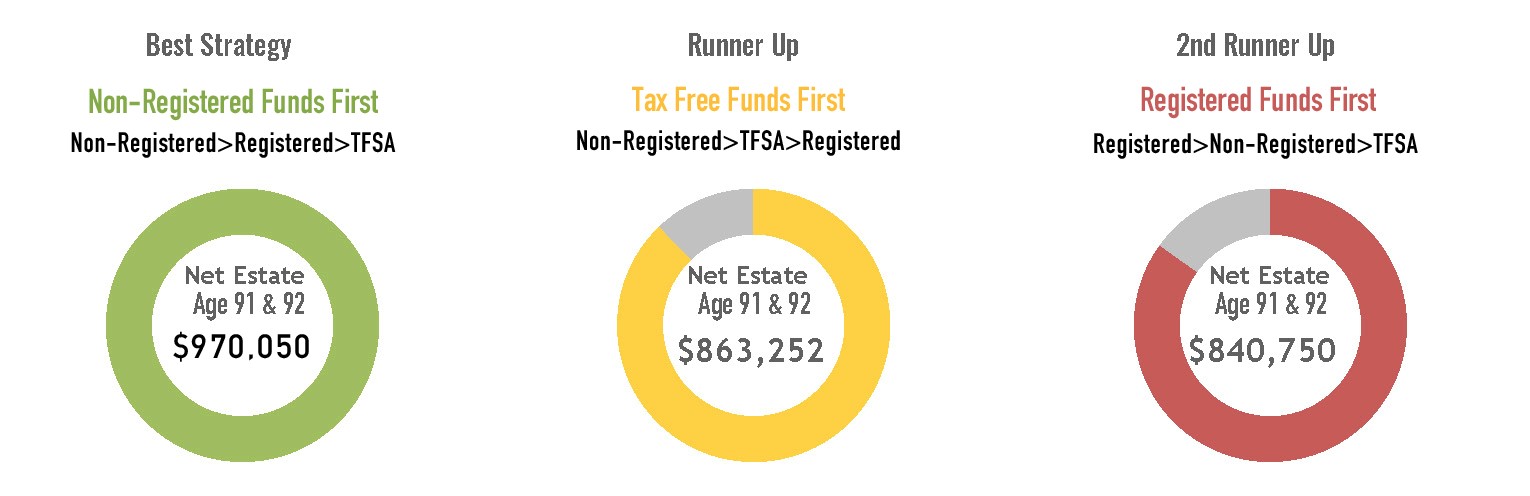
Cascades is a Canadian retirement income calculator that takes the difficulty out of retirement income planning. In many cases it saves retirees hundreds of thousands of dollars in income tax, while showing a year-over-year road map guiding them through retirement. Who wouldn’t want to save money? But in some cases, like the one highlighted below, it’s not about extra tax savings: it’s about having enough money to last your entire retirement.

Bob and Ann’s story is based on a real-life case we came across last week, and it’s a great example of why proper retirement income planning is so important.

Meet retiree Bob, 65, and Ann, 56, still working

Bob is currently 65 and has been retired for 2 years. He was self-employed as a cabinet maker and still has his shop at home where he works part time bringing in $12,000 annually. Because he was self- employed, Bob has no defined benefit or defined contribution pensions. He currently holds about $250,000 in his RRSP, $15,500 in his TFSA, and $50,000 in a non-registered account. Bob receives close to max CPP at $12,600 and $7,248 from OAS.

Ann is originally from the United States and met Bob while he was vacationing in Florida. She is currently 56 and plans on retiring at 63 from her job as a logistics coordinator for an auto parts manufacturer. Ann brings in $57,500 annually and has a defined contribution pension currently worth about $140,000. Ann has no other savings apart from her defined contribution pension, but will receive $4,800 in CPP that she plans to start receiving as soon as she retires at 63. Because Ann hasn’t been in Canada for 40 years since the age of 18, she will only receive $3,500 annually from OAS.

Continue Reading…

How to create a pension for the Average Joe: 65 with as little as $200K in Savings

By Billy and Akaisha Kaderli, RetireEarlyLifestyle.com

Special to the Financial Independence Hub

We know many of our readers are not “average.” However, if average Joe can support his retirement on as little as US$200,000 savings, imagine what you can do with the amount you have!

By reading the chart below, you can see that the average spending for retirement households age 65 – 74 is US$46,000.


It is tough to make that $46k amount with only Joe’s savings, so what should he do?

Social Security

The average recipient today (in the United States) collects US$1,461 a month, or US$17,532 a year. Joe’s SS check is average and he has a wife who also collects the average Social Security amount.

$17,532 times 2 (people) = US$35,000 per year.

Not quite the $46,000 that they need but getting closer.

Hopefully, Joe has his retirement money invested in VTI (Vanguard Total Stock Market) or SPY (S&P 500 Index) and is making market gains equaling around 10% annually.


Here you can see that since the 1950’s — about when Joe was born — the S&P 500 has had an annualized return of over 11%, dividends reinvested, but let’s use 10% as a more conservative projection.

Remember, Joe has to make up $11,000 to match his average spending ($46,000). But let’s give Joe an extra one thousand dollars per year so he can pamper Mrs. Joe with occasional gifts and dinners out.

So, he needs $12,000 out of the $200,000 in savings per year to make up the difference in spending. That’s an extra $1.000 per month.

Invested in the S&P 500 — based on 69 years of returns and using 10% as the annual return — after his first year he would have $220,000 minus $12,000 withdrawal = $208,000.

Now Joe has $47,000 in annual income: $35,000 from Social Security and $12,000 from investments.

Plus, his $200,000 has grown to $208,000, a 4% gain outpacing inflation at the current rate of less than 2% per year.

Their Social Security payment is also indexed to inflation so as inflation rises, so will their Social Security. Continue Reading…

No surprise: the best retirement investments are the same as for everyone else

We recommend that you base your investing for retirement on a sound financial plan relying on the best retirement investments.

One thing investors of all ages fear is not having a good financial plan in place so they have enough retirement income to live on once they’ve stopped working. Looking for the best retirement investments, addressing this concern is usually a high priority for many of our Successful Investor Portfolio Management clients.

Four key factors to consider when investing for retirement

  1. How much you expect to save prior to retirement;
  2. The return you expect on your savings;
  3. How much of that return you’ll have left after taxes;
  4. How much retirement income you’ll need once you’ve left the workforce.

Our portfolio diversification approach gives you strong potential for long-term gains  

If you diversify as we advise, you improve your chances of making money over long periods, no matter what happens in the market.

For example, manufacturing stocks may suffer if raw-material prices rise, but in that case your Resources stocks will gain. Rising wages can put pressure on manufacturers, but your Consumer stocks should do better as workers spend more.

If borrowers can’t pay back their loans, your Finance stocks will suffer. But high default rates usually lead to lower interest rates, which push up the value of your Utilities stocks.

As part of their portfolio diversification strategy, most investors should have investments in most, if not all, of these five sectors. The proper proportions for you depend on your temperament and circumstances.

For example, conservative or income-seeking investors may want to emphasize utilities and Canadian banks in their portfolio diversification, because of these stocks’ high and generally secure dividends.

More aggressive investors might want to increase their portfolio weightings in Resources or Manufacturing stocks. For example, more aggressive investors could consider holding as much as, say, 25% to 30% of their portfolios in Resources.

However, you’ll want to spread your Resource holdings out among oil and gas, metals and other Resources stocks for diversification and exposure to a number of areas.

Stick with conservative estimates to account for unforeseen setbacks

As for the return you expect from investing for retirement, it’s best to aim low. If you invest in bonds, assume you will earn the current yield; don’t assume you can make money trading in bonds.

Over long periods, the total return on a well-diversified portfolio of high-quality stocks runs to as much as 10%, or around 7.5% after inflation. Aim lower in your retirement planning — 5% a year, say — to allow for unforeseeable problems and setbacks.

Above all, it’s important to remember that while finances are important, the happiest retirees are those who stay busy. You can do that with travel, golf or sailing. But volunteering, or working part-time at something you enjoy, can work just as well. Continue Reading…