Longevity & Aging

No doubt about it: at some point we’re neither semi-retired, findependent or fully retired. We’re out there in a retirement community or retirement home, and maybe for a few years near the end of this incarnation, some time to reflect on it all in a nursing home. Our Longevity & Aging category features our own unique blog posts, as well as blog feeds from Mark Venning’s ChangeRangers.com and other experts.

Cascades retirement planning software: a case study

By Ian Moyer

(Sponsor Content)

The task of retirement income planning can be overwhelming for Canadians as they get closer to leaving the workforce. Making the right decisions can be difficult with all the possible sources of income they might have, including Old Age Security (OAS) and Canada Pension Plan (CPP), and of course, Canada’s complex tax codes don’t make it any easier. People need help.

Cascades is a Canadian retirement income calculator that takes the difficulty out of retirement income planning. In many cases it saves retirees hundreds of thousands of dollars in income tax, while showing a year-over-year road map guiding them through retirement. Who wouldn’t want to save money? But in some cases, like the one highlighted below, it’s not about extra tax savings: it’s about having enough money to last your entire retirement.

Bob and Ann’s story is based on a real-life case we came across last week, and it’s a great example of why proper retirement income planning is so important.

Meet retiree Bob, 65, and Ann, 56, still working

Bob is currently 65 and has been retired for 2 years. He was self-employed as a cabinet maker and still has his shop at home where he works part time bringing in $12,000 annually. Because he was self- employed, Bob has no defined benefit or defined contribution pensions. He currently holds about $250,000 in his RRSP, $15,500 in his TFSA, and $50,000 in a non-registered account. Bob receives close to max CPP at $12,600 and $7,248 from OAS.

Ann is originally from the United States and met Bob while he was vacationing in Florida. She is currently 56 and plans on retiring at 63 from her job as a logistics coordinator for an auto parts manufacturer. Ann brings in $57,500 annually and has a defined contribution pension currently worth about $140,000. Ann has no other savings apart from her defined contribution pension, but will receive $4,800 in CPP that she plans to start receiving as soon as she retires at 63. Because Ann hasn’t been in Canada for 40 years since the age of 18, she will only receive $3,500 annually from OAS.

Continue Reading…

How to create a pension for the Average Joe: 65 with as little as $200K in Savings

By Billy and Akaisha Kaderli, RetireEarlyLifestyle.com

Special to the Financial Independence Hub

We know many of our readers are not “average.” However, if average Joe can support his retirement on as little as US$200,000 savings, imagine what you can do with the amount you have!

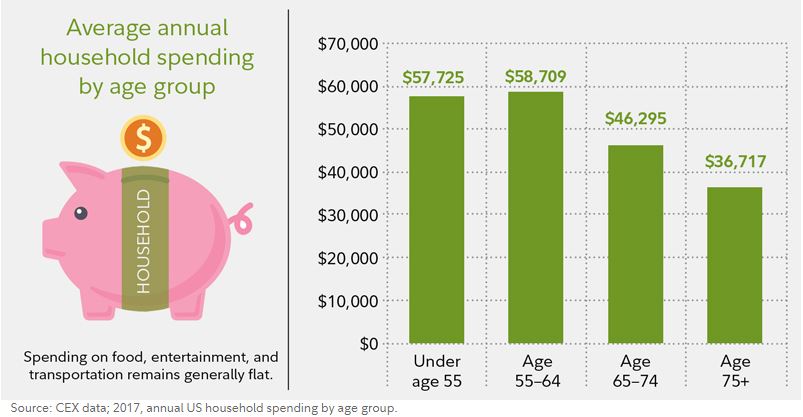
By reading the chart below, you can see that the average spending for retirement households age 65 – 74 is US$46,000.


It is tough to make that $46k amount with only Joe’s savings, so what should he do?

Social Security

The average recipient today (in the United States) collects US$1,461 a month, or US$17,532 a year. Joe’s SS check is average and he has a wife who also collects the average Social Security amount.

$17,532 times 2 (people) = US$35,000 per year.

Not quite the $46,000 that they need but getting closer.

Hopefully, Joe has his retirement money invested in VTI (Vanguard Total Stock Market) or SPY (S&P 500 Index) and is making market gains equaling around 10% annually.


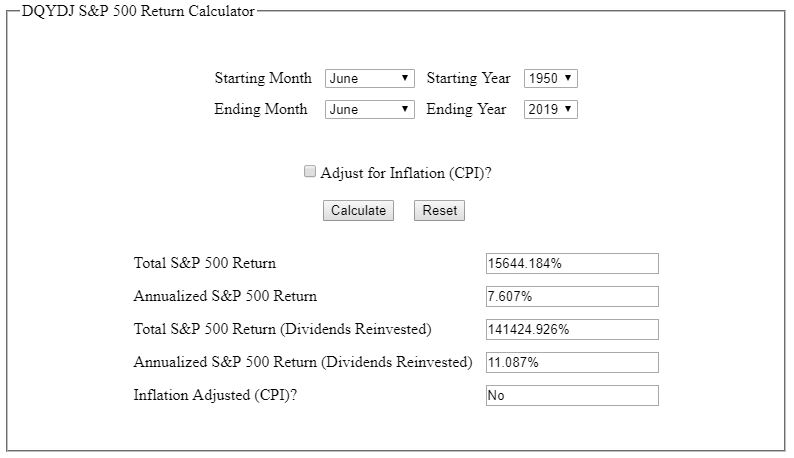
Here you can see that since the 1950’s — about when Joe was born — the S&P 500 has had an annualized return of over 11%, dividends reinvested, but let’s use 10% as a more conservative projection.

Remember, Joe has to make up $11,000 to match his average spending ($46,000). But let’s give Joe an extra one thousand dollars per year so he can pamper Mrs. Joe with occasional gifts and dinners out.

So, he needs $12,000 out of the $200,000 in savings per year to make up the difference in spending. That’s an extra $1.000 per month.

Invested in the S&P 500 — based on 69 years of returns and using 10% as the annual return — after his first year he would have $220,000 minus $12,000 withdrawal = $208,000.

Now Joe has $47,000 in annual income: $35,000 from Social Security and $12,000 from investments.

Plus, his $200,000 has grown to $208,000, a 4% gain outpacing inflation at the current rate of less than 2% per year.

Their Social Security payment is also indexed to inflation so as inflation rises, so will their Social Security. Continue Reading…

No surprise: the best retirement investments are the same as for everyone else

We recommend that you base your investing for retirement on a sound financial plan relying on the best retirement investments.

One thing investors of all ages fear is not having a good financial plan in place so they have enough retirement income to live on once they’ve stopped working. Looking for the best retirement investments, addressing this concern is usually a high priority for many of our Successful Investor Portfolio Management clients.

Four key factors to consider when investing for retirement

  1. How much you expect to save prior to retirement;
  2. The return you expect on your savings;
  3. How much of that return you’ll have left after taxes;
  4. How much retirement income you’ll need once you’ve left the workforce.

Our portfolio diversification approach gives you strong potential for long-term gains  

If you diversify as we advise, you improve your chances of making money over long periods, no matter what happens in the market.

For example, manufacturing stocks may suffer if raw-material prices rise, but in that case your Resources stocks will gain. Rising wages can put pressure on manufacturers, but your Consumer stocks should do better as workers spend more.

If borrowers can’t pay back their loans, your Finance stocks will suffer. But high default rates usually lead to lower interest rates, which push up the value of your Utilities stocks.

As part of their portfolio diversification strategy, most investors should have investments in most, if not all, of these five sectors. The proper proportions for you depend on your temperament and circumstances.

For example, conservative or income-seeking investors may want to emphasize utilities and Canadian banks in their portfolio diversification, because of these stocks’ high and generally secure dividends.

More aggressive investors might want to increase their portfolio weightings in Resources or Manufacturing stocks. For example, more aggressive investors could consider holding as much as, say, 25% to 30% of their portfolios in Resources.

However, you’ll want to spread your Resource holdings out among oil and gas, metals and other Resources stocks for diversification and exposure to a number of areas.

Stick with conservative estimates to account for unforeseen setbacks

As for the return you expect from investing for retirement, it’s best to aim low. If you invest in bonds, assume you will earn the current yield; don’t assume you can make money trading in bonds.

Over long periods, the total return on a well-diversified portfolio of high-quality stocks runs to as much as 10%, or around 7.5% after inflation. Aim lower in your retirement planning — 5% a year, say — to allow for unforeseeable problems and setbacks.

Above all, it’s important to remember that while finances are important, the happiest retirees are those who stay busy. You can do that with travel, golf or sailing. But volunteering, or working part-time at something you enjoy, can work just as well. Continue Reading…

How much does it cost to Retire?

By Steve Lowrie, CFA

I’ll start with one good question posed, because it probably crosses everyone’s mind with increased frequency over time:  How much money do I need to retire?

Since I’ve been a financial professional now for more than two decades, I feel well qualified to answer that question.  The answer is:  It depends.

Okay, I realize that isn’t a very helpful answer, even if it’s the truth.  Let’s dig a little deeper.

From a purely quantitative perspective, there are several rules of thumb in common use.  For example, some say if you’ve got 20 or 25 times your annual income in reserve that should do it. Others suggest you’re ready to retire if you can withdraw no more than 4% of your investment portfolio each year.  So, if you have $1 million in your investment accounts, you should plan to withdraw no more than $40,000 annually in a “successful” retirement.

These and similar guidelines offer a decent starting point.  But bad luck happens.  Even if you’ve diligently saved up 20 times your income, if you happened to retire on the eve of a bear market or if you encounter large unexpected expenses, your handy rule of thumb could end up poking you in the eye. Continue Reading…

Boomer & Echo guest blog: What I’ve learned so far in Semi-Retirement

Regular Hub guest blogger Robb Engen returned the favour earlier this week by inviting me to write a blog for his site Boomer & Echo. You can find that version by clicking on the highlighted headline: What I’ve learned so far in Retirement.

For convenience, it also appears below, including original links, with a Hub headline and a few subheadings that better reflect the central point that I personally don’t consider myself fully retired yet. This version has a few extra points added, plus two links to FIRE pieces that didn’t appear in the original B&E version. And as a bonus, it includes near the end an update on some of our recent travels, which hopefully reinforce some of the broader themes described in this blog.

Which begins as follows:

Through most of the five years the Financial Independence Hub has existed, Boomer & Echo’s Robb Engen has been kind enough to allow the “Hub” to republish some of his blogs that first appeared on his own site.

He recently suggested we turn the tables and invited me to write a guest blog for Boomer & Echo recounting some of the lessons I’ve learned in my decades as a financial writer and what I’ve learned so far in Retirement. Here it is.

For starters, my age alone qualifies me as a Boomer: I recently turned 66, but do not consider myself retired: at most, I consider myself semi-retired. As Robb would know, running a website is no trivial undertaking and I aim for new content 5 days a week, 52 weeks a year. That and writing for a handful of media outlets keeps me fairly occupied, although the privilege of doing this from home means I gain a couple of hours that would formerly have been expended on commuting.

Indeed my last full-time salaried staff job that involved commuting and bosses ended five years ago, when I stepped down from the editorship of MoneySensemagazine. That two-year stint followed 19 years at the National Post/Financial Post, most of which time I was the paper’s personal finance columnist.

Those familiar with my books or blogs would not expect me to describe myself as Retired, since my shtick has long been Financial Independence, or my contraction for it: Findependence. That’s as in Findependence Day, a financial novel I wrote in 2008 (Canadian edition) and 2013 (US edition.)

As I have often written, I do not regard the terms Retirement and Findependence as synonyms. You can be Findependent but not Retired, as I am; but it’s hard to be Retired if you’re not Findependent.

In the old days, the traditional “full-stop” retirement was considered to happen at age 65, which even today is when you can first start receiving Old Age Security benefits. (And yes, I do now collect OAS, for reasons I’ve explained elsewhere). But “Findependence Day” can be years or even decades earlier: you may still choose to work for money but on your terms: the magic day is when you’re completely free of debt and have enough saved (and properly invested) that even if you never earned another dime you could meet all your major living expenses, assuming some variant of the 4% Rule.

Even if I considered myself as having “retired” at age 61, that’s relatively old by the standards of the so-called FIRE movement, which of course stands for Financial Independence Retire Early. True FIRE people aspire to “retire” in their 30s or 40s, sometimes even in their 20s, typically by saving like demons for a decade or so: in the most extreme cases they may save      something like 50% of their income.

I’m more like Robb, where he described in his blog why he wasn’t yet paying down his mortgage because he first wanted to maximize RRSP and TFSA savings. Mind you, my books do argue that “the foundation of financial independence is a paid-for home” but I’m old school and we bought our first home (of only two) back in the 1980s, when Toronto real estate was pricey but hardly at the lofty levels of today. Of course, interest rates were much higher then: close to 12% in our case, so we were motivated to pay off the mortgage as quickly as possible.

I don’t see myself as an early retiree or a “FIRE” blogger

There have been some interesting critiques of FIRE, nicely summarized by Fritz Gilbert in a guest blog for the Hub: Is the Fire community full of hypocrites? Fritz is an American Pluto award winning blogger for RetirementManifesto.com, who I’ve come to know through our joint membership in the Younger Next Year 2019 Facebook group, which I helped found and have helped moderate (along with the site’s prime mover Vicki Peuckert Cook) since late 2017. Fritz “retired” himself at age 55 about this time last year. But as we would both argue, he’s hardly retired in the classical sense of the term. Continue Reading…


Powered by the Financial Independence Hub.
© 2013-2026 All Rights Reserved.
Financial Independence Hub Logo

Sign up for our Daily Digest E-Mail!

Get daily updates from the FindependenceHub.com straight to your inbox.